
Loading...
Sign in / Sign up

You Can’t Improve What You Can’t See: Observability for AI Voice & Chat Agents

Most AI assistants fail silently.

They don’t crash.
They don’t throw errors.
They just slowly become less accurate, less helpful — and more expensive.

In production, the biggest risk for AI agents isn’t the model.
It’s the lack of observability.

This article explains what AI observability really means, why traditional analytics aren’t enough, and how Monobot approaches monitoring, QA, and continuous improvement for voice and chat agents.

Why AI Agents Degrade Over Time

Unlike traditional software, AI agents don’t stay static.

Over time:

  • user behavior changes
  • new edge cases appear
  • policies and pricing evolve
  • knowledge becomes outdated
  • traffic volume increases
  • integrations change

Without visibility, small issues compound.

By the time a team notices:

  • containment rate is down
  • escalations are up
  • customers are frustrated

…damage is already done.

Why Traditional Analytics Don’t Work for AI

Standard metrics like:

  • number of messages
  • call duration
  • average response time

tell you what happened, but not why.

AI systems need a different level of insight.

You need to understand:

  • which intents fail
  • where knowledge retrieval breaks
  • when the agent guessed instead of knowing
  • why handoff was triggered
  • which answers cause confusion

This is where AI observability starts.

What “Observability” Means for AI Agents

For AI voice and chat agents, observability answers five questions:

  1. Did the agent resolve the request?
  2. If not — why?
  3. Was the knowledge missing, unclear, or wrong?
  4. Was escalation necessary or avoidable?
  5. What should be improved next?

Observability is not just dashboards.
It’s structured insight into agent behavior.

Key Signals to Monitor in Production AI

1. Containment vs Escalation

  • How many conversations are fully resolved by AI?
  • What percentage is escalated to humans?
  • Which intents escalate most often?

High escalation isn’t always bad — but unexplained escalation is.

2. Knowledge Base Coverage

Track:

  • unanswered questions
  • fallback responses
  • “I’m not sure” cases
  • repeated clarifications

These signals show exactly where the KB needs work.

3. Intent Drift

Over time, users ask the same thing differently.

Monitoring intent distribution helps you spot:

  • new phrasing patterns
  • emerging topics
  • outdated intent mappings

Without this, intent accuracy slowly decays.

4. Voice-Specific Failures

For voice agents, you also need to track:

  • ASR misrecognitions
  • interruptions
  • long pauses
  • repeated confirmations

Voice failures feel much worse to users than chat failures.

5. Cost vs Value Signals

AI that works but costs too much is also a failure.

You need visibility into:

  • model usage per intent
  • expensive flows vs simple ones
  • opportunities for lighter models

This is where observability meets optimization.

How Monobot Enables AI Observability

Monobot treats AI agents as production systems, not demos.

That means:

  • structured logging of conversations
  • visibility into resolution and escalation
  • knowledge base interaction tracking
  • support for QA workflows and reviews
  • analytics across voice and chat

Instead of guessing what to improve, teams can see it.

From Observability to Continuous Improvement

The real value comes when observability feeds action.

A healthy loop looks like this:

  1. Monitor agent behavior
  2. Identify failing intents or KB gaps
  3. Update knowledge, flows, or routing
  4. Validate improvement
  5. Repeat weekly

AI agents improve fastest when treated like a living product, not a one-time setup.

Why This Matters for Production Teams

AI agents don’t fail loudly.
They fail quietly.

Observability is what turns:

  • AI from a black box
  • into a controllable system

If you’re running AI in production — especially voice agents — visibility is not optional.

It’s infrastructure.

Final Thought

Better models help.
Better prompts help.
But visibility is what keeps AI working long-term.

That’s why Monobot focuses not only on building AI agents — but on making them observable, testable, and continuously improvable in real-world environments.

Why Using Multiple LLMs Matters — and How Monobot Chooses the Right Model for Every Task

Large Language Models (LLMs) are the foundation of modern AI assistants.
But one of the most common misconceptions in the market is this:

“Just pick the best LLM — and everything will work.”

In reality, no single LLM is best at everything.

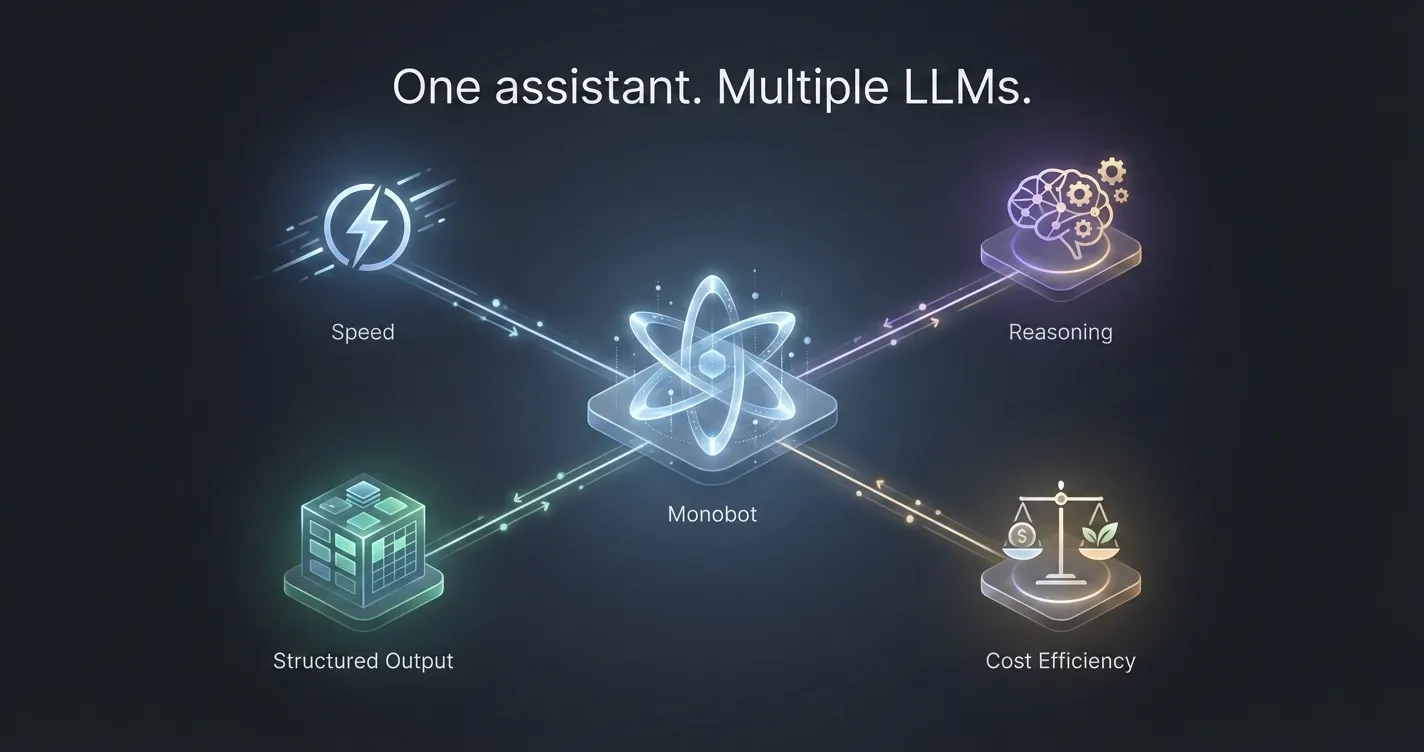
Different tasks require different strengths:
speed, reasoning depth, cost efficiency, multilingual support, or structured output.

That’s why Monobot is designed to work with multiple LLMs, selecting the right model for each specific job — instead of forcing everything through one.

One Model ≠ One Solution

LLMs vary significantly in how they perform:

  • Some are faster but less precise
  • Some reason deeply but are slower
  • Some are great at conversation, others at structured data
  • Some are cost-efficient at scale, others are premium

Using one model for all scenarios often leads to trade-offs:

  • higher costs
  • slower responses
  • lower accuracy in critical flows

In production environments, these trade-offs matter.

How Monobot Uses Multiple LLMs

Monobot is built as a model-agnostic platform, which means:

  • We are not locked into a single provider
  • Different models can be assigned to different tasks
  • Models can be swapped or updated without redesigning the system

This flexibility allows Monobot to adapt as models evolve — and they evolve fast.

Matching the Model to the Task

Here’s how multiple LLMs are typically used inside Monobot:

1. Conversational Flow & Voice Interactions

Some tasks prioritize:

  • low latency
  • natural dialogue
  • stable conversational tone

For these, Monobot can use models optimized for real-time interaction, especially in voice scenarios where delays break the experience.

2. Reasoning-Heavy or Decision-Based Tasks

Other scenarios require:

  • multi-step reasoning
  • intent disambiguation
  • complex logic validation

In these cases, Monobot can route requests to more advanced reasoning models, ensuring accuracy over speed.

3. Structured Outputs & Business Actions

When the assistant needs to:

  • extract structured data
  • validate inputs
  • trigger workflows
  • call APIs

The priority is consistency and reliability, not creativity.

Monobot assigns models that perform best with:

  • schema-based outputs
  • deterministic responses
  • strict formatting

4. Cost-Optimized High-Volume Requests

Not every interaction requires a top-tier model.

For:

  • repetitive questions
  • simple confirmations
  • status updates

Monobot can use lighter, more cost-efficient models, dramatically reducing operational costs at scale.

Why This Matters in Production

Using multiple LLMs is not about flexibility for developers —
it’s about stability, performance, and cost control for businesses.

With a multi-model approach, Monobot can:

  • reduce latency where speed matters
  • improve accuracy where mistakes are expensive
  • scale without exploding costs
  • avoid dependency on a single vendor
  • adapt instantly as better models appear

This is especially critical for voice assistants, customer support, and automation-heavy workflows.

Future-Proof by Design

The LLM landscape changes monthly.

New models appear.
Existing ones improve or decline.
Pricing shifts.
Capabilities evolve.

Monobot is designed so that the assistant stays stable even when models change.

Businesses don’t need to rebuild their logic every time the AI ecosystem moves forward — Monobot absorbs that complexity.

Final Thoughts

The future of AI assistants is not about choosing the best LLM.

It’s about building systems that can:

  • use the right model for the right task
  • evolve without breaking
  • stay efficient, accurate, and reliable in production

That’s why Monobot uses multiple LLMs — and why this approach matters far more than most people realize.

The Future of AI Assistants: Why Monobot Is Already Ahead of the Curve

Just a few years ago, AI assistants were treated as optional add-ons — nice to have, not essential.
Fast-forward to 2025, and the reality has shifted: AI voice and chat assistants are becoming core infrastructure for communication, automation, and customer experience.

We’re now at a point where AI is no longer a prototype — it’s becoming the new normal. And companies building today’s AI assistants are shaping how businesses and people will communicate in the next decade.

Here are the biggest trends shaping the industry — and how Monobot fits into this evolution.

1️⃣ Voice Is Making a Comeback — And This Time, It’s Leading

Text-based chatbots dominated early AI adoption. But the most natural way humans communicate is voice — fast, intuitive, emotional.

Recent advances in speech recognition and real-time processing made voice not just possible, but pleasant and practical.

Modern voice assistants can:

  • Understand accents and informal speech
  • Respond without noticeable delay
  • Recognize intent, not just keywords
  • Maintain natural, back-and-forth dialogue

📌 Monobot is built with voice at its core, not as an afterthought — which gives it a technological advantage as the market shifts.

2️⃣ Omnichannel Is No Longer a Feature — It’s a Standard

Customers expect to speak with a business where they already are — not where the company decides.

The new model is:

The channel doesn’t matter — the conversation continues.

Whether someone starts via phone, website chat, SMS, or messaging apps, the assistant should follow seamlessly.

📍 Monobot already supports:

  • Voice calls
  • Web chat
  • SMS
  • Social platforms and messengers

No context lost. No repeated questions. No friction.

3️⃣ No-Code + AI Logic Is Replacing Traditional Development

Traditional automation required developers, long implementation cycles, and high maintenance costs.

Now, the expectation is:

Create and adjust automation visually — without writing code.

This speeds up deployment dramatically.

📌 With Monobot Flows, teams can:

  • Build complex conversational logic
  • Route calls or messages
  • Connect external systems
  • Use dynamic conditions and personalized responses

—all without needing engineering resources.

4️⃣ AI Assistants Are Becoming Doers — Not Just Responders

The biggest shift is functional.

We’ve moved from:

❌ Bots that answer questions
to
✅ AI agents that complete tasks.

Today’s AI assistants:

  • Book appointments
  • Create CRM records
  • Confirm orders
  • Trigger automated workflows
  • Integrate with APIs
  • Update business systems

💡Monobot belongs to this new category of action-driven AI agents — not text-based FAQ responders.

5️⃣ Hybrid Intelligence: AI + Human = Best Possible Customer Experience

Automation does not mean replacing people — it means using humans where they matter most.

The future is hybrid.

AI handles:

✔️ repetitive tasks
✔️ high-volume inquiries
✔️ predictable workflows

A human steps in when:

⚠️ context is complex
⚠️ emotional decisions matter
⚠️ expertise is required

Seamless handoff is key — and Monobot preserves full conversation context when switching to a live agent.

6️⃣ Personalization Is Replacing Scripted Responses

Customers expect conversations that feel tailored — not robotic.

AI assistants now use:

  • Past conversation history
  • Customer preferences
  • Intent recognition
  • Tone and emotional cues

—to adapt responses in real time.

Monobot leverages contextual memory and intent modeling to deliver personal, relevant, human-like interactions.

🔮 The Era of Intelligent AI Agents Has Begun

We are moving into a world where AI assistants:

  • Speak naturally
  • Understand context
  • Operate across channels
  • Trigger real business actions
  • Learn and improve over time

They’re no longer “tools.”
They’re becoming digital teammates.

And Monobot isn’t waiting for the future — it’s building it.