



TL;DR:
- Conversational commerce uses AI-driven dialogue to guide purchasing, support, and transactions in real time. Its market is expected to grow significantly, transforming how businesses sell and engage with customers. Proper strategy, quality input data, and CRM integration are essential for maximizing its benefits and avoiding common implementation mistakes.
Conversational commerce is defined as the use of AI-driven, real-time dialogue between brands and customers to guide purchasing decisions, resolve questions, and complete transactions within the conversation itself. The term was coined by Uber’s Chris Messina in 2015, but the industry standard phrase today is “conversational commerce,” covering the full spectrum from AI chat to voice assistants. The conversational commerce market will grow from $8.8 billion in 2025 to $32.6 billion by 2035. That growth signals a fundamental shift in how businesses sell, not just how they communicate. Businesses that adopt conversational strategies see 3x higher conversion rates and 40% shorter sales cycles compared to traditional static methods. For marketers and business professionals, understanding this model is no longer optional.
What is conversational commerce and how does it work?
Conversational commerce is a full-funnel strategy, not a chatbot add-on. It uses AI-powered dialogue across chat, voice assistants, and messaging apps to guide customers from initial discovery through post-purchase support. The key distinction is two-way interaction: instead of a customer reading a static FAQ page, they ask a question and receive a personalized, contextual answer in real time.

The mechanics follow a clear pattern. A customer lands on a pricing page, a chat interface activates, and the AI asks a qualifying question. The customer responds, the system recognizes intent using natural language processing (NLP), and it routes the conversation toward a relevant product recommendation, a demo booking, or a live agent. Every step happens within the same conversation thread, with no page reloads or form abandonment.
70% of brands now use AI to facilitate customer communications, moving away from static contact forms toward real-time messaging. That adoption rate reflects a practical reality: customers expect answers immediately, and delayed responses cost conversions.
What technologies power conversational commerce platforms?
Three core technologies make conversational commerce work at scale.
- Natural language processing (NLP): NLP parses what a customer types or says and extracts intent. It distinguishes between “I want to cancel my order” and “I want to change my order,” then routes each to the correct workflow.
- Machine learning (ML): ML improves response accuracy over time by analyzing past conversations. The more interactions the system processes, the better it predicts what a customer needs next.
- Large language models (LLMs): LLMs generate human-sounding responses that feel contextual rather than scripted. They pull from product descriptions, FAQs, and knowledge bases to construct relevant answers.
Beyond AI, the practical components of any conversational commerce platform include a chat or voice interface, structured data-collection forms, and scheduling or calendar tools. High-intent pages like pricing pages and demo request pages are the optimal deployment points for these tools. Placing a conversational interface on a page where a customer is already considering a purchase shortens the gap between interest and action.
CRM integration ties everything together. When a conversation syncs natively with your CRM, every agent who touches that customer sees the full history. Disconnected backend systems lead directly to poor customer experience and lost pipeline opportunities. A customer who has to repeat their problem to three different agents will not convert.
Pro Tip: AI performance depends more on the quality of your input content than on the model itself. Clean, detailed product descriptions and well-structured FAQs produce far more accurate AI responses than a powerful model fed vague or incomplete data.
How does conversational commerce differ from conversational marketing and social commerce?
These three terms overlap, but they serve different functions. Confusing them leads to misaligned strategy.
| Concept | Primary focus | Where it happens | Goal |
|---|---|---|---|
| Conversational commerce | Direct sales and support via dialogue | Chat, voice, messaging apps | Complete a transaction or resolve a support issue |
| Conversational marketing | Engagement and lead nurturing across the funnel | Website, email, ads | Build relationships and qualify leads |
| Social commerce | Product discovery and influencer-driven sales | Instagram, TikTok, Pinterest | Drive purchase intent through social proof |
Conversational commerce sits at the intersection of sales and service. It activates when a customer is close to a decision and needs a final push or a quick answer. Conversational marketing is the broader discipline that includes awareness and nurturing, while social commerce relies on platform algorithms and creator content rather than direct dialogue.
Understanding these differences matters because each requires a different investment. Social commerce needs content creators and platform ad budgets. Conversational marketing needs nurture sequences and audience segmentation. Conversational commerce needs AI agents, CRM integration, and well-designed conversation flows. Mixing up the three leads to budget misallocation and unclear success metrics.
What are the key benefits of adopting conversational commerce?
The business case for conversational commerce rests on four measurable outcomes.
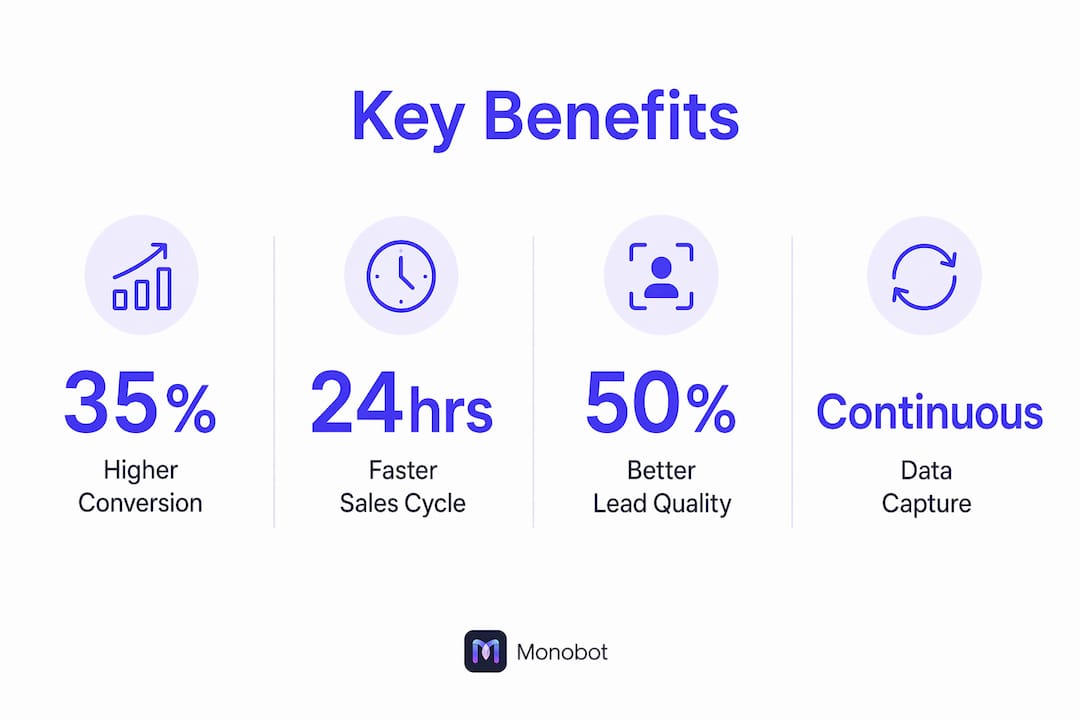
Higher conversion rates. Replacing static messages with two-way dialogue improves engagement and purchase confidence. A customer who gets an immediate, relevant answer to a pre-purchase question is far more likely to complete the transaction than one who leaves to search for the answer elsewhere.
Shorter sales cycles. Real-time qualification moves prospects through the funnel faster. Instead of waiting 24 hours for a sales rep to respond to a form submission, a qualified lead books a demo within the same conversation.
Better lead quality. Conversational workflows collect structured data during the interaction itself. By the time a lead reaches a human agent, the system has already captured intent, budget range, and timeline. This means your sales team spends time on prospects who are ready to buy.
Continuous data capture. Every conversation generates data. Treating conversations as learning assets and refining AI responses based on real interaction patterns produces compounding improvements in both accuracy and customer satisfaction over time.
The operational efficiency gains are equally significant. Monobot, for example, automates up to 80% of inbound calls and chats, which directly reduces the volume of routine inquiries that reach human agents. That frees your team to focus on complex, high-value interactions. AI-driven lead qualification also reduces the cost per qualified lead compared to manual outreach methods.
How can businesses implement conversational commerce effectively?
Effective implementation follows a phased approach. Trying to automate every customer touchpoint at once produces fragmented experiences and frustrated customers.
- Start narrow. Deploy your first conversational interface on one or two high-intent pages, such as your pricing page or your demo request page. These are the moments when customers are closest to a decision and most receptive to a conversation.
- Map your conversation flows. Define the questions your AI will ask, the responses it will give, and the conditions that trigger a handoff to a human agent. A well-mapped flow prevents dead ends and keeps the customer moving forward.
- Integrate with your CRM from day one. Backend integration that syncs conversation history natively with your CRM lets human agents pick up exactly where the AI left off. Without this, context is lost and customers repeat themselves.
- Build in human escalation paths. Avoid automating everything immediately. Complex queries, complaints, and high-value deals need human judgment. Design your flows so the AI recognizes when to step back and route the conversation to a live agent or a scheduled call.
- Optimize continuously. Review conversation transcripts weekly. Identify where customers drop off, where the AI gives irrelevant answers, and where human agents intervene most often. Use those patterns to refine your flows.
Pro Tip: Improving the naturalness of your AI conversations is as much about tone and phrasing as it is about technology. Resources on humanizing AI text can help you write prompts and knowledge base entries that produce responses customers actually want to read.
The most common implementation mistake is treating conversational commerce as a one-time deployment. Conversation flows go stale as products change, customer questions evolve, and new objections emerge. Businesses that schedule regular flow reviews consistently outperform those that set and forget their AI agents.
Key Takeaways
Conversational commerce is a full-funnel AI strategy that drives measurable conversion gains when built on quality data, tight CRM integration, and continuous flow optimization.
| Point | Details |
|---|---|
| Full-funnel strategy | Conversational commerce spans discovery through post-purchase, not just chatbot support. |
| Technology foundation | NLP, ML, and LLMs work together; AI quality depends on the content you feed it. |
| CRM integration is non-negotiable | Syncing conversation history prevents context loss and protects pipeline value. |
| Start narrow, then scale | Deploy on high-intent pages first and expand only after flows are proven. |
| Treat conversations as data | Regular review of transcripts drives compounding improvements in AI accuracy and conversion rates. |
Why most businesses get conversational commerce wrong
The biggest misconception I see is that conversational commerce is a technology purchase. Teams buy a platform, deploy a chatbot, and expect results. What they actually needed was a strategy, and the technology was just the delivery mechanism.
The businesses that get real results define their success metrics before they write a single conversation flow. Not “number of conversations started,” but “demos booked,” “cart abandonment recovered,” or “support tickets deflected.” Defining clear success metrics aligned with broader business goals is what separates a productive AI deployment from an expensive experiment.
The second mistake is underestimating how much the quality of your input content matters. I have seen companies spend months selecting an AI platform and then feed it product descriptions written for a catalog from 2019. The AI produces vague, off-topic responses, and the team blames the technology. The technology was fine. The content was the problem.
The future of conversational commerce runs through voice as much as text. Voice AI is closing the gap with human-sounding conversation faster than most marketers realize. Businesses that build voice-ready conversation flows now will have a structural advantage when voice becomes the default interface for customer support and sales. The brands winning in 2026 are not the ones with the most sophisticated AI. They are the ones with the clearest conversation design and the most disciplined optimization habits.
— Alex
How Monobot powers your conversational commerce strategy
Building a conversational commerce program requires more than a chat widget. You need an AI agent that understands your products, qualifies leads in real time, and hands off to your team without losing context.
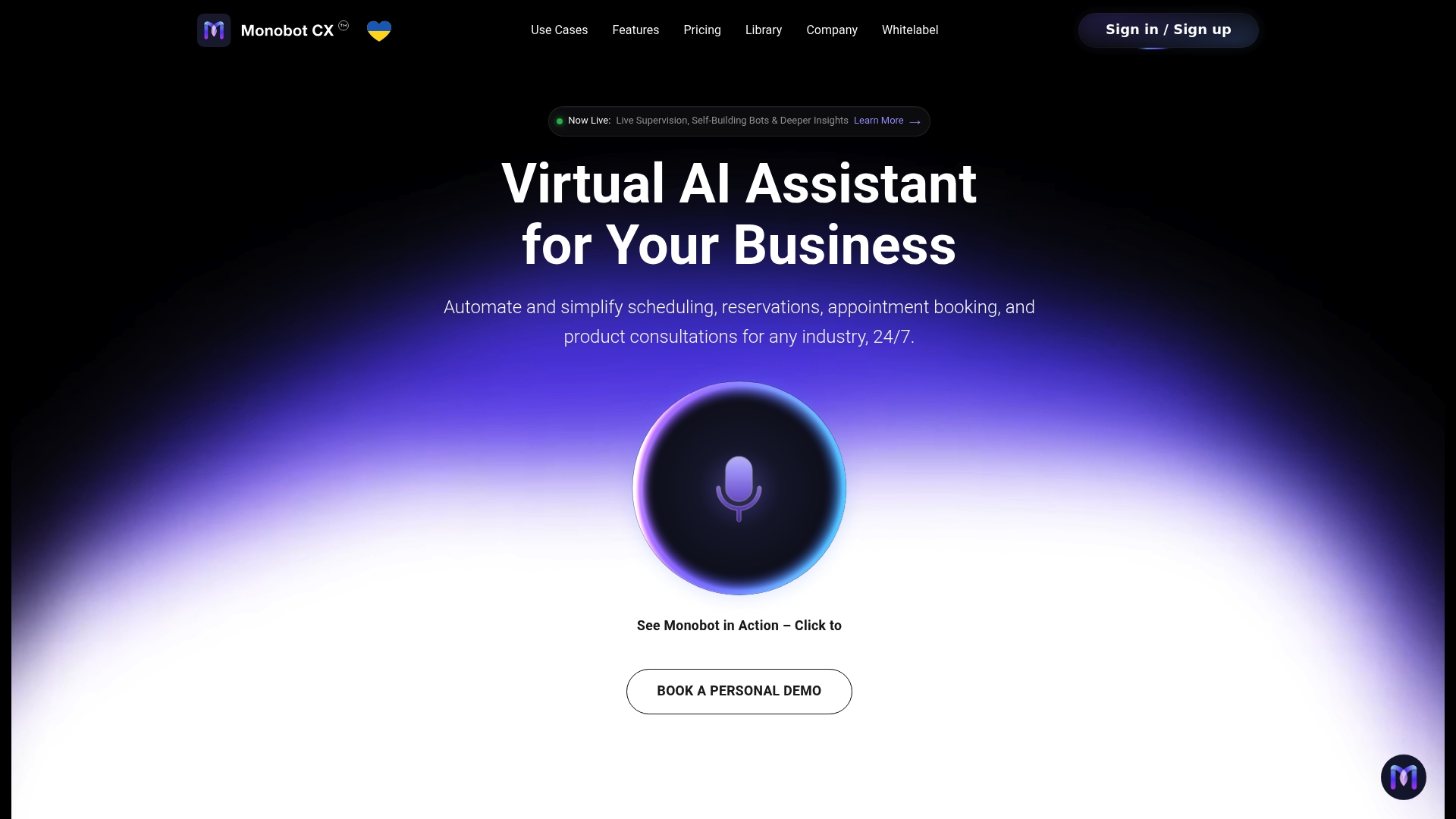
Monobot’s AI Voice Agent Builder lets you create custom voice and chat agents without writing code, deploying them in minutes across your highest-value pages. The Dashboard Insights feature gives you granular analytics on every conversation, so you can see exactly where customers drop off and which flows drive the most conversions. Monobot integrates natively with your CRM and third-party tools, preserving conversation context from first touch to closed deal. If you are ready to put conversational commerce to work, explore Monobot and see how quickly your first agent can go live.
FAQ
What is conversational commerce in simple terms?
Conversational commerce is the practice of using AI-powered chat or voice interactions to help customers find products, get answers, and complete purchases in real time. It replaces static web pages and forms with two-way dialogue.
How does conversational commerce differ from a standard chatbot?
A standard chatbot handles scripted, single-turn responses. Conversational commerce is a full-funnel strategy using AI, NLP, and CRM integration to guide customers through the entire buying process, from discovery to post-purchase support.
What are the most common conversational commerce examples?
Common examples include AI chat on pricing pages that books demos, voice assistants that handle order status updates, and messaging-based support that resolves returns without a human agent. Monobot deploys all three across industries including retail, healthcare, and banking.
What is the importance of CRM integration in conversational commerce?
CRM integration preserves the full conversation history so human agents can take over without asking customers to repeat themselves. Without it, context is lost at the handoff point, which directly damages conversion rates and customer satisfaction.
How do businesses measure the success of conversational commerce?
The most reliable metrics are demos booked, cart abandonment recovered, support tickets deflected, and qualified leads generated per conversation. Tracking conversation volume alone does not indicate business impact.