


How an AI Voice Agent Transformed a Transportation Business
The Challenge
Recently, we encountered an interesting case that perfectly illustrates the value of AI agents in real-world operations. A customer, who owns a bus charter company in California, reached out to the Monobot team with a very relatable problem.
As both the owner and a driver, he prefers to communicate directly with clients, understanding the importance of not missing a lead or leaving a customer feeling unattended. However, while driving, it’s nearly impossible to take notes, check a calendar, or send confirmations. Juggling customer calls and admin tasks behind the wheel isn’t just uncomfortable; it’s unsafe and inefficient.
Why This Problem Matters
For transportation businesses, every phone call can become a booking opportunity. A customer may call only once, compare several providers, and choose the company that responds fastest and sounds the most reliable. In this kind of business, missed details are not small mistakes. A wrong pickup time, incomplete address, forgotten passenger count, or missed follow-up can directly affect revenue and customer trust.
The challenge becomes even more difficult when the owner is personally involved in daily operations. In small and mid-sized transportation companies, the owner often wears several hats at the same time: driver, dispatcher, sales representative, customer support agent, and operations manager. This makes every incoming call important, but also difficult to manage properly.
The customer in this case wanted to keep personal communication with clients because that human connection helped build trust. But he also needed a system that could remember everything, organize the details, and make sure nothing was forgotten after the call ended. This is where an AI agent becomes much more than a simple voice bot. It becomes an operational safety net.
The Solution
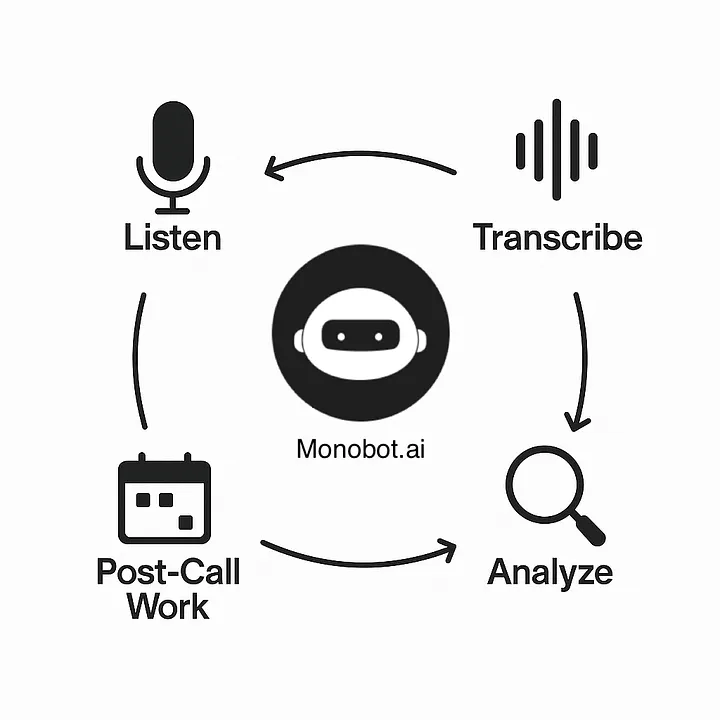
To address this, we built a custom AI voice bot that seamlessly joins every call. Here’s how it works:
- Silent Listening & Transcription: The AI agent is always on the call, silently listening and transcribing every conversation in real-time.
- Post-Call Automation: After each call, the bot analyzes the conversation, creates calendar events, sends confirmation emails, and even verifies addresses and availability — handling all the admin tasks automatically.
- “Hey Monobot” Activation: We also introduced a voice trigger feature, “Hey Monobot.” When this phrase is spoken, the bot becomes active — able to answer questions (e.g., about fleet availability) during the call.
- Privacy Control: The bot can temporarily put the other participant on hold, allowing the business owner to discuss sensitive details privately.
AI as a Real-Time Business Assistant - What made this solution valuable was not just transcription. Recording a conversation is useful, but it does not solve the entire workflow. The real value comes when AI understands the conversation and turns it into structured business actions.
- After a customer call, the AI agent can identify important information such as trip dates, pickup and drop-off locations, passenger count, vehicle needs, special instructions, email addresses, and follow-up requests. Instead of leaving the owner with a long transcript to review manually, the system can extract what matters and prepare the next step.
- This transforms the phone call from an unstructured conversation into an organized workflow. A customer speaks naturally, the owner responds naturally, and Monobot handles the administrative layer in the background.
- For the business owner, this means less manual work after every conversation. For the customer, it means faster confirmations, fewer mistakes, and a more professional experience.
- Keeping the Human Touch
- One of the most important parts of this implementation is that the AI did not replace the owner’s role in customer communication. The owner still speaks directly with customers, answers questions, builds trust, and makes decisions. The AI simply supports the process.
- This is important because many service businesses do not want to fully automate customer conversations. Their personal approach is part of their value. Customers may prefer speaking with the owner or a real team member, especially when planning transportation for important events, group trips, or business travel.
- In this case, AI works in the background. It listens, remembers, structures, and automates. The human stays in control of the relationship, while the AI handles the details that are easy to miss.
- That balance is what makes the “agent in the loop” model so powerful. It combines human communication with AI-powered accuracy and automation.
The Feedback
After just one day, our client shared this with us:
“Just wanted to say that I used Monobot to its full potential today, without writing down any of the information — and I loved it.”
From One Successful Call to a New WorkflowThe client’s feedback showed that the solution solved a real daily problem. He was able to complete customer conversations without writing anything down and still trust that the important details were captured.
This may sound simple, but for a transportation business owner, it changes the entire workflow. Instead of ending the day with scattered notes, missed reminders, and information stored only in memory, every call becomes part of a structured process.
The owner no longer needs to choose between being present in the conversation and managing administrative tasks. He can focus on the customer while the AI assistant takes care of documentation and follow-up preparation.
This creates confidence. The business owner knows that important details will not disappear after the call. The customer receives a smoother experience. The company becomes more reliable without adding more staff or forcing the owner to change how he communicates.
The Impact
Within a week, the “Hey Monobot” feature became a game-changer. No more scribbling notes or struggling to recall details after a long day on the road. The business runs smoother, the owner stays focused on what matters, and no lead is ever lost due to missed details.
Business Benefits Beyond Time Savings
The most obvious benefit is time savings, but the impact goes deeper. AI reduces mental load, improves accuracy, and helps the business operate with more consistency.
In transportation, consistency matters. Customers need to receive the correct pickup time, clear confirmation, accurate address information, and reliable communication. When those details are handled manually, mistakes can happen, especially during busy days.
With Monobot, the business can create a more predictable process. Calls are captured, details are extracted, and follow-ups can be automated. This helps reduce operational risk and improves the customer experience.
The AI agent also helps protect leads. If a customer provides information during a call but the owner forgets to follow up, that lead may be lost. With automated post-call actions, the chance of losing a potential booking is much lower.
For a small business, this can have a direct impact on revenue. More organized follow-ups mean more completed bookings, fewer missed opportunities, and stronger customer trust.
Why This Works Especially Well for Transportation
Transportation companies are a perfect fit for AI agents because their conversations are highly detail-based. A typical call may include many pieces of information that need to be remembered and processed correctly.
For example, a customer may say they need transportation for 18 people, from one address to another, on a specific date, with a return trip later in the evening. They may also mention luggage, accessibility needs, stops along the way, or changes in schedule. All of this information is important.
A human can handle the conversation, but the AI can make sure the operational details are captured accurately. This reduces the chance of mistakes and makes the booking process smoother.
The same approach can work for airport transfers, private drivers, shuttle companies, limousine services, logistics providers, delivery companies, and any business where phone calls include time-sensitive details.
The Future
We believe this is just the beginning for AI-powered assistants in transportation — and beyond. By putting an AI agent in the loop, we’re helping business owners work smarter, not harder.
A New Model for Small Business Automation
This use case shows a practical direction for AI in small business operations. Many businesses do not need a complicated enterprise system. They need an assistant that fits naturally into their existing workflow and solves a real problem.
The “AI agent in the loop” model is especially useful because it does not require the business to fully change how it works. The owner still answers calls. Customers still speak naturally. The process still feels human. But now there is an intelligent assistant in the background that captures, organizes, and automates.
This makes AI adoption easier. Instead of replacing a workflow, the AI improves it. Instead of forcing customers into a robotic system, the AI supports the human conversation.
For service businesses, this is one of the most practical ways to use AI: not as a replacement for people, but as a layer that helps people work smarter, faster, and with fewer mistakes.