



Managing inbound calls and chats across multiple channels, languages, or CRM systems creates operational headaches for support and sales organizations. Many platforms split voice, chat, and integration features across separate modules or add unpredictable usage fees that make scaling complicated and costly. This comparison highlights pricing, deployment speed, integration scope, and language support so support and sales organizations can match an alternative to their automation and budget needs.
Table of Contents
Monobot
At a Glance
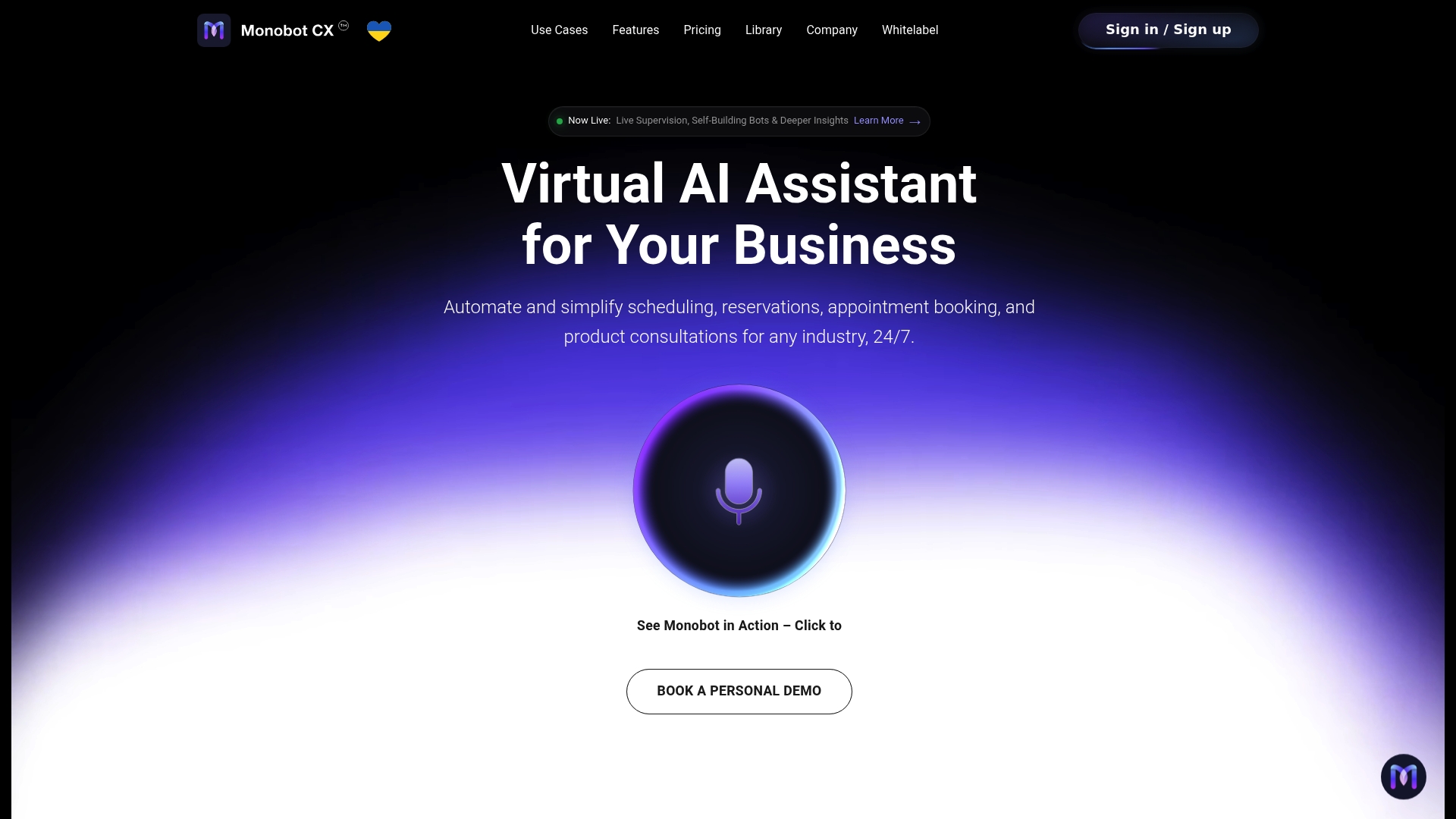
The vendor advertises automating up to 80% of inbound calls and chats. Monobot reports support for over 20 languages and offers multiple voice options for live voice agents. The platform emphasizes quick setup and fast deployment so teams can go live within minutes.
Core Features
Monobot includes an AI Agent Builder for creating and customizing voice and chat agents and a Workspace to manage conversations and agent instances. An Integration Hub connects agents to CRM and helpdesk tools while Interaction Details and a Knowledge Base supply context and instant answers during live sessions. The stack supports multi-channel routing and noncoding customization to shorten internal build time.
Key Differentiator
All core capabilities come bundled inside volume-based plans with broad language and voice support plus built-in integrations. That packaging reduces the need to buy separate modules for voice, chat, and connectors. For teams that expect growth, this makes scaling predictable and cuts integration overhead.
Pros
Onboarding requires minimal technical skills, so operations teams can configure agents without an engineering backlog. The platform’s Integration Hub and Workspace let contact centers connect CRM and helpdesk systems without custom middleware. That language support and multiple voice options help multinational programs keep a uniform customer experience across channels. Pricing uses a credits model, which provides predictable volume billing for growth scenarios, and the vendor cites cross-industry success stories supporting deployments in healthcare, retail, banking, and logistics.
Cons
- Pricing complexity might confuse small businesses on limited budgets.
Who It’s For
Monobot suits mid to large enterprises and contact centers that need multi-channel voice and chat automation at scale. It fits teams that must support multiple languages and prefer a credits model over per-feature line items. Choose it when you want rapid deployment and fewer integration projects.
Unique Value Proposition
Credits-based pricing starting at $200/month lets buyers bundle agent builder, voice options, and integrations under a single volume plan. That model shifts procurement from a per-feature negotiation to predictable monthly credits and simplifies scaling across regions. For procurement teams, the result is fewer line items and clearer capacity planning.
Real World Use Case
A national retail chain deployed Monobot to handle appointment bookings and customer inquiries across stores. Agents answered routine questions and routed complex issues to human staff, which reduced manual call volume and freed agents to handle exceptions. Store managers reported faster response times and fewer repetitive call tasks.
Pricing
Monobot uses credits-based pricing starting at $200/month with varying rates per feature. Plans include Starter, Growth, Business, and Enterprise, and custom solutions are available for large-scale needs. Volume-based credits and tiered plans aim to align cost with usage and growth.
Website: https://monobot.ai
Vapi
At a Glance
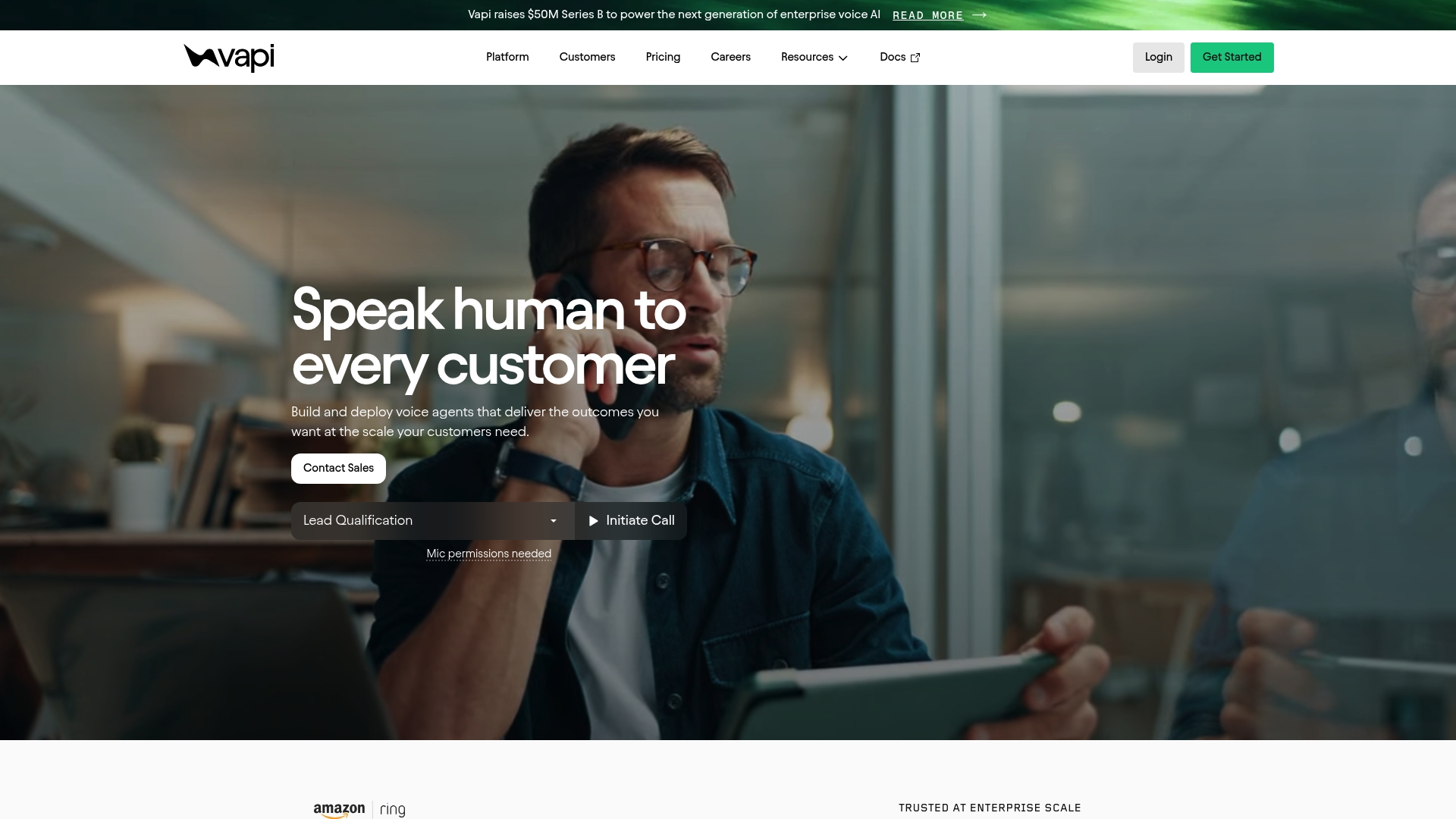
The company reports a $50M Series B and targets Fortune 500 clients. Vapi focuses on enterprise voice automation with natural sounding agents and full life cycle control. The platform emphasizes real time monitoring, developer tooling, and enterprise grade security for large deployments.
Core Features
Vapi offers a unified environment for building, deploying, and orchestrating voice agents with real time monitoring and analytics. The system uses an API first architecture so teams can ground responses in external data and trigger third party tools. It also supports custom models, telephony control, and multi agent orchestration with fine tuning and safety measures for enterprise use.
Key Differentiator
Vapi’s marketing materials state enterprise grade orchestration and monitoring with ultra low latency and robust security for mission critical voice deployments. That positioning matters when you need multi agent workflows, strict compliance controls, and operational visibility at scale.
Pros
Very natural voice quality improves caller trust and reduces repeat clarifications during interactions. The developer friendly architecture exposes many configuration points and APIs, which speeds prototype to production cycles. Robust orchestration and multi agent features let engineering teams model complex call flows while the platform claims enterprise grade security and uptime guarantees.
Cons
-
Platform stability has been reported as inconsistent in some production environments, which can disrupt live deployments.
-
High latency occurs for certain call types, and that can impair sensitive real time interactions.
-
Several users report slow or unresponsive customer support after launch, increasing troubleshooting time.
-
Customers describe hidden costs, unexpected charges, and difficult cancellation or refund processes.
When It May Not Fit
Organizations that cannot tolerate service interruptions should avoid live dependence on this platform. Setup complexity requires engineering resources and specialized expertise for full deployment. Teams expecting quick, low friction support for high demand traffic may find the company’s responsiveness insufficient.
Notable Integrations
Vapi lists integrations with OpenAI GPT models and Deepgram transcription, plus connectors for various telephony providers and APIs. Those integrations let you combine LLM responses with accurate speech transcription and direct phone network control.
Who It’s For
Large enterprises and Fortune 500 companies that need customizable voice agents and deep telemetry will get the most value. The platform fits teams with engineering capacity to build and maintain complex conversational systems. Organizations requiring formal compliance and contractual uptime terms will find the enterprise features relevant.
Real World Use Case
The vendor advertises major retail chains and contact centers using Vapi to handle millions of support calls with natural voice interactions and integrated back end data. In practice, teams use the platform to automate appointment scheduling, route complex workflows to specialists, and surface real time customer data during calls.
Pricing
Pricing uses a usage based build model with a fixed platform fee and volume commitments for scale. Expect charges to combine platform fees plus consumption costs and contract terms for large deployments.
Website: https://vapi.ai
Retell AI
At a Glance
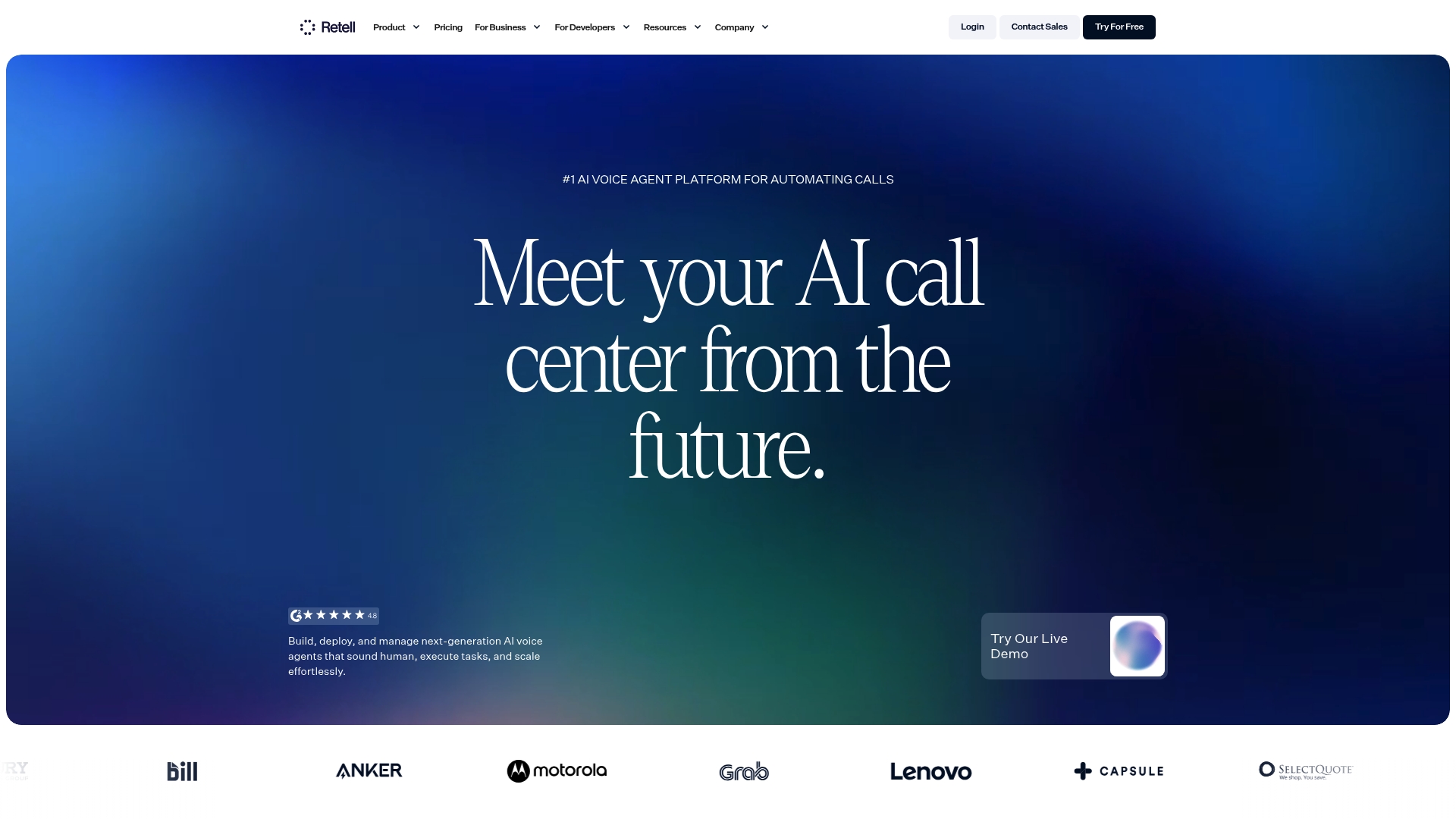
$0.07/min pay as you go voice pricing makes minute‑based pilots inexpensive. According to the company, average voice latency is about 600ms. Retell AI targets large support and sales teams with built in telephony and CRM connectors for rapid deployment.
Core Features
Retell AI runs LLM driven voice agents that manage multi turn conversations for inbound and outbound calls. It offers drag and drop call design, templates, and built in functions for booking, payments, and transfers. The vendor advertises HIPAA, SOC2, GDPR support and PII redaction, plus real time call analysis and open APIs for customization.
Key Differentiator
Retell AI centers on proprietary voice orchestration tuned to sustain realistic, extended dialogs. That architecture combines natural language generation with routing and call controls so conversations stay on task. The platform aims to preserve context across long exchanges for fewer transfers.
Pros
The platform produces high quality, humanlike voice synthesis and natural multi turn conversations that cut awkward handoffs. Its responsiveness helps shorten hold times. That latency figure supports faster first responses and smoother agent takeovers. Built in analytics and continuous performance loops give clear visibility into call quality and escalation triggers. Drag and drop design and templates speed deployment, and deployment options include on premises and cloud.
Cons
-
Higher cost for startups and small projects. This pricing can limit pilots on tight budgets.
-
Outbound call performance can trail some rivals. Expect extra tuning for large scale campaigns.
-
Complex integrations may require engineering support. Full API customization is powerful but technical.
-
Limited support for non US and Canadian phone numbers and regions. Global reach is narrower than some competitors.
When It May Not Fit
If your team runs small volume pilots on a shoestring budget, Retell AI may be too costly. If you need deep native sales workflow automation, feature gaps exist compared with niche vendors. If your target markets rely heavily on non US telephony, look for broader regional support.
Notable Integrations
- Twilio
- Vonage
- Hubspot
- Make
- n8n
- Go High Level
- Salesforce
- Live telephony providers and APIs
Who It’s For
Large support and sales organizations that need scalable, voice first automation and fast time to value. Teams that already use major CRMs and telephony vendors will get the most from the integrations. Enterprises requiring formal compliance controls will find the platform aligned with those needs.
Real World Use Case
The vendor reports a healthcare provider saw a 38% rise in scheduling NPS after deploying Retell AI for appointment calls. The vendor also reports a SaaS company reduced support costs by over 50% using Retell to handle first level voice inquiries. Those outcomes illustrate the platform’s focus on high volume call handling.
Pricing
Pay as you go from $0.07/min for voice agents with a free trial that includes $10 in credits. Enterprise plans use custom pricing and include dedicated support and SLA options.
Website: https://retellai.com
Comparison of Alternatives
Monobot.ai offers swift deployment coupled with scalable language support within a credits-based pricing model, positioning it as a feasible choice for diverse contact center scenarios. However, both Vapi and Retell AI also present intriguing advantages depending on the organization’s specific workflows and priorities.
Deployment and Integration Efficiency
Monobot.ai emphasizes minimal setup complexity and faster deployment times, ideal for mid-sized teams looking to minimize engineering dependencies. Retell AI also provides streamlined tools like drag-and-drop call design, which simplifies training and operation for high-volume call centers. However, integrations as flexible as those offered by Vapi—with API-first architecture allowing extensive data grounding, telephony control, and custom model deployment—can be critical for organizations with layered workflows.
Specialized Capabilities
Retell AI leads in orchestration and persistent dialog management, excelling in long-form conversational scenarios integral to industries like healthcare and enterprise sales. Its ability to maintain context across multiple interaction turns stands out as a vital feature for handling intricate workflows effectively. Conversely, Vapi’s focus on real-time monitoring and compliance may resonate more with clients focused on mission-critical interactions requiring transparent controls.
Best Fit
- Teams prioritizing multi-language automation within a predictable pricing structure find Monobot.ai well-suited.
- Enterprises needing orchestration for long, context-rich dialogs will appreciate Retell AI.
- Engineer-driven organizations emphasizing integration control and compliance requirements benefit from Vapi’s API-centric controls.
- Contact centers requiring cost-effective pilot builds without long-term commitment prefer Retell AI’s pay-as-you-go model.
Our Pick
Monobot.ai delivers an adept balance of ease of use, versatile language capacity, and scalability within a clear and predictable pricing framework, making it a reliable recommendation for contact centers seeking rapid yet manageable automation solutions. However, if dialog complexity or custom engineering oversight dominate your requirements, evaluating alternatives like Retell AI or Vapi might provide better alignment for niche workflows.
Selecting the right voice and chat assistant platform depends on features, pricing, and scalability that suits enterprise needs.
| Product | Key Features | Best For | Pricing | Limitations |
|---|---|---|---|---|
| Monobot | AI Agent Builder, CRM integration | Mid to large enterprises and multilingual support | Starting at $200/month | Pricing complexity might confuse small businesses. |
| Vapi | API-first architecture, enterprise-grade orchestration | Large enterprises needing robust orchestration | Price not published | Reported issues with service stability and customer support. |
| Retell AI | LLM-driven voice agents, rapid deployment capabilities | Large teams with scaling requirements | $0.07/min pay-as-you-go | Limited support for non-US/Canada phone numbers. |
How To Choose Among VoiceOwl.ai Alternatives That Match Your Enterprise Needs
Many large enterprises and contact centers face challenges balancing fast deployment, multi-language support, and integration ease when evaluating voice automation platforms. Monobot addresses these concerns by automating up to 80% of inbound calls and chats, reducing operational complexity without requiring heavy technical skills. Its credit-based pricing bundles AI voice agents, chat, and integrations into a single plan that grows with your team’s needs.
Benefits include:
- Quick setup with non-coding customization
- Support for over 20 languages and multiple voices
- Built-in CRM and helpdesk connectors
See how Monobot can scale your multi-channel voice and chat automation while improving first-call resolution rates. Visit Monobot to review detailed features and request a demo tailored to your enterprise requirements.
FAQ
What is Monobot’s pricing model?
Monobot uses a credits-based pricing model starting at $200/month. This model allows users to bundle the agent builder, voice options, and integrations under one volume plan, simplifying scaling for teams and reducing procurement complexity.
How does Monobot compare to Vapi in terms of deployment speed?
Vapi focuses on enterprise voice automation and emphasizes developer tooling, which can lead to setup complexity requiring engineering expertise. In contrast, Monobot offers quick setup and fast deployment, allowing teams to go live within minutes without needing extensive technical skills.
Can I use Monobot for multilingual support?
Yes, Monobot supports over 20 languages, making it suitable for multinational teams looking to maintain a uniform customer experience across call and chat interactions. That capability positions Monobot as an effective choice for diverse customer bases.
Does Monobot require technical skills for onboarding?
No, onboarding with Monobot requires minimal technical skills, allowing operations teams to configure agents without needing an engineering backlog. This feature makes it accessible for teams without extensive technical resources.
What key feature does Monobot offer for managing conversations?
Monobot includes an Integration Hub that connects agents to CRM and helpdesk tools, enhancing interaction contexts and providing instant answers during live sessions. This capability optimizes the efficiency of managing customer interactions across platforms.