



TL;DR:
- Call center virtual agents are AI systems that automate customer interactions across voice and digital channels. Choosing the right type, such as AI voice, chat, hybrid, or industry-specific agents, improves resolution rates and customer satisfaction. Proper selection based on interaction complexity and channel preference prevents inefficiencies and enhances customer experience.
A call center virtual agent is defined as an AI-driven system that automates customer interactions by understanding and acting on requests across voice and digital channels. Knowing the distinct types of call center virtual agents helps customer service leaders pick the right tool for each job, whether that means resolving a billing dispute at 2:00 AM or handling a thousand simultaneous chat inquiries during a product launch. The gap between a basic rule-based bot and a fully AI-powered virtual agent is wide, and choosing the wrong type costs you both money and customer trust.
1. Types of call center virtual agents: an overview
Call center virtual agents fall into several distinct categories, each built around a specific interaction model and capability set. The industry term for the most advanced category is “AI virtual agent,” which uses natural language processing, machine learning, and agentic reasoning to understand and resolve requests autonomously. Below that tier sit rule-based chatbots, voice IVR systems, and hybrid agents. Understanding where each type fits helps you avoid over-engineering simple workflows and under-powering complex ones.

2. AI-powered voice virtual agents
AI voice virtual agents handle inbound and outbound calls using natural language understanding instead of rigid menu trees. A caller can say “I need to change my delivery address for order 4821” and the agent parses intent, retrieves the order from the CRM, and executes the update without transferring to a human. That capability, connecting conversational intent to real backend action, is what separates modern AI voice assistants from legacy interactive voice response systems.
Key capabilities of AI voice virtual agents include:
- Natural language understanding (NLU): Interprets free-form speech, not just keywords.
- Real-time CRM integration: Pulls account data, order status, and billing records mid-call.
- Multi-step task execution: Completes actions like scheduling, payments, and address changes without human help.
- Confidence scoring: A well-configured AI agent monitors its own confidence and routes to a live agent when resolution is uncertain.
- 24/7 availability: Handles calls outside business hours without staffing costs.
The main limitation is accuracy in noisy environments or with heavy accents, which requires ongoing speech-to-text (STT) model tuning. Voice agents also need tight integration with backend systems to deliver value beyond conversation.
Pro Tip: Test your voice agent against off-script inputs before launch. Customers rarely follow the path you expect, and your confidence-score thresholds will need calibration based on real call data.
3. Chat-based virtual agents: how text interactions enhance customer service
Chat virtual agents operate across web chat, SMS, and messaging platforms, handling text-based customer requests at scale. They use large language models (LLMs) to maintain context across a conversation, so a customer who asks about a return policy and then asks “how long does it take?” gets a coherent answer, not a reset. This contextual memory is what makes modern chat agents feel like a conversation rather than a form.
Chat agents excel at:
- FAQ resolution: Answering product questions, policy lookups, and how-to guides without agent involvement.
- Troubleshooting flows: Walking customers through step-by-step fixes for common technical issues.
- Lead qualification: Collecting contact details, budget ranges, and intent signals before routing to sales.
- Multi-channel coverage: Running simultaneously across web chat, WhatsApp, and SMS from a single deployment.
- Escalation with context: Passing the full conversation transcript to a live agent so customers never repeat themselves.
Scaling digital customer support with chat agents reduces per-interaction costs significantly. One agent instance can handle hundreds of simultaneous conversations, something no human team can match during peak hours.
4. Hybrid virtual agents combining voice and chat for omnichannel service
Hybrid virtual agents operate across both voice and digital channels from a single underlying AI model. AI virtual agents that switch from web chat to phone deliver consistent, contextual responses without requiring the customer to repeat information. That continuity is the defining advantage of the hybrid type.
Here is how hybrid agents create value across a customer journey:
- Channel-agnostic context: The agent retains conversation history whether the customer moves from chat to voice or vice versa.
- Consistent resolution logic: The same intent model handles requests regardless of channel, reducing inconsistent answers.
- Unified analytics: One dashboard tracks resolution rates, escalation triggers, and customer satisfaction across all channels.
- Reduced handoff friction: When a live agent takes over, they receive the full interaction history from every channel in one view.
Hybrid agents are the best fit for businesses with complex customer journeys, such as insurance claims, financial onboarding, or multi-step technical support. They require more upfront integration work, but the payoff is a customer experience that feels continuous rather than fragmented.
5. Specialized virtual agents for industry-specific functions
Specialized virtual agents are trained and integrated for a single industry vertical, giving them deeper accuracy and faster resolution within that domain. A generic AI agent can answer “what is my balance?” but a financial services agent retrieves the real-time figure, flags unusual activity, and escalates to a licensed representative when a regulated action is needed. That specificity is what drives first-call resolution in high-stakes environments.
Industry examples worth knowing:
- Retail: Retail virtual agents handle order status, returns, and product inquiries autonomously during seasonal spikes, reducing hiring pressure and freeing live agents for complex complaints.
- Financial services: These agents handle balance inquiries, rate lookups, and loan status updates across voice and chat, with built-in escalation paths for licensed actions.
- Human resources: HR virtual agents give employees self-service access to PTO balances, payroll dates, and benefits details anytime, cutting internal ticket volume without adding headcount.
- Healthcare: Appointment scheduling, prescription refill requests, and insurance verification are all automatable with a healthcare-trained agent.
- Logistics: Shipment tracking, delivery exception alerts, and rerouting requests are handled without a human dispatcher.
Pro Tip: When deploying a specialized agent, map your top 20 query types by volume before building. Agents trained on your actual call data outperform generic templates from day one.
Specialization also helps with AI in eCommerce, where product recommendation, cart recovery, and post-purchase support all benefit from domain-specific training rather than general-purpose models.
6. Rule-based vs. AI-driven virtual agents: key differences
Rule-based chatbots follow fixed decision trees. When a customer deviates from the expected path, the bot fails. Traditional chatbots cannot handle nuanced or off-script requests, while AI agents learn and adapt to natural language inputs. That difference has direct consequences for resolution rates and customer satisfaction.
| Feature | Rule-based bots | AI virtual agents |
|---|---|---|
| Input handling | Keyword matching, button clicks | Free-form natural language |
| Flexibility | Fixed decision trees only | Adapts to off-script inputs |
| Backend integration | Limited or manual | Real-time CRM, billing, and data systems |
| Maintenance | High, requires manual updates | Improves over time through ongoing training |
| Best use case | Simple, predictable FAQs | Complex, multi-step customer interactions |
AI-native platforms are designed for complexity and adaptability, not layered workarounds. The practical result is lower no-match rates, fewer escalations, and a system that gets better with every interaction rather than requiring constant manual reprogramming.
Key takeaways
The most effective call center virtual agent strategy matches agent type to interaction complexity, channel, and industry context rather than deploying a single solution across all use cases.
| Point | Details |
|---|---|
| AI voice agents handle complex calls | They use NLU and CRM integration to resolve multi-step requests without human help. |
| Chat agents scale digital support | One deployment handles hundreds of simultaneous text conversations across multiple channels. |
| Hybrid agents preserve context | Customers move between voice and chat without repeating themselves, improving satisfaction. |
| Specialized agents drive resolution | Industry-trained agents outperform generic bots on domain-specific queries and peak-volume periods. |
| AI beats rule-based for complexity | AI agents reduce maintenance costs and improve over time; rule-based bots require constant manual updates. |
Why the agent type you pick matters more than you think
After working with call center automation across multiple industries, the single biggest mistake I see is treating virtual agent selection as a technology decision rather than a customer experience decision. Teams spend months evaluating NLP benchmarks and integration specs, then deploy a voice agent on a channel where their customers overwhelmingly prefer text. The agent type has to match where your customers actually are, not where you wish they were.
The second mistake is underestimating the gap between understanding intent and executing action. A virtual agent that can recognize “I want a refund” but cannot actually process it is not solving your problem. It is just a more expensive FAQ page. The agents worth investing in are the ones that connect intent to backend systems and complete the task end to end.
My honest recommendation: start with your top 20 call types by volume, identify which ones are fully automatable with current AI, and deploy a specialized agent there first. Prove the ROI on a narrow use case before expanding to hybrid or omnichannel. That sequenced approach consistently outperforms big-bang deployments. When you are ready to scale, choose a platform built for omnichannel context retention from the start, because retrofitting that capability later is painful and expensive.
— Alex
Monobot’s AI platform for call center virtual agents
Monobot builds AI voice and chat agents that go beyond conversation to complete real tasks. The AI agent builder lets your team create and customize agents without writing code, using industry templates for healthcare, retail, banking, logistics, and more. Deployment takes minutes, not months.
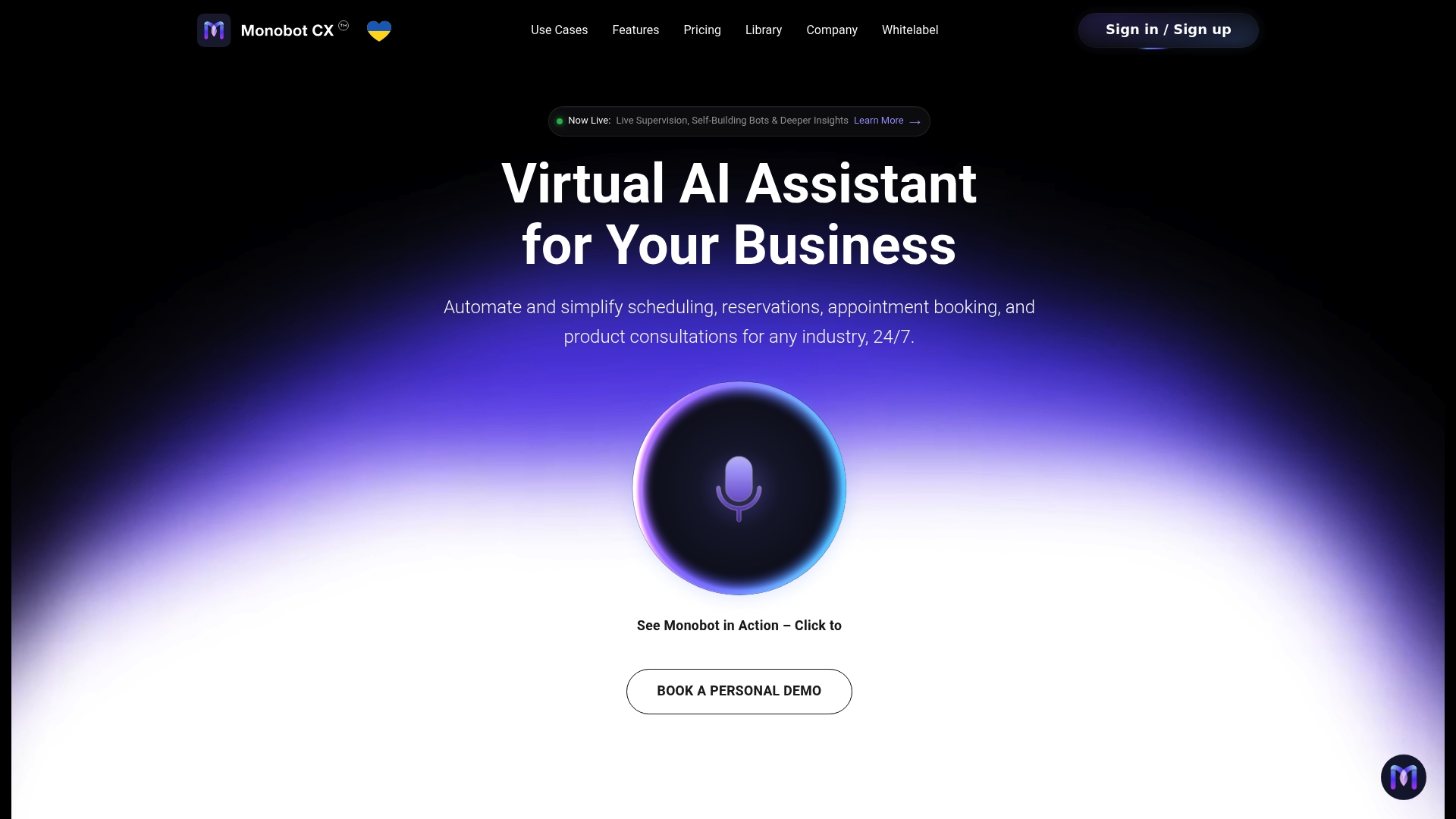
Monobot’s platform covers every agent type covered in this article, from specialized voice agents to omnichannel hybrid deployments. Real-time analytics through the performance dashboard show resolution rates, escalation triggers, and customer satisfaction scores as they happen. If you are ready to see how AI virtual agents perform in your specific environment, explore Monobot and request a demo today.
FAQ
What is a virtual agent in a call center?
A call center virtual agent is an AI-driven system that handles customer requests across voice and digital channels without human intervention. It uses natural language processing and backend integrations to understand requests and complete tasks autonomously.
How is a virtual agent different from a chatbot?
A virtual agent uses AI, machine learning, and real-time data access to resolve complex, multi-step requests. A traditional chatbot follows fixed decision trees and fails when customers go off-script.
What types of call center virtual agents exist?
The main types are AI voice agents, chat-based agents, hybrid omnichannel agents, and specialized industry agents. Each type is optimized for a different interaction model, channel, and complexity level.
Which virtual agent type is best for first call resolution?
Specialized AI virtual agents trained on domain-specific data deliver the highest first-call resolution rates. They connect directly to backend systems and handle industry-specific queries without escalation.
Can virtual agents handle multiple channels at once?
Hybrid virtual agents operate across voice, chat, SMS, and email simultaneously, maintaining context as customers switch channels. This omnichannel capability eliminates the need for customers to repeat information.