



Yes, CCPA and CPRA apply the moment a chatbot collects or infers personal information from a California resident, including names, device identifiers, and behavioral patterns drawn from conversation. The three immediate priorities are updating your notice-at-collection to list exactly what the bot gathers, locking vendor contracts into proper service-provider terms, and standing up a 45-day DSR workflow. If your chatbot processes sensitive personal information, you also need a working Limit Use mechanism under CPRA.
TL;DR:
- Updating notices must explicitly list all personal data categories collected by the chatbot, especially inferred attributes like sentiment or intent.
- Vendor contracts should include clear purpose restrictions, deletion obligations, and disclosure of any third parties handling chat data to avoid reclassification as a third party.
- Building a 45-day data subject request workflow involves mapping chats to consumers, verifying identities, and fully purging transcripts and inferences within the legal response window.
- Disclosing chatbot data collection at the start requires placing a clear, specific notice in the chat widget with links to the full privacy policy and opt-out options.
- Limiting the collection of sensitive personal information and implementing technical controls, such as server-side GPC detection and data partitioning, helps comply with opt-out and deletion mandates.
Table of Contents
- Quick compliance checklist: prioritized short-term actions
- What CCPA/CPRA requires for chatbot data collection and disclosure
- Consumer rights and operational workflows for chatbot data
- Vendor contracts and service provider controls for chatbot platforms
- Sensitive personal information and limit-use handling in chat
- Technical controls to honor opt-outs and implement deletion
- Privacy policy microcopy and placement for chat widgets
- Practical implementation patterns and lessons learned
- Priority roadmap and why minimization matters
- How Monobot helps you put these controls in place
- FAQ
- Sources
Quick compliance checklist: prioritized short-term actions
Most compliance teams we talk with are not starting from zero, but they are starting from scattered pieces: a privacy policy that predates the chatbot rollout, a vendor contract signed before anyone thought about CPRA, and no clear owner for data subject requests. Here is the order that actually reduces risk fastest.
- Rewrite your pre-chat disclosure and privacy policy so they name the specific categories your bot collects, the purposes behind each one, and whether any vendor receives that data.
- Pull your chatbot vendor contract and confirm it contains service-provider language restricting use, plus a real deletion and export capability you can test.
- Turn on Global Privacy Control (GPC) honoring and post clear Do Not Sell/Share links if your chatbot setup shares data in ways that trigger that obligation.
- Build a DSR intake and verification playbook that tracks the clock from request to resolution within 45 days.
- Set retention periods for chat transcripts and automate deletion once those periods expire instead of relying on manual cleanup.
Each of these maps to a specific statutory duty, which we break down in the sections that follow, but sequencing matters: notices and contracts come first because they’re audit fodder regulators ask for immediately, and workflows come second because they take longer to operationalize correctly.
Pro Tip: Treat your chatbot like any other data collection point on your site. If you disclosed it for a web form, disclose it for the bot, including anything the model infers rather than explicitly asks for.
What CCPA/CPRA requires for chatbot data collection and disclosure
Chatbots collect more than the text a visitor types. They often log device identifiers, timestamps, page context, and inferred attributes such as sentiment or likely purchase intent. Under California Civil Code §1798.100, businesses must inform consumers at or before the point of collection about the categories gathered, the purposes for using them, whether the information is sold or shared, and the criteria used to set retention periods.
That means your notice-at-collection needs to specifically call out chatbot interactions as a collection point, not bury them inside a general “information we collect” paragraph written for web forms and cookies. If your bot infers emotional tone, likely demographics, or purchase readiness from conversation patterns, those inferences count as personal information and need their own line in the disclosure.
Purpose limitation matters just as much as the initial disclosure. If you tell consumers you’re collecting chat data to resolve support tickets, you cannot later repurpose that same data to train a generic model or build marketing segments without a compatible, disclosed purpose. The California Attorney General’s guidance on the CCPA makes clear that regulators look closely at whether businesses actually disclose what their chatbots collect and whether vendors reuse conversation data for model training, since vendor assurances alone do not transfer or reduce the business’s own disclosure duty.
Regulators focus on whether businesses actually disclose what chatbots collect and whether vendors use conversation data for model training. Vendor attestations alone do not shift the business’s disclosure duties.
This is where many chatbot deployments quietly cross into “sale” or “sharing” territory under CPRA, even when no money changes hands. If a vendor uses chat transcripts for cross-context behavioral advertising, or shares them with an analytics partner that builds audience profiles, that can trigger sale or sharing definitions requiring a Do Not Sell/Share link and opt-out mechanism. The practical test is not whether a check was written, but whether the data crosses into another party’s independent use for its own purposes.
California Civil Code §1798.130 also sets requirements for how your privacy policy itself must read: specified methods for submitting requests, clear categories of rights, and update cadence tied to material changes in practice. If you change what your chatbot collects or who receives it, your notice needs to reflect that before the change goes live, not months later during an annual policy refresh.
Vendor processing is the detail most teams get wrong first. A chatbot platform that merely stores and returns your data on your instructions is typically acting as a service provider, a narrower role with real restrictions. A platform that uses your conversation data to improve its own general-purpose model, or that shares it with a separate ad network, starts to look like a third party receiving a sale or share, which changes your disclosure obligations substantially. Our AI compliance checklist breaks this distinction down with specific contract language to look for.

Consumer rights and operational workflows for chatbot data
Once your disclosures are accurate, the harder operational problem is honoring rights requests against data that lives in chat transcripts rather than a tidy customer database. Here is the workflow we recommend building, step by step.
- Map chat sessions to a consumer identifier early, whether that’s an account ID, email captured during the conversation, or a session token tied to a logged-in profile, so a request can actually be matched to the right transcripts.
- Log the request timestamp the moment it arrives, since California Civil Code §1798.130 gives you 45 days to respond to a verifiable consumer request, with one permitted 45-day extension when the request is unusually complex.
- Verify identity using a method proportionate to the sensitivity of the data, matching at least two identifiers already on file rather than accepting a self-reported email with no corroboration.
- Limit what you do with the data during verification itself, meaning verification activity should not become an excuse to further profile or process the requester’s information beyond confirming identity.
- Build an export format that includes the actual conversation content, inferred attributes, timestamps, and any third parties the data was shared with, not just a summary of account metadata.
- Route deletion requests through the same per-session mapping so transcripts, derived inferences, and any vendor-side copies are all purged, not just the primary record in your own database.
The 45-day clock is unforgiving once it starts, and the biggest operational failure we see is treating chatbot transcripts as somehow separate from “real” customer data subject to the same rights timeline. They are not. A transcript sitting in a vendor’s logging system is just as much in scope as a row in your CRM.
Vendor contracts and service provider controls for chatbot platforms
Your chatbot vendor contract is where most CCPA exposure actually lives, because the statute places real weight on what your service providers are contractually permitted to do with your data. California Civil Code §1798.100 requires that businesses enter into compliant contracts with service providers that limit the use of personal information to the specific business purpose disclosed, with contractor obligations spelled out as well.
Before signing or renewing any chatbot vendor agreement, confirm the contract covers these points:
- Explicit purpose limitation language stating the vendor may only use conversation data to provide the contracted service, not to train general-purpose models without your opt-in.
- Deletion and export obligations that specify a concrete timeline and format, not a vague commitment to “reasonable efforts.”
- Audit rights letting you verify the vendor’s practices rather than relying solely on a signed attestation.
- Subprocessor disclosure so you know which other companies touch your consumers’ chat data, since your disclosure duty extends to them too.
- Breach notification timelines that are fast enough to let you meet your own downstream obligations to consumers and regulators.
Whether a vendor counts as a service provider or a third party changes what you have to tell consumers. A service provider processing data strictly on your instructions, under a compliant contract, generally does not trigger sale or sharing disclosures. A vendor that independently uses your chat data for its own purposes, including improving its general model, functions more like a third party, and that typically requires disclosure as a sale or share along with an opt-out mechanism. Our piece on chatbot training data walks through exactly how that line gets crossed in practice.
Pro Tip: During vendor due diligence, ask directly: “Does any part of our conversation data ever get used to train a model that serves other customers?” A vague or evasive answer is the single biggest red flag in a chatbot vendor review.
Sensitive personal information and limit-use handling in chat
Chat interfaces are unusually good at collecting sensitive personal information (SPI) by accident, because consumers type freely instead of filling out a structured form with guardrails. A support bot asking “how can we help” will regularly receive health details, financial account numbers, or government ID fragments volunteered in the first message.
CPRA defines SPI broadly enough to cover precise geolocation, health conditions, financial account details, government identifiers, and several other categories, and it gives consumers the right to limit how businesses use and disclose that information once collected, as the California Attorney General’s office confirms. Practical handling means:
- Design conversation flows to redirect away from free-text SPI capture, routing a consumer who mentions a medical condition or account number to a secure form or a human agent instead of logging it in an open chat field.
- Flag any SPI that does get captured so it can be excluded from general analytics, marketing use, or model improvement pipelines automatically.
- Build a visible Limit Use control, typically a link or toggle, that lets consumers restrict SPI processing to what’s strictly necessary for the service requested.
- Escalate healthcare-adjacent conversations to compliant channels when your chatbot touches anything resembling protected health information, which is a separate layer of obligation we cover in our guide to HIPAA compliant chatbots.
The cheapest fix here is architectural, not legal: a chatbot that never invites SPI into an open text field in the first place has far less to disclose, limit, or defend later.
Technical controls to honor opt-outs and implement deletion
Policy language means nothing if the underlying system can’t actually act on it. Engineering teams need concrete patterns, not just legal summaries, to make opt-outs and deletions real.
- Detect the Sec-GPC header server-side before any call goes out to a third-party analytics or model API, and suppress that call entirely when the signal is present, rather than relying on client-side scripts that a vendor’s own tag might override.
- Partition conversation data per user with clear metadata linking each record to a consumer identifier, so an export or deletion request can target exactly the right rows instead of requiring a manual search through shared logs.
- Keep deletion proofs, meaning a log entry confirming what was deleted, when, and from which system, since “we deleted it” without a record satisfies neither an auditor nor a skeptical consumer.
- Store conversation data in your own environment rather than solely in a vendor’s shared infrastructure, which reduces the chance that a single vendor-side breach or policy change silently creates a sale or sharing problem you didn’t choose.
- Add DSR and opt-out test cases to your regression suite so a routine product update can’t silently break deletion or GPC honoring without anyone noticing until a complaint arrives.
A majority of chatbot deployments we’ve reviewed were not honoring Sec-GPC signals server-side at launch, relying instead on client-side scripts that third-party vendor tags could bypass entirely. That gap is exactly the kind of technical shortfall that turns a policy promise into an enforcement exposure.
Our regression testing playbook walks through building these DSR and opt-out checks directly into your release cycle, so compliance testing happens automatically instead of once a year during an audit scramble.
Privacy policy microcopy and placement for chat widgets
A pre-chat disclosure does not need to be long, but it does need to be specific and visible before the first message is sent. A workable pattern reads something like: “This chat may use AI to answer your questions. We collect your messages, device information, and inferred interests to provide support and improve this service. We do not sell your information. [Privacy Policy] [Do Not Sell or Share My Personal Information].”
Place that disclosure directly in the chat window on first load, not buried behind a separate click, and keep a persistent link to your full privacy policy and your Do Not Sell/Share mechanism in the widget’s footer so it’s reachable throughout the conversation, not just at the start.
| Category collected | Purpose | Typical retention |
|---|---|---|
| Chat message content | Resolve inquiry, provide support | Until case closed plus a defined retention window |
| Device and browser identifiers | Session continuity, fraud prevention | Duration of session plus short buffer |
| Inferred intent or sentiment | Route to appropriate agent or flow | Tied to the interaction, not indefinite |
| Contact details volunteered in chat | Follow-up communication if requested | Until consumer opts out or requests deletion |
Review and version your notice every time the chatbot’s data flow changes, such as adding a new analytics integration or a new vendor. Date-stamp each version internally so you can show regulators exactly what was disclosed at the time a given consumer interacted with the bot.
Practical implementation patterns and lessons learned
We built Monobot’s platform around the assumption that compliance teams need to prove controls work, not just describe them in a policy document. Per-session data partitioning means every conversation is tied to a traceable identifier from the start, which is what makes a targeted export or deletion request actually executable rather than a manual search project.
Our templates for regulated industries, including healthcare and financial services, include vendor clause language structured around service-provider restrictions rather than open-ended data use, helping to streamline the legal review process. The handoff between legal, security, and operations teams works best when each has a defined checkpoint: legal approves the disclosure language, security confirms the technical controls exist, and operations owns the day-to-day DSR queue.
The most common pitfall we see is undisclosed analytics integrations layered onto a chatbot after launch, where a marketing team adds a new tracking pixel or audience tool without looping in whoever owns the privacy notice. The second most common is assuming a vendor’s general terms of service cover model-training restrictions when they don’t specifically say so.
- Per-session partitioning makes deletion and export requests targeted instead of manual.
- Pre-built vendor clause templates cut legal review time on contract renewals.
- Defined handoffs between legal, security, and operations prevent compliance gaps from forming after launch.
Pro Tip: Revisit your chatbot’s vendor list every quarter, not just at contract renewal. New integrations get added between renewals more often than compliance teams expect.
Priority roadmap and why minimization matters
If we had to compress this entire guide into one piece of advice, it would be this: fix your disclosures and vendor contracts before you touch anything technical. A perfectly engineered deletion pipeline does not help you if your privacy notice never told consumers what the chatbot collects in the first place, and a beautifully worded notice does not help you if your vendor contract quietly permits model training on conversation data.
The deeper principle underneath all of this is minimization. Every compliance headache in this guide gets smaller when the chatbot simply collects less sensitive data to begin with. A bot that redirects health and financial details to a secure channel instead of logging them in open text has fewer SPI obligations to manage, not just easier ones.
Treat DSR and opt-out tests as part of your release process, not an annual fire drill. Compliance that only gets checked once a year is compliance that breaks quietly in between.
— Alex
How Monobot helps you put these controls in place
Building CCPA-ready chatbot infrastructure from scratch is a real engineering lift, which is why we designed Monobot’s platform with per-session data partitioning, export and delete hooks, and GPC opt-out detection built into the deployment rather than bolted on afterward. Teams configuring a new conversational flow can apply industry-specific templates that already reflect the disclosure and vendor-structure patterns covered in this guide, cutting the setup time compliance officers usually spend chasing engineering for custom work.
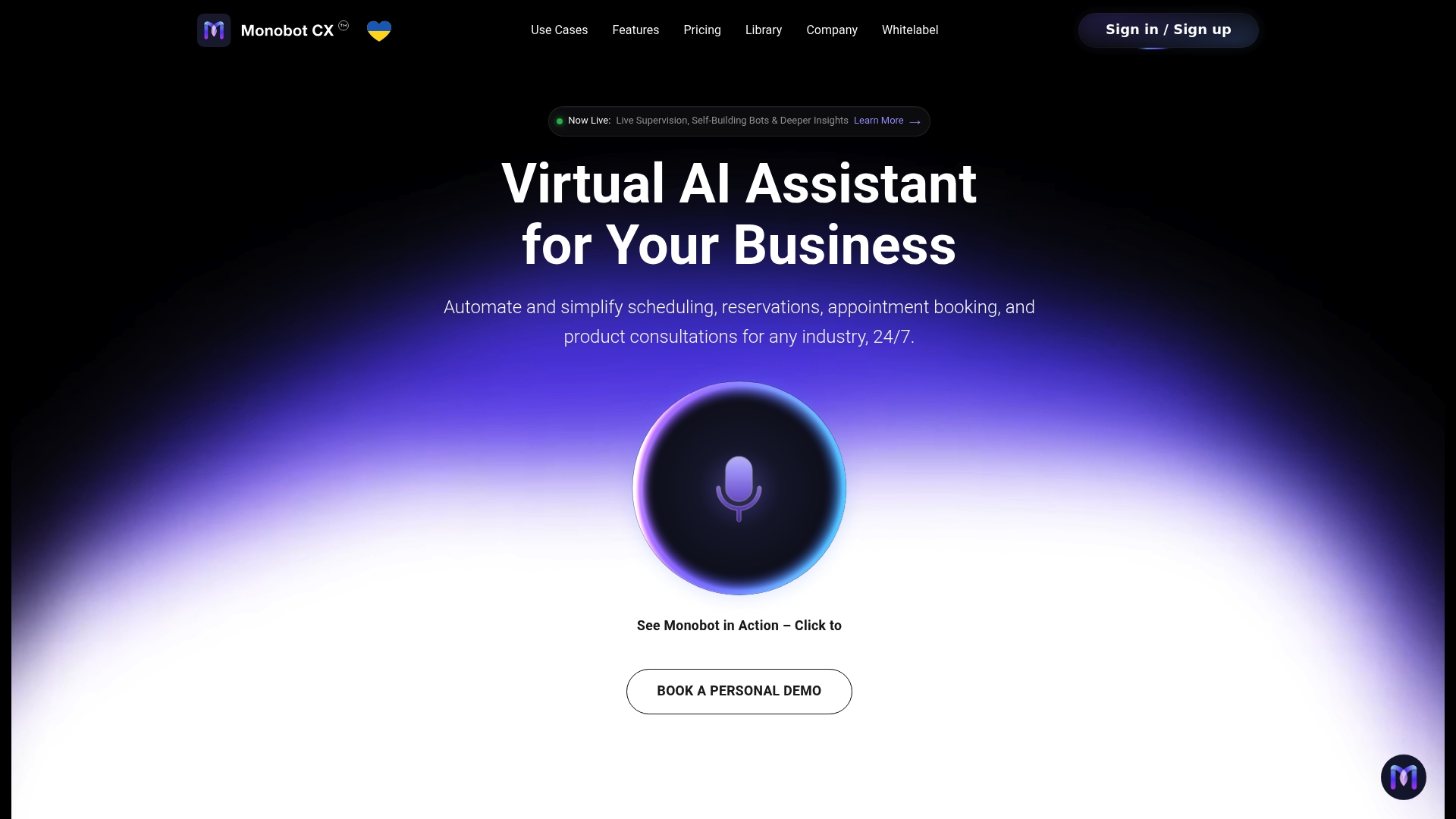
Our pricing page lists the Starter, Growth, and Business plans along with add-on fees for voice interaction, workspace seats, and HIPAA-ready configuration, so you can compare deployment costs against the cost of building this infrastructure in-house. Teams needing a branded or embedded deployment can also review our white-label and OEM options.
- Per-session partitioning helps facilitate targeted exports and deletions.
- Server-side GPC detection is implemented as part of the deployment.
- Industry templates include vendor contract language considerations.
- Dashboard analytics support monitoring of DSR and opt-out activity.
If you’re evaluating how to operationalize these controls without a lengthy build cycle, explore our templates or reach out through our platform overview to schedule a walkthrough suited to your compliance timeline.
FAQ
Does CCPA apply to businesses outside California?
CCPA applies to any business meeting its thresholds that collects personal information from California residents, regardless of where the business itself is headquartered. If your chatbot is accessible to California visitors and your business meets the law’s size or data-volume criteria, the CCPA applies to those interactions even if you operate primarily in another state.
What does California law say about chatbot disclosure?
California requires that any chatbot used to deceive someone about whether they’re interacting with a human be clearly disclosed as a bot under state law, and separately, CCPA notice-at-collection rules require disclosing what personal information the chatbot collects and why. Both obligations typically apply at the same time to a customer-facing bot.
Is there a GDPR equivalent in the United States?
The United States has no single federal law equivalent to GDPR; instead, states including California have passed their own comprehensive privacy laws. CCPA and CPRA are the closest analogue, giving California residents rights to know, delete, correct, and limit the use of their personal information, though the scope and enforcement mechanisms differ from GDPR.
Is there federal regulation on AI in the United States?
There is no single comprehensive federal law regulating AI directly in the way CCPA regulates personal information in California. Businesses deploying AI chatbots instead need to comply with the patchwork of applicable state privacy laws, sector-specific rules, and general consumer protection standards that already govern data collection and automated decision-making.
What happens if a chatbot vendor uses our data for model training?
If your vendor uses conversation data to train a model serving other customers without proper disclosure and consent, that use can shift the vendor’s role from service provider to third party under CCPA/CPRA, triggering sale or sharing disclosure obligations you may not have made. Reviewing your vendor contract’s purpose limitation language before signing is the most reliable way to prevent this.
Sources
- California Consumer Privacy Act (CCPA) – Attorney General
- California Civil Code §1798.100 — General Duties of Businesses that Collect Personal Information