



Use this AI compliance checklist as a one-page, audit-ready control set mapped to the NIST AI Risk Management Framework functions GOVERN, MAP, MEASURE, and MANAGE, and aligned to US regulatory guidance from the FTC and the White House Blueprint for an AI Bill of Rights. Whether you’re preparing for an internal audit, a third-party assessment, or a regulatory inquiry, the controls below give your team a concrete starting point.
One-page checklist: minimum controls by NIST AI RMF function
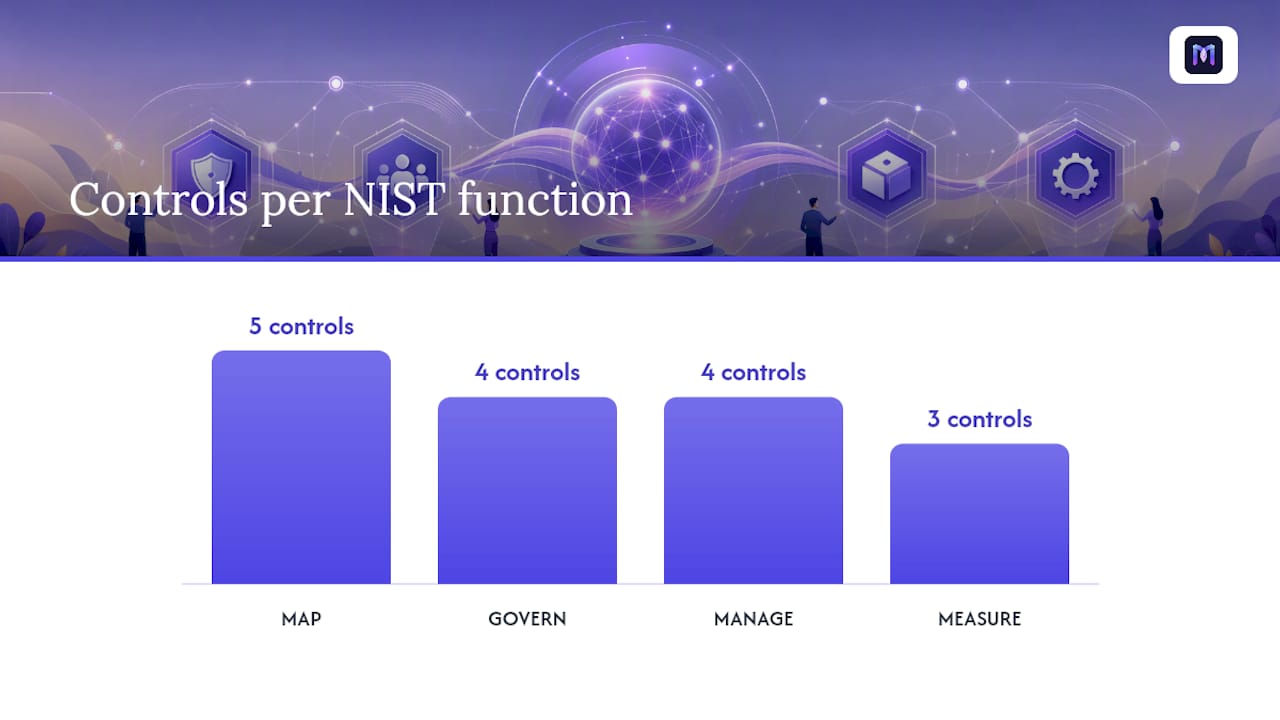
- GOVERN: AI policy documented and board-approved; roles assigned (CRO, CISO, DPO, model owner); risk appetite statement signed; ethics review board convened at least annually
- MAP: All AI systems inventoried; each system classified low/medium/high risk; purpose statements written; data lineage documented; TEVV scope decisions recorded
- MEASURE: TEVV plan executed with defined test sets, performance thresholds, and fairness metrics; drift indicators configured; monitoring dashboards live
- MANAGE: Incident response runbook covers AI-specific failure modes; change control log maintained; vendor contracts include SLA, data residency, and audit rights; periodic re-assessment cadence set
Minimum evidence artifacts an auditor will request:
- Model card (purpose, training data summary, known limitations, metrics, RUN_ID)
- TEVV report (test set description, fairness checks, drift thresholds, tester signatures)
- Data Protection Impact Assessment (DPIA) for high-risk processing
- Vendor due diligence package (SLA, subprocessors, security posture, audit rights)
- Compliance log tied to RUN_ID or MLflow run ID
- Decision dossier for high-stakes automated decisions
Readiness verdict: If your organization can produce all six artifacts above within 48 hours of an audit request, you are operationally ready. If two or more are missing or undated, prioritize evidence automation before your next model deployment.
Key Takeaways
A complete AI compliance checklist maps every control to a NIST AI RMF function (GOVERN, MAP, MEASURE, MANAGE), assigns a named owner, and produces a dated, signed artifact that an auditor can verify within 48 hours of a request.
| Point | Details |
|---|---|
| Start with discovery and classification | Inventory every AI system and classify it low/medium/high risk before any other control work. |
| TEVV is continuous, not one-time | Schedule periodic re-evaluations triggered by drift indicators, not just pre-deployment test runs. |
| Evidence automation beats manual prep | Link model cards and TEVV reports to RUN_IDs in MLflow so your audit bundle assembles automatically. |
| US guidance is the baseline; EU rules apply when data crosses borders | Build on NIST AI RMF and FTC guidance domestically; add GDPR/EU AI Act checkpoints for EU data subjects. |
| Monobot operationalizes logging, monitoring, and gating | Monobot’s agent builder, automation flows, and analytics dashboard map directly to MEASURE and MANAGE controls. |
Table of Contents
- 1. What does a complete AI compliance checklist cover?
- 2. How to use the checklist: roles, timeline, and resourcing
- 3. What documentation and evidence do auditors actually ask for?
- 4. How checklist items map to US guidance and when international rules apply
- 5. Copy-paste templates and quick checklist entries you can use immediately
- 6. Applying the checklist to conversational AI: what Monobot deployments should collect
- 7. How this checklist was assembled and what auditors will verify
- 8. What actually fails in production: a practitioner perspective
- Monobot helps you operationalize key checklist controls
- Primary sources and references auditors expect
- Sources
- FAQ
1. What does a complete AI compliance checklist cover?
The NIST AI RMF explicitly states that its actions are not a prescriptive checklist but can be used to structure controls and evidence. That distinction matters in practice: your checklist must translate the framework’s outcomes into verifiable checkpoints your team can pass or fail. The four sections below do exactly that.
GOVERN: leadership accountability and policy
GOVERN is where compliance either gets traction or quietly dies. Without documented ownership, every other control is aspirational; use tools like the AI Overview Checker to ensure transparency and explainability of your AI policies.
- AI governance policy: Written, version-controlled, and signed by the board or C-suite. Must define scope (which systems are covered), risk appetite, and escalation paths.
- Role assignments: Chief Risk Officer (CRO) owns enterprise AI risk appetite. CISO owns security and access controls. Data Protection Officer (DPO) owns privacy obligations. Model owners own individual system risk decisions.
- Ethics review board: Convened at least annually; minutes and attendance records retained as artifacts.
- Training records: All staff who build, deploy, or oversee AI systems must complete documented AI ethics and compliance training. Completion certificates are audit artifacts.
Acceptance criteria: Policy document dated within 12 months; role matrix signed by named individuals; ethics board minutes on file.
MAP: inventory, classification, and scoping
You cannot manage risk you have not mapped. Industry checklists consistently identify discovery and classification as the hardest and most important tasks.
- AI system inventory: Every AI system in production or development listed with system name, owner, deployment environment, and data inputs.
- Risk classification: Each system rated low, medium, or high risk using documented criteria (impact on individuals, reversibility of decisions, data sensitivity, regulatory sector).
- Purpose statements: One-paragraph description of intended use, intended users, and out-of-scope uses for each system.
- Data lineage: Training data sources, preprocessing steps, and annotation quality controls documented per system.
- TEVV scope decision: Written record of what testing was scoped in or out, and why, for each system.
Acceptance criteria: Inventory spreadsheet or registry with all fields populated; risk classification signed by model owner and CRO; purpose statements reviewed by legal.
MEASURE: TEVV plans, metrics, and monitoring
Testing, evaluation, validation, and verification (TEVV) is the technical core of machine learning compliance. The NIST AI RMF playbook emphasizes documentation, interdisciplinary review, and traceable evidence for TEVV and monitoring.
- TEVV plan: Documented before model deployment; includes test set description, performance thresholds (accuracy, precision, recall, F1), fairness metrics (demographic parity, equalized odds), and privacy risk assessment.
- Baseline performance report: Pre-deployment results against all TEVV metrics, signed by tester and an independent reviewer for high-risk systems.
- Drift indicators: Configured in production monitoring; thresholds defined for when a re-test is triggered.
- Monitoring dashboard: Live view of key performance and fairness metrics; alert rules documented.
- Periodic re-evaluation schedule: Frequency set by risk level (high-risk: quarterly; medium: semi-annual; low: annual).
Acceptance criteria: TEVV plan dated before deployment; baseline report signed; monitoring alerts tested and confirmed active.
MANAGE: incidents, vendors, and change control
- Incident response runbook: Covers AI-specific failure modes (model drift, adversarial inputs, hallucination in generative systems, PII leakage). Runbook tested at least annually via tabletop exercise.
- Change control log: Every model update, retraining event, or configuration change logged with date, description, approver, and post-change TEVV summary.
- Vendor management: All third-party AI providers assessed against a due diligence checklist (SLA, data residency, subprocessors, security posture, audit rights). Contracts updated to reflect AI-specific obligations.
- Re-assessment cadence: Formal re-assessment triggered by material model changes, significant performance drift, or regulatory updates.
Acceptance criteria: Runbook dated within 12 months; change log entries for all production changes; vendor DD packages on file for all third-party AI components.
2. How to use the checklist: roles, timeline, and resourcing
Who owns what: a RACI summary
Cross-functional ownership is non-negotiable. Security, legal, product, privacy, and engineering must each have documented responsibilities and sign-offs for every RMF function.
| Activity | Responsible | Accountable | Consulted | Informed |
|---|---|---|---|---|
| AI system discovery and inventory | Engineering / IT | CRO | Legal, Privacy | Board |
| Risk classification | Model Owner | CRO | CISO, DPO | Compliance |
| TEVV execution | ML Engineering | Model Owner | External Assessor | Legal |
| Documentation and evidence capture | Compliance / MLOps | CRO | Legal | Audit |
| Vendor due diligence | Procurement | CISO | Legal, DPO | CRO |
| Monitoring and drift alerts | MLOps / Engineering | Model Owner | CISO | Compliance |
Sample implementation timeline
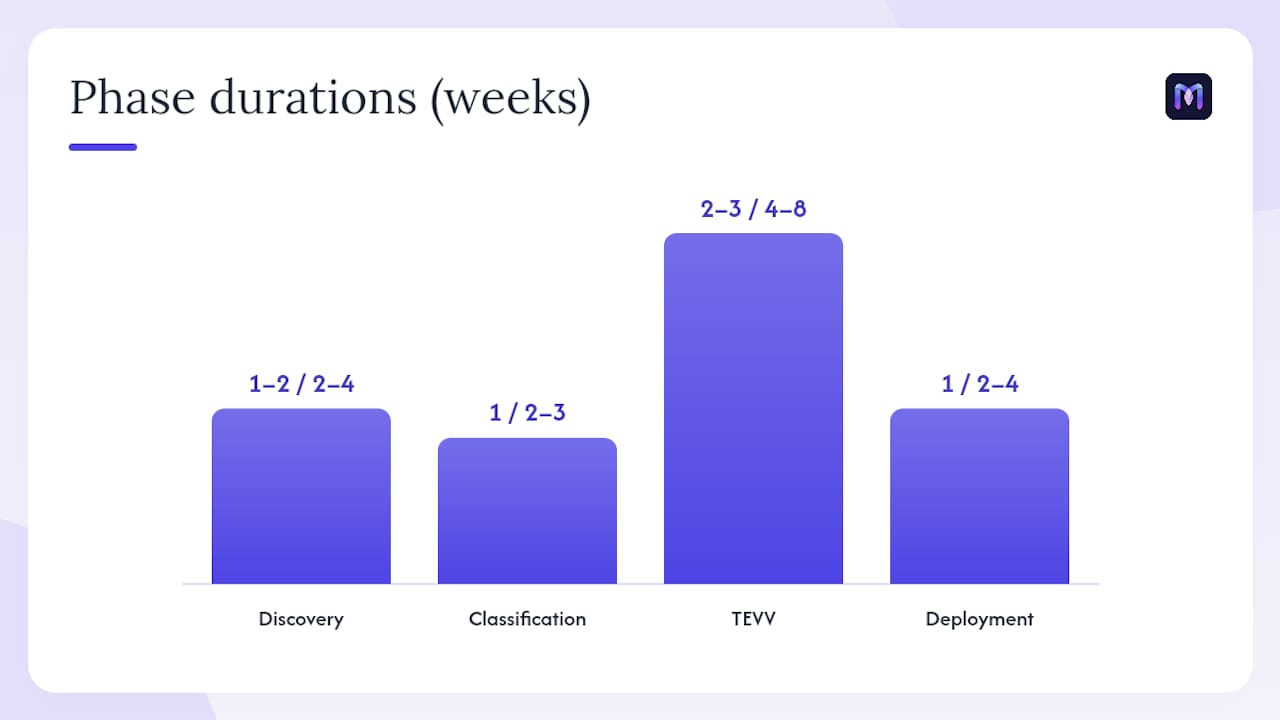
Time ranges vary by system risk level. High-risk systems (automated decisions affecting individuals, healthcare, financial services) require the most rigorous path.
| Phase | Activity | Low-risk system | High-risk system |
|---|---|---|---|
| Discovery | Inventory and classify all AI systems | 1–2 weeks | 2–4 weeks |
| Classification | Risk scoring, purpose statements, data lineage | 1 week | 2–3 weeks |
| TEVV | Test plan, execution, baseline report | 2–3 weeks | 4–8 weeks |
| Deployment | Monitoring setup, change control, vendor DD | 1 week | 2–4 weeks |
| Ongoing | Drift monitoring, periodic re-assessment | Continuous | Continuous |
A first-time compliance program for an organization with five or fewer AI systems typically runs 8–16 weeks end-to-end for high-risk systems. Organizations with mature MLOps pipelines can compress that significantly by automating evidence capture.
Resourcing guidance
For a mid-size organization standing up an AI governance framework from scratch, expect to allocate roughly 0.5–1.0 FTE in compliance or legal, 0.5 FTE in ML engineering for TEVV and monitoring setup, and part-time involvement from legal, privacy, and security. External assessors are worth commissioning for high-risk systems, particularly for independent TEVV review and vendor due diligence validation. Their involvement also strengthens auditor confidence in the evidence bundle.
Pro Tip: Embed evidence gates directly into your CI/CD pipeline using Compliance-as-Code approaches. When governance thresholds are machine-readable, evidence generation becomes automatic rather than a manual pre-audit scramble.
3. What documentation and evidence do auditors actually ask for?
Auditors do not want a policy deck. They want artifacts: dated, signed, traceable files that prove controls were operating at the time a model was deployed or a decision was made. A compliance-by-design approach that produces verifiable evidence bundles tied to RUN_IDs supports exactly this kind of auditability.
Core artifact checklist
- Model card: Purpose, training data summary, known limitations, intended use, performance metrics, and RUN_ID. One per model version.
- TEVV report: Test set description, metrics achieved, fairness check results, drift thresholds, tester name, and independent reviewer signature.
- DPIA (Data Protection Impact Assessment): Required for high-risk processing. Documents the processing purpose, necessity, proportionality, and risk mitigation measures. The CNIL AI checklist recommends DPIAs wherever processing is high risk, a standard that maps directly onto US healthcare (HIPAA) and financial services contexts.
- Compliance log: Timestamped record of control checks, linked to RUN_ID or MLflow run ID.
- Decision dossier: For automated decisions with significant individual impact, a structured record of the decision logic, inputs, outputs, and human review.
- Vendor due diligence package: SLA, data residency confirmation, subprocessor list, security posture summary, and audit rights clause.
- Code and data manifest: Cryptographic hashes of training data and model artifacts, stored with the compliance log to prove integrity at a point in time.
- Training completion records: Certificates showing which staff completed AI ethics and compliance training, and when.
Retention and versioning
Retain model cards, TEVV reports, and compliance logs for the operational life of the model plus a minimum of three years. For systems subject to HIPAA or financial services regulation, follow the longer of the AI-specific retention period or the sector-specific requirement. Tag every artifact with the model version, deployment date, and RUN_ID so that any artifact can be traced back to a specific production state.
Cryptographic hashing of training datasets and model binaries at the time of deployment creates an immutable reference point. Store hashes in your manifest file alongside the compliance log. This makes it possible to prove, after the fact, that the model an auditor is reviewing is the same one that was deployed.
Pro Tip: Use MLflow or a comparable experiment-tracking tool to auto-generate RUN_IDs and attach artifact links at training time. Linking your model card and TEVV report to the same RUN_ID means your evidence bundle assembles itself rather than requiring manual reconstruction before an audit. For conversational AI deployments, Monobot’s interaction logging and transcription features can feed directly into this evidence chain.
4. How checklist items map to US guidance and when international rules apply
The US regulatory environment for AI is not a single statute. It is a layered set of guidance documents, sector-specific rules, and emerging state laws. Your checklist items map to different authorities depending on your industry and deployment context.
US guidance crosswalk
| Checklist item | NIST AI RMF function | US guidance reference |
|---|---|---|
| AI governance policy and roles | GOVERN | NIST AI RMF GOVERN; FTC transparency guidance |
| Risk classification (low/medium/high) | MAP | NIST AI RMF MAP; White House AI Bill of Rights |
| TEVV plan and baseline report | MEASURE | NIST AI RMF MEASURE; NIST Generative AI Profile (NIST-AI-600-1) |
| Fairness metrics and bias testing | MEASURE | White House AI Bill of Rights (Algorithmic Discrimination Protections) |
| Transparency and user disclosures | GOVERN / MANAGE | FTC guidance on deceptive AI practices |
| Incident response runbook | MANAGE | FTC reasonable security guidance; NIST AI RMF MANAGE |
| Vendor due diligence | MANAGE | FTC supply chain guidance; NIST AI RMF MANAGE |
| DPIA for high-risk processing | MAP / MEASURE | HIPAA (healthcare); CCPA/CPRA (California); GDPR (EU data subjects) |
| Monitoring and drift detection | MEASURE / MANAGE | NIST AI RMF MEASURE; FTC ongoing monitoring expectations |
The NIST AI RMF and its associated Generative AI Profile (NIST-AI-600-1) are the primary US reference points for TEVV and deployment controls. The FTC’s guidance on deceptive and unfair AI practices sets the enforcement floor for transparency and user-facing disclosures. The White House Blueprint for an AI Bill of Rights adds principles around algorithmic discrimination, data privacy, and human alternatives.
When EU and international rules apply
Most US-based organizations can operate primarily under US guidance. Three triggers shift that calculus:
- EU data subjects: If your AI system processes personal data of individuals located in the EU, GDPR applies regardless of where your servers are. The CNIL checklist translates GDPR principles into development checkpoints including purpose limitation, data minimization, annotation quality, and DPIA requirements.
- EU AI Act classification: If your system is deployed in the EU or processes EU residents’ data in a way that triggers the EU AI Act’s high-risk categories (biometric identification, employment decisions, credit scoring, healthcare), you must comply with the Act’s conformity assessment requirements.
- Cross-border healthcare data: HIPAA governs US-based protected health information. If that data also involves EU residents, both HIPAA and GDPR apply simultaneously.
Practical rule of thumb: Build your checklist on US guidance (NIST AI RMF, FTC, White House) for domestic operations. Add GDPR/EU AI Act checkpoints as a supplemental layer whenever data, users, or hosting cross EU boundaries.
5. Copy-paste templates and quick checklist entries you can use immediately
These stubs are designed to paste directly into your repository, evidence bundle, or compliance management system. Fill in the bracketed fields before use.
1. Model card stub
Model Name: [System name and version]
Purpose: [One sentence describing the model's intended function]
Intended Users: [Who is authorized to use this model]
Out-of-Scope Uses: [Explicitly prohibited uses]
Training Data Summary: [Data sources, date range, preprocessing steps]
Known Limitations: [Performance gaps, demographic disparities, edge cases]
Performance Metrics: [Accuracy, F1, fairness metrics — values and thresholds]
RUN_ID: [MLflow or equivalent run identifier]
Model Owner: [Name and title]
Last Updated: [Date]
Review Cycle: [Frequency]
2. TEVV log stub
System: [Model name and version]
RUN_ID: [Link to experiment tracking entry]
Test Set Description: [Size, source, demographic coverage]
Performance Results: [Metric name | Threshold | Actual value]
Fairness Checks: [Demographic parity | Equalized odds | Results]
Drift Thresholds: [Metric | Alert threshold | Current value]
Privacy Risk Assessment: [PII exposure risk | Mitigation applied]
Tester: [Name, role, date]
Independent Reviewer: [Name, organization, date — required for high-risk systems]
Pass/Fail: [Overall result]
3. Vendor due diligence checklist
- SLA terms: Uptime commitment, incident response SLA, and escalation path documented.
- Data residency: Confirm where training data and inference data are stored and processed.
- Subprocessors: Full list of subprocessors with their roles and data access scope.
- Security posture: SOC 2 Type II report or equivalent; penetration test results within 12 months.
- Audit rights: Contract clause granting your organization the right to audit or request third-party audit results.
- Model transparency: Vendor provides model card or equivalent documentation for any AI component they supply.
- Incident notification: Vendor commits to notifying you within 72 hours of any security incident affecting your data.
- Exit provisions: Data deletion or portability guaranteed within 30 days of contract termination.
4. Decision dossier template fields
- Decision type and system name
- Inputs used (feature list, data sources)
- Model output and confidence score
- Human review step (reviewer name, date, outcome)
- Applicable regulation or policy (HIPAA, FCRA, ECOA, state AI law)
- Appeal or correction mechanism available to affected individual
- RUN_ID linking to the model version that produced this decision
6. Applying the checklist to conversational AI: what Monobot deployments should collect
Conversational AI systems, including voice agents and chatbots, have compliance requirements that differ from batch-inference models. The interaction is real-time, the data is often sensitive (names, account numbers, health information), and the failure modes include both technical errors and harmful outputs delivered directly to customers.
Operational checkpoints specific to conversational AI
- Transcript logging with PII redaction: Every conversation logged with automatic redaction of sensitive fields (SSN, credit card numbers, health identifiers) before storage. Redaction markers retained in the log so auditors can verify the control was active.
- Live agent handoff audit: Every escalation from AI to human agent logged with timestamp, trigger reason (confidence below threshold, customer request, topic out of scope), and agent ID.
- Conversation sampling for bias analysis: A statistically representative sample of conversations reviewed periodically for demographic disparities in resolution rates, escalation rates, and response quality.
- Confidence threshold gating: Responses below a defined confidence threshold routed to human review rather than delivered to the customer. Threshold value documented in the model card.
- Rate limits and abuse controls: Documented limits on request volume per session; anomaly detection configured for unusual interaction patterns.
Evidence artifacts for a conversational AI deployment
| Artifact | Content | Retention |
|---|---|---|
| Interaction log | Timestamped transcript with redaction markers, session ID, channel | Operational life + 3 years |
| Flow version record | Version of conversation flow active at time of interaction | Operational life + 3 years |
| Intent model card | Purpose, training data, accuracy by intent class, RUN_ID | Per model version |
| TEVV report for intent accuracy | Test set, accuracy, escalation safety metrics, fairness checks | Per model version |
| Escalation audit log | Trigger reason, agent ID, resolution outcome | Operational life + 3 years |
| Redaction audit log | Confirmation that PII redaction ran on each session | Operational life + 3 years |
For a regression testing playbook specific to chat-based systems, the key TEVV metrics to track are intent recognition accuracy, slot-filling accuracy, escalation trigger precision, and out-of-scope detection rate. These four metrics, measured against a held-out test set before every production deployment, form the core of your TEVV evidence for a conversational AI system.
Pro Tip: Post-deployment monitoring dashboards should surface intent confidence distributions, not just aggregate accuracy. A model that performs well on average but shows low confidence on a specific demographic’s phrasing patterns is a fairness risk that aggregate metrics will miss. Monobot’s voice analytics and AI for customer experience capabilities give you the granular visibility needed to catch these patterns early.
7. How this checklist was assembled and what auditors will verify
Primary sources and standards
This checklist draws on the following authoritative references:
- NIST AI RMF 1.0: The foundational US framework for AI risk management, defining GOVERN, MAP, MEASURE, and MANAGE functions with associated actions and outcomes.
- NIST Generative AI Profile (NIST-AI-600-1): Operationalizes TEVV and risk considerations specific to generative AI systems, including LLMs and conversational agents.
- NIST AI RMF Playbook: Provides subcategory-level actions and outcomes that translate RMF functions into implementable controls.
- FTC guidance on AI: Covers deceptive and unfair AI practices, transparency obligations, and reasonable security expectations.
- White House Blueprint for an AI Bill of Rights: Sets principles for safe, effective, non-discriminatory, privacy-protective, and human-overseen AI.
- EU AI Act: Applies to systems deployed in the EU or processing EU residents’ data; sets conformity assessment requirements for high-risk systems.
- EDPB AI auditing checklist: An international audit reference that translates GDPR principles into development and deployment checkpoints.
- CNIL AI development checklist: Translates GDPR into practical development controls including purpose limitation, data minimization, annotation quality, and DPIA triggers.
Versioning recommendations
Every checklist you publish internally should carry a version number, a changelog, and a last-updated date. Auditors look for evidence that the checklist itself is maintained. A checklist last updated two years ago, with no changelog, signals that governance is a one-time exercise rather than an ongoing program.
Stakeholder review evidence matters too. An ethics board sign-off, a legal review stamp, and a CISO approval on the checklist document itself are trust signals that carry weight with external auditors.
When to commission external TEVV or independent audits
For high-risk systems, an independent TEVV review by an external assessor is worth the investment. External reviewers bring test sets and evaluation methodologies your internal team may not have considered, and their sign-off on the TEVV report significantly strengthens your evidence bundle. Expect an external TEVV engagement to validate test set representativeness, fairness metric selection, threshold appropriateness, and monitoring configuration.
8. What actually fails in production: a practitioner perspective
The most common failure mode in AI compliance programs is not a missing policy. It is a policy that exists but has no evidence trail. Organizations spend weeks drafting governance documents, then deploy models with no model card, no TEVV report, and no monitoring alert configured. When an auditor arrives, the policy deck looks good and the artifact bundle is empty.
Three areas account for most of the gaps: enterprise governance, evidence readiness, and data controls. Governance gaps usually trace back to unclear ownership, where the CRO thinks the model owner is responsible for TEVV sign-off and the model owner thinks it is the compliance team. Evidence gaps come from treating documentation as a post-deployment task rather than embedding it into the deployment pipeline. Data control gaps are the hardest to fix retroactively because, as SecureML’s compliance guidance notes, data minimization and privacy measures must be applied at the data collection and annotation stages, not bolted on after training.
The practical priority order for any team starting from scratch: run discovery and classification first, because you cannot prioritize remediation without knowing what you have. Then execute TEVV for your highest-risk systems, because that is where regulatory exposure is greatest. Then automate evidence capture, because manual evidence collection does not scale and will fail under audit pressure.
One tip worth emphasizing: focus remediation where risk and impact intersect, not where effort is lowest. A low-effort fix on a low-risk system produces no meaningful compliance improvement. A harder fix on a high-risk system, like adding an independent TEVV reviewer or configuring real-time fairness monitoring, is the work that actually reduces your exposure.
Monobot helps you operationalize key checklist controls
Interaction logging, PII redaction, and post-deployment monitoring are three of the most time-consuming checklist items to implement from scratch. Monobot’s platform addresses all three directly. The AI agent builder lets you configure confidence thresholds, human-in-loop gating, and escalation triggers at the flow level, so your compliance controls are embedded in the agent’s operating logic rather than layered on top after deployment. Automation flows let you build approval gates and evidence-tagging steps into your deployment pipeline without writing custom code.

The analytics dashboard surfaces intent confidence distributions, escalation rates, and resolution metrics in real time, giving your compliance team the monitoring evidence NIST AI RMF’s MEASURE function requires. Every interaction is logged with redaction markers and session IDs that feed directly into your evidence bundle. This article is produced by Monobot, and the checklist items above reflect where Monobot’s features map to real audit requirements. To see how these controls work in your environment, schedule a demo or explore the agent builder directly.
Primary sources and references auditors expect
Auditors in US-based AI compliance reviews expect to see evidence traceable to these primary documents:
- NIST AI Risk Management Framework (AI RMF 1.0): The foundational US standard; defines GOVERN, MAP, MEASURE, and MANAGE. Hosted by NIST.
- CNIL AI Development Checklist: Translates GDPR into development checkpoints; used as an international audit reference for DPIA and data minimization controls.
- XAI-Compliance-by-Design framework: Peer-reviewed framework for evidence automation and compliance-by-design in high-risk AI systems.
- Compliance-as-Code for AI governance: Research on machine-readable governance and automated evidence generation in MLOps pipelines.
- AI Compliance Checklist: 12 Steps for 2026: Industry reference for operational controls including discovery, classification, access control, and framework mapping.
- FTC guidance on AI: Available at ftc.gov; covers deceptive practices, transparency, and reasonable security obligations for AI systems.
- White House Blueprint for an AI Bill of Rights: Available at whitehouse.gov; sets principles for safe, fair, and human-overseen AI in the US context.
These references form the backbone of evidence expectations in US audits. Citing them in your governance policy and checklist documentation signals to auditors that your program is grounded in recognized standards rather than internal convention.
This article is general information, not a substitute for advice from a qualified lawyer. Consult a qualified legal professional about your own circumstances before acting on anything here.
Sources
- Artificial Intelligence Risk Management Framework (AI RMF 1.0)
- XAI-Compliance-by-Design: A Modular Framework for GDPR- and AI Act-Aligned Decision Transparency in High-Risk AI Systems
- Compliance-as-Code approaches for AI governance (arXiv)
- AI Compliance Checklist: 12 Steps for 2026
FAQ
What is the NIST AI RMF and why does it matter for compliance?
The NIST AI Risk Management Framework defines four functions, GOVERN, MAP, MEASURE, and MANAGE, that organizations use to structure AI risk controls and evidence. It is the primary US reference standard for AI compliance audits and maps directly to FTC and White House AI guidance.
Which artifacts does an auditor most commonly request first?
Auditors typically request the model card, TEVV report, and compliance log first, because these three documents prove that a system was tested, documented, and monitored before deployment. A DPIA is also requested immediately for any system processing sensitive personal data.
When does the EU AI Act apply to a US-based organization?
The EU AI Act applies when your AI system is deployed in the EU or processes personal data of EU residents, regardless of where your organization is headquartered. US teams should add EU AI Act checkpoints to their checklist as a supplemental layer whenever data, users, or hosting cross EU boundaries.
How does Monobot help satisfy MEASURE and MANAGE checklist controls?
Monobot’s analytics dashboard provides real-time monitoring of intent confidence, escalation rates, and resolution metrics that satisfy NIST AI RMF MEASURE requirements. Its agent builder lets you configure confidence thresholds and human-in-loop gating that map directly to MANAGE controls.
How often should you re-run TEVV after initial deployment?
High-risk systems should be re-evaluated quarterly or whenever production monitoring detects significant drift. Medium-risk systems warrant semi-annual re-evaluation, and low-risk systems can run on an annual cycle, provided drift indicators are actively monitored between formal reviews.