



TL;DR:
- AI improves first contact resolution by closing gaps in customer context and support channels. It automates data retrieval, streamlines routing, and enhances issue resolution, leading to faster, more consistent outcomes. Proper deployment across all channels and transparent communication maximize these benefits.
First contact resolution (FCR) is defined as a customer’s issue being fully resolved in a single interaction, without callbacks, escalations, or repeat contacts. AI improves first contact resolution by closing the two biggest gaps that cause repeat contacts: missing customer context and inconsistent support across channels. Agent pauses mid-conversation affect roughly 45% of support interactions, making them a primary driver of unresolved calls. AI solutions for support address this directly by surfacing complete customer history, automating triage, and maintaining context across every channel your team uses.
How AI improves first contact resolution by closing context gaps
Context gaps are the single largest cause of low FCR. A context gap occurs when an agent starts an interaction without knowing the customer’s account history, recent product behavior, or previous ticket outcomes. The agent then spends the first half of the call gathering information the system already holds, which wastes time and frustrates the customer.
AI fixes this by pulling data from your CRM, product usage logs, and ticket history the moment a conversation begins. The agent sees a complete picture before typing the first response. Resolution accuracy improves by up to 25% when agents have this pre-surfaced context, because they spend less time searching and more time solving.
The placement of this context panel matters more than most teams realize. When context is buried in a sidebar tab the agent has to click open, adoption drops. When it appears automatically in the primary workspace view, agents use it on every ticket. This is a configuration decision, not a technology limitation.
- CRM integration: AI pulls account tier, open tickets, and recent purchases before the agent responds.
- Product usage data: Behavioral signals (last login, feature errors, usage frequency) tell the agent what the customer was doing before they reached out.
- Ticket history: Prior resolution notes prevent agents from asking questions already answered in a previous interaction.
- Sentiment signals: AI flags frustrated or high-value customers so agents can adjust their tone immediately.
Pro Tip: Place your AI context panel in the agent’s primary view, not a secondary tab. Agents who see context without clicking are far more likely to use it on every single interaction.
Most B2B SaaS support teams see measurable FCR improvement within 30–60 days after deploying context-aware AI integrated with CRM and ticketing systems. The fastest gains come from eliminating the information-gathering exchanges that consume the first half of most interactions.
What is surface fragmentation and how does it hurt FCR?
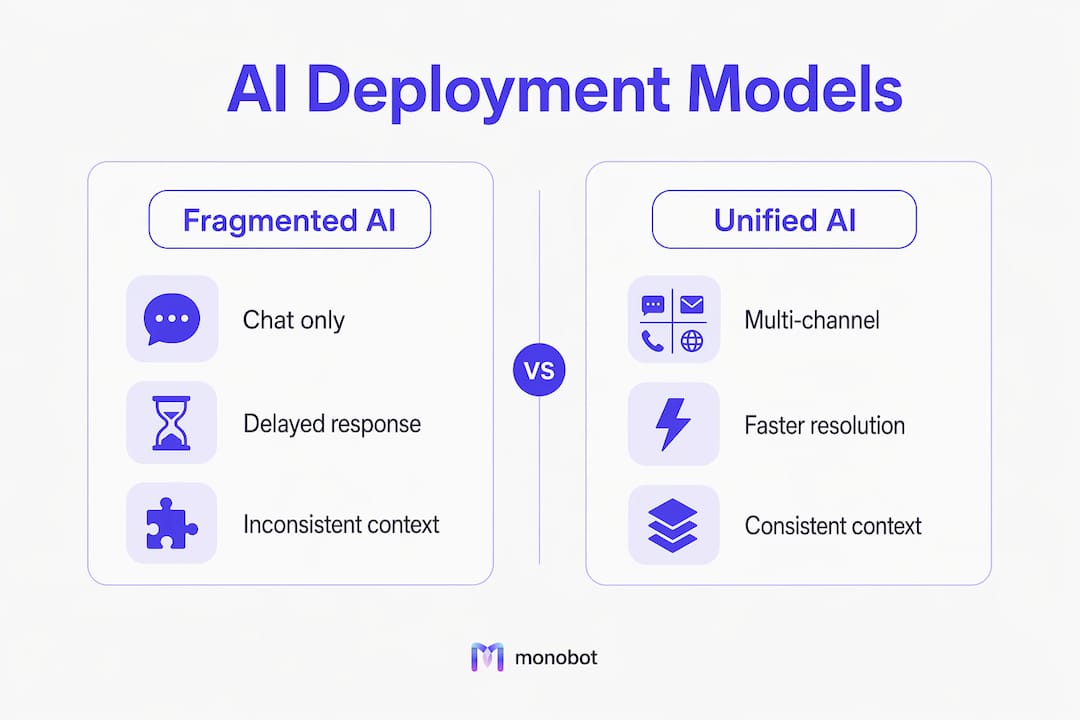
Surface fragmentation occurs when AI is active on one support channel but absent from others. A customer gets instant, accurate help via chat but hits a wall when they switch to email or phone. They repeat their issue from scratch. FCR drops, and customer trust drops with it.
Unified AI platforms that operate across chat, email, phone, Slack, and in-product support maintain consistent customer context regardless of where the conversation starts. The AI carries the thread. The agent inherits the full history. No repetition required.
The table below shows the practical difference between fragmented and unified AI channel deployments.
| Scenario | Fragmented AI | Unified AI |
|---|---|---|
| Channel coverage | Chat only | Chat, email, phone, Slack, in-product |
| Context on handoff | Lost. Agent starts from zero. | Carried. Agent sees full history. |
| Customer repetition | High. Customer re-explains the issue. | None. Context transfers automatically. |
| FCR impact | Low. Repeat contacts increase. | High. Issues resolved in one interaction. |
| Agent workload | High. Manual context gathering required. | Reduced. AI surfaces context automatically. |
The business case for unified AI is direct. Every 1% increase in FCR cuts operating costs by approximately 1%, because fewer callbacks and escalations mean fewer agent hours consumed. Fragmented AI deployments forfeit that gain on every cross-channel interaction.
How does AI-powered triage and routing improve resolution speed?
Routing errors are a silent FCR killer. When a ticket lands with the wrong agent or team, the customer waits, gets transferred, and often has to re-explain the issue. Each handoff is a new opportunity for the interaction to fail.
AI automatically identifies issue type from the customer’s message and routes the ticket to the correct agent or workflow before a human touches it. Eliminating routing failures raises FCR by limiting escalations and delays. The AI reads intent, not just keywords, so a message like “my invoice is wrong” routes to billing rather than general support.
Agent-assist tools take this further by providing real-time knowledge retrieval during the conversation. The agent types a question or the AI detects the topic, and the relevant knowledge base article, policy, or troubleshooting guide appears instantly. This is how AI in customer service reduces the 45% of interactions where agents pause mid-conversation to search manually.
Here is a practical sequence for agents using AI-assisted support effectively:
- Review pre-surfaced context before responding. The AI has already pulled account history and recent tickets.
- Check the AI-suggested response or article before searching manually. The suggestion is based on the customer’s exact message.
- Confirm issue type matches the AI’s routing classification. Override if needed, and the AI learns from the correction.
- Use AI-generated draft responses as a starting point. Edit for tone and specifics rather than writing from scratch.
- Log resolution notes in the format the AI expects. This improves future context surfacing for the next agent who handles the account.
Following this sequence consistently is how AI voice and chat tools translate into measurable FCR gains rather than just faster typing.
Can AI visual support resolve issues that text alone cannot?
Augmented reality (AR) visual support is one of the most underused tools in the FCR toolkit. It lets an agent see exactly what the customer sees through the customer’s smartphone camera, in real time. The agent annotates the live video feed to guide the customer through a fix. No guesswork. No misdiagnosis from a text description.
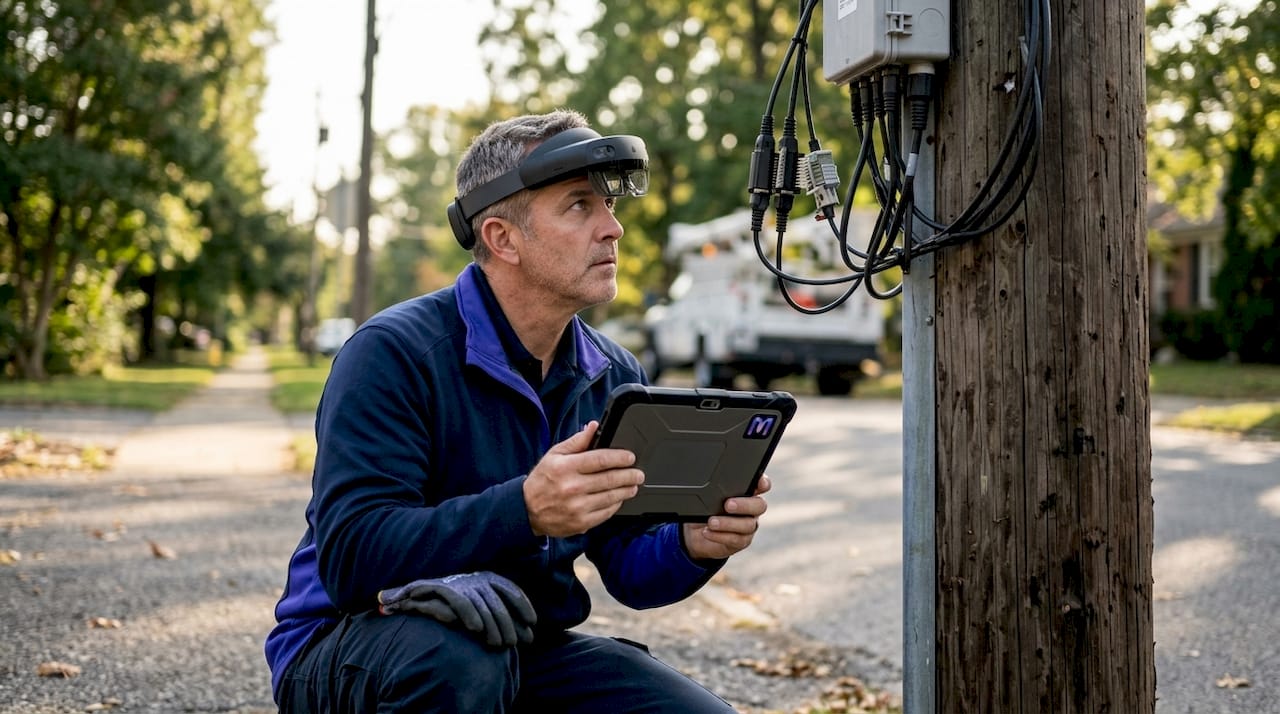
Telecom customers improved first call resolution by approximately 40% and cut truck rolls by up to 30% with AR visual support. A truck roll (sending a technician on-site) is one of the most expensive outcomes in customer support. Eliminating even a fraction of them produces significant cost savings.
The AI layer in visual support does more than stream video. It identifies objects in the frame, suggests likely fault points, and prompts the agent with relevant troubleshooting steps. This combination of human judgment and AI pattern recognition resolves issues that a text-based interaction simply cannot.
| Support type | Diagnosis method | Resolution rate | Truck roll risk |
|---|---|---|---|
| Text-based support | Customer description only | Lower. Misdiagnosis is common. | Higher. Uncertainty leads to on-site visits. |
| AR visual support with AI | Live video with AI annotation | Higher. Agent sees the actual issue. | Lower. Most issues resolved remotely. |
Pro Tip: Introduce AR visual support as an optional escalation step within your existing workflow. Agents who can offer it on demand resolve more issues without transferring the call, which keeps FCR high without requiring a full workflow rebuild.
The user experience improvements that come from visual support extend beyond FCR. Customers who experience a live, guided resolution report higher satisfaction and are less likely to churn, even when the issue itself was significant.
Best practices for deploying AI to maximize FCR gains
Deploying AI without a clear integration plan produces inconsistent results. The technology works. The implementation is where most teams fall short.
Start by connecting your AI platform to your CRM and ticketing system before going live. Context surfacing only works when the AI has access to complete data. A disconnected deployment means agents still gather information manually, and the FCR benefit disappears. AI solutions for support deliver the fastest returns when they read from and write to the same data sources your agents already use.
Train agents on the AI tools before launch, not after. Agents who understand how the routing logic works, where the context panel pulls data from, and how to override AI suggestions are more effective from day one. Measure FCR alongside customer satisfaction (CSAT) scores from the start. FCR and CSAT move together. If FCR rises but CSAT drops, the AI is resolving issues technically but not satisfying customers, which points to a tone or empathy gap in agent responses.
Common pitfalls to avoid when deploying AI for FCR:
- Deploying on one channel only. Surface fragmentation immediately reduces the FCR benefit across your full contact volume.
- Skipping agent training. Agents who distrust or ignore AI suggestions revert to manual processes, negating the investment.
- Measuring FCR in isolation. FCR without CSAT gives an incomplete picture of resolution quality.
- Ignoring routing override data. Every time an agent overrides an AI routing decision, it is a training signal. Collect and act on it.
- Treating deployment as a one-time event. AI models improve with feedback. Schedule monthly reviews of routing accuracy and context relevance.
Key Takeaways
AI improves first contact resolution most effectively when it closes context gaps, unifies support across all channels, and automates routing before a human agent touches the ticket.
| Point | Details |
|---|---|
| Context gaps drive repeat contacts | AI that pre-surfaces CRM and ticket history cuts information-gathering time and raises resolution accuracy by up to 25%. |
| Surface fragmentation lowers FCR | Unified AI across chat, email, phone, and Slack prevents customers from repeating themselves across channels. |
| Accurate routing reduces escalations | AI triage that identifies issue type and routes correctly limits handoffs, a primary cause of unresolved first contacts. |
| AR visual support resolves complex issues | Live video with AI annotation improved FCR by approximately 40% in telecom deployments and cut truck rolls by up to 30%. |
| Measure FCR and CSAT together | FCR rising while CSAT drops signals a quality gap. Track both from day one of any AI deployment. |
The FCR metric that most teams are still missing
The highest form of FCR is not resolving an issue in one contact. It is preventing the contact entirely. An AI layer that monitors product behavior can surface help prompts before a support ticket is submitted, effectively achieving 100% first contact resolution by eliminating the need for contact at all. Most support leaders are not measuring this because it does not show up in ticket volume data. It shows up as an absence of tickets, which looks like a quiet day rather than a win.
I have seen teams celebrate a 20% FCR improvement while missing the fact that proactive AI nudges were quietly preventing another 15% of contacts upstream. The metric you track shapes the behavior you reward. If your team only measures resolved tickets, you will never invest in preventing them.
The other tension worth naming is the one between AI speed and human empathy. Only 8% of customers prefer AI agents over humans, with speed and accuracy being the main reasons those 8% prefer AI. That means the other 92% want a human at some point, especially for emotionally charged issues. The right architecture is not AI replacing agents. It is AI handling context, routing, and knowledge retrieval so agents can focus entirely on the human part of the conversation.
Transparency also matters more than most vendors admit. 14% of consumers lose trust if AI is not clearly identified as a bot. That trust loss is hard to recover. Label your AI interactions honestly, and your FCR gains will hold. Hide the AI, and you risk a backlash that erases the efficiency you built.
— Alex
Monobot’s AI platform for stronger first contact resolution
Monobot is built for exactly the FCR challenges covered in this article. Its AI Agent Builder lets you create custom voice and chat agents that handle routine inquiries, route complex issues to the right human agent, and maintain full customer context across every channel. You can deploy a working agent in minutes, without writing code.
Monobot’s real-time analytics dashboard tracks FCR alongside CSAT, giving your team the paired metrics that actually reflect resolution quality. When an AI agent reaches its limit, Monobot hands the conversation to a human agent with the full context intact. No repetition. No dropped threads. You can also explore Monobot’s IT helpdesk automation to see how these capabilities apply to technical support environments specifically.
FAQ
What is first contact resolution and why does it matter?
First contact resolution (FCR) measures whether a customer’s issue is fully resolved in a single interaction without callbacks or escalations. Higher FCR directly reduces operating costs, since every 1% FCR improvement cuts costs by approximately 1%.
How does AI reduce repeat contacts in customer support?
AI reduces repeat contacts by surfacing complete customer context before the agent responds and by routing tickets accurately to the right team. Both actions eliminate the information gaps and handoffs that cause customers to call back.
Does AI replace human agents for complex issues?
AI handles routine inquiries and context gathering, but only 8% of customers prefer AI agents over humans. The most effective model uses AI to prepare agents with full context so humans can focus on resolution and empathy.
How quickly can AI improve FCR after deployment?
Most B2B SaaS support teams see measurable FCR improvement within 30–60 days of deploying context-aware AI integrated with CRM and ticketing systems. The fastest gains come from eliminating manual information-gathering at the start of interactions.
What is surface fragmentation in AI customer support?
Surface fragmentation occurs when AI is active on one support channel but absent from others, forcing customers to repeat their issue when they switch channels. Unified AI platforms that operate across all channels prevent this and maintain consistent FCR quality.