



TL;DR:
- Chatbots enhance customer satisfaction by providing fast, accurate, and context-aware support that resolves issues early.
- Effective chatbots incorporate personalization, sentiment detection, and seamless handovers to maintain high CSAT scores.
Chatbots improve CSAT scores by delivering instant, accurate, and context-aware support that resolves customer issues before frustration sets in. The industry standard term for this metric is Customer Satisfaction Score, and chatbots affect it directly through speed, personalization, and smart escalation. 87% of customers report positive experiences with AI chatbots, and top-performing deployments resolve 70–90% of queries without any human involvement. That level of containment means fewer escalations, shorter wait times, and customers who leave interactions feeling heard. The key is not just deploying a chatbot. It is deploying one built around the right architecture, data, and escalation logic.
Why chatbots improve CSAT scores: speed and availability
The most direct reason chatbots raise CSAT is simple: they answer immediately. A customer who waits 10 minutes for a live agent is already frustrated before the conversation starts. A chatbot responds in seconds, any time of day, without a queue.
This 24/7 availability changes the customer experience in ways that go beyond convenience. Customers in different time zones, or those reaching out after business hours, get real help instead of an automated “we’ll get back to you” message. That shift in perceived service quality shows up directly in satisfaction scores.
The impact of chatbots on CSAT is clearest in high-volume, routine query categories: order status, account lookups, appointment scheduling, and basic troubleshooting. These are exactly the interactions where speed matters most and where human agents add the least unique value.
Here is what drives the speed advantage in practice:
- Instant response: No hold music, no queue position updates, no callbacks. The customer types and gets an answer.
- Parallel handling: One chatbot handles thousands of simultaneous conversations. One human agent handles one.
- Consistent accuracy: A well-trained chatbot gives the same correct answer every time. Human agents vary.
- First-contact resolution: Hybrid chatbot models that resolve routine issues and escalate complex ones improve CSAT by reducing repeat contacts.
Pro Tip: Set a clear escalation threshold before you launch. Define which query types the bot handles alone and which ones trigger a handoff. Teams that skip this step see CSAT drop when customers hit a wall the bot cannot cross.
How personalization and context make chatbots more effective
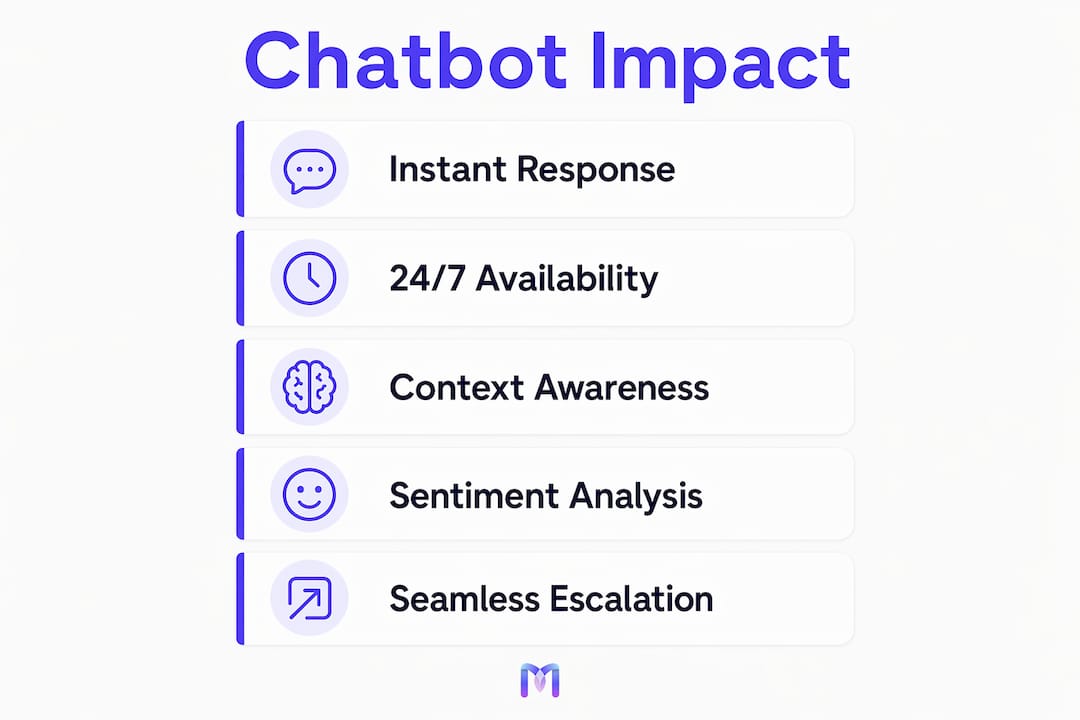
Speed alone does not guarantee satisfaction. A fast chatbot that asks a customer to repeat their account number three times is worse than a slow human who already has the file open. Usability is the strongest predictor of chatbot customer satisfaction, ahead of accessibility, responsiveness, empathy, and trust. That finding reframes the design priority: make the bot easy and accurate to use first, then layer in other features.

Personalization is what makes a chatbot feel useful rather than generic. When a chatbot pulls from a unified customer profile, it knows the customer’s purchase history, open tickets, and preferred contact channel before the first message is sent. That context eliminates the repetitive information requests that frustrate customers most.
Brand voice integration matters too. A chatbot that sounds nothing like your company creates cognitive dissonance. Customers notice when the bot’s tone is off, and it erodes trust even when the answer is technically correct. Aligning the bot’s language to your brand voice is not cosmetic. It is part of the experience.
Key personalization factors that directly affect CSAT:
- Unified customer profiles: Pull CRM data, order history, and past interactions into every conversation.
- Context retention: Carry conversation context across sessions so customers never repeat themselves.
- Brand-aligned tone: Match the chatbot’s language register to your company’s voice.
- Conversational clarity: Natural, clear chatbot interactions drive better outcomes than complex or overly formal language.
Pro Tip: Tell customers upfront that they are talking to an AI. Transparency about AI improves trust and sets realistic expectations, which means customers judge errors more fairly and CSAT stays higher even when the bot makes a mistake.
How does sentiment analysis help chatbots boost CSAT?
Sentiment analysis is the technology that lets a chatbot read the emotional tone of a customer’s message and adjust its response accordingly. It analyzes word choice, punctuation patterns, sentence structure, and conversation history to detect frustration, confusion, or satisfaction in real time.
This matters because a customer who types “I’ve been waiting THREE DAYS for this” is not just asking a question. They are expressing anger. A chatbot without sentiment detection treats that message the same as a calm inquiry. A sentiment-aware bot recognizes the emotional state and either shifts its tone, offers a faster resolution path, or escalates to a human agent before the situation gets worse.
Sentiment analysis engines analyze multiple linguistic layers and full conversation history for accurate emotional detection. That depth is what separates a surface-level keyword scan from genuine emotional intelligence in a chatbot.
The business case for sentiment detection is strong. Consider these outcomes:
- Early frustration detection: The bot catches negative signals before the customer reaches a breaking point, reducing the chance of a low CSAT score.
- Dynamic escalation: When frustration crosses a defined threshold, the bot routes the conversation to a human agent with full context already attached.
- Tone adjustment: The bot shifts from efficient and brief to warmer and more empathetic based on detected emotional state.
- Trust building: Nearly two-thirds of consumers trust empathetic AI agents, which means sentiment-aware bots actively build the relationship rather than just closing tickets.
Measuring the impact of sentiment analysis requires tracking more than CSAT alone. Chatbot containment rate, first-contact resolution, and customer effort score together give a fuller picture of where friction exists and where the bot is performing well. Teams that track only CSAT miss the upstream signals that predict score drops before they happen.
The connection between sentiment analysis and CSAT is also relevant for AI in e-commerce, where customer emotions during a purchase journey directly influence both conversion and post-purchase satisfaction.
Common chatbot mistakes that hurt CSAT and how to fix them
Most chatbot CSAT problems are not technology failures. They are design and architecture failures. The bot works as built. The problem is what it was built to do, or not do.
The most damaging mistake is the set-and-forget approach. A chatbot launched without ongoing review quickly falls out of sync with customer needs, product changes, and language patterns. CSAT drops gradually, and teams often blame the technology rather than the lack of maintenance.
The second most common mistake is overinvesting in human-like features at the expense of accuracy. Information quality and problem-solving capability are stronger drivers of satisfaction than human-mimicking features. Giving a bot a name, a personality, and a set of emojis does not compensate for wrong answers or dead ends. Customers care about getting their problem solved.
The third mistake is missing the warm handover. Many implementations fail by neglecting the mechanism that passes full conversation context to a human agent during escalation. When a customer has to re-explain their issue from scratch after being transferred, CSAT drops sharply. The handover is not a secondary feature. It is a core requirement.
Practical fixes for each of these pitfalls:
- Schedule quarterly reviews: Audit the bot’s most common failure points and update its training data and response logic.
- Prioritize accuracy over personality: Invest in knowledge base quality and integration depth before adding conversational flair.
- Build warm handovers from day one: Pass the full conversation transcript, customer profile, and detected sentiment to the agent at the moment of transfer.
- Test escalation paths regularly: Run simulated frustrated-customer scenarios to confirm the escalation logic fires correctly.
Pro Tip: Track your bot’s “dead end” rate separately from its containment rate. A dead end is when the customer stops responding without a resolution. That metric reveals design gaps that CSAT scores alone will not surface.
Key Takeaways
Chatbots improve CSAT scores when they combine instant resolution, contextual personalization, sentiment-aware escalation, and warm handovers built into the architecture from the start.
| Point | Details |
|---|---|
| Speed drives first impressions | Instant responses eliminate wait-time frustration before the conversation even begins. |
| Usability outranks personality | Accuracy and ease of use predict CSAT more reliably than human-like chatbot features. |
| Sentiment detection prevents drops | Real-time emotional analysis lets bots escalate or adjust tone before a customer disengages. |
| Warm handovers are non-negotiable | Passing full context to human agents at escalation prevents the repeat-yourself frustration that tanks scores. |
| Measure beyond CSAT | Containment rate, first-contact resolution, and customer effort score reveal upstream friction CSAT alone misses. |
What I’ve learned about chatbots and CSAT after years in the field
The teams I have seen succeed with chatbots share one habit: they treat the bot as a living system, not a finished product. They review conversation logs weekly, update training data when products change, and track sentiment trends alongside CSAT. The teams that struggle treat launch day as the finish line.
The other pattern worth naming is the empathy trap. Leaders sometimes push for bots that feel more human, adding names, backstories, and casual language. The research is clear that this is the wrong priority. Customers want their problem solved accurately and quickly. A bot named “Max” that gives wrong answers is worse than an unnamed bot that gets it right every time.
What actually moves the needle is data integration. The more context a bot has, the better it performs. That means connecting it to your CRM, your order management system, and your ticketing platform. Bots operating in isolation from customer data are working with one hand tied behind their back.
The future of chatbot-driven CSAT is not more human-like bots. It is smarter, better-connected bots that know when to step aside. The AI-powered support tools that will define the next few years are the ones that combine real-time sentiment detection with deep system integrations and frictionless human handoffs. That combination is where the CSAT gains are.
— Alex
How Monobot helps your team hit higher CSAT targets
Customer service teams that want to put these principles into practice need a platform built around the right architecture from the start.
Monobot’s AI Agent Builder lets you create chatbots that connect directly to your CRM, order systems, and ticketing tools, so every conversation starts with full customer context already loaded. The platform includes built-in sentiment detection, configurable escalation thresholds, and warm handover logic that passes the full conversation transcript to your human agents. Monobot’s dashboard analytics track containment rate, first-contact resolution, and customer effort score alongside CSAT, giving your team the complete picture. You can deploy a fully configured agent in minutes using industry-specific templates for healthcare, retail, banking, and logistics.
FAQ
What is the main reason chatbots improve CSAT?
Chatbots improve CSAT primarily by resolving issues instantly and accurately, eliminating the wait times and repeated questions that frustrate customers most. Top-performing deployments resolve 70–90% of queries without human involvement.
How does sentiment analysis affect chatbot satisfaction scores?
Sentiment analysis detects frustration or confusion in customer messages and triggers tone adjustments or escalation before dissatisfaction grows. Nearly two-thirds of consumers trust empathetic AI agents, which means sentiment-aware bots actively build customer confidence.
What is the biggest chatbot design mistake that hurts CSAT?
Missing the warm handover is the most damaging mistake. When customers must re-explain their issue after being transferred to a human agent, CSAT drops sharply. Passing full conversation context at escalation is a core requirement, not an optional feature.
Should I prioritize making my chatbot sound more human?
No. Information quality and problem-solving capability drive satisfaction more than human-mimicking features like names or emojis. Invest in accuracy and data integration before adding conversational personality.
Which metrics should I track alongside CSAT for chatbots?
Track chatbot containment rate, first-contact resolution, and customer effort score alongside CSAT. These metrics reveal upstream friction points that CSAT scores alone do not surface until it is too late to prevent a drop.