



TL;DR:
- AI now orchestrates personalized, autonomous customer interactions across all touchpoints, transforming enterprise CX. Building a unified, data-driven architecture ensures faster resolutions, better personalization, and a competitive advantage that scales with AI’s full potential.
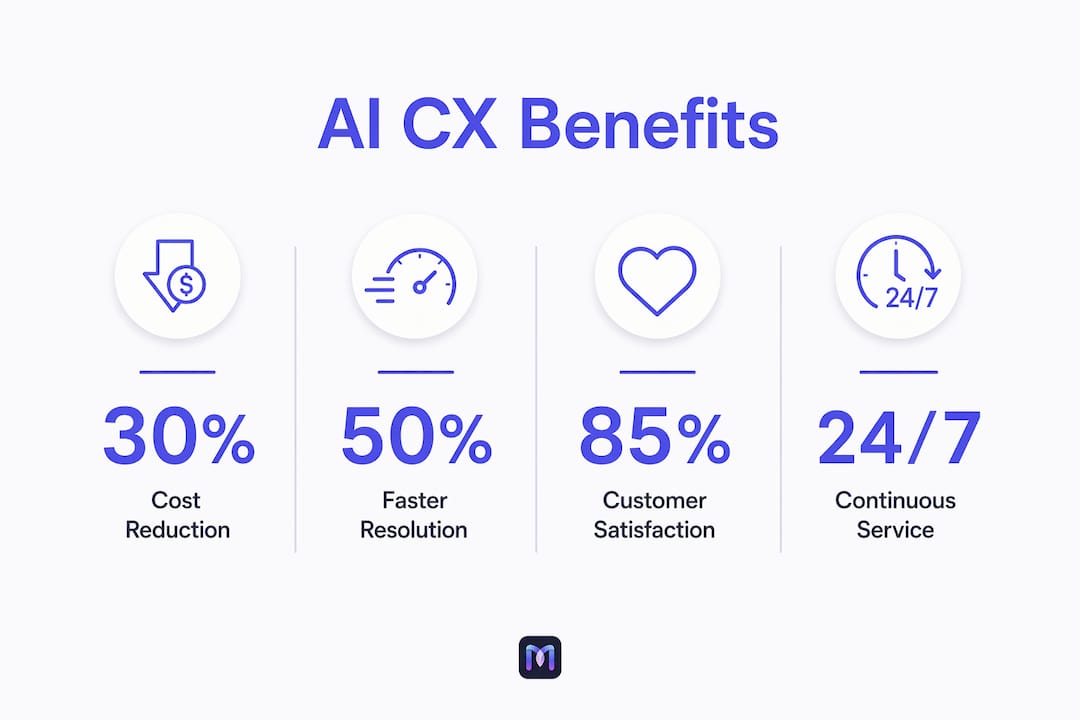
AI defines the role of enterprise customer experience today by enabling personalized, autonomous interactions at a scale no human team can match alone. Enterprises that treat AI as a feature add-on miss the point entirely. The real shift is architectural: AI systems now reason, plan, and act across every customer touchpoint, turning fragmented service moments into connected journeys. The result is faster resolution, higher retention, and measurable cost reduction. For CX leaders building or refining their AI-driven CX strategy, understanding the full architecture behind this transformation is the starting point for competitive advantage.
What is the role of AI in enterprise customer experience?
AI in enterprise CX is best understood through the lens of Agentic Customer Experience, or ACx. ACx is an emerging architecture where AI systems reason, plan, and act autonomously across channels. That distinction matters because traditional AI in CX was reactive: a chatbot answered a question, a recommendation engine surfaced a product. Agentic AI goes further. It holds context across sessions, coordinates actions across systems, and makes decisions without waiting for a human to prompt each step.
The five pillars that define a mature ACx architecture are:
- Context and continuity: The AI retains customer history and intent across every channel, from voice to chat to email.
- Velocity: Responses and resolutions happen in real time, not in the next business day.
- Accountability: Every AI decision is logged, auditable, and traceable to a specific trigger.
- Ecosystem sovereignty: The enterprise controls its own data and AI logic, not a third-party black box.
- Autonomy: The system completes multi-step tasks, such as rescheduling a delivery or processing a refund, without human intervention at each step.
Enterprises that deploy ACx architectures should validate ROI within 90 days of deployment. That 90-day window forces teams to tie AI performance to real business outcomes, not vague satisfaction scores. If the numbers do not move within that window, the use case or the implementation needs rethinking.
Pro Tip: Start your ACx rollout with one high-volume, low-complexity use case, such as order status inquiries. Prove ROI in 90 days, then expand. This avoids the common trap of piloting AI everywhere and measuring nothing.
How does the Intelligent Digital Brain power personalized CX at scale?
Personalization at enterprise scale requires more than a large language model. It requires a unified intelligence layer that knows your business, your customers, and your decision logic. Accenture calls this the Intelligent Digital Brain: a continuously learning system that integrates proprietary data, context, and decision logic to adapt CX dynamically. The key word is “proprietary.” Generic AI models trained on public data cannot replicate the institutional knowledge your enterprise has built over years.

The Intelligent Digital Brain works by breaking down data silos. A customer’s purchase history, service tickets, contract terms, and behavioral signals all feed into a single semantic model. That model powers every AI interaction, so a voice agent handling a billing dispute already knows the customer’s tier, their last three contacts, and the resolution pattern that works for their segment. The result is a conversation that feels informed rather than scripted.
This architecture also enables continuous improvement. Every interaction generates feedback that refines the model’s decision logic. The Intelligent Digital Brain bridges silos and powers domain-specific intelligence that generic AI cannot replicate. For CX leaders, this means the system gets more accurate over time without requiring manual retraining cycles.
The practical benefits show up in three areas: decision consistency (every agent, human or AI, works from the same context), resolution speed (the AI already has the answer before the customer finishes explaining), and continuous learning (edge cases today become standard handling tomorrow).
Pro Tip: Audit your data architecture before deploying any AI CX layer. If your customer data lives in five disconnected systems, your AI will be five times less effective than it could be. Data unification is not a prerequisite you can skip.
What are best practices for embedding AI into enterprise CX workflows?
AI transformation in CX is narrower and more specific than broad digital transformation. Effective enterprises redesign workflows to be AI-native rather than simply adding AI to legacy processes. That distinction separates enterprises that see measurable gains from those that spend heavily and wonder why satisfaction scores barely moved.
A practical AI automation roadmap for enterprise CX covers six components:
- Use-case portfolio: Identify and prioritize CX interactions by volume, complexity, and business impact. Start where AI can replace repetitive, high-volume tasks.
- Sourcing decisions: Decide which AI capabilities to build internally, buy from a platform, or configure through a no-code agent builder.
- Data and infrastructure: Confirm that customer data is clean, accessible, and governed before connecting it to any AI model.
- Governance and risk: Define who owns AI decisions, how errors are escalated, and how the system is audited. A robust AI strategy requires a 12–36 month operational horizon covering all six of these components.
- Talent and adoption: Train CX teams to interpret AI output, not just receive it. Human agents who understand why the AI made a recommendation perform better than those who simply follow it.
- Outcomes measurement: Track leading indicators like task completion rates alongside lagging indicators like cost per resolution and customer satisfaction scores.
AI transformation ROI depends on adoption rates, workflow quality, data maturity, and organizational readiness. Completion rates are the leading indicator. Cost reductions and time saved are the outcomes. Enterprises that measure only the outcomes and ignore adoption metrics miss the early warning signs of a failing implementation.
The most common pitfall is what practitioners call the “activity trap”: deploying AI features, generating reports on usage, and confusing activity with value. Successful AI transformation focuses on redesigning decision points and equipping employees to interpret AI output within their workflows. That is a fundamentally different goal than deploying a chatbot and tracking deflection rates.
Pro Tip: Give your CX business users no-code tools to build and test AI-driven conversational flows. Business users with visual tools iterate faster than developer-dependent teams. Faster iteration means faster personalization.
How will agent-to-agent commerce reshape enterprise CX by 2028?
The next frontier in enterprise CX is not human-to-AI interaction. It is AI-to-AI interaction. By 2028, a growing share of customers will interact with brands through third-party AI agents acting on their behalf. A customer’s personal AI agent will search for the best insurance renewal, compare service options, and initiate a transaction, all without the customer visiting your website or speaking to your team. This is agent-led CX, and it requires a fundamentally different architecture than today’s interface-led model.
The two modes of CX that enterprises must prepare for are:
- Mode 1 (interface-led): The customer interacts directly with your brand through your app, website, or voice channel. This is the current dominant model.
- Mode 2 (agent-led): A third-party AI agent acts on the customer’s behalf, querying your systems through APIs and semantic data layers. Your brand’s visibility depends entirely on how well your data and APIs are structured.
Failure to architect semantic data and APIs as CX decisions risks making your enterprise structurally invisible to customers using third-party AI agents by 2028. That is not a hypothetical risk. It is the same structural shift that made poorly indexed websites invisible to search engines in the early 2000s.
The table below maps the architectural requirements for each mode:
| CX Mode | Customer Interaction | Key Architecture Requirement | Primary Risk |
|---|---|---|---|
| Mode 1: Interface-led | Direct with brand channels | Agentic AI, unified data layer | Slow resolution, poor personalization |
| Mode 2: Agent-led | Via third-party AI agent | Semantic APIs, structured data | Brand invisibility, lost transactions |
Enterprises building their AI CX architecture today need to invest in semantic API design and structured data governance now. Waiting until Mode 2 becomes dominant means rebuilding under competitive pressure. Enterprise AI must be orchestrated as a system spanning applications, agents, context, models, data, and governance. No single layer is sufficient on its own.
The enterprises that maintain direct customer connection in an agent-led world are those that make their data and services easy for AI agents to find, trust, and use. Ecosystem sovereignty, the ability to control your own AI logic and data, is the competitive moat of the next decade. For a deeper look at how AI is reshaping customer service operations at scale, the architectural principles are consistent across industries.
Measuring the financial value of AI in CX requires tracking both operational efficiency and revenue impact, not just deflection rates. Enterprises that connect AI performance to revenue retention and lifetime value make a far stronger case for continued investment.
Key Takeaways
Enterprises that architect AI as a system spanning data, agents, governance, and workflows, rather than deploying isolated features, achieve measurable CX gains and sustainable competitive advantage.
| Point | Details |
|---|---|
| Agentic AI redefines CX | ACx systems reason and act autonomously across channels, replacing reactive, single-step AI tools. |
| Validate ROI in 90 days | Tie AI deployment to business outcomes within 90 days to avoid vague metrics and stalled programs. |
| Unify data before deploying AI | The Intelligent Digital Brain requires clean, connected proprietary data to deliver personalized, consistent CX. |
| Redesign workflows, not just tools | AI-native workflow redesign outperforms adding AI to legacy processes every time. |
| Prepare for agent-led CX now | Semantic APIs and structured data governance are required today to stay visible in a Mode 2 world by 2028. |
Why most enterprises are still thinking about AI CX too small
After working with enterprise CX programs across industries, the pattern I see most often is this: a team deploys a capable AI tool, measures deflection rates for 90 days, declares success, and moves on. The underlying workflows, data architecture, and governance model stay exactly as they were. Six months later, the gains plateau and leadership starts questioning the investment.
The problem is not the AI. The problem is that AI was treated as a feature, not as a system. Real CX transformation requires you to ask a harder question: “If AI can handle 80% of this interaction type, what does the other 20% look like, and how do we redesign the entire workflow around that split?” That question forces you to rethink staffing, escalation paths, data flows, and quality measurement all at once.
The enterprises I find most impressive are the ones that give their CX business users the tools to build and iterate on AI agents without waiting for an engineering sprint. When a CX manager can modify a voice agent’s decision logic on a Tuesday afternoon and see the impact by Wednesday morning, the pace of improvement is qualitatively different. That speed compounds over time.
Governance is the piece most teams underinvest in. Customers increasingly want to know when they are talking to an AI, what data it is using, and how to reach a human. Transparent AI communication is not a legal checkbox. It is a trust signal that directly affects satisfaction scores. Build it in from the start, not as an afterthought.
My honest recommendation: pick two high-leverage use cases, validate ROI in 90 days, and use that proof to fund the deeper infrastructure work. The foundational investment in data unification and semantic API design is not glamorous, but it is what separates enterprises that lead in 2028 from those that scramble to catch up.
— Alex
How Monobot accelerates enterprise AI CX deployment
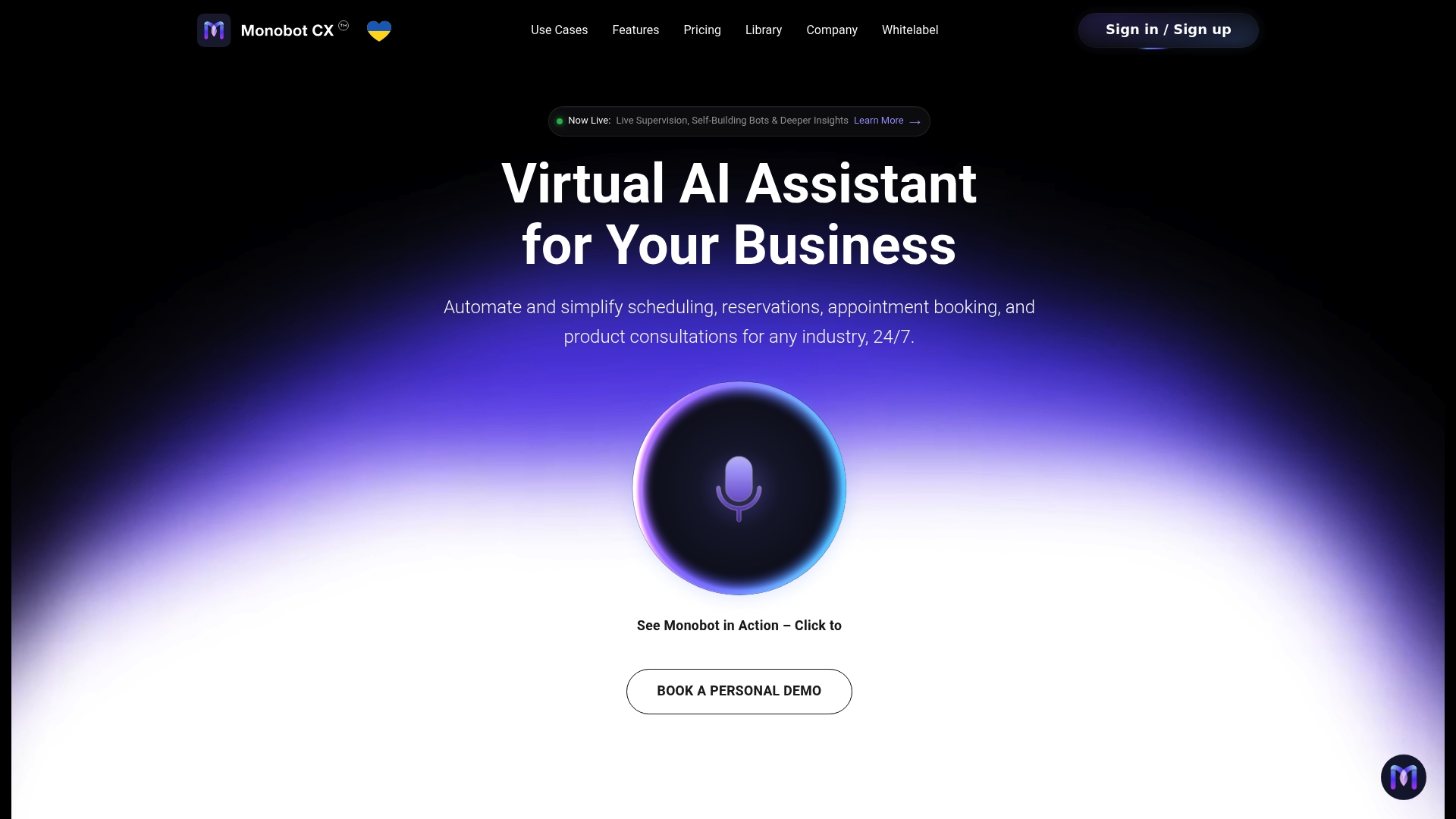
Monobot gives enterprise CX teams a direct path from strategy to deployment. The AI Agent Builder lets you create custom voice and chat agents without writing code, configure decision logic visually, and deploy across channels in minutes. Industry templates for healthcare, banking, retail, and logistics mean you start from a proven framework rather than a blank page. Monobot automates up to 80% of inbound calls and chats, improving first-call resolution while reducing operational costs. The dashboard analytics surface real-time performance data so your team can measure completion rates, resolution speed, and customer satisfaction in one place. If you are ready to move from AI pilots to a production-grade CX architecture, Monobot is built for that scale.
FAQ
What is agentic AI in enterprise customer experience?
Agentic AI in enterprise CX refers to systems that reason, plan, and act autonomously across channels without requiring a human prompt at each step. Unlike traditional chatbots, agentic systems maintain context across sessions and complete multi-step tasks independently.
Why do enterprises prioritize AI in customer service?
Enterprises prioritize AI in customer service because it reduces cost per interaction, improves resolution speed, and enables personalization at a scale that human teams cannot sustain alone. AI also generates interaction data that continuously improves service quality.
How do you measure ROI for AI in enterprise CX?
AI CX ROI is measured through leading indicators like task completion rates and lagging indicators like cost per resolution, time saved, and customer satisfaction scores. Tying both sets of metrics to business outcomes within a 90-day window is the most reliable validation method.
What is the Intelligent Digital Brain in AI CX architecture?
The Intelligent Digital Brain is a continuously learning intelligence layer that unifies proprietary data, context, and decision logic to power personalized customer interactions. It breaks down data silos and enables domain-specific AI that generic models cannot replicate.
How should enterprises prepare for agent-led CX by 2028?
Enterprises should invest now in semantic API design and structured data governance so their services are accessible to third-party AI agents acting on customers’ behalf. Failure to do so risks structural invisibility in a market where AI agents mediate an increasing share of customer decisions.