



TL;DR:
- Speech recognition converts spoken interactions into structured text, enabling automation and real-time analysis.
- It improves contact center efficiency and customer experience by reducing handling time and supporting proactive retention.
Automatic speech recognition (ASR) is the technology that converts spoken customer interactions into structured text, forming the foundation of modern contact center automation. The role of speech recognition in contact centers extends far beyond simple transcription. It powers real-time agent assistance, voice self-service, quality assurance, and speech analytics, all from a single audio stream. Speech analytics enables contact centers to analyze 100% of calls, replacing manual QA sampling of just 2–4%, and delivers 20–30% operational cost savings alongside a 10–15% increase in CSAT. For contact center professionals evaluating where to invest next, ASR is not a feature. It is the infrastructure that makes every other AI capability possible.
How does speech recognition improve contact center efficiency?
Speech recognition removes the single biggest bottleneck in contact center operations: the gap between what happens on a call and what your systems know about it. Without ASR, agents spend time on manual wrap-up notes, supervisors sample a fraction of calls, and performance data arrives days late. With ASR, every word is captured, structured, and available for analysis within seconds.

The efficiency gains are concrete and measurable. Reducing Average Handle Time by 30 seconds in a midsize center saves $150,000 to $200,000 annually. A 1% improvement in First Call Resolution yields $286,000 in savings and a 1.4-point NPS increase. These are not projections. They are the direct result of giving agents and supervisors better information, faster.
Real-time ASR changes how agents work during a call, not just after it. When a system transcribes speech as it happens, it can surface relevant knowledge base articles, flag compliance risks, and suggest next-best actions before the agent has to ask. That reduces cognitive load, shortens handle time, and increases the chance of resolving the issue on the first contact.
Here is how the efficiency gains stack up across key operational metrics:
- Automated transcription eliminates manual note-taking and post-call wrap-up time, freeing agents for the next interaction.
- 100% call coverage replaces 2–4% manual sampling, giving supervisors a complete and accurate picture of performance.
- Real-time agent assist surfaces relevant information mid-call, reducing average handle time and escalation rates.
- Automated quality scoring flags issues immediately, cutting the lag between a problem occurring and a supervisor addressing it.
- Intent detection routes calls more accurately, reducing transfers and repeat contacts.
Pro Tip: Do not measure ASR success by transcription accuracy alone. Track downstream metrics like AHT, FCR, and CSAT before and after deployment. Those numbers tell you whether the technology is actually working in your environment.
What are the primary applications of speech recognition in contact centers?
Speech recognition automates transcription, enabling a range of downstream applications that were either impossible or prohibitively expensive with manual processes. Each application builds on the same audio-to-text pipeline, which means deploying ASR well gives you multiple capabilities from a single investment.
The core applications in production contact centers today include:
-
Interactive Voice Response (IVR) with natural language understanding. Traditional touch-tone IVR forces customers into rigid menus. ASR-powered IVR lets customers speak naturally, which reduces misroutes and cuts the time to reach the right agent or self-service option.
-
Real-time agent assist and coaching. The system listens to the live call and pushes relevant content to the agent’s screen. This includes product information, compliance scripts, and suggested responses. Agents handle complex queries faster and with greater accuracy.
-
Automated quality assurance and compliance monitoring. Automated quality management through speech analytics covers all interactions to flag compliance risks and agent performance issues, freeing supervisors for targeted coaching rather than manual review.
-
Speech analytics and sentiment analysis. ASR output feeds sentiment models that score calls by emotion, topic, and outcome. Supervisors see which call types generate frustration, which agents need support, and which processes create friction.
-
Voicebots and AI-powered self-service. ASR is the input layer for every voicebot. When a customer speaks, the voicebot transcribes the request, interprets intent, and responds. Real-time speech-to-speech architecture reduces latency to 100 ms, enabling live call sentiment analysis and supervisor alerts, compared to 1–3 seconds of lag in older pipelines. That difference is the gap between a natural conversation and a frustrating one.
The most effective contact centers treat these applications as a connected system. Sentiment data informs coaching. Coaching data refines IVR scripts. IVR data shapes voicebot training. ASR is the thread that ties them together.
What challenges affect speech recognition accuracy?
ASR accuracy is not a fixed number. It shifts based on the conditions of each call. High error rates in ASR amplify in multi-turn dialogs, meaning a small transcription error early in a conversation compounds into a wrong intent classification, a failed self-service attempt, or a misrouted call.
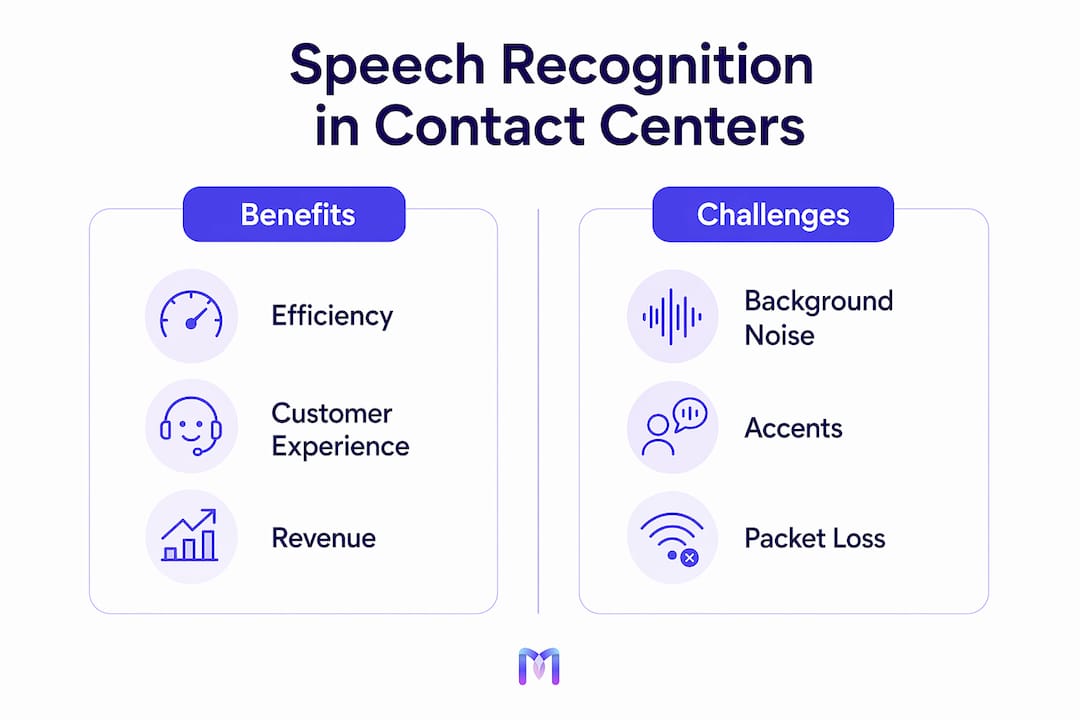
The factors that degrade accuracy most in contact center environments are background noise, regional accents, codec compression, and packet loss. A call recorded over a low-quality mobile connection with ambient noise in the background will produce a materially worse transcript than a clean VoIP call. That difference flows directly into your downstream analytics and agent assist accuracy.
Successful ASR implementation must address real-world telephony issues like packet loss and background noise using voice activity detection (VAD) and diarization for proper speaker separation. VAD filters out silence and noise before the audio reaches the ASR engine. Diarization separates the agent’s voice from the customer’s voice, which is critical for accurate sentiment scoring and compliance monitoring.
Headline ASR accuracy metrics like Word Error Rate (WER) can be misleading without cohort analysis. Higher error rates on mobile, accented speakers, and noisy environments disproportionately degrade downstream NLP and resolution rates. A system that reports 95% accuracy overall may perform at 80% on your highest-volume customer segment.
Pro Tip: Run cohort analysis on your ASR accuracy data. Break down WER by channel (mobile vs. landline vs. VoIP), by accent group, and by call type. You will find the specific failure points that headline accuracy numbers hide.
How does speech recognition affect customer experience and business outcomes?
Speech recognition shifts the contact center from a reactive cost center to a proactive service engine. When every call is transcribed and analyzed, you stop managing by exception and start managing by pattern. That shift produces measurable improvements across the metrics that matter most to your business.
Speech analytics identifies churn risk keywords and negative sentiment, allowing proactive customer retention interventions and reducing silent churn. A customer who mentions a competitor’s name or expresses frustration three calls in a row is a retention risk. Without speech analytics, that signal is invisible. With it, your team can act before the customer cancels.
Speech recognition enables upsell detection during calls by recognizing customer cues, turning contact centers from cost centers to revenue generators. When a customer asks about upgrading a service or mentions a life event, the system flags the opportunity in real time. The agent receives a prompt and can respond naturally, without breaking the flow of the conversation.
The table below maps key speech recognition capabilities to the business outcomes they drive:
| Capability | Business outcome |
|---|---|
| 100% call transcription | Complete QA coverage, no blind spots in performance data |
| Real-time sentiment analysis | Early churn detection, proactive retention outreach |
| Intent detection and routing | Fewer transfers, higher first-call resolution rates |
| Upsell cue recognition | Revenue generation from existing customer interactions |
| Automated compliance monitoring | Reduced regulatory risk, faster audit response |
The benefits of voice technology in customer service compound over time. As your ASR models see more of your specific call data, accuracy improves. As accuracy improves, downstream analytics get sharper. Sharper analytics produce better coaching, better IVR design, and better voicebot performance. The return on investment grows with scale, which is why early deployment gives you a compounding advantage over teams that wait.
Metrics that consistently improve with mature ASR deployments include CSAT, Net Promoter Score (NPS), and Customer Effort Score (CES). Each of these reflects how easy and satisfying the interaction was for the customer. ASR reduces friction at every stage of the call, from routing to resolution, and that reduction shows up directly in your scores. For a broader view of how AI drives productivity gains across customer-facing operations, the pattern holds across industries.
Key Takeaways
Speech recognition is the foundational layer that makes contact center automation, analytics, and real-time agent assistance possible, and its impact compounds as deployment matures.
| Point | Details |
|---|---|
| ASR enables 100% call coverage | Replaces 2–4% manual sampling, giving supervisors complete and accurate performance data. |
| Efficiency gains are quantifiable | Cutting 30 seconds from AHT saves up to $200,000 annually in a midsize center. |
| Accuracy varies by environment | Run cohort analysis by channel and accent group to find where WER degrades downstream performance. |
| Applications span the full call lifecycle | IVR, agent assist, QA, sentiment analysis, and voicebots all run on the same ASR pipeline. |
| Revenue impact is direct | Upsell cue detection and churn risk identification turn call data into business outcomes. |
What I have learned from watching contact centers deploy ASR
Most contact center teams I have seen approach speech recognition as a point solution. They deploy it for transcription or for IVR and stop there. That is the wrong frame. ASR is a data pipeline. Its value multiplies every time you connect it to another system, whether that is your CRM, your quality management platform, or your agent coaching workflow.
The teams that get the most from ASR treat it as infrastructure, not a feature. They invest in data quality upfront, run cohort accuracy analysis before going live, and build feedback loops so the model improves on their specific call types. The teams that struggle deploy a generic model, measure headline WER, declare success, and wonder why their CSAT scores did not move.
There is also a tendency to over-index on the technology and under-invest in the process change. ASR surfaces insights. Humans still have to act on them. A supervisor who receives a real-time alert about a frustrated customer needs a clear protocol for what to do next. Without that, the alert is noise.
The future I see is one where voice AI transforms contact center economics entirely, not by replacing agents but by making every agent significantly more effective. The contact centers that build their ASR foundation now will have a structural advantage when that shift accelerates. The ones that wait will spend years catching up.
— Alex
Monobot’s AI voice agents put speech recognition to work
Contact centers that want to move from manual processes to full speech-driven automation need more than a transcription engine. They need a platform that connects ASR to real-time analytics, agent workflows, and customer self-service in one place.
Monobot’s AI Voice Agent Builder lets your team deploy custom voice agents that handle inbound calls, transcribe interactions in real time, and feed data directly into your analytics dashboard. The live transcription and analytics features give supervisors granular visibility into every call, not just the 2–4% a manual QA team can review. You can build, configure, and launch a voice agent without writing a single line of code, and scale it across your entire operation from day one.
FAQ
What is the role of speech recognition in contact centers?
Speech recognition converts spoken customer interactions into structured text, enabling automation, real-time agent assistance, quality assurance, and speech analytics. It is the foundational technology that makes AI-powered contact center operations possible.
How does ASR improve first-call resolution rates?
ASR enables real-time intent detection and agent assist, surfacing relevant information mid-call before agents need to search for it. A 1% improvement in FCR yields approximately $286,000 in annual savings for a midsize contact center.
What factors affect speech recognition accuracy in call centers?
Background noise, regional accents, codec quality, and packet loss all degrade ASR accuracy. Voice activity detection (VAD) and speaker diarization are the primary techniques used to mitigate these issues in production telephony environments.
How does speech analytics support customer retention?
Speech analytics flags churn risk keywords and negative sentiment patterns across 100% of calls, allowing teams to intervene proactively before a customer disengages. This capability reduces silent churn that manual QA sampling would never detect.
Can speech recognition generate revenue in a contact center?
Yes. ASR-powered upsell cue detection identifies buying signals during live calls and prompts agents in real time, turning routine service interactions into revenue opportunities.