



Agent assist is the right first choice when your priority is real-time agent performance for complex, emotional, or regulated contacts, while customer-facing chatbots fit best when the goal is high-volume automation of routine tasks. Most contact centers eventually need both, and running them on one integrated platform avoids disconnected data and duplicated setup work. We built Monobot around that reality: our platform automates up to 80% of inbound calls and chats while giving human agents real-time support on the contacts that still need a person.
TL;DR:
- Prioritize agent assist for regulated contacts, rising handle times, slow new hire ramp, or frequent supervisor checks; start with the three top escalation reasons.
- Use chatbots for stable, repeatable tasks such as order status, scheduling, password resets, and basic account questions, with escalation paths ready before launch.
- Trigger handoff on low confidence, negative sentiment, a direct request, or three failed clarifications, and pass agents the summary, recent replies, and relevant knowledge passages.
- Pilot one flow for four to eight weeks after setting KPIs, checking integrations and privacy, and training agents; collect feedback alongside performance data.
- An IT self service study found chatbots answered 57% of queries in one or two turns, but that result applies to routine support tasks.
Table of Contents
- Agent Assist vs Chatbot: Comparing Capabilities and KPI Impact
- When Real-Time Agent Support Should Come First
- When Customer-Facing Chatbots Deliver Faster Wins
- Making AI and Human Handoffs Feel Like One Conversation
- Your Pilot-to-Scale Checklist for This Quarter
- Why We Usually Recommend Starting with Agent Assist
- Our Honest Take on the Hybrid Debate
- How Monobot Brings Agent Assist and Chatbots Together
- FAQ
- Sources
Agent Assist vs Chatbot: Comparing Capabilities and KPI Impact
Agent assist software listens to or reads a live conversation and feeds the human agent real-time suggestions, knowledge base passages, and next-best-action prompts. A customer-facing chatbot, on the other hand, carries the entire conversation itself, resolving or routing the request without a human in the loop until escalation.
The two tools solve different problems, and conflating them leads to the wrong purchase. Here is where they diverge in practice:
- Audience: agent assist serves your employees; chatbots serve your customers directly.
- Autonomy: agent assist never speaks to the customer; chatbots handle full conversations independently.
- Coverage window: chatbots typically run 24/7; agent assist is only active during staffed hours.
- Context handling: agent assist pulls from the live call or chat plus your knowledge base; chatbots rely on scripted flows or retrieval-augmented generation.
- Risk profile: agent assist keeps a human making the final call, which matters for regulated or sensitive topics.
- Setup complexity: chatbots need broader intent coverage up front; agent assist can start narrower, tied to a few high-value scenarios.
On KPIs, chatbots move automation rate and first contact resolution for simple, repeatable requests, and they tend to lower average handle time by removing those requests from the queue entirely. Agent assist moves the needle differently: it shortens handle time on complex calls, raises first-call resolution by surfacing the right answer faster, and cuts new-hire ramp time because agents lean on suggested responses instead of memorized scripts. One industry study on IT self-service found chatbots answered 57% of queries in just one or two turns, which is the kind of routine volume agent assist was never meant to carry.
Each tool also fails in a predictable way. Chatbots stumble on ambiguous, multi-intent, or emotionally charged requests, producing frustrating loops if escalation paths are weak. Agent assist can backfire too: when suggestion volume is too high or confidence is low, agents start ignoring the panel entirely, which defeats the investment.
When Real-Time Agent Support Should Come First
Some organizational signals point clearly toward agent assist as the priority investment, especially when call complexity or compliance risk is already straining your team.
- Your contacts frequently involve regulated topics like billing disputes, healthcare, or financial accounts, where a wrong answer carries real consequences.
- New agents take weeks to reach full productivity, and inconsistent answers are showing up in quality scores.
- Average handle time on complex, non-routine calls is rising even though your knowledge base is solid.
- Agents are escalating internally to supervisors just to confirm answers, slowing the whole queue.
These signals show up together more often than not: a healthcare scheduling line handling insurance questions, or a banking support desk fielding fraud reports, both benefit from real-time prompts more than from a new chatbot flow. Implementation needs some groundwork too. You will want call or chat transcription in place, privacy controls around any sensitive data surfaced to agents, and a short training cycle so agents trust the suggestions instead of second-guessing every one.
Pro Tip: Start agent assist with your three highest-volume escalation reasons, not a full knowledge base rollout. Narrow scope gets you faster wins and clearer feedback.
When Customer-Facing Chatbots Deliver Faster Wins
Chatbots earn their keep fastest where contact volume is high and the underlying request rarely varies. Order status checks, appointment scheduling, password resets, and basic account questions are the classic targets.
- Deploy a chatbot when more than a modest share of your inbound volume maps to two or three repeatable intents.
- Expect quick wins on Tier 1 coverage and better self-service satisfaction for straightforward tasks, consistent with usability findings on IT support chatbots.
- Build the escalation path before launch, not after, so a confused customer never gets stuck.
- Disclose clearly when a customer is talking to an automated assistant, and confirm identity before sharing account details.
A retail brand fielding constant “where is my order” questions, or a clinic managing appointment reminders and reschedules, are textbook fits. The limits show up at the edges: anything involving negotiation, complaint handling, or nuanced judgment calls should route to a human quickly rather than looping the customer through retry prompts.
Pro Tip: Launch your chatbot on your single highest-volume transactional flow first, then expand intent coverage only after escalation rates stabilize.
Making AI and Human Handoffs Feel Like One Conversation
A hybrid setup only works when the switch from bot to agent feels invisible to the customer. That starts with defining clear handoff triggers: low bot confidence, a detected negative sentiment, a direct request for a human, or three failed clarification attempts are all reasonable thresholds.

When a handoff happens, the agent needs more than a blank chat window. Pass along a conversation summary, the bot’s last few responses, and any relevant knowledge base passages the bot already pulled, so the agent isn’t asking the customer to repeat themselves.
A shared knowledge base matters on both sides of the handoff. Retrieval-augmented generation, built on an indexed and access-controlled knowledge source, reduces hallucinated answers and speeds up the suggestions agent assist surfaces mid-call. The NIST/NCCoE technical report on RAG-based chatbots outlines exactly this pattern: local deployment, access controls, and validation filters paired with RAG to keep responses grounded and reduce data exposure risk.
A few practical standards keep the system usable day to day:
- Set a latency target for agent assist prompts so suggestions arrive before the agent needs them, not after.
- Show a confidence score next to every suggested reply so agents know when to trust it and when to rely on judgment.
- Track delegation rate, the reasons behind each escalation, time-to-resolution after handoff, and how often agents override suggestions.
Field evidence from Alibaba’s customer service operations found that early, high-effort human intervention after an AI escalation preserved service quality, while delayed or low-effort handoffs degraded it. Speed and effort at the handoff moment matter as much as the handoff design itself.
Your Pilot-to-Scale Checklist for This Quarter
Moving from decision to deployment goes smoothly when the stages are sequenced rather than rushed together.
- Pre-pilot (week 1 to 2): define target KPIs, assemble sample dialogs for your top intents, confirm knowledge base and CRM integration points, and complete a privacy review for any data agents or bots will access.
- Pilot (week 3 to 10): run a focused 4 to 8 week test on one flow, instrument the KPIs you defined, train agents on the assist interface, and collect qualitative feedback alongside the numbers.
- Scale (week 11 onward): formalize governance and update SLAs, tune models against real pilot data, and adjust staffing and training as coverage expands.
Ownership typically splits across contact-center operations for KPIs and training, IT for integrations and data access, and a project lead keeping the three stages on schedule.
Why We Usually Recommend Starting with Agent Assist
Teams that succeed with hybrid automation almost always raise agent performance before expanding bot coverage, not the other way around. Agent assist surfaces where knowledge gaps and script problems actually live, and that information makes chatbot design far more accurate when you build it next.
The common mistake is launching a customer-facing chatbot first because it looks like the bigger cost win, then discovering the underlying answers it gives were inconsistent all along. Fixing that after launch is harder and more visible to customers than fixing it before.
We have seen this sequencing play out across industries that use Monobot for both sides of the stack, from healthcare scheduling to retail order support, and the pattern holds regardless of sector.
Our Honest Take on the Hybrid Debate
The conventional advice treats agent assist and chatbots as a sequencing question: pick one, prove ROI, then add the other. That framing undersells how much the two tools depend on shared infrastructure. A knowledge base built well enough to power accurate agent suggestions is the same asset a chatbot needs to avoid hallucinating, so building them on separate systems means doing the knowledge work twice.
What gets overrated is automation rate as the headline metric. A chatbot that automates a large share of contacts but routes confused customers in circles is not a win, and the Nature Communications research on communication style synergy found that mixed, deliberately designed communication roles between bot and human agents improved satisfaction more than raw automation volume did.
Our take: prioritize the handoff experience before you expand chatbot scope. A clean escalation with full context preserved will protect customer satisfaction more reliably than another percentage point of automation.
— Alex
How Monobot Brings Agent Assist and Chatbots Together
Running agent assist and customer-facing chatbots on separate systems means separate knowledge bases, separate analytics, and separate vendor relationships to manage. We built Monobot so both sides of the hybrid strategy share one platform instead.
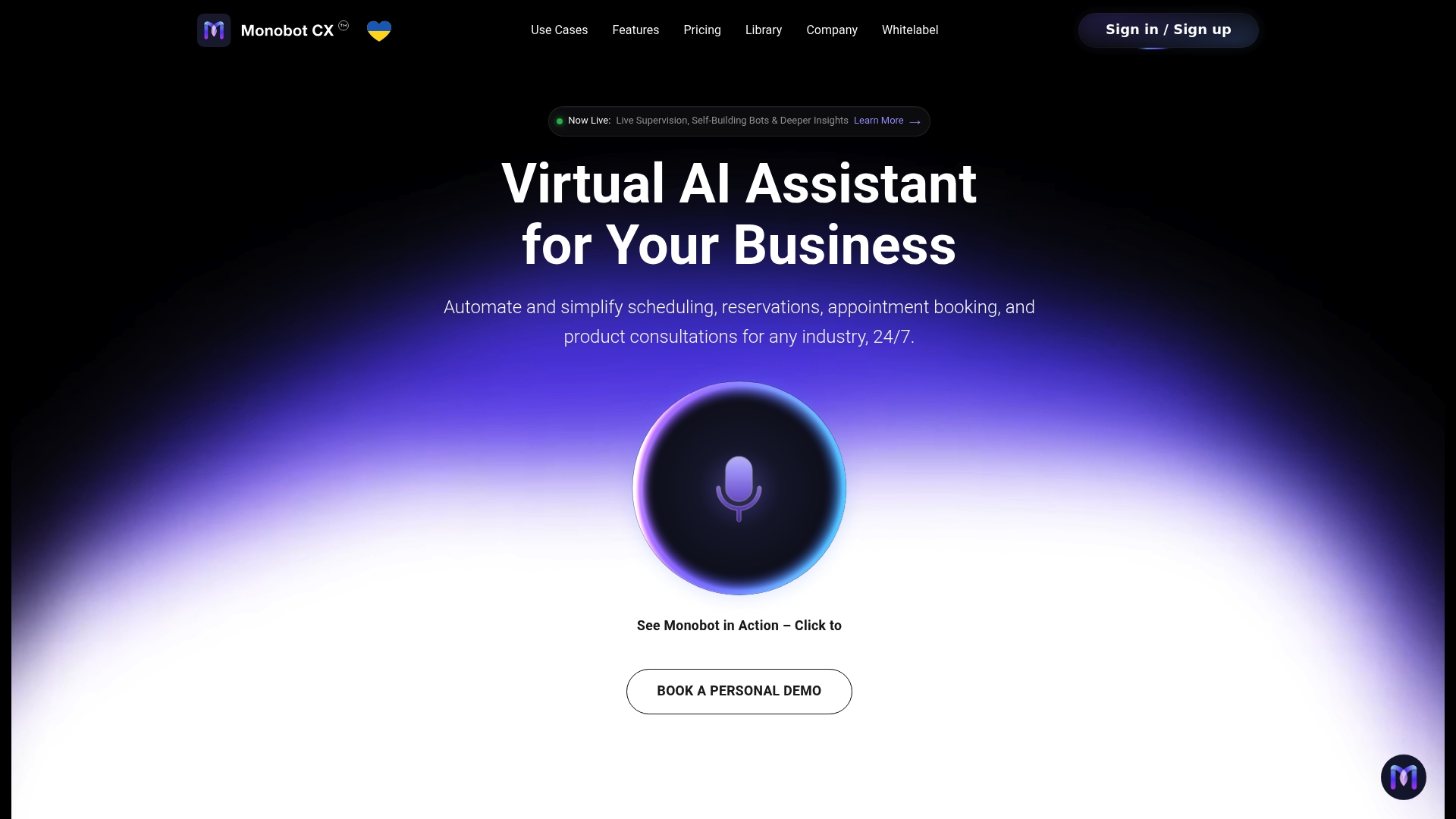
That means the knowledge base your chatbot uses to answer customer questions is the same one feeding real-time suggestions to your agents, which keeps answers consistent across both channels.
- Real-time agent assist surfaces suggested responses and knowledge base passages during live calls and chats.
- AI voice agents and chat templates cover common flows like scheduling and order status without custom coding.
- Integrations connect your CRM and existing tools so context carries through handoffs automatically.
- Interaction dashboards track delegation rate, resolution time, and agent override patterns from day one.
If the checklist above matches where your team is headed, our pricing page outlines the Starter, Growth, and Business plans, and our team can walk through which fits your contact volume.
FAQ
Is agent assist the same thing as a chatbot?
No. Agent assist supports a human agent during a live conversation with suggestions and knowledge base passages, while a chatbot carries the full conversation with the customer on its own.
Can one platform run both agent assist and a customer-facing chatbot?
Yes, and sharing a single knowledge base across both keeps answers consistent between what the chatbot tells customers and what agents see suggested. Monobot’s platform is built around that shared architecture.
Which one improves first-call resolution more?
Agent assist tends to have a bigger effect on first-call resolution for complex requests, since it gives agents the right answer faster on calls a chatbot would have escalated anyway. Chatbots improve resolution mainly on simple, repeatable requests they can fully automate.
How long does a typical pilot take to show results?
A focused pilot on one flow or intent usually runs 4 to 8 weeks, long enough to instrument KPIs and gather agent feedback before deciding on wider rollout.
Do chatbots actually satisfy customers as well as a human agent?
Research on IT self-service found chatbots can outperform traditional search tools on user satisfaction, with 57% of queries resolved in one or two turns. Results vary by context and task complexity, so routine, well-defined requests see the strongest results.
Sources
- Communication style synergy in chatbot-human service teams: dividing warmth and competence to enhance customer satisfaction | Humanities and Social Sciences Communications
- NIST / NCCoE report on chatbot architecture and security
- Agentic AI and Human-in-the-Loop Interventions: Field Experimental Evidence from Alibaba’s Customer Service Operations
- From self-service to AI-assisted service: A mixed-method study of IT support service provision using search tools and chatbots