



TL;DR:
- AI chatbots cost significantly less than human agents and handle most routine inquiries efficiently. However, they struggle with emotional, complex, or sensitive issues requiring human judgment and discretion. A hybrid model combining AI automation and human support offers the best balance of cost savings and customer satisfaction.
AI chatbots are automated digital agents that handle customer interactions using natural language processing (NLP) and machine learning, while traditional call centers rely on human agents to manage voice and chat conversations. The debate around the AI chatbot vs traditional call center model has moved from theoretical to urgent: businesses now face real cost, speed, and quality tradeoffs that directly affect their bottom line. AI chatbots cost $0.03–$0.15 per conversation compared to $4–$18 per call for in-house US human agents. That gap is not a rounding error. It is a structural cost difference that forces every customer service leader to rethink how they staff and automate.
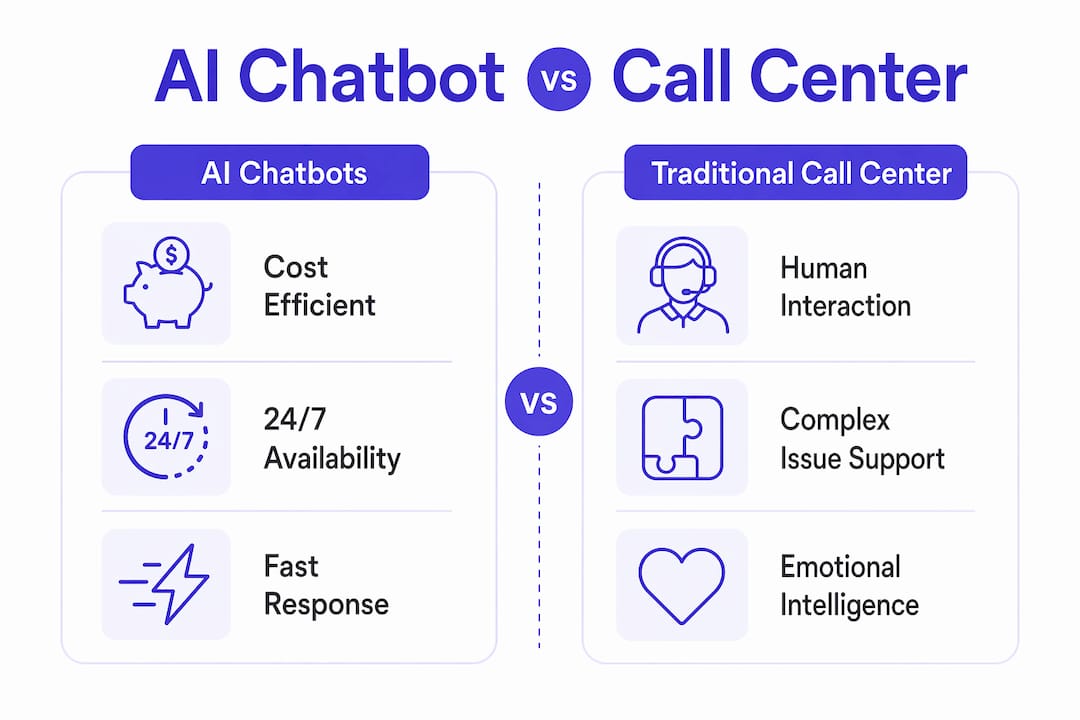
How do AI chatbots improve customer service efficiency?
The efficiency advantage of AI chatbots for customer service comes down to three factors: speed, availability, and cost per interaction.

AI chatbots respond in under 5 seconds, around the clock, with no shift changes or sick days. AI systems handling 60–80% of repeat tickets reduce human workload and deliver near-instant replies. That ticket deflection rate means your human agents spend less time on password resets and order status checks, and more time on issues that actually require judgment.
The cost comparison is stark. At $0.03–$0.15 per AI conversation versus $4–$18 per human call, a business handling 10,000 routine inquiries per month can save tens of thousands of dollars annually by automating the right tier of requests. The savings compound as volume grows, because AI does not require overtime pay or additional hiring during peak seasons.
Quality holds up, too. AI chatbots achieve customer satisfaction scores of 4.2–4.5 out of 5 on routine tasks, with first-contact resolution rates of 75–88%. Those numbers are competitive with Tier-1 human agent benchmarks, which means you are not sacrificing quality to cut costs on standard inquiries.
Key efficiency advantages of AI chatbots:
- Instant response times with no queue wait
- 24/7 availability across chat, voice, and social messaging channels
- Consistent answers drawn from a live knowledge base
- Automatic scaling during high-volume periods without additional staffing
- Reduced average handle time on routine requests
Modern AI chatbots also use Retrieval-Augmented Generation (RAG) to pull answers from live knowledge bases. RAG-powered chatbots update automatically when product catalogs or policy documents change, eliminating the manual bot-flow maintenance that plagued older rule-based systems. Your chatbot stays accurate without a developer touching it every time a policy shifts.
Pro Tip: Before going live, run your AI chatbot in shadow mode. The bot drafts responses that human agents review and approve before they reach customers. This builds internal confidence in the system and surfaces gaps in your knowledge base before they become customer complaints.
What are the limitations of AI chatbots vs human agents?
AI chatbots struggle with three categories of interaction: emotional complexity, open-ended problem diagnosis, and negotiation. A customer calling to dispute a billing error after a family emergency does not want a scripted response. They want a person who can read the situation, apply discretion, and resolve it with empathy. AI cannot reliably do that yet.
The traditional call center hierarchy, with its tiered agents, supervisors, and quality assurance teams, exists precisely because some problems require human judgment at multiple levels. Complex technical troubleshooting, sensitive healthcare inquiries, and high-value sales conversations all benefit from a human who can ask follow-up questions freely and adapt in real time.
The biggest failure point in AI customer service is not the AI itself. Inadequate escalation design, where no conversation history follows the customer to a human agent, is the primary driver of negative customer experiences. When a customer explains their problem to a bot and then has to repeat everything to a human agent, frustration spikes immediately. That single design flaw erases much of the goodwill that fast AI responses build.
Common AI chatbot failure points to watch:
- Inability to handle ambiguous or multi-part questions accurately
- Poor performance on emotionally charged or sensitive topics
- Escalation without context transfer, forcing customers to repeat themselves
- Outdated responses when knowledge bases are not maintained
- Regulatory constraints in industries like healthcare and financial services that limit what AI can say or decide
Regulatory and ethical considerations add another layer. In healthcare, HIPAA governs what patient data an AI can access and share. In financial services, regulations around advice and disclosures limit what an automated agent can say. These constraints do not make AI unusable in those sectors, but they do require careful scoping of what the bot handles versus what a licensed human agent must own.
Pro Tip: Design your escalation flow before you build your chatbot. Map every scenario where a human must take over, and confirm that your AI platform passes the full conversation history, customer record, and recommended next steps to the agent. Customers who never have to repeat themselves are far more forgiving of the fact that they spoke to a bot first.
How to choose between AI chatbots and traditional call centers
The right choice depends on four variables: your call volume, your inquiry mix, your customer demographics, and your brand positioning.
Start with your inquiry mix. Pull three months of support tickets and categorize them by complexity. If more than 50% are routine, repeatable questions (order status, account lookups, appointment scheduling, FAQs), AI automation is a strong fit. If your volume skews toward complex, multi-step issues, a human-first model with AI assistance makes more sense.
Assessing cost vs. customer experience tradeoffs
Cost savings from AI are real, but they carry a customer experience risk if applied too broadly. Businesses with premium brand positioning, where customers expect white-glove service, need to be careful about where automation appears. A luxury retailer and a high-volume e-commerce operation have very different risk tolerances for a bot-first experience.
Customer demographics matter, too. Younger customers generally accept and prefer self-service through chat and messaging. Older customers or those in high-stakes situations (medical, legal, financial) often prefer speaking to a person. Segment your customer base before you set your automation thresholds.
The case for hybrid models
Hybrid AI-plus-human models make human agents 20–35% more productive by automating routine calls and assisting with routing. That productivity gain is the strongest argument for a blended approach. You keep the human touch for complex cases while AI handles the volume that would otherwise burn out your team.
A practical decision framework:
- Automate inquiries that are high-volume, low-complexity, and have clear, consistent answers.
- Assist human agents with AI tools that surface relevant knowledge base articles and suggest next steps in real time.
- Escalate to humans any inquiry involving emotion, negotiation, regulatory sensitivity, or a customer who explicitly requests a person.
- Review your automation thresholds quarterly using customer satisfaction scores and first-contact resolution data.
Explore BPO automation examples to see how businesses across industries have structured this split in practice.
Best practices for implementing AI chatbots alongside your call center
Effective implementation follows a sequence. Rushing to full automation without quality benchmarks is the most common mistake businesses make.
Step 1: Start in shadow mode. The best AI implementations begin with shadow mode, where AI drafts responses that humans review before sending. Once the AI consistently meets your quality benchmarks, flip it to autonomous responses one queue at a time. This approach reduces risk and builds team trust in the system.
Step 2: Build your knowledge base first. Your AI is only as accurate as the information it draws from. Before deployment, audit your FAQs, policy documents, and product catalogs. Structure them clearly so your AI can retrieve and apply them correctly. RAG-based systems update automatically when you change source documents, which reduces ongoing maintenance significantly.
Step 3: Configure escalation with full context transfer. Passing the full conversation history, customer record, and recommended next steps during escalation prevents customers from repeating themselves. Build this into your integration before launch, not as an afterthought.
Step 4: Select channels and integrate with your helpdesk. Deploy AI on the channels your customers actually use: live chat, voice, SMS, or social messaging. Connect your AI platform to your CRM and helpdesk so agents have complete customer context the moment they take over a conversation. Monobot’s AI agent builder supports no-code configuration across multiple channels, which shortens deployment time considerably.
Step 5: Monitor quality continuously. Track customer satisfaction scores, first-contact resolution rates, and escalation rates by queue. Use dashboard analytics to identify which inquiry types the AI handles well and which need human backup. Adjust your automation thresholds based on data, not assumptions.
Pro Tip: Automate routine tasks like appointment scheduling, order tracking, and account lookups first. These have clear, verifiable answers and low emotional stakes. Free your agents for the conversations where human judgment genuinely changes the outcome.
Key takeaways
AI chatbots deliver the strongest return when they handle high-volume, routine inquiries while human agents focus on complex, emotionally sensitive cases that require judgment and empathy.
| Point | Details |
|---|---|
| Cost advantage is significant | AI chatbots cost $0.03–$0.15 per conversation vs. $4–$18 for human agents. |
| Quality holds on routine tasks | AI achieves 4.2–4.5/5 satisfaction scores and 75–88% first-contact resolution on Tier-1 requests. |
| Escalation design is critical | Passing full conversation context to human agents is the single biggest factor in customer satisfaction. |
| Hybrid models outperform either alone | AI-plus-human setups make agents 20–35% more productive by automating volume and assisting routing. |
| Shadow mode reduces launch risk | Starting with AI-drafted responses reviewed by humans builds quality benchmarks before full automation. |
Where I think most businesses get this wrong
After watching dozens of companies deploy AI in live customer service environments, the pattern is consistent. Businesses spend months selecting and configuring their AI platform, then treat the escalation handoff as a minor technical detail. It is not. The escalation handoff is the moment that defines whether a customer feels served or abandoned.
The companies that get it right build the escalation flow first. They define exactly which signals trigger a human takeover, confirm that the full conversation record transfers instantly, and train human agents on how to pick up mid-conversation without making the customer feel like they are starting over. That design work takes a few weeks. Skipping it costs you customer trust that takes months to rebuild.
The other misstep I see constantly is deploying AI on every channel simultaneously before the knowledge base is ready. A bot that gives inconsistent or outdated answers is worse than no bot at all. Start with one channel, one queue, and get it right before expanding.
The future of customer service is not AI replacing human agents. It is AI handling the volume so human agents can do the work that actually requires a human. The businesses winning right now are the ones that have accepted that framing and built their operations around it. They use automated inquiry handling for the predictable, and they protect human capacity for the unpredictable.
— Alex
Monobot’s AI platform for customer service teams
Monobot gives your team a direct path from traditional call center operations to AI-assisted customer service, without requiring a developer for every change.
The Monobot platform supports AI voice agents and chat assistants that handle appointment scheduling, order inquiries, lead qualification, and account lookups across industries including healthcare, retail, banking, and logistics. You can build and deploy a custom AI agent using the no-code agent builder, connect it to your existing helpdesk or CRM, and monitor performance through real-time analytics. Monobot automates up to 80% of inbound calls and chats, and its live dashboard gives your team the visibility to adjust automation thresholds as your needs change. Schedule a demo to see it in your environment.
FAQ
How much cheaper is an AI chatbot than a human agent?
AI chatbots cost $0.03–$0.15 per conversation compared to $4–$18 per call for in-house US human agents, making AI 5–15x cheaper for routine interactions.
Can AI chatbots handle complex customer issues?
AI chatbots perform well on routine, repeatable inquiries but struggle with emotional, multi-step, or regulatory-sensitive issues. Those cases require escalation to a human agent with full conversation context transferred.
What is shadow mode in AI customer service implementation?
Shadow mode is a deployment method where the AI drafts responses that human agents review and approve before they reach customers. It builds quality benchmarks and internal trust before the system moves to autonomous replies.
How does a hybrid AI and human call center model work?
In a hybrid model, AI handles high-volume routine inquiries while human agents manage complex or sensitive cases. Hybrid setups improve agent productivity by 20–35% by reducing the routine workload that would otherwise consume agent time.
What is the biggest risk when deploying an AI chatbot?
Poor escalation design is the primary risk. When a customer’s conversation history does not transfer to the human agent, the customer must repeat themselves, which is the leading cause of dissatisfaction in AI-assisted service environments.