



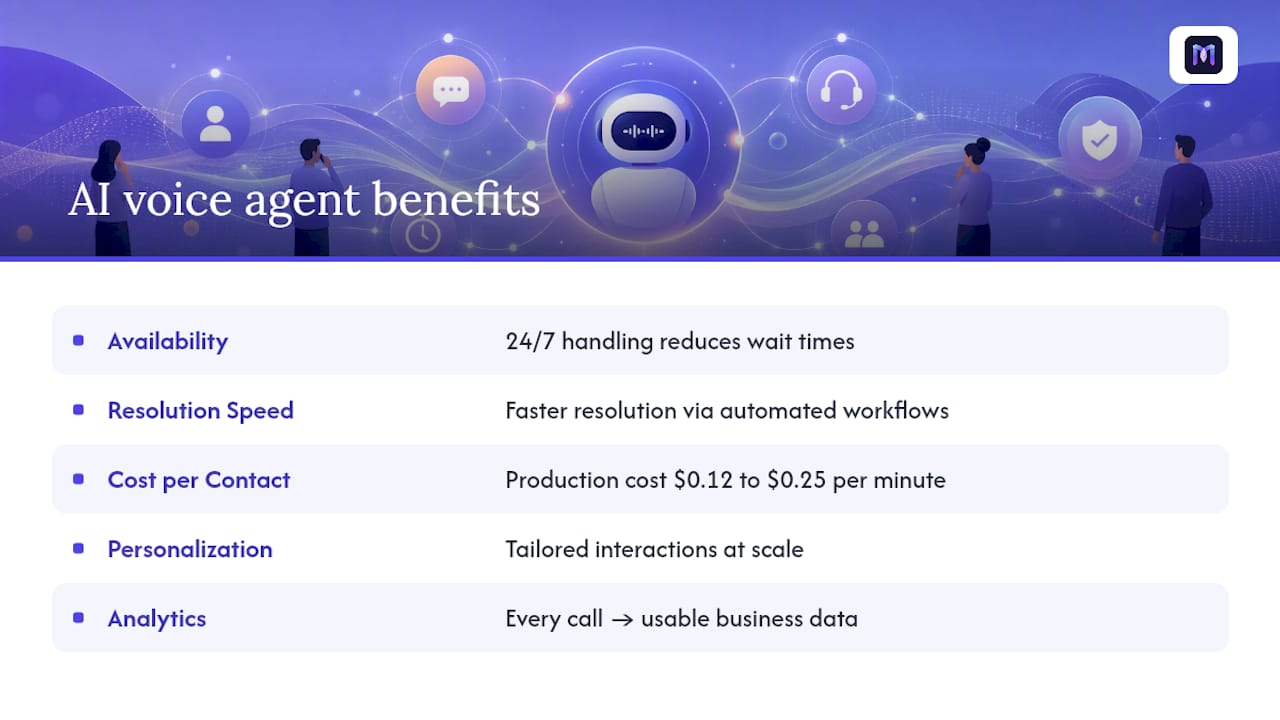
The core AI voice agent benefits for customer service leaders break down into five buckets: constant availability, faster resolution, lower cost per contact, personalization at scale, and analytics that turn every call into usable business data. Production-grade deployments run $0.12 to $0.25 per minute once you count every component in the stack, not the headline rate vendors lead with.
This guide walks through what drives each of those benefits, how the underlying technology actually works, what it costs once you strip away the marketing math, where it fails, and how to roll it out without breaking your existing contact center. You’ll also see how a platform like Monobot maps directly onto these benefits, so you have a concrete reference point rather than an abstract framework.
Key Takeaways
AI voice agents cut cost per contact and resolution time simultaneously by automating high-volume, low-complexity calls while routing complex cases to human agents with full context.
| Point | Details |
|---|---|
| Five benefits drive ROI | 24/7 availability, faster resolution, lower cost per contact, personalization, and analytics all compound together. |
| Real cost is per-minute stacked | STT, LLM inference, TTS, telephony, and orchestration fees combine to a typical $0.12 to $0.25 per minute. |
| Automation rate isn’t the finish line | Track cost per successful outcome, not just percentage of calls handled without escalation. |
| Pilot narrow, then expand | Start with high-volume, low-complexity workflows like order status or scheduling before tackling complex cases. |
| Monobot maps features to benefits | Its agent builder, templates, and live transcription target the same automation and analytics gains discussed throughout this guide. |
Table of Contents
- What Are the Real Benefits of AI Voice Agents for Customer Support?
- How Do AI Voice Agents Actually Work?
- Which Use Cases Deliver the Fastest ROI?
- What Does an AI Voice Agent Actually Cost?
- What Are the Biggest Risks and Limitations?
- How Should You Roll Out a Voice Agent Program?
- How Does Monobot Put These Benefits Into Practice?
- What Businesses Get Wrong About AI Voice Agent ROI
- Get Started With an AI Voice Agent Built for Your Support Volume
- Sources
- FAQ
What Are the Real Benefits of AI Voice Agents for Customer Support?
Every benefit on this list ties back to one operational fact: a voice agent doesn’t get tired, doesn’t need a shift schedule, and doesn’t cost more per hour after 5 p.m. That single structural difference from human staffing is what cascades into everything else.
Availability without staffing math. A voice agent answers the 200th call of the night with the same consistency as the first call of the morning shift. For businesses with seasonal spikes, retailers around holidays, insurers after a storm, this eliminates the brutal choice between overstaffing for peaks or losing customers to hold music during them.
Faster resolution, measurable in seconds. Average handle time (AHT) drops when a voice agent pulls order status or account details instantly instead of routing a caller through three menu layers and a hold queue. First call resolution (FCR) improves too, because the agent has already retrieved the relevant account data before the caller finishes explaining the problem. Salesforce’s research on voice AI points to reduced wait times and personalized handling as two of the clearest, most immediate wins businesses see after deployment.

Cost savings that compound. A human agent costs money whether they’re on a call or between calls. A voice agent’s marginal cost is per minute of actual conversation. When automation rates reach 70 to 80% of inbound volume, the staffing math changes: your human team shifts from handling every call to handling only the calls that need judgment, empathy, or exception handling. That’s a smaller team doing higher-value work, not the same team doing more of the same work.
Personalization without extra headcount. Because voice agents can pull CRM history, order data, and prior interaction context in real time, they remember what happened on the last call and adjust accordingly — something that’s expensive to guarantee consistently across a rotating human team, especially one with turnover.

Analytics that become a strategy input. Every automated conversation generates structured data: sentiment, intent, resolution outcome, drop-off points. Platforms that pair automation with real-time analytics and QA turn call center transcripts into a feedback loop for product, marketing, and operations teams, not just a compliance archive nobody reads.
Here’s how those benefits typically show up in operational terms:
- Call volume handled outside business hours rises without added shift cost.
- Hold time drops because agents don’t queue behind each other the way humans do.
- AHT falls for routine transactions (order status, account lookups, appointment changes).
- Escalation rates to human agents concentrate on genuinely complex cases, improving job satisfaction for the humans who remain.
- Multilingual support becomes a configuration choice rather than a hiring problem.
Pro Tip: Don’t measure success by “calls automated” alone. Track cost per successful outcome, meaning completed resolutions divided by total cost, so you’re not celebrating a high automation rate that’s quietly generating a lot of unresolved, frustrated callers who call back twice.
A support line dominated by billing disputes and account cancellations won’t hit that ceiling; one dominated by order status, appointment changes, and password resets will clear it easily.
How Do AI Voice Agents Actually Work?
An AI voice agent isn’t a smarter version of the phone tree you’re used to. It’s a pipeline of specialized systems working in sequence, fast enough that the caller never notices the handoffs between them. AssemblyAI frames this as listen, transcribe, understand, respond, a simple model that holds up well for non-technical evaluation.
- Speech-to-text (STT) converts the caller’s spoken words into text. Accuracy here sets the ceiling for everything downstream. A poor STT model on a noisy line or a strong regional accent can misfire before the conversation even starts.
- Natural language understanding (NLU) and LLM inference interpret intent and generate a response. This is where the agent decides whether “I want to cancel” means canceling an order or canceling a subscription, and it’s the most computationally expensive step in the chain.
- Text-to-speech (TTS) turns the generated response back into audio. Voice quality and latency trade off here: more natural-sounding voices generally take longer to render.
- Telephony and orchestration manage the actual phone session, routing, call transfer, and the timing that keeps all these components feeling like one fluid conversation instead of four separate systems talking past each other.
The build versus buy decision comes down to a real trade-off, not a simple answer. Managed platforms bundle orchestration and media handling, which lowers engineering overhead and reliability risk, particularly valuable at moderate call volumes. Building in-house can shave the per-minute variable cost, but it adds a fixed engineering cost that only pays off at real scale, and most contact centers never reach that scale on voice alone.
Which Use Cases Deliver the Fastest ROI?
Not every call type is worth automating first. The workflows that pay off fastest share three traits: high volume, predictable structure, and low emotional stakes. Complex or high-empathy conversations remain better handled by humans, and trying to automate those first is where most pilots stall.
- Tier-1 support (order status, FAQs, password resets): These are the highest-volume, lowest-complexity calls in almost any contact center, which makes them the obvious starting point. A caller asking “where’s my order” needs a database lookup, not a conversation.
- Appointment scheduling and reminders: Healthcare clinics, salons, and service businesses lose real revenue to no-shows and phone tag. A voice agent that confirms, reschedules, and reminds without a human touching the calendar removes that friction entirely.
- Lead qualification and outbound campaigns: Voice agents can run structured qualifying questions at a volume no outbound team could match, routing only the qualified leads to a human closer.
- Internal automation (IT helpdesk, HR requests): Employee-facing use cases like password resets and benefits questions follow the same volume-and-predictability logic as customer-facing tier-1 support, just pointed inward. Monobot’s IT helpdesk automation is built around exactly this pattern.
To prioritize among these, multiply volume by value by complexity, inverted. A workflow with high call volume, moderate business value, and low complexity should be your first pilot every time. Save the low-volume, high-complexity, high-emotion calls (a customer disputing a $2,000 charge, a patient with a medical concern) for your human team, indefinitely, not just during rollout.
One industry analysis pegs agency-side productivity gains at 3.2x ROI when AI tools are matched to the right workflow, which tracks with what contact centers see when automation targets high-volume, low-complexity calls instead of everything at once.
What Does an AI Voice Agent Actually Cost?
The rate a vendor quotes you and the rate you’ll actually pay are rarely the same number. Headline per-minute pricing usually reflects only one piece of the stack, not the full cost of running a production call.
A real per-minute cost stacks five components: speech-to-text processing, LLM inference (the most variable and often the largest line item), text-to-speech generation, telephony (the actual phone line and carrier fees), and platform orchestration fees. Fully loaded, that typically lands between $0.12 and $0.25 per minute, even when advertised rates start as low as $0.05.
| Cost Component | What Drives the Price | Where Costs Hide |
|---|---|---|
| Speech-to-text (STT) | Audio quality, accent handling, real-time vs. batch processing | Higher-accuracy models cost more per minute |
| LLM inference | Model choice, conversation length, context window size | Long calls with growing context balloon token usage |
| Text-to-speech (TTS) | Voice naturalness, latency requirements | Premium voices often carry a per-character surcharge |
| Telephony | Carrier rates, call routing, number provisioning | International or toll-free numbers add fees |
| Platform orchestration | Session management, monitoring, uptime guarantees | Concurrency limits and silence billing add up fast |
Ask any vendor for a sample bill based on your actual call volume and average call length, not their advertised floor rate, before you sign anything. A business running 10,000 calls a month at an average of four minutes each is looking at a monthly bill in the thousands, not hundreds, once every component is counted.
- Silence billing (charging for dead air while a caller thinks) can quietly inflate your bill on calls with pauses.
- Concurrency limits cap how many simultaneous calls your plan supports, forcing overage fees during peak hours.
- Compliance surcharges apply in regulated industries like healthcare and finance.
- Negotiated volume discounts exist but rarely appear on the public pricing page. Ask.
Pro Tip: Summarizing conversation history periodically, rather than feeding the entire call transcript back into the model turn after turn, is one of the most effective ways to control LLM inference cost on longer calls without losing conversational context.
Monobot’s pricing and features breakdown for call centers walks through this same component logic if you’re building a budget from scratch.
What Are the Biggest Risks and Limitations?
Voice agents fail in predictable, avoidable ways, mostly when businesses skip the guardrail work.
- Accuracy and accents. Strong regional accents, background noise, and code-switching between languages still trip up STT models. Test with real customer audio, not clean studio samples, before launch.
- Latency stacking. Every extra turn in a conversation adds processing time and cost. A caller who has to repeat themselves twice isn’t just annoyed, they’re also running up your LLM inference bill.
- Escalation design. A voice agent needs a clear, low-friction path to a human the moment a call exceeds its competence, not after three failed attempts to understand the caller.
- Privacy and compliance. Healthcare and financial services carry data retention and consent rules that a generic voice agent configuration may not satisfy out of the box. Confirm data handling terms before deploying in regulated environments.
- Monitoring gaps. Track completion rate, escalation rate, and retry counts from day one; these are the early warning signs of a script that’s failing silently.
Pro Tip: Build the escalation path before you build the happy path. Most failed voice agent pilots don’t fail because the AI is bad, they fail because there was no graceful way out when it hit a case it couldn’t handle.
How Should You Roll Out a Voice Agent Program?
A phased rollout beats a full-scale launch every time, because it lets you catch design flaws on a small blast radius instead of your entire call volume.
- Pick a pilot workflow with high volume, low complexity, and clear success criteria. Order status and appointment scheduling are the classic starting points for good reason.
- Design the conversation with real transcripts, not assumptions. Pull actual call recordings to understand how customers really phrase requests.
- Set operational guardrails before launch. Define SLA targets for latency and completion rate, and set an error budget for how many failed calls trigger a review.
- Instrument the KPIs that matter: automation rate, cost per successful outcome, FCR, CSAT, and completion rate.
- Manage the human transition deliberately. Agents who used to field routine calls need a clear picture of their new role: handling escalations and exceptions, not competing with the automation.
| Metric | Why It Matters |
|---|---|
| Automation rate | Shows what percentage of volume the agent handles without escalation |
| Cost per successful outcome | Ties spend directly to resolved cases, not just calls answered |
| First call resolution (FCR) | Indicates whether callers are getting answers or calling back |
| CSAT | Captures the human experience the raw metrics can miss |
How Does Monobot Put These Benefits Into Practice?
Monobot’s platform is built around the exact benefits outlined above, not as separate add-ons but as one connected system. The AI agent builder lets teams deploy industry-specific templates (healthcare, banking, retail, logistics) without writing code, which shortens the path from decision to live pilot to a matter of minutes rather than a development sprint.
- Industry templates map directly to the tier-1 use cases covered earlier: appointment scheduling, order status, lead qualification.
- Live transcription gives supervisors real-time visibility into what the agent and caller are actually saying.
- Real-time analytics dashboards turn call outcomes into the same kind of business intelligence discussed in the benefits section.
- Real-time agent assistance supports human agents during escalated calls instead of leaving them to start from zero.
Automating up to 80% of inbound calls doesn’t mean replacing your team. It means giving them the 20% that actually needs a human, with full context already loaded.
Readers evaluating a platform for their own contact center can start with Monobot’s product overview to see how these features apply to their specific industry.
What Businesses Get Wrong About AI Voice Agent ROI
The conventional pitch for voice agents leans too hard on the automation rate number. The metric that actually matters is cost per successful outcome, and most businesses don’t set up the tracking to measure it until months after launch.
The other blind spot: businesses treat the pilot phase as a technology test when it’s really an operations test. The AI model rarely fails outright. What fails is picking the wrong workflow for a first pilot, skipping the escalation design, or launching without a plan for what the displaced human hours actually go toward.
My take, based on how these rollouts tend to play out: start narrower than feels comfortable. One workflow, real transcripts, a hard cap on call complexity. Prove the cost-per-outcome math before you expand scope. The businesses that get burned on voice AI almost always tried to automate too much, too fast, without the instrumentation to know it was going wrong.
Get Started With an AI Voice Agent Built for Your Support Volume
If the workflows covered above, order status, appointment scheduling, tier-1 FAQs, sound like the calls eating up your team’s day, Monobot is built to take them off your plate without a multi-month engineering project. Where a custom-built voice stack means assembling your own STT, LLM, and TTS providers and maintaining the orchestration layer yourself, Monobot bundles all of it into one platform with industry templates already configured for healthcare, banking, retail, and logistics.
Deployment runs in minutes, not sprints, thanks to no-code customization, and the analytics dashboard gives you the cost-per-outcome visibility this article argued is the metric that actually matters, right from day one. If you’re ready to see what automating your highest-volume call types would look like on your own numbers, start with a demo of the platform and bring your real call volume to the conversation.
Sources
- The economics of a voice agent: what a minute of conversation actually costs
- AI Voice Agent Pricing: Full Cost Breakdown (2026)
- AI Voice Agents for Customer Service: A Complete Guide – Salesforce
- AI voice agents: what they are & how they work in 2025 – AssemblyAI
FAQ
What are the main benefits of voice AI for customer service?
The core benefits are 24/7 availability, reduced wait times, lower cost per contact, personalization through CRM integration, and analytics that convert calls into business intelligence. Most deployments also see improved first call resolution on routine transaction types.
What are the benefits of AI agents beyond voice specifically?
AI agents generally extend beyond simple scripted responses by remembering past interactions and completing tasks end-to-end, such as updating a CRM record or completing a booking, rather than just answering a question and ending the interaction.
How good are AI voice agents at handling real customer calls?
They perform strongly on high-volume, predictable workflows like order status and scheduling, but complex or emotionally sensitive calls still perform better with human agents. Quality depends heavily on how well the escalation path and conversation design were built during implementation.
How do AI voice agents work technically?
They run a pipeline of speech-to-text transcription, natural language understanding and LLM-based response generation, text-to-speech output, and telephony orchestration that manages the live call session. AssemblyAI describes this as a listen, transcribe, understand, respond loop that happens in real time during the call.
How much does an AI voice agent typically cost per minute?
Fully loaded production costs, including STT, LLM inference, TTS, telephony, and platform fees, typically run $0.12 to $0.25 per minute, even though advertised rates sometimes start lower before hidden fees are added.