



A chatbot evaluation framework is a KPI-driven measurement and QA system that prioritizes containment paired with false-resolution and task completion as the lead diagnostics. Get this pairing wrong and you’ll optimize for the wrong thing entirely: a bot that closes conversations fast but sends the same frustrated customer back through your queue three days later. Your primary KPIs, in priority order, are:
- Containment rate (paired always with false resolution)
- Task completion rate / first-contact resolution
- CSAT, segmented by resolution path
- Escalation rate, broken into a five-tier taxonomy
- Cost per interaction, tied to an ROI formula
Pro Tip: Never report containment alone. A bot showing 70% containment with a hidden 20% false-resolution rate is quietly making your support problem worse, not better. False resolution is best defined as any interaction with a repeat contact inside 72 hours, a post-chat CSAT below 3 out of 5, or a reviewer flag marking the outcome wrong.
Key Takeaways
Containment rate only becomes a trustworthy metric once it’s paired with false resolution, and every other KPI in the framework exists to explain why that pair moved.
| Point | Details |
|---|---|
| Never report containment alone | Pair it with false resolution (72-hour repeat, low CSAT, or reviewer flag) on every dashboard. |
| Use the five-tier escalation taxonomy | Tag each escalation by reason to turn a raw rate into a diagnostic signal. |
| Instrument tool calls separately | Score selection, argument correctness, output use, and side-effect safety for every function call. |
| Run weekly rubric QA | Score groundedness, helpfulness, tone, and escalation appropriateness against a five-by-five confusion matrix. |
| Monobot maps directly to this framework | Its analytics dashboard and agent builder already track containment, false resolution, and escalation in paired views. |
Table of Contents
- What Is a Chatbot Evaluation Framework in Practice?
- Building the Measurement Layer: Event Schema and Escalation Taxonomy
- Instrumentation: Tracing, Tool Calls, and Telemetry That Hold Up
- How Should Teams Run Rubric-Based QA Sampling?
- What Should an Evaluation Dashboard Actually Show?
- Governance: Who Owns Each Metric and What Gates a Release?
- What Most Teams Get Wrong About Chatbot Evaluation
- Putting the Framework to Work with Monobot
- Sources
- FAQ
What Is a Chatbot Evaluation Framework in Practice?
Ops teams building an AI chatbot testing framework tend to make one mistake early: they borrow developer-side benchmarks meant for measuring model quality, then wonder why the dashboard says nothing about cost or customer frustration. An operational framework is different. It groups metrics into outcome, experience, quality and safety, efficiency, and business impact, which keeps any single number from getting optimized in isolation, as the conversational AI success metrics guide lays out.
Here’s how the core chatbot performance metrics break down operationally:
- Containment rate and false resolution. Containment measures the share of conversations the bot resolves with no human involved. It’s meaningless without its pair. A multi-dimensional evaluation approach treats containment and false resolution as a single unit, tracked on one dashboard with a shared confusion matrix, according to research on evaluating conversational AI chatbots.
- Task completion and FCR. Containment tells you the bot didn’t escalate. Task completion tells you whether the customer’s actual job got done. Favor task-level scoring over raw containment whenever the workflow has a clear finish line, like rescheduling an appointment or checking an order status.
- CSAT and NPS. Collect CSAT immediately post-interaction, and always segment it by resolution path, bot-only versus bot-then-agent. A blended average hides the fact that bot-only resolutions might be scoring far worse than assisted ones.
- Escalation rate and the five-tier taxonomy. Not all escalations are failures. Some are the correct outcome. Tag each one by reason so the rate tells a diagnostic story instead of a scary number.
- Cost per interaction and ROI. Netguru’s benchmarking work frames a simple formula: deflected conversations multiplied by cost per human-handled contact, minus platform cost, equals gross monthly savings. A contact center deflecting 4,000 conversations a month at $6 per human-handled contact nets roughly $24,000 in gross savings before subtracting platform fees, a number worth stress-testing against your own false-resolution rate before you present it upward.
Building the Measurement Layer: Event Schema and Escalation Taxonomy
None of the KPIs above compute reliably without a consistent data layer underneath them. Every conversation needs a minimal event schema logged from day one, not retrofitted after a leadership question you can’t answer.
Required fields include:
- Session ID and timestamps for every turn
- Detected intent and confidence score
- Tool calls made, with arguments and results
- Escalation flag and escalation reason
- Outcome label (resolved, false resolution, escalated, abandoned)
- Knowledge base version active at time of response
The five-tier escalation taxonomy that practitioner guidance on evaluating support chatbots recommends runs: in-scope answer, in-scope escalate, out-of-scope refuse, ambiguous clarify, and billing-sensitive route-to-human. Each tier implies something different diagnostically. A spike in “ambiguous clarify” usually points to weak intent classification. A spike in “in-scope escalate” often means the bot recognized the request but lacked the tool access to finish it.
Pro Tip: Label Resolved-Correctly versus False Resolution using the same three signals every time: 72-hour repeat contact, sub-3 CSAT, or a human reviewer override. Consistency in labeling matters more than the exact thresholds you choose. Set confidence thresholds conservatively at launch, and route anything below them to a clarifying question rather than a guess.
Instrumentation: Tracing, Tool Calls, and Telemetry That Hold Up
Bot assessment criteria are only as good as the data feeding them, and most chatbot failures that reach a support manager’s desk trace back to a tool call that silently used the wrong argument, not a language model that “misunderstood” something.
Span-attached tracing, using an open standard like OpenTelemetry, lets you follow a single conversation across every function call it triggers. Tool-call correctness deserves its own scoring surface entirely: selection accuracy, argument correctness, correct use of the returned output, and side-effect safety, each scored separately, per tool-call evaluation research. This is what makes deterministic function_call_accuracy auditable instead of anecdotal.
Log retrieval evidence (which knowledge base chunks the bot pulled), the KB version active, and the exact model output alongside the schema the tool call was supposed to follow. Segment every metric by channel, since voice and chat behave differently, and monitor uptime and latency as their own operational health category, separate from conversation quality. Gate anything touching payments or identity verification behind PII controls and human approval before it executes, a practice worth pairing with a documented data security policy for your deployment.
| Telemetry Element | What It Captures |
|---|---|
| Span trace | Full path of a conversation across tool calls and turns |
| Tool-call log | Selected tool, arguments passed, output returned |
| KB version tag | Which knowledge snapshot generated the response |
| Channel segment | Voice vs. chat performance split |
How Should Teams Run Rubric-Based QA Sampling?
Numbers alone miss context a transcript reveals in seconds. Weekly sampling, reviewed against a consistent rubric, is how you catch what dashboards can’t.
- Sample transcripts weekly, scoring across groundedness, helpfulness, tone, escalation appropriateness, and tool-call correctness.
- Build a five-by-five confusion matrix mapping predicted escalation tier against the correct tier, and set a minimum accuracy floor per tier rather than one blended average.
- Treat containment plus false resolution as your lead diagnostic pair. Rubric scores for groundedness and escalation appropriateness map directly to downstream repeat-contact and CSAT outcomes, according to multi-dimensional benchmarking research, which is exactly why lexical similarity scores alone consistently underperform as an evaluation signal.
- Run regression tests before every release to confirm a change that fixes one intent doesn’t quietly break three others, an approach covered in more depth in Monobot’s regression testing playbook.
Pro Tip: When automating parts of this review, pair a model-based judge with human spot checks rather than trusting either alone. Guidance on hybrid evaluation techniques from humanizing AI text workflows applies just as well to scoring bot transcripts as it does to written content.
What Should an Evaluation Dashboard Actually Show?
Different roles need different views, and cramming everything into one screen defeats the purpose. Split reporting into three layers.
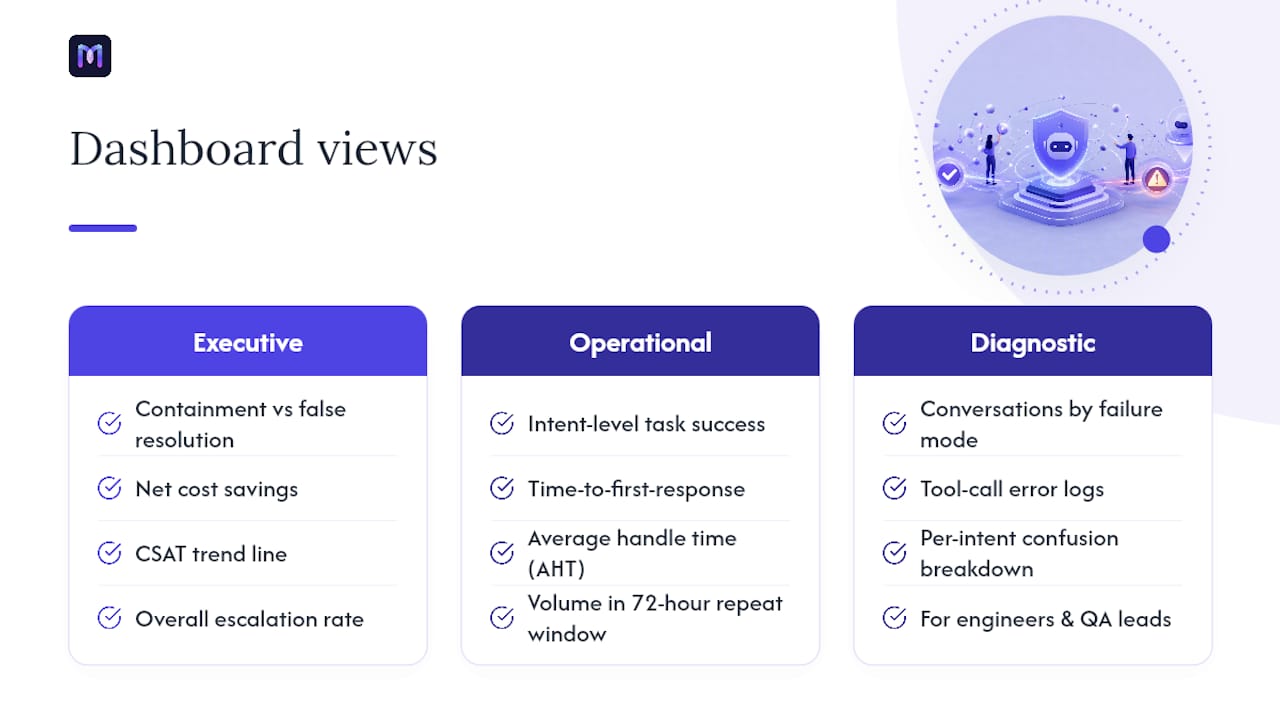
The executive view shows containment against false resolution side by side, never containment alone, plus net cost savings, the CSAT trend line, and overall escalation rate. The operational view goes deeper: intent-level task success, time-to-first-response, average handle time, and the volume of contacts landing inside that 72-hour repeat window. The diagnostic view is transcript-level: conversations filtered by failure mode, tool-call error logs, and a per-intent confusion breakdown for engineers and QA leads to dig into directly.
Cadence matters as much as content. Review operational panels daily, run rubric QA weekly, and present the executive view monthly. Set alert thresholds now rather than after an incident: a jump in false resolution past your baseline, or a drop in containment paired with rising CSAT, both deserve same-day attention. Monobot’s conversation analytics guidance covers dashboard construction for containment, CSAT, and AHT in more depth.
Governance: Who Owns Each Metric and What Gates a Release?
Assign a single owner to each KPI category before launch, not after a disagreement. Operations typically owns containment and escalation, analytics owns CSAT and cost reporting, and an AI governance function owns model behavior and drift.
- Set release gates in advance: a minimum intent accuracy, a maximum tolerable false-resolution rate, and a required QA sample pass rate before any change ships to production.
- Require approval gates for write-access tools (anything that changes an order, processes a refund, or touches billing) and roll changes out in stages rather than to 100% of traffic at once.
- Monitor for drift by versioning your training data and knowledge base snapshots, so a regression can be traced to the exact change that caused it, a practice that also supports the audit trail covered in Monobot’s AI compliance checklist.
What Most Teams Get Wrong About Chatbot Evaluation
Alex here. The biggest recurring mistake isn’t a missing metric. It’s treating containment as a finish line instead of half of a diagnostic pair. Teams under pressure to show automation ROI quietly tune bots to end conversations faster, and containment climbs while false resolution climbs right alongside it, invisibly.
The fix isn’t complicated. It’s disciplined. Rubric QA that specifically checks escalation appropriateness catches the drift weeks before repeat-contact volume would have shown it in the raw numbers, and that lead time is the entire point of building the framework this way.
Putting the Framework to Work with Monobot
Monobot gives contact-center teams a shorter path from framework to functioning dashboard, mainly because containment, escalation, and CSAT tracking are already built into the platform rather than something you bolt on after launch.
The AI agent builder lets you deploy a voice or chat assistant with non-coding customization and industry templates for healthcare, banking, retail, and logistics, so instrumentation starts on day one instead of after a quarter of manual tagging. The analytics and reporting dashboard surfaces containment against false resolution, AHT, and escalation trends in the same paired view this article recommends building, and teams supporting internal staff can apply the same rubric-based QA approach through the IT helpdesk automation use case. If you’re ready to see how the paired-KPI dashboard looks against your own call volume, book a Monobot demo and bring your current containment number. It usually tells a different story once false resolution sits next to it.
Sources
- Comprehensive Framework for Evaluating Conversational AI Chatbots
- Chatbot KPIs that prove ROI to leadership (with benchmarks)
- What metrics measure conversational AI success?
- Build Evaluate Customer Support Chatbot 2026
FAQ
What is a chatbot evaluation framework?
It’s a KPI-driven measurement and QA system for deployed voice and chat assistants, built around paired metrics like containment and false resolution rather than any single number.
What is the most important chatbot performance metric?
No single metric stands alone reliably, but containment paired with false resolution is the lead diagnostic, since containment without that pairing hides repeat contacts and low satisfaction.
How do you measure false resolution?
Track any interaction with a repeat contact within 72 hours, a post-chat CSAT below 3 out of 5, or a senior reviewer marking the outcome incorrect.
How often should QA sampling happen?
Weekly transcript sampling against a consistent rubric, covering groundedness, helpfulness, tone, and escalation appropriateness, catches drift long before it shows up in monthly KPI reports.
Can a platform like Monobot help implement this framework?
Yes. Monobot’s analytics dashboard tracks containment against false resolution, escalation rate, and CSAT in paired views, and its agent builder logs tool calls for the instrumentation this framework requires.