



For most customer service teams, the honest answer is both. Route urgent, spoken, real-time issues to a voicebot, send high-volume, asynchronous, or visual questions to a chatbot, and stitch them together with a hybrid handoff for anything that starts in one channel and escalates to the other. Gartner’s guidance backs this up: evaluate conversational AI by business outcomes like containment rate and CSAT, not by feature lists. A platform like Monobot lets you run that hybrid model from one dashboard instead of stitching together two vendors.
Here is your action map:
- Pilot voice first if phone volume is high, calls are urgent, or IVR frustration is driving complaints.
- Prioritize chat first if customers need to share screenshots, review order history, or self-serve outside business hours.
- Run a hybrid pilot if your journeys mix both, which is most contact centers today.
Quick stat: Analyst coverage of conversational AI increasingly frames voicebots and chatbots as complementary channels within one automation strategy, not competing technologies.
Key Takeaways
Voice and chat solve different problems, and the winning strategy for most contact centers is a hybrid deployment measured by containment rate, AHT, and CSAT rather than channel loyalty.
| Point | Details |
|---|---|
| Match modality to urgency | Route urgent, spoken issues to voice and high-volume asynchronous tasks to chat. |
| Latency drives voice architecture | Voice needs near-real-time speech processing; chat tolerates delay comfortably. |
| Never port scripts unchanged | Converting a chat flow to voice requires shorter sentences and confirmatory prompts. |
| Track outcome KPIs, not features | Measure containment rate, AHT, CSAT, and automation rate during any pilot. |
| Monobot unifies both channels | Monobot runs AI voice agents and chatflows on one platform with shared analytics and CRM integrations. |
Table of Contents
- Voicebot vs Chatbot: What’s the Core Difference?
- What Technical Differences Should Shape Your Architecture Decisions?
- Where Do Voicebots Actually Win for Customer Service?
- Why Do Chatbots Still Matter Next to Voicebots?
- Which Industries Fit Voice, Chat, or Both?
- How Should You Decide Between Voice, Chat, and Hybrid?
- What Does Implementation Actually Cost and Take?
- Why Monobot Fits Both Sides of This Decision
- The Bottom Line on Voice, Chat, and Hybrid
- A Publisher’s Take: Why Unified Beats Piecemeal
- See What a Unified Voice and Chat Platform Looks Like
- Sources
- FAQ
Voicebot vs Chatbot: What’s the Core Difference?
A voicebot is a speech-first assistant. It listens, processes spoken language, and replies out loud, usually over a phone line or a smart speaker. A chatbot is a text-first assistant that reads typed messages and responds in writing, on a website, an app, or a messaging platform.
The real distinction isn’t the branding. It’s the modality, and modality dictates everything downstream. Voicebots suit spoken, real-time interactions, while chatbots handle text-based self-service and asynchronous conversations better. Voice demands immediate, natural-sounding replies because silence on a call feels broken. Text tolerates a delay because the customer can glance away and come back.
That single difference in modality creates a cascade of implications:
- Hands-free access favors voice; drivers, warehouse workers, and people with visual impairments benefit most.
- Visual sharing (links, screenshots, order confirmations) only works in chat.
- Asynchronous flexibility belongs to chat, where a customer can start a conversation and finish it hours later.
| Modality | Best enables | Main limitation |
|---|---|---|
| Voice | Real-time, hands-free resolution | No visual content, higher latency sensitivity |
| Text | Visual sharing, reviewable history | Not truly hands-free, slower for urgent issues |
What Technical Differences Should Shape Your Architecture Decisions?
Latency separates the two builds more than any other engineering factor. Text can tolerate a two or three second pause without feeling broken. Voice can’t. Latency has a far greater impact on voice interactions than on text, because natural conversation depends on quick turn-taking, and a laggy voicebot sounds like a bad phone connection, not a smart assistant.
Voice also requires a longer technical stack: speech-to-text, a language model, text-to-speech, and telephony integration with the right codecs to keep audio quality clean over carrier networks. Chatbots skip most of that. They work with structured text input and a visible conversation history, which makes debugging and QA far simpler.
Context management diverges too. Voice systems need to handle interruptions and overlapping speech gracefully, since callers talk over prompts constantly. Chat systems just wait for the next message.
- Voice needs real-time inference, low-latency infrastructure, and telephony carrier agreements.
- Chat needs structured NLU, session memory, and channel integrations (web, SMS, WhatsApp).
- Converting an existing chat flow to voice without redesigning it usually fails, because spoken language needs shorter sentences, confirmations, and audio cues that text scripts don’t include.
Pro Tip: When you port a chatbot script to voice, cut every sentence to under 15 words and add a confirmatory prompt after each data collection step (“I heard $500, is that right?”). Skipping this step is the single most common reason voice pilots underperform.
Where Do Voicebots Actually Win for Customer Service?
Voicebots shine when speed, urgency, and hands-free access matter more than visual detail. They deliver human-like audio interactions and handle real-time tasks like appointment scheduling while a caller is multitasking or driving, which text simply can’t replicate.

Operationally, a well-tuned AI voice assistant can reduce average handle time on repetitive calls and improve containment on high-volume phone lines, replacing rigid IVR menus with something closer to a real conversation. Generative AI has pushed voicebots well past scripted IVR trees, letting them schedule, recommend, and execute transactions in a single call.
The trade-offs are real, though:
- Higher infrastructure and compute costs than a comparable chatbot.
- Speech-recognition accuracy drops in noisy environments or with heavy accents.
- Latency requirements mean cutting corners on infrastructure shows up immediately as a bad caller experience.
Tradeoff callout: Lower average handle time on phone volume often comes paired with higher real-time compute and telephony costs. Budget for both, not just the win.
Why Do Chatbots Still Matter Next to Voicebots?
Chatbots win on scale and cost efficiency. They handle enormous volume with low marginal latency cost, and they can share links, images, and documents that a phone call never could. Chatbots work best for FAQs, product searches, and shipping updates, especially where a reviewable transcript adds value.

Operationally, chat tends to be cheaper to run since it skips telephony fees and real-time voice compute, and it fits naturally into asynchronous workflows where a customer starts a conversation on a lunch break and finishes it that night. A chatbot deployment also tends to launch faster than a voice build, since there’s no carrier integration to negotiate.
The gaps show up in different places:
- Text feels awkward for hands-free contexts like driving or cooking.
- Some emotionally sensitive requests land better with a human voice or a live agent, not a typed script.
- Chatbots can’t help a customer who calls the main phone line, full stop.
Tradeoff callout: Asynchronous convenience is a genuine advantage, but it comes at the cost of shutting out every customer who only knows how to pick up the phone.
Which Industries Fit Voice, Chat, or Both?
Industry context decides more than preference does. Some sectors lean voice, some lean chat, and most enterprise deployments end up running both side by side.
- Banking: Voice for fraud alerts and urgent account issues; chat for balance checks and statement requests.
- Healthcare: Voice for appointment scheduling and prescription refill reminders, with HIPAA-ready handling of patient data; chat for intake forms and general clinic FAQs.
- Retail and e-commerce: Chat dominates for order tracking, product questions, and return requests; voice helps with urgent delivery issues.
- Logistics and transportation: Voice for time-sensitive delivery exceptions; chat for routine shipment status lookups.
- Contact centers generally: Voice replaces first-tier IVR menus; chat deflects repetitive tickets before they ever reach a queue.
A retail brand running a chatbot for order status alone commonly sees meaningful deflection off live agents, while a bank piloting a voicebot for card-lost reporting can cut average call handling time on that single flow substantially. The pattern across industries is consistent: match the channel to the urgency and complexity of the task, not to whichever tool is trendiest.
How Should You Decide Between Voice, Chat, and Hybrid?
Start with data, not instinct. Here’s a workable sequence:
- Pull your channel analytics. Which contact reasons come in by phone versus web chat versus email today?
- Profile volume and urgency. High-volume, low-urgency issues favor chat; low-volume, high-urgency issues favor voice.
- Survey customer preference. Some demographics and use cases skew heavily toward one channel.
- Map integration requirements. Does the flow need CRM lookups, telephony routing, or ticketing system access?
- Design the escalation path. Decide upfront when a bot hands off to a human agent, and how.
Before signing with any vendor, ask these questions:
- Which telephony carriers and codecs are supported out of the box?
- How is training data collected, and who owns it after the contract ends?
- What does the escalation flow look like when a customer needs a live agent?
- Are there industry-specific templates for regulated sectors like healthcare or finance?
Track these KPIs from day one:
- Containment rate — the percentage of interactions the bot resolves without human help.
- Average handle time (AHT) — how long the full resolution takes, bot or human.
- CSAT — post-interaction satisfaction score.
- Automation rate — the share of total volume the bot touches at all.
- Cost per interaction — blended cost across compute, telephony, and staffing.
Run pilots for four to eight weeks on a single, well-defined flow before expanding. A pilot that can’t hit a meaningful lift in containment or a measurable CSAT improvement in that window usually needs a redesign, not more time.
What Does Implementation Actually Cost and Take?
A realistic MVP timeline runs through five phases: discovery, conversation design, model training, integration, and launch. Chat MVPs often move faster since there’s no telephony carrier negotiation involved; voice MVPs take longer because carrier setup and speech-model tuning add real time.
Cost drivers differ by channel:
- Telephony and carrier fees apply to voice only, and they scale with call volume.
- Real-time compute for speech recognition and generation is voice’s biggest recurring cost.
- Integration complexity (CRM, ticketing, analytics dashboards) affects both channels roughly equally.
- Maintenance and retraining costs rise with the number of distinct intents you support.
Staffing shifts during rollout too. Expect to reassign, not eliminate, some frontline agents toward reviewing bot transcripts and handling escalations in the first 90 days.
Why Monobot Fits Both Sides of This Decision
Monobot builds voice and chat agents on one platform instead of forcing you to stitch together separate vendors for each channel. That matters because the decision framework above rarely ends with “voice only” or “chat only.” It ends with both, deployed with shared analytics and a consistent escalation flow.
The platform includes AI voice agents, chatflows, real-time analytics, and integrations with CRM, telephony, and ticketing systems, plus industry templates for healthcare, banking, retail, and logistics. Monobot’s automation model is built to handle a large share of inbound calls and chats without human intervention, freeing agents for the complex cases that need them.
Before a demo, ask about supported telephony carriers, HIPAA-ready templates if you’re in healthcare, pilot SLA terms, and what the analytics dashboard actually surfaces day one.
The Bottom Line on Voice, Chat, and Hybrid
Most contact centers land on a hybrid model: voice for urgent phone volume, chat for high-volume asynchronous tasks, with clear escalation between them.
Three things to do in the next 30 days:
- Pull your channel analytics and identify your top three contact reasons.
- Pilot one voice flow and one chat flow on your highest-volume, lowest-complexity issue.
- Schedule a Monobot demo to see how both channels run from a single dashboard.
A Publisher’s Take: Why Unified Beats Piecemeal
Running voice and chat as separate vendor relationships creates friction that shows up in every escalation. A customer starts in chat, gets bounced to a phone queue, and repeats their entire problem to a new system that has no memory of the first conversation. That’s a design failure, not a customer service failure.
A unified platform fixes that by sharing context across channels and letting agents see the full history regardless of where it started. It also changes what “workforce impact” means. Agents shift from repetitive intake work toward reviewing escalations and coaching the bot’s weak spots. None of this replaces a human for a genuinely distressed or complex case. Bots should route those to a person fast, not try to script empathy they can’t deliver.
See What a Unified Voice and Chat Platform Looks Like
You’ve just read the trade-offs between building separate voice and chat systems versus running both from one place. A Monobot demo shows exactly what that looks like in practice: sample voice and chat flows built from your own website content, live integrations with your CRM and telephony provider, and a walkthrough of the analytics dashboard that tracks containment, AHT, and CSAT in one view.
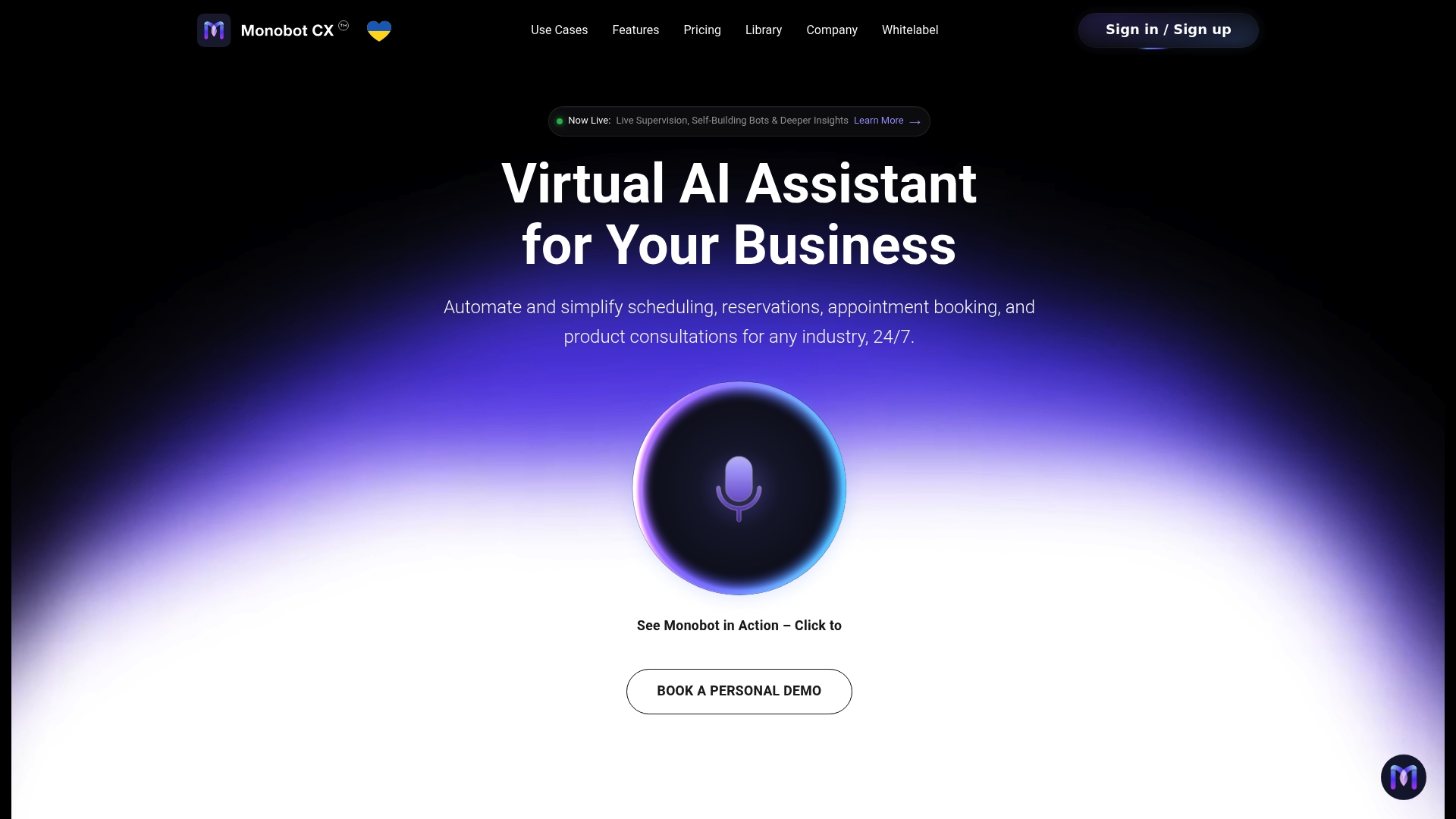
Deployment starts from industry-specific templates for healthcare, banking, retail, and logistics, which is why most pilots go live in minutes rather than months. During the demo, you’ll also get a pilot proposal scoped to your highest-volume contact reason, not a generic feature tour. Try the AI voice and chat agent builder and book a demo to see your first flow built live.
Sources
- Voice Bot vs Chatbot: Key Differences, Benefits & Use Cases
- Voice bot vs. chatbot: What’s the difference and why does it matter?
- Chatbot vs voicebot: Which one is better for you? | The Jotform Blog
- Gartner
FAQ
What Is a Voicebot?
A voicebot is an AI-powered assistant that understands spoken language and responds with synthesized speech, typically over a phone line or voice-enabled device, to handle tasks like scheduling or account inquiries.
What Are the Four Types of Chatbots?
Chatbots are commonly grouped into rule-based (menu-driven), keyword-recognition, AI-powered/NLU-based, and hybrid chatbots that combine scripted flows with AI understanding for more flexible conversations.
What Is the Difference Between a Bot and a Chatbot?
A bot is any automated software agent that performs tasks without human input, while a chatbot is specifically a bot designed to hold text-based conversations with people.
What Is an AI Voicebot?
An AI voicebot uses speech recognition, natural language understanding, and text-to-speech to hold spoken conversations, handling tasks like appointment booking or support inquiries without a live agent. Platforms like Monobot build these as customizable AI voice agents that integrate directly with existing telephony and CRM systems.
Is Chat or Voice Better for Customer Service?
Neither wins universally. Chat suits high-volume, asynchronous, and visual tasks, while voice suits urgent, hands-free, or emotionally sensitive interactions, which is why most contact centers deploy both.