



TL;DR:
- BPO chat automation uses AI agents to handle up to 80 percent of routine customer interactions across various channels. These systems connect to live data, execute multi-step tasks, and escalate only when necessary, improving efficiency and responsiveness. Hybrid models combine AI with human oversight, focusing human effort on complex or emotional cases.
BPO chat automation is defined as the use of AI-driven conversational agents to handle customer interactions across channels like WhatsApp, web chat, and voice without requiring human agents for routine tasks. The best examples of BPO chat automation show that up to 80% of routine interactions can be resolved automatically, with sub-3 second response times and 24/7 availability. Platforms like Monobot and agentic AI frameworks are setting the standard for what automated chat systems can accomplish in 2026. The industry term for this category is conversational process automation, though BPO professionals use both terms interchangeably.
1. What are the most effective examples of BPO chat automation?
The most effective automated chat systems in BPO today go well beyond scripted FAQ responses. They connect to live databases, execute multi-step tasks, and escalate to humans only when genuinely necessary. The examples below represent the current state of the art.
WhatsApp AI agent for end-to-end order management
The Bandbox WhatsApp AI agent is one of the clearest real-world examples of chatbots in BPO delivering measurable results. The agent automates order booking, status checks, and pricing queries, logs every transaction in real-time Google Sheets, and replies in under 3 seconds. When a complaint requires escalation, the agent alerts a manager with full conversation context already attached. No staff involvement is needed for the majority of interactions.

This model works because it treats WhatsApp as a full service channel, not just a notification tool. Customers get instant answers at any hour, and managers only see cases that genuinely need judgment.
Multi-Agent Orchestration for complex inquiry resolution
Multi-Agent Orchestration frameworks coordinate four specialized AI agents: a routing agent, a context retrieval agent, an execution agent, and a communication agent. Each handles one layer of the interaction. Together, they resolve inquiries autonomously and escalate only when necessary, passing a summarized context to the human agent who takes over.
This architecture removes the single-point-of-failure problem that plagues simpler bots. When one agent cannot resolve a step, the orchestration layer reroutes rather than failing the entire interaction.
Hybrid AI-human workflows
Hybrid models pair AI automation with human oversight. AI handles FAQs, order tracking, and routine transactions. Human agents act as AI pilots, monitoring exception queues and stepping in for complex or emotional cases. This model maximizes both speed and judgment quality.
The key distinction from older models is that humans are no longer primary responders. They are exception handlers who review AI decisions and intervene when accuracy or empathy demands it.
- End-to-end WhatsApp automation: Order intake, status updates, complaint escalation, and real-time data logging without staff involvement.
- Multi-agent orchestration: Specialized agents for routing, context, execution, and communication working in sequence.
- Hybrid AI-human model: AI manages volume; humans manage exceptions and edge cases.
- Voice and chat integration: Platforms like Monobot handle both inbound calls and chat through a single AI agent builder, reducing tool sprawl.
Pro Tip: When evaluating BPO chat solutions, require a live demo that shows escalation behavior. The quality of the handoff to a human agent reveals more about a platform’s maturity than its FAQ resolution rate.
2. How do agentic AI workflows transform traditional BPO chat automation?
Traditional BPO chatbots follow decision trees. They match keywords to scripted responses and fail the moment a customer’s request falls outside the predefined flow. Agentic AI workflows use reasoning loops to interpret complex intent and execute multi-step backend tasks autonomously. That is a fundamental shift in what automation can do.
The role of AI pilots and exception handlers
In agentic models, human agents no longer answer every ticket. They oversee exception queues, verify AI decisions on high-risk cases, and handle interactions requiring emotional intelligence. This role is called the AI pilot. The AI pilot does not replace the human agent. It redefines what the human agent’s time is worth.
“The shift in BPO is from descriptive chatbots to agentic AI workflows that autonomously interpret intent and handle complex multi-system tasks.” — Philstar Business
Outcome-based pricing as a business model signal
Outcome-based pricing replaces hourly billing in mature BPO automation strategies. Providers are rewarded for resolution improvements, not call volume. This model only works when automation is reliable enough to be measured by outcomes. It signals that a BPO operation has moved past experimentation and into production-grade deployment.
- Fraud detection automation: AI agents flag suspicious transactions, apply provisional holds, and generate case summaries without waiting for a human review cycle.
- Autonomous case summarization: Before escalation, the AI drafts a full case summary so the human agent starts with context, not a blank screen.
- Multi-system execution: A single customer request can trigger actions across CRM, billing, and logistics systems in one conversation turn.
3. What tools and integrations power BPO chat automation workflows?
The technology stack behind effective BPO customer support automation includes AI platforms, APIs, and in some cases Robotic Process Automation (RPA) for legacy systems. Choosing the right combination determines how far your automation can reach.
AI platforms embedded in collaboration tools
Monobot embeds AI voice and chat agents into existing workflows, enabling BPO teams to automate client delivery, billing inquiries, and support interactions without rebuilding their tech stack. The platform supports no-code customization, which means deployment can happen in minutes rather than months. Its integration hub connects to third-party APIs, databases, and communication channels from a single interface.
API-driven live data responses
Connecting chat agents to APIs like Shopify or Stripe allows the bot to pull real-time order data, payment status, and account information during a conversation. This is what separates a genuinely useful BPO chat solution from a glorified FAQ page. Without live data access, the bot cannot answer the questions customers actually ask.
RPA for legacy system integration
Many BPO operations run on legacy platforms that lack modern APIs. Robotic Process Automation fills that gap by scripting interactions with older interfaces. RPA acts as a translation layer between the AI agent and systems that were never designed for automation. It is not elegant, but it works reliably for high-volume, rule-based tasks.
- Map your API landscape first. Identify which systems hold the data your customers ask about most often.
- Use RPA only where APIs are unavailable. RPA adds maintenance overhead; prefer native integrations when possible.
- Build specialized agents for distinct task types. A single general-purpose bot performs worse than three focused agents working in sequence.
- Connect analytics to every automation flow. Monobot’s dashboard analytics surface resolution rates, escalation triggers, and response latency in real time.
Pro Tip: Before selecting a BPO chat automation tool, test its behavior when an API call fails mid-conversation. Graceful degradation, not a hard error, is the mark of a production-ready system.
4. What are best practices for implementing BPO chat automation effectively?
Successful BPO AI deployments start with Tier-0 and Tier-1 interactions: password resets, order tracking, appointment scheduling, and balance inquiries. These are high-volume, rule-based, and low-risk. Starting here builds confidence, surfaces data quality issues early, and creates a governance foundation before you tackle complex workflows.
Knowledge base quality determines automation quality
The accuracy of your knowledge base directly controls how well your chat agents perform. Poorly structured knowledge bases produce confident wrong answers, which damages customer trust faster than no automation at all. Invest in intent routing accuracy before expanding automation scope. A well-structured knowledge base is the single highest-leverage asset in any BPO chat automation program.
Where AI still requires human backup
AI handles volume well. It handles emotional nuance poorly. Customers dealing with billing disputes, service failures, or sensitive account issues expect empathy and judgment that current LLMs cannot reliably deliver. AI is most effective as an augmentation layer, supporting human agents with real-time suggestions and knowledge during live interactions rather than replacing them entirely in high-stakes conversations.
- Start with Tier-0 and Tier-1 processes. Build automation confidence before tackling complex workflows.
- Audit your knowledge base quarterly. Outdated information is the most common cause of AI escalation failures.
- Train human agents as AI pilots. They need to understand when and how to override AI decisions.
- Monitor escalation rates weekly. A rising escalation rate signals a knowledge gap or an intent routing problem, not a technology failure.
- Set governance rules before go-live. Define which case types the AI can close autonomously and which require human sign-off.
Pro Tip: Track your “wrong answer rate” separately from your escalation rate. An AI that confidently gives wrong answers without triggering escalation is more damaging than one that escalates too often.
Key takeaways
BPO chat automation delivers the highest return when agentic AI workflows, quality knowledge bases, and hybrid human oversight are combined from the start.
| Point | Details |
|---|---|
| Start with Tier-0 and Tier-1 | Automate password resets and order tracking before tackling complex workflows. |
| Agentic AI outperforms scripted bots | Reasoning-loop AI resolves multi-step tasks that decision-tree bots cannot handle. |
| Hybrid models maximize outcomes | AI manages volume; human agents handle exceptions and emotionally sensitive cases. |
| API integration is non-negotiable | Live data access separates genuinely useful chat agents from glorified FAQ bots. |
| Outcome-based pricing signals maturity | BPO operations ready for this model have moved from experimentation to production-grade automation. |
Why the BPO automation conversation is still getting it wrong
The industry talks about automation as if the primary goal is headcount reduction. That framing leads to bad decisions. The BPO operations I have watched succeed with chat automation were not trying to eliminate agents. They were trying to give agents better problems to solve.
The Bandbox WhatsApp case is instructive here. The automation did not replace a team. It removed the repetitive work that was burning out a team. The agents who remained became more effective because they only handled cases that required actual judgment. That is the model worth replicating.
What concerns me about the current wave of agentic AI adoption is the speed at which BPO leaders are skipping the knowledge base work. You cannot build a reliable reasoning agent on top of a poorly organized knowledge base. The AI will hallucinate with confidence, and your customers will notice before your metrics do.
My advice for BPO decision-makers is direct: treat your knowledge base as infrastructure, not content. Audit it before you deploy anything. Then start small, measure escalation rates obsessively, and expand scope only when your Tier-1 automation is performing cleanly. The technology is ready. The data usually is not.
— Alex
Monobot’s AI platform for BPO chat and voice automation
BPO teams ready to move from proof-of-concept to production-grade automation need a platform built for that transition. Monobot’s BPO optimization solutions cover AI voice agents, chat agents, and multi-step automation flows designed specifically for high-volume customer service environments.
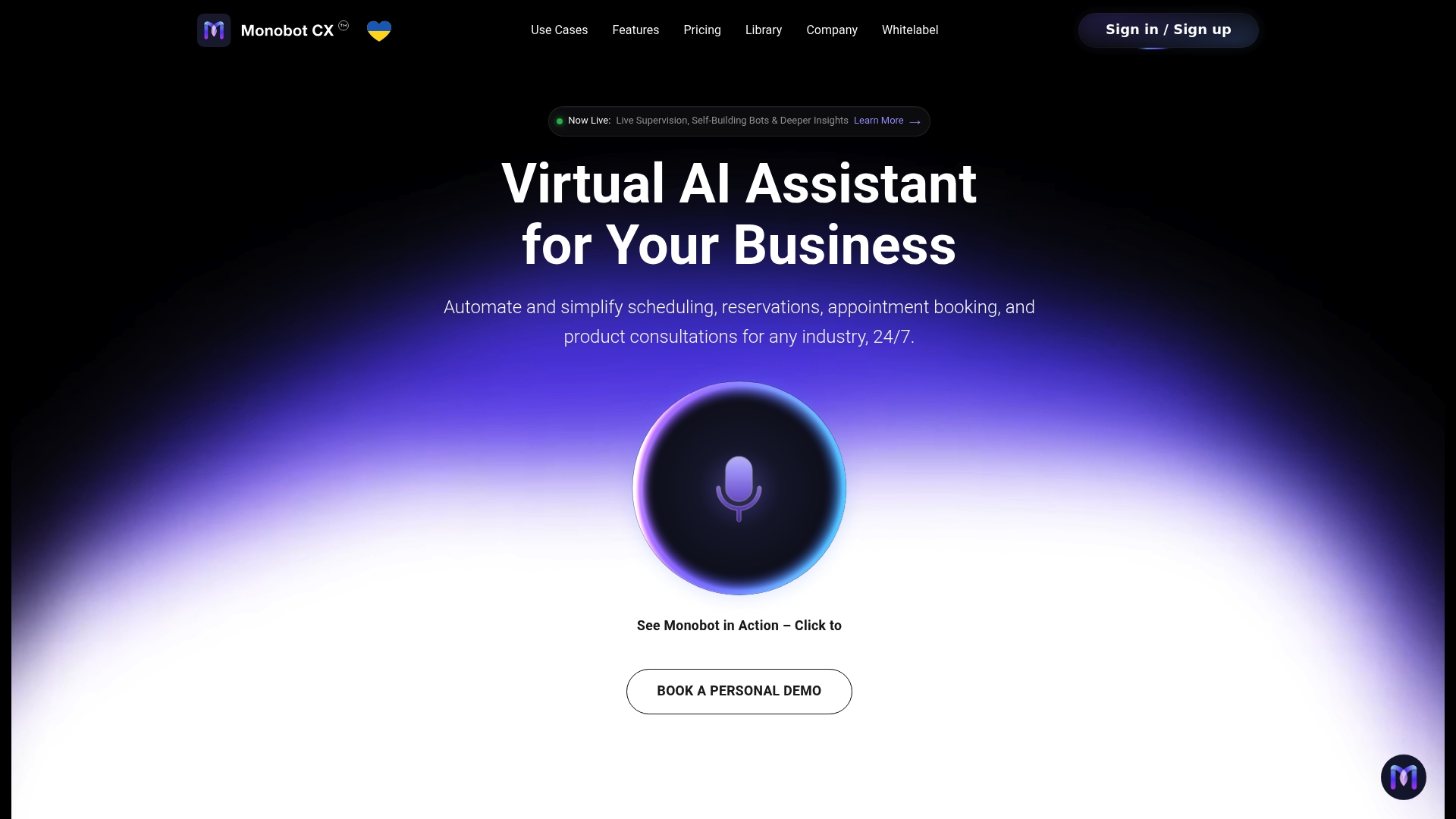
The platform handles up to 80% of routine inbound interactions without manual work, integrates with your existing APIs and CRM tools, and gives your team real-time analytics to track resolution rates and escalation patterns. No-code customization means your team can adjust agent behavior without waiting on a development sprint. If you are evaluating chatbot solutions for BPO, Monobot is built for the scale and complexity your operation demands.
FAQ
What is BPO chat automation?
BPO chat automation is the use of AI-powered conversational agents to handle customer inquiries, order tracking, and support tasks across channels like WhatsApp and web chat without requiring human agents for routine interactions.
How much of BPO customer support can be automated?
Up to 80% of routine BPO interactions can be automated using structured knowledge bases and API integrations, with responses delivered in under 3 seconds around the clock.
What is the difference between a scripted chatbot and an agentic AI workflow?
Scripted chatbots follow fixed decision trees and fail outside predefined flows. Agentic AI workflows use reasoning loops to interpret complex intent and execute multi-step backend tasks autonomously.
Where should BPO teams start with chat automation?
Start with Tier-0 and Tier-1 processes such as password resets and order tracking. These high-volume, rule-based interactions build governance and confidence before you automate more complex workflows.
What is a hybrid AI-human model in BPO?
A hybrid model pairs AI automation with human oversight. AI resolves routine transactions while human agents act as AI pilots, managing exception queues and handling cases that require emotional judgment or complex decision-making.