



Real-time analytics in contact centers give supervisors immediate visibility into live queue health, agent performance, and customer sentiment, enabling decisions that change outcomes within the same shift. Unlike post-call reporting, which tells you what went wrong after the fact, real-time contact center analytics surface problems while you can still fix them. The core metrics monitored include abandonment rates, first-contact resolution (FCR), average handle time (AHT), service level attainment, and agent occupancy. These live signals feed intraday feedback loops where supervisors spot an abandonment spike, identify the cause, and adjust staffing or routing before the hour is out.
Key operational signals tracked in real time:
- Queue abandonment rate and average speed to answer (ASA)
- Agent occupancy and availability across channels and skill groups
- Customer sentiment scores during active conversations
- FCR and repeat contact rates measured intraday
- Service level attainment against defined thresholds
The difference between a contact center that reacts and one that adapts comes down to whether analytics are wired to action, not just display.
What core capabilities do real-time analytics platforms provide?
A real-time analytics platform for call centers is only as useful as the infrastructure underneath it. The foundational requirement is sub-second data streaming rather than periodic API polling. Refresh-based systems that update every few minutes are near-real-time at best, and they cannot support live mid-call interventions.
Beyond latency, the capabilities that matter most in practice include:
- Live dashboards showing queue depth, agent status, channel volumes, and sentiment scores updated continuously
- Configurable alerts that fire when abandonment, handle time, or sentiment cross defined thresholds
- Agent monitoring views that let supervisors see ongoing conversations, intervene, or transfer interactions without disrupting the customer
- CRM and workforce management (WFM) integration for unified visibility, personalized interactions, and dynamic scheduling
- Customizable filters by queue, channel, agent, skill group, or conversation status
- AI-driven agent assist delivering live prompts, compliance reminders, and next-best-action suggestions during calls
Platforms like Microsoft Dynamics 365 Customer Service surface these through structured reports: Summary, Voice, Agents, Ongoing Conversation, and Bot views, each filterable by queue or agent. The goal is not more dashboards. The goal is giving every supervisor a clear line from data to decision.
10 real-time analytics use cases in contact centers
1. Intraday performance management
Intraday performance management is where real-time analytics deliver the fastest, most visible returns. The workflow is straightforward: an alert fires when abandonment rises, sentiment drops, or handle time spikes. The supervisor investigates the cause, whether it is an intent surge, a staffing gap, or a system issue, then acts by moving agents, updating routing, or triggering a callback offer. Operational improvements show up the same day, which makes this the clearest quick win in contact center analytics.

2. Real-time quality assurance and compliance monitoring
Manual QA sampling covers a fraction of interactions. Automated real-time QA expands coverage across every call and flags compliance deviations, script adherence failures, or policy disclosure gaps as they happen. In regulated industries like financial services and healthcare, this is not optional. The added benefit is that coaching becomes tied to specific, timestamped moments rather than vague post-call impressions.
3. Customer sentiment and emotion detection
Sentiment analysis during live calls identifies frustration or satisfaction in real time, helping agents adjust tone or escalate before a situation deteriorates. Sentiment tracking also surfaces silent failures: customers who disengage without complaining, or who are heading toward churn without signaling it directly. When integrated with supervisor dashboards, a sentiment drop on multiple simultaneous calls can trigger an immediate team-wide alert.
4. Workforce optimization and dynamic staffing
Real-time analytics give WFM teams the live signal they need to act on intraday staffing gaps rather than waiting for the next scheduled review. When queue depth climbs and occupancy hits ceiling, supervisors can pull agents from lower-priority queues, authorize overtime, or activate overflow routing, all based on live data rather than forecasts made hours earlier. This use case pairs naturally with intelligent automation to handle routine contacts and free agents for complex interactions.

5. Real-time agent assist with AI-driven prompts
True real-time agent assist requires millisecond-latency streaming to surface live prompts, compliance reminders, and knowledge base suggestions while the call is still happening. Refresh-based systems cannot do this. When implemented correctly, agent assist reduces handle time, improves FCR, and lowers the risk of compliance errors without requiring agents to pause and search for information manually.
6. Root cause analysis and first-contact resolution improvement
FCR problems rarely have a single cause. Real-time analytics help supervisors connect the dots between intent spikes, routing failures, and knowledge gaps as they emerge, rather than discovering the pattern in a weekly report. When a cluster of calls on the same topic shows low FCR intraday, supervisors can push a knowledge fix or adjust routing before the issue compounds across the full day.
7. Self-service optimization and escalation management
When customers abandon self-service and escalate to an agent, that escalation carries data. Real-time analytics capture the intent, the drop-off point, and the escalation reason, giving operations teams the information they need to fix the self-service flow rather than just absorb the volume. Measuring good containment, meaning resolution rather than raw deflection, is the standard that separates effective self-service programs from ones that simply push customers away.
8. Journey friction detection
Contact centers often see journey failures before any other part of the business does. A billing update, a policy change, or a mobile app release can generate a contact surge within hours. Real-time analytics link those volume patterns to specific intents, letting operations teams identify the systemic cause and route the insight to the team that can fix it. The metric to watch is repeat contacts for the same reason within a short window.
9. Upsell and cross-sell detection during live conversations
Sentiment and intent signals during a call can indicate when a customer is receptive to an offer. Real-time analytics platforms surface these moments to agents as prompts, increasing the likelihood of a relevant offer at the right point in the conversation. This use case works best when CRM data is integrated, giving agents full context on the customer’s history before the prompt fires.
10. Sector-specific applications in healthcare, finance, and retail
Healthcare contact centers use real-time analytics to monitor appointment scheduling queues, flag compliance language in patient interactions, and detect distress signals that require immediate escalation. Financial services teams apply live compliance monitoring to every call, with alerts for missing disclosures or high-risk conversation patterns. Retail operations use real-time queue data and sentiment scoring to manage peak periods, such as product launches or post-holiday return surges, without letting abandonment rates climb. Each sector has its own regulatory and operational pressures, but the underlying analytics infrastructure is the same.
What operational benefits does real-time analytics deliver?
The measurable gains from real-time contact center analytics are well documented. Real-time queue monitoring has reduced abandonment significantly, while dynamic staffing adjustments during peaks have improved first-contact resolution considerably. These are not theoretical improvements. They come from connecting live data to specific operational decisions.
The broader benefits across operations include:
- Faster incident response: supervisors detect and act on service degradation in minutes, not hours
- Higher agent performance: live coaching tied to specific call moments is more effective than end-of-day feedback
- Better resource utilization: intraday staffing adjustments reduce idle time and prevent queue overflow simultaneously
- Compliance risk reduction: automated real-time QA catches deviations before they become regulatory incidents
- Greater transparency: operations leaders get a live view of the entire contact center, not a snapshot from last night’s report
- Improved customer satisfaction: faster resolution, lower wait times, and better-informed agents all contribute directly to CSAT scores
The key shift is treating real-time analytics as a management system rather than a reporting layer. When every alert has a defined response and every dashboard has a clear owner, the data translates into outcomes.
How do you overcome the challenges of implementing real-time analytics?
Implementation challenges are real, and most of them are organizational rather than technical. The most common obstacles include:
- Data integration complexity: connecting CRM, WFM, and QA systems into a unified real-time view requires careful API architecture and ongoing maintenance
- Analysis paralysis: displaying too many metrics without clear action protocols leads to supervisors watching dashboards without acting on them
- Latency confusion: many vendors describe refresh-based reporting as “real-time” when it updates every two to five minutes, which is insufficient for live agent assist or mid-call interventions
- Staff readiness: supervisors and agents need training not just on how to read live data, but on what to do when specific alerts fire
- Data privacy and governance: real-time processing of voice and chat data must comply with regulations like HIPAA, PCI-DSS, and state-level privacy laws, requiring clear data handling policies and access controls
- Siloed teams: when QA, WFM, and operations work in separate systems with separate reporting, real-time insights rarely reach the people who can act on them
The solution to most of these is not a better dashboard. It is a defined intraday feedback loop with clear roles, escalation paths, and decision authority.
Pro Tip: Before you go live with any real-time analytics platform, map out exactly who owns each alert type, what action they are authorized to take, and how fast they are expected to respond. Without that protocol, even the best data sits unused.
Governance deserves specific attention. Real-time voice analytics that process personally identifiable information (PII) must have automated redaction, role-based access controls, and audit trails built in from day one. Retrofitting compliance into a live system is far more costly than designing it in upfront.
What does the research say about real-time analytics effectiveness?
The evidence for real-time analytics in U.S. contact centers points consistently in one direction: the value is in the action, not the display. Connecting data to decisions through intraday feedback loops is what separates high-performing operations from those that collect data without changing outcomes. Passive dashboards, no matter how well designed, do not move service levels on their own.
On the technical side, operations leaders should verify that any platform they evaluate supports true streaming data with sub-second latency rather than periodic polling. This distinction determines whether the system can support live agent assist or only post-interaction reporting.
Key findings that inform implementation decisions:
- Intraday performance management, QA at scale, and self-service optimization deliver the fastest ROI because they have short feedback cycles and clear operational levers
- CRM and WFM integration is a prerequisite for unified visibility and the personalized, context-aware interactions that drive CSAT
- Journey friction detection and VoC feedback loops deliver larger long-term gains but require cross-team coordination and longer measurement windows
- Compliance monitoring delivers fast ROI by reducing downside risk, particularly in healthcare and financial services
The measurement framework matters as much as the platform. Track abandonment, ASA, service level attainment, intraday FCR, and time-to-detect for major spikes. If those metrics do not move after implementation, the system is likely delivering near-real-time reporting rather than true live analytics.
Monobot gives your contact center live data and AI agents in one platform
Contact center managers who want real-time analytics paired with AI agents that actually handle interactions, not just report on them, get both with Monobot. Where most analytics tools stop at the dashboard, Monobot’s real-time analytics dashboard connects live performance data directly to AI voice and chat agents that resolve routine contacts automatically, freeing your team to focus on the interactions that need a human.
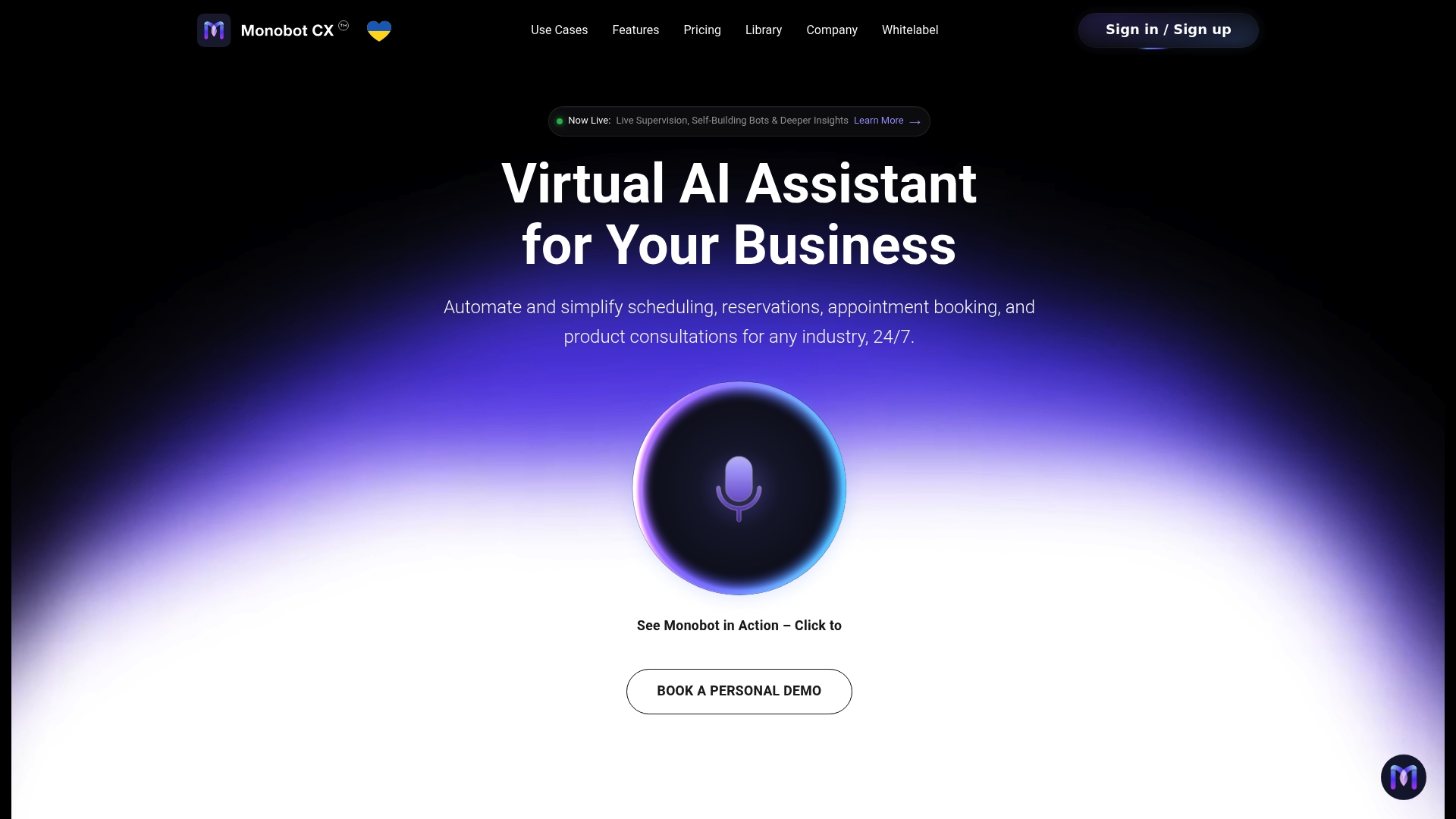
Monobot automates up to 80% of inbound calls and chats, with AI agents built from your existing workflows using no-code configuration and deployed in minutes. The platform’s AI agent builder lets you create custom voice agents for healthcare, retail, finance, and more, each backed by live analytics that show exactly how those agents are performing right now, not in yesterday’s report. Your supervisors get granular visibility into queue health, sentiment, and FCR in real time, while Monobot handles the volume that would otherwise overwhelm your team. Schedule a demo at monobot.ai to see the platform in action.
FAQ
What is real-time analytics in a contact center?
Real-time analytics in a contact center is the continuous processing and display of live operational data, including queue depth, agent status, and customer sentiment, enabling supervisors to make decisions during active interactions rather than after them.
How much can real-time analytics reduce abandonment rates?
Real-time queue monitoring has reduced abandonment rates by up to 25% through dynamic staffing adjustments and alert-triggered routing changes applied during the same shift.
What is the difference between real-time and near-real-time analytics?
True real-time analytics use sub-second streaming data to support live interventions like mid-call agent coaching, while near-real-time systems refresh every few minutes and are only suitable for monitoring, not live action.
Which real-time analytics use cases deliver the fastest ROI?
Intraday performance management, automated QA at scale, and self-service optimization typically deliver the fastest ROI because each has a short feedback cycle and a clear operational lever that supervisors can pull immediately.
How does Monobot support real-time analytics in contact centers?
Monobot combines a live analytics dashboard with AI voice and chat agents that handle routine contacts automatically, giving supervisors real-time visibility into performance while the platform reduces inbound volume and improves first-contact resolution.
Key Takeaways
Real-time analytics in contact centers deliver measurable gains only when live data is connected to defined action protocols, not just displayed on a dashboard.
| Point | Details |
|---|---|
| Abandonment and FCR impact | Real-time queue monitoring reduces abandonment by up to 25% and improves FCR through intraday staffing adjustments. |
| True real-time requires streaming | Sub-second latency streaming is required for live agent assist; refresh-based systems updating every few minutes cannot support mid-call interventions. |
| Fastest ROI use cases | Intraday performance management, QA at scale, and self-service optimization deliver results within days because their feedback cycles are short and levers are clear. |
| Action protocols over dashboards | Defining who owns each alert and what action they take is the single most important implementation step, more than the platform itself. |
| Monobot’s approach | Monobot pairs a real-time analytics dashboard with AI agents that automate up to 80% of inbound contacts, connecting live data to automated resolution in one platform. |