



The strongest mono.co alternatives for US fintech integrations are Salt Edge, Bridge, BankingSDK, Okra, and Stitch. Each covers a distinct combination of geographic reach, compliance credentials, and developer tooling that Mono’s Africa-first footprint does not address. Whether you need PSD2-licensed European connectivity, US bank coverage, or deep African open banking data, the right aggregator depends on your target market and product roadmap, not on which platform has the most name recognition.
Mono itself is an open banking platform acquired by Flutterwave, covering Nigeria, Ghana, and Kenya with connections to 30+ financial institutions. Developers move to competitors when they need coverage outside that footprint, more specialized KYC workflows, or payment initiation alongside data access. The table below maps the 26 leading alternatives across the dimensions that matter most for integration decisions.
| Provider | Geographic Coverage | Compliance/Licensing | Pricing Structure | Key Features | Developer Experience | Best For |
|---|---|---|---|---|---|---|
| BankingSDK | US, Europe, international | PSD2, Open Banking UK | Per API call / subscription | Modular AIS, PIS, sandbox | Strong portal, sandbox | US and international fintech |
| BankSync | US, Europe | Varies by region | Per connected account | Bank statement parsing, reconciliation | Good documentation | Accounting integrations |
| BanqUP | Multi-country Europe | PSD2 compliant | Subscription | AIS, PIS, multi-market | Wide reach | Multi-market fintechs |
| Bridge | US, Europe | Licensed | Per API call | Payment initiation, data access | Excellent docs | Payment + data products |
| Budget Insight | Europe | Full PSD2 licensed | Subscription | AIS, security certs | Solid | US fintechs entering Europe |
| enable:Banking | Europe | PSD2 | Per call / subscription | AIS, PIS | Clear API docs | European bank integrations |
| Enfuce | Europe | Licensed | Subscription | Credit scoring, payments | Modular | Credit + banking data |
| Equens Worldline | Europe, enterprise | Licensed, enterprise-grade | Enterprise pricing | Payment processing, AIS | Enterprise APIs | Large-scale payment ops |
| Fintecture | Europe | Licensed | Per transaction | Direct payment initiation | Clean docs | Fast payment integrations |
| Ibanity | Multi-country Europe | PSD2 | Subscription | Unified API, AIS, PIS | Strong compliance tools | Multi-country EU access |
| Lean | MENA, expanding | Varies | Per call | AIS, payments | Developer-focused | Startups, quick onboarding |
| Lunch Flow | Regional | Varies | Tiered | Data aggregation, payments | Medium | SMB fintech developers |
| Neonomics | Pan-European | PSD2 | Subscription | Wide EU connectivity | Compliance-focused | EU banking connectivity |
| OpenWrks | UK, Europe | PSD2, UK licensed | Subscription | AIS, comprehensive docs | Verified compliance | UK/EU licensed services |
| Salt Edge | Global, multi-region | Multi-jurisdiction | Tiered subscription | Extensive bank network, AIS | Wide coverage | Multinational fintechs |
| Flutterwave | Africa, global | Licensed | Per transaction | Payments, cross-border, APIs | Versatile | Africa-centric payments |
| CreditChek | Africa | Varies | Per query | Credit data, risk analytics | Analytics-focused | Credit scoring in Africa |
| Stitch | Africa (SA focus) | Licensed | Per connected account | AIS, payments, data | Reliable APIs | African market developers |
| Pngme | Africa, emerging markets | Varies | Subscription | ML-ready data, insights | Feature-building tools | Credit scoring, analytics |
| Zeeh | Kenya, Ghana, Nigeria | Varies | Per call | Last-mile banking data | Local support | East African markets |
| PiggyVest | Nigeria | Varies | Platform-based | Savings, investment data | User-centric | Savings-focused fintechs |
| OnePipe | Nigeria, Africa | Varies | Per API call | Cross-sector finance APIs | Solid docs | Cross-industry finance |
| Interswitch | Nigeria, Africa | Licensed | Enterprise | Payment switching, processing | Infrastructure-grade | Enterprise payment ops |
| Paga | Nigeria, Africa | Licensed | Per transaction | Multi-currency payments | Broad method support | Comprehensive payments |
| Paystack | Nigeria | Licensed | Per transaction | Card, bank transfer, mobile | Easy integration | Nigerian payment APIs |
| Okra | Nigeria, Africa | Licensed | Per connected account | Financial data, AIS | Consistent data accuracy | African financial data |
How do the leading mono.co alternatives compare in depth?
The providers above split into three clear clusters: European-licensed aggregators, African open banking specialists, and global platforms with multi-region reach. Understanding where each cluster excels saves you weeks of vendor evaluation.
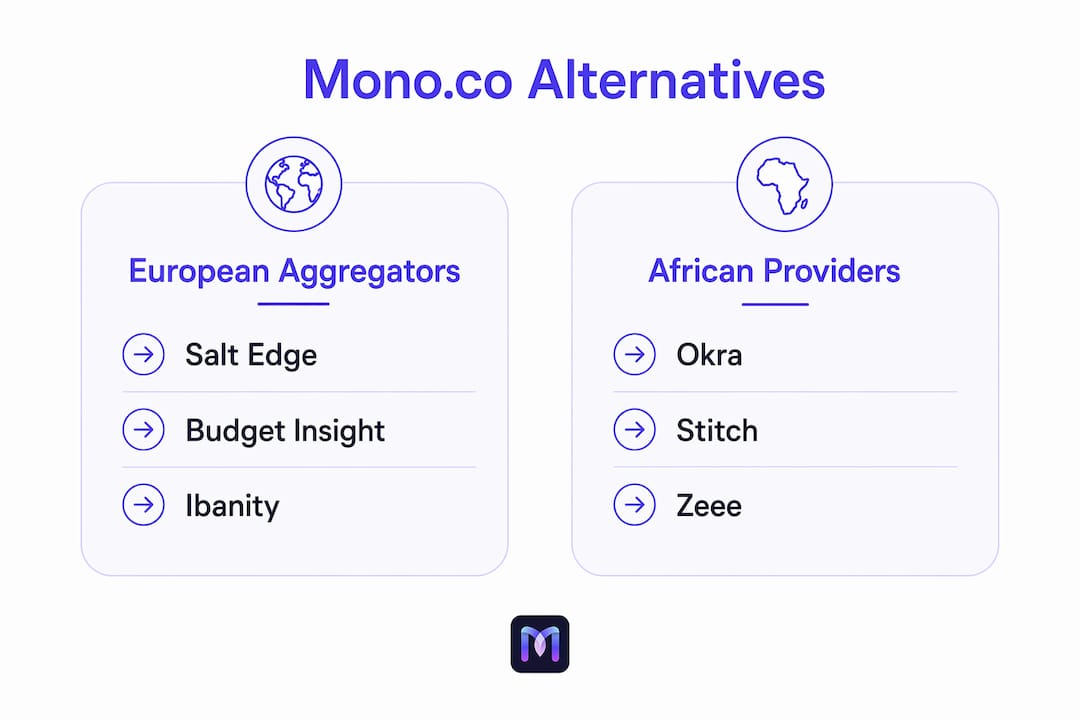
European-licensed providers are the right starting point when your product needs PSD2 compliance out of the box. Salt Edge covers the widest geographic network of any provider on this list, with connections spanning Europe, North America, and parts of Asia Pacific. Budget Insight holds full PSD2 licensing and security certifications, making it the cleaner choice for US fintechs expanding into the EU without building compliance infrastructure from scratch. Ibanity and Neonomics both offer unified API interfaces across multiple European markets, though Neonomics leans harder into pan-European breadth while Ibanity prioritizes compliance tooling at the integration layer.

Bridge stands out among US-relevant providers because it pairs payment initiation with data access in a single API suite. Most aggregators force you to stitch together a separate PIS provider. Bridge’s documentation quality is consistently cited as a differentiator, which matters when your team is shipping fast.
African open banking specialists require a different evaluation lens. Geographic fit matters more than feature count in this cluster. Okra and Stitch are Mono’s closest direct competitors, both founded in 2019 and focused on financial data access and payments. Okra’s strength is data consistency across local Nigerian banks. Stitch, headquartered in South Africa, has broader coverage across the continent and 90 more employees than Mono, giving it more capacity for enterprise support. Zeeh is the specialist pick for Kenya and Ghana specifically, where its last-mile banking connectivity outperforms generalist aggregators.
Flutterwave sits in a category of its own. As Mono’s parent company post-acquisition, it offers payment processing, cross-border transactions, and multi-currency support at a scale none of the pure aggregators match. If your product needs payments infrastructure rather than just data access, Flutterwave’s API suite covers more ground.

Modular value-add providers like Enfuce, Pngme, and CreditChek bundle services that reduce the complexity of your vendor stack. Enfuce adds credit scoring modules alongside standard banking data. Pngme delivers machine learning-ready data infrastructure, which is particularly useful for fintechs building credit models in emerging markets. CreditChek focuses on creditworthiness assessment, making it the right call when risk analytics is the core use case rather than a secondary feature.
Pro Tip: Upfront cost savings on API aggregators can be offset quickly by maintenance overhead when provider support is lacking. Evaluate vendor SLAs and developer portal quality before committing to a pricing model.
What factors should you weigh when choosing an open banking API aggregator?
Picking the wrong aggregator costs more than the integration time. Connection breakages, API deprecations, and compliance gaps create technical debt that compounds over months. The real cost of API integration includes ongoing maintenance, not just the initial build.
- Geographic coverage: Match the aggregator to your target banking infrastructure, not to the largest provider by name. A global aggregator with thin local coverage will underperform a localized specialist in the same market.
- Compliance and licensing: Confirm the provider holds the licenses your target market requires. PSD2 for Europe, FCA authorization for the UK, and CBN licensing for Nigeria are non-negotiable in those regions.
- Pricing model: Models range from per-API-call fees to per-connected-account charges to flat monthly subscriptions. Per-call pricing scales poorly at high volume; per-account pricing suits products with stable user bases.
- Feature set completeness: Determine whether you need Account Information Services only, Payment Initiation Services, or bundled modules like identity verification and direct debit. Bundled service modules reduce vendor stack complexity for fintechs building advanced product roadmaps.
- Developer experience: Sandbox quality, uptime consistency, and clear error messaging shorten time to market more than raw bank connection count. Evaluate these before you evaluate pricing.
Pro Tip: Treat your aggregator evaluation like choosing a travel adapter. The wall socket changes by region, so you pick the plug that fits your geography first, then compare features within that shortlist.
Profiles of additional notable competitors and emerging players
Beyond the core comparison, several providers address niche needs or are gaining traction in specific verticals.
- OnePipe connects banking and payment services across sectors through a no-code and API layer, making it practical for businesses that need cross-industry finance integrations without deep engineering resources.
- Interswitch has operated since 2002 and built the payment switching infrastructure that much of Nigeria’s digital economy runs on. It suits enterprises that need proven, large-scale payment processing rather than a developer-first API product.
- Paga supports multi-currency payments for both individuals and businesses, with broad payment method coverage that includes mobile money, bank transfers, and agent networks.
- Paystack is the most widely adopted payment API among Nigerian businesses, known for straightforward integration and high uptime. It focuses on card, bank transfer, and mobile money acceptance rather than open banking data.
- PiggyVest operates primarily as a savings and investment platform but exposes data integration capabilities relevant to fintechs building personal finance or wealth management products in Nigeria.
- Lean targets MENA-region developers with a clean, developer-focused API and fast onboarding, making it a practical pick for startups that need to move quickly in that geography.
- Lunch Flow serves SMB fintech developers with tiered pricing and solid coverage of medium-sized banks, filling a gap between enterprise-grade aggregators and bare-bones API providers.
- Pngme is worth tracking for any fintech building credit models in emerging markets. Its machine learning-ready data infrastructure goes beyond what standard aggregators provide, giving data science teams a head start on feature engineering.
Platforms like Anchor and Paga Engine, while not pure aggregators, offer expanded Banking-as-a-Service features including virtual accounts, payment processing, and lending APIs that complement or replace aggregator-only solutions for fintechs building full financial products.
Monobot brings AI-powered customer engagement to fintech teams
Open banking API aggregators handle the data and payment layer. What they do not handle is the customer conversation layer, and that gap is where fintech teams lose efficiency at scale.
Monobot is built for exactly that layer. While you are evaluating which aggregator fits your banking infrastructure, Monobot’s AI voice and chat agents handle the inbound customer interactions your product generates: account inquiries, transaction status checks, onboarding questions, and support escalations. The platform automates up to 80% of inbound calls and chats, with real-time analytics that give your team visibility into every conversation. For fintech teams running lean support operations, that kind of automation is the difference between scaling your product and scaling your headcount. Monobot integrates with third-party tools your team already uses, deploys without writing code, and includes banking-specific templates that reduce setup time. If you want to see how it fits your IT helpdesk or support workflow, the platform is worth a closer look alongside your aggregator selection.
FAQ
What is Mono.co and why do developers look for alternatives?
Mono.co is an African open banking platform, now a Flutterwave company, that provides financial data access and payment APIs across Nigeria, Ghana, and Kenya. Developers look for alternatives when they need coverage outside that footprint, more specialized compliance credentials, or payment initiation services Mono does not offer.
Is Mono.co safe to use for financial data integrations?
Mono.co operates with standard open banking security practices and is backed by Flutterwave’s infrastructure. For US-market integrations, verify that any aggregator you use meets the specific compliance and data residency requirements of your target jurisdiction.
What is the best Mono.co alternative for European markets?
Salt Edge offers the widest geographic network for European integrations, while Budget Insight and Ibanity are stronger picks when full PSD2 licensing and compliance tooling are the priority.
How do pricing models differ across Mono.co competitors?
Pricing models vary widely across the category, from per-API-call fees to per-connected-account charges to flat monthly subscriptions. Per-account pricing suits stable user bases; per-call pricing works better for low-volume or testing phases.
Which alternative works best for African fintech markets?
Okra and Stitch are the closest direct competitors to Mono for African open banking data. Zeeh is the stronger choice specifically for Kenya and Ghana, where its local banking connectivity tends to outperform generalist aggregators.
Key Takeaways
The best mono.co alternative is the one that matches your target geography and compliance requirements, not the one with the most connections globally.
| Point | Details |
|---|---|
| Geography first | Match your aggregator to your target banking infrastructure; a local specialist often outperforms a global provider in specific markets. |
| Compliance is non-negotiable | Confirm PSD2, FCA, or CBN licensing before shortlisting any provider for European, UK, or Nigerian integrations. |
| Developer experience drives speed | Sandbox quality, uptime, and clear error messaging shorten integration time more than raw bank connection count. |
| Bundled modules reduce complexity | Providers like Enfuce, Pngme, and CreditChek bundle credit scoring and identity verification, cutting vendor stack overhead. |
| Monobot covers the customer layer | Monobot’s AI voice and chat agents automate up to 80% of inbound customer interactions, complementing your open banking API stack. |