



AI chatbots cut customer service operating costs by 30% on average, with top-performing deployments achieving up to 53% reduction. The math behind that number is straightforward: an AI-handled ticket costs significantly less than a human-handled ticket, resulting in a large cost differential at scale. The savings come from four primary cost drivers: labor, training, availability, and average handling time.
Here is what that looks like in practice:
- Ticket deflection: Modern AI chatbots handle a large majority of routine inquiries when backed by a current knowledge base, absorbing volume that would otherwise require additional headcount.
- After-hours coverage: Chatbots provide 24/7 availability without overtime pay, shift premiums, or weekend staffing costs.
- Faster resolution: AI pre-qualifies and resolves simple issues instantly, reducing average handling time and the number of tickets that escalate to senior agents.
- Lower headcount costs: Fewer agents needed for tier-one support means reduced recruiting, onboarding, and training spend.
Monobot, an AI voice and chat platform built for U.S. businesses, automates up to 80% of inbound calls and chats, directly targeting each of these cost drivers from day one.
Table of Contents
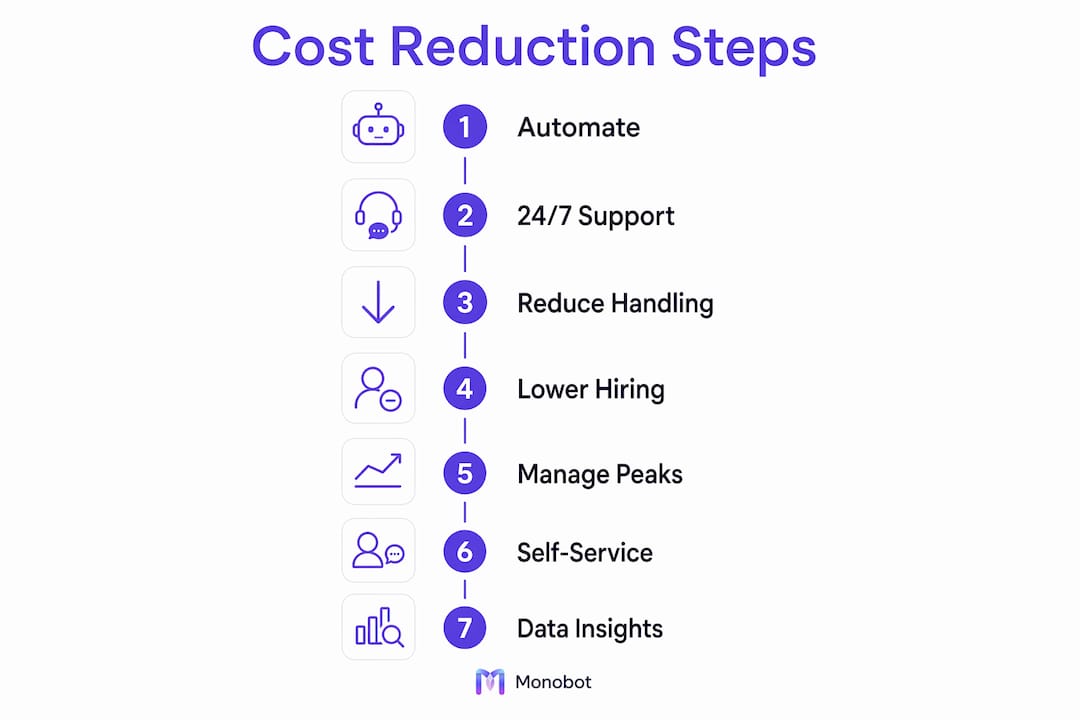
- 1. How AI chatbots reduce operating costs through automation of repetitive inquiries
- 2. How chatbots deliver 24/7 support without overtime costs
- 3. Reducing average handling time and lowering escalations
- 4. Lowering hiring, training, and onboarding expenses
- 5. Managing seasonal demand and peak periods without overstaffing
- 6. How self-service and multi-channel deployment cut live support demand
- 7. Using data insights to cut costs and improve operations over time
- 8. How Monobot delivers measurable cost reductions for U.S. businesses
- 9. Ensuring compliance and data privacy to avoid regulatory fines
- 10. Addressing potential challenges and limitations in cost reduction
- Monobot cuts your operating costs from day one
- Key Takeaways
- FAQ
1. How AI chatbots reduce operating costs through automation of repetitive inquiries
The single largest source of savings is volume absorption. When your support queue is dominated by password resets, order status checks, appointment scheduling, and FAQ responses, you are paying human agents $8 to $12 per ticket to answer questions that never change. AI handles those at a fraction of the cost.
- FAQ deflection: Chatbots resolve common questions instantly, without agent involvement.
- Order and account status: Real-time integrations let AI pull live data and respond accurately.
- Appointment scheduling: Automated booking and rescheduling eliminates phone tag entirely.
- Lead qualification: AI screens inbound inquiries before routing to sales or support staff.
The 80% routine inquiry rate cited by IBM assumes a well-maintained knowledge base. Teams with outdated documentation see that figure drop substantially, which is why knowledge base quality is the single strongest predictor of sustained savings. Best-in-class deployments achieve high total ticket deflection across all ticket types, not just routine ones.
Pro Tip: Update your knowledge base weekly, not monthly. Forrester data shows teams that update more frequently achieve faster ROI than those on monthly update cycles…
2. How chatbots deliver 24/7 support without overtime costs
Traditional contact centers face a painful tradeoff: staff for peak hours and pay idle agents during slow periods, or understaff and miss after-hours demand. Neither option is cheap. Night shifts, weekend premiums, and holiday pay stack up fast, and the Consumer Financial Protection Bureau notes that 24/7 availability and immediate response are primary drivers of chatbot adoption across financial institutions.
- Zero shift premiums: AI operates at the same cost at 2:00 AM as at 2:00 PM.
- Instant response: No hold times, no queue abandonment, no callbacks required.
- Off-hours capture: A wellness chain deploying chatbots for booking saw a 23% increase in off-hours appointments, capturing demand that would otherwise be lost.
- Reduced abandonment: Customers who get immediate answers do not call back, reducing repeat contact volume.
For industries with genuine 24/7 demand, like healthcare, banking, and e-commerce, the labor cost avoidance from eliminating overnight staffing alone can justify the deployment cost within months.

3. Reducing average handling time and lowering escalations
Every minute an agent spends on a call costs money. AI shortens that time by resolving simple issues before human involvement and by pre-qualifying tickets so agents have context when escalation occurs. That second point is underappreciated. An agent who receives a pre-filled ticket summary spends less time on discovery and more time on resolution.
- Pre-qualification: AI collects account details, issue type, and prior contact history before routing.
- Intelligent escalation: Only tickets that genuinely require human judgment reach a live agent.
- Real-time agent assist: Some platforms surface suggested responses and relevant knowledge base articles during live chats, cutting per-interaction time further.
- Throughput gains: Productivity per agent rises substantially in mature AI deployments, according to IBM data.
Top-quartile deployments maintain 62% ticket deflection while keeping customer satisfaction intact. Pushing deflection beyond a certain point can degrade the customer experience and increase churn, so the goal is calibrated deflection, not maximum deflection.
4. Lowering hiring, training, and onboarding expenses
Recruiting and training a customer service agent is expensive before they take a single call. When you factor in job postings, interviews, onboarding, product training, and the ramp period before an agent reaches full productivity, the true cost of a new hire is considerably higher than their base salary. AI chatbots reduce the number of tier-one agents you need, which compresses that entire cost structure.
- Smaller teams: Fewer agents needed for routine volume means fewer open roles to fill.
- Lower turnover costs: High-volume, repetitive work drives agent burnout and attrition. Shifting that volume to AI reduces the churn that makes recruiting a recurring expense.
- Faster scaling: Adding AI capacity takes minutes, not the weeks required to hire and train a new agent.
- Continuous learning: AI models update from conversation data, reducing the need for ongoing human retraining programs.
For context on AI chatbot vs. traditional call center economics, the gap widens significantly when you include turnover costs, which run high in contact center environments.
5. Managing seasonal demand and peak periods without overstaffing
Seasonal volume spikes create a staffing dilemma. Hire temporary workers and you pay for onboarding, training, and idle time during the off-peak. Understaff and you lose customers. Neither approach is cost-efficient. AI chatbots absorb volume spikes instantly, with no ramp time and no idle cost when demand drops.
- Retail: Holiday season inquiry volumes can multiply several times over. AI handles the surge without a single temporary hire.
- Healthcare: Open enrollment periods flood support lines. Chatbots answer eligibility and plan questions at scale.
- Telecom and utilities: Outage events generate sudden spikes. AI provides status updates automatically, deflecting thousands of identical calls.
- Travel and hospitality: Booking surges around major holidays are handled without adding staff.
Small businesses using off-the-shelf chatbot solutions see payback in 3 to 5 months, partly because seasonal flexibility eliminates the temporary staffing costs that previously consumed a significant portion of their operating budget.

6. How self-service and multi-channel deployment cut live support demand
Customers increasingly prefer to resolve issues themselves, provided the self-service experience is fast and accurate. Chatbots deployed across multiple channels, including your website, mobile app, SMS, and messaging platforms like WhatsApp, meet customers where they already are. Each channel adds a deflection layer that reduces inbound live contact volume.
- Website chat: Handles product questions, support requests, and lead qualification in real time.
- Mobile app integration: In-app chatbots resolve account issues without forcing users to call.
- Social messaging: Chatbots on platforms like WhatsApp and Facebook Messenger extend coverage without additional headcount.
- SMS support: Automated text responses handle appointment reminders, confirmations, and simple status updates.
Multi-channel deployment does more than reduce costs. It also improves the customer experience by providing consistent answers across every touchpoint. For a deeper look at how AI-powered customer support works across channels, the implementation details matter as much as the channel selection.
7. Using data insights to cut costs and improve operations over time
Chatbot analytics turn every conversation into operational intelligence. Unlike human interactions, which are difficult to analyze at scale, AI conversations are fully logged, searchable, and measurable. That data identifies where your processes break down, which questions recur most often, and where agents are spending time they should not be.
- Conversation analysis: Identifies the top recurring issues driving contact volume, so you can fix root causes.
- Escalation tracking: Flags which ticket types escalate most often, revealing gaps in AI training or knowledge base coverage.
- Resolution rate monitoring: Tracks first-contact resolution by channel, agent, and issue type.
- Resource allocation: Real-time dashboards show volume distribution, enabling smarter staffing decisions.
| KPI | What it measures | Cost impact |
|---|---|---|
| Ticket deflection rate | % of tickets resolved without human touch | Direct labor cost reduction |
| Average handling time | Minutes per interaction | Agent productivity and throughput |
| First-contact resolution | % resolved in one interaction | Repeat contact and callback reduction |
| Escalation rate | % of AI tickets routed to humans | Training gap identification |
| Cost per ticket | Total support cost divided by ticket volume | Overall efficiency benchmark |
Platforms like Monobot provide real-time analytics dashboards that surface these KPIs continuously, so your team can act on the data rather than wait for monthly reports. Optimizing for ChatGPT and other LLM-based AI responses also plays a role in long-term cost effectiveness, as AI response quality directly affects deflection rates and customer satisfaction scores.
8. How Monobot delivers measurable cost reductions for U.S. businesses
Monobot is built specifically for businesses that need to reduce operating costs without sacrificing customer experience. Its AI voice and chat agents handle the full tier-one support workload, from appointment scheduling and order status to lead qualification and inbound call routing, across industries including healthcare, banking, retail, and logistics.
Key capabilities that drive cost reduction:
- 80% automation rate: Monobot automates up to 80% of inbound calls and chats, directly reducing the volume that reaches human agents.
- No-code deployment: Agents can be built and launched without engineering resources, cutting implementation time and cost.
- CRM and third-party integrations: Native connections to existing systems mean AI responses are accurate and context-aware from day one.
- Industry-specific templates: Pre-built workflows for healthcare, banking, retail, and logistics reduce configuration time significantly.
- Real-time agent assist: Human agents receive live suggestions and relevant context during escalated interactions, shortening handling time even when AI hands off.
- Voice analytics: AI-powered call analysis identifies patterns in voice interactions that text-only platforms miss entirely.
The combination of high automation rates, fast deployment, and continuous analytics puts Monobot in the category of platforms that deliver measurable ROI within the first few months of deployment, not after a year of configuration work.
9. Ensuring compliance and data privacy to avoid regulatory fines
Compliance is a cost driver that chatbot deployments can either reduce or amplify, depending on how the system is configured. A poorly configured AI that collects personal data without proper consent mechanisms, retains conversation logs beyond legal limits, or fails to provide required disclosures can generate regulatory exposure that far exceeds any labor savings.
For U.S. businesses, the relevant frameworks include CCPA in California, HIPAA for healthcare interactions, and sector-specific guidance from regulators like the Consumer Financial Protection Bureau, which has published detailed analysis on chatbot use in financial services. The CFPB’s review found that chatbot limitations become particularly costly when customers cannot access tailored support for complex or sensitive issues.
Practical steps to keep compliance costs down:
- Data minimization: Collect only the data the interaction requires. Do not store conversation transcripts beyond your defined retention policy.
- Clear escalation paths: Always provide a visible, easy route to a human agent. Customers who feel trapped by a chatbot generate complaints and regulatory attention.
- Consent and disclosure: Inform users they are interacting with an AI. Several state laws now require this explicitly.
- Audit logging: Maintain records of AI decisions for regulatory review, particularly in financial services and healthcare.
Getting compliance right from the start is far cheaper than retrofitting it after a regulatory inquiry.
10. Addressing potential challenges and limitations in cost reduction
Significant average cost reductions are achievable, but many AI customer service projects fail to hit their year-one savings targets. The failure causes are consistent: common causes of failure include outdated knowledge bases, unclear escalation rules, and over-reliance on vendor default configurations… These are not technology problems. They are implementation and governance problems.
Common challenges to plan for:
- Knowledge base decay: AI accuracy degrades as your products, policies, and processes change. Without a weekly update process, deflection rates drop and customer frustration rises.
- Escalation design: An AI that cannot gracefully hand off to a human agent creates worse outcomes than no AI at all. Design escalation paths before you go live, not after.
- Scope creep: Pushing AI into complex, judgment-intensive interactions before it is ready increases error rates and erodes customer trust.
- Year-one implementation costs: Mid-market deployments with custom integrations involve substantial year-one costs which may extend payback periods to several months. Enterprise deployments with full CRM and compliance work can have longer break-even times.
- Customer preference: A substantial portion of customers still prefer human agents for complex issues. Hybrid models, where AI handles tier-one and humans handle tier-two and above, consistently outperform AI-only approaches on both cost and satisfaction.
The teams that get the strongest results treat AI deployment as an ongoing operational discipline, not a one-time technology purchase.
Monobot cuts your operating costs from day one
Cutting customer service costs by 30% on average is achievable, with top deployments reaching 53%. The gap between businesses that hit that number and those that see flat or rising costs after AI deployment comes down to one thing: how well the platform matches the actual work your team does every day.
Monobot is built for exactly this. Its AI agent builder lets you create and deploy voice and chat agents without writing a single line of code, with industry-specific templates for healthcare, banking, retail, and logistics that get you to production fast. The platform automates up to 80% of inbound calls and chats, integrates with your existing CRM, and surfaces real-time analytics so you can see exactly where costs are dropping and where to push further. You are not buying a black box. You are getting a configurable system your team can own, update, and scale as your needs change. Schedule a demo at monobot.ai to see what your cost reduction looks like with your actual ticket volume.
Key Takeaways
AI chatbots reduce operating costs by 30% on average, with top deployments reaching 53%, driven by ticket deflection, 24/7 availability, and lower per-interaction costs compared to human agents.
| Point | Details |
|---|---|
| Average cost reduction | AI chatbots cut support costs by 30% on average, with top deployments reaching 53%. |
| Per-ticket cost advantage | AI-handled tickets cost $0.50–$1.05 vs. $8–$12 for human-handled tickets, a 12× to 24× difference. |
| Routine inquiry automation | Modern chatbots manage approximately 80% of routine customer inquiries effectively when supported by an updated knowledge base. |
| Implementation risk | 61% of AI projects miss year-one savings targets due to outdated knowledge bases and poor escalation design. |
| Monobot’s automation rate | Monobot automates up to 80% of inbound calls and chats, improving first-call resolution and reducing operational costs significantly. |
FAQ
How much do AI chatbots reduce operating costs on average?
AI chatbots reduce customer support operating costs by 30% on average, with top-performing companies achieving up to 53% cost reduction, according to IBM 2025 data.
What is the cost difference between AI-handled and human-handled tickets?
AI-handled tickets cost $0.50 to $1.05 each, compared to $8 to $12 for human-handled tickets, producing a 12× to 24× per-ticket cost difference.
How quickly do AI chatbots pay back their implementation cost?
Small businesses using off-the-shelf tools typically see payback in 3 to 5 months. Mid-market deployments with custom integrations average 6–9 months, and enterprise deployments with full CRM and compliance work can take over a year.
Why do so many AI chatbot projects fail to deliver cost savings?
61% of projects miss year-one targets primarily because of outdated knowledge bases, unclear escalation rules, and over-reliance on vendor default configurations rather than custom training.
How does Monobot help businesses reduce operating costs?
Monobot automates up to 80% of inbound customer calls and chats, improving first-call resolution and reducing operational costs significantly.