



TL;DR:
- Conversational marketing engages customers through real-time, two-way conversations using AI tools. It shortens sales cycles and improves lead qualification by enabling instant, personalized interactions. The approach relies on advanced technologies like chatbots, voice agents, and CRM integration for continuous improvement.
Conversational marketing is the practice of engaging customers through real-time, personalized, two-way dialogue that replaces one-way broadcast messaging with interactive exchanges. Using AI chatbots, voice agents, and messaging platforms, this approach shortens sales cycles by moving prospects from first contact to qualification in a single session. That speed advantage is what separates conversational marketing from every traditional marketing method. Marketers who understand this shift gain a direct line to customer intent, richer data, and faster revenue cycles. This guide covers the conversational marketing definition, its core components, measurable benefits, and a practical implementation framework for 2026.
What is conversational marketing and how does it differ from traditional marketing?
Conversational marketing is defined as a real-time, dialogue-driven marketing approach that uses chatbots, AI voice agents, and messaging apps to engage prospects and customers in personalized, two-way exchanges. The industry also refers to this as “dialogue marketing” or “real-time engagement marketing,” though conversational marketing is the dominant term across B2B and B2C contexts.
Traditional marketing broadcasts a message and waits. Conversational marketing responds immediately. A TV ad, email blast, or banner campaign delivers information to a passive audience. A conversational agent asks a qualifying question, answers a product inquiry, and books a demo appointment, all within the same session. Inbound marketing is the broader umbrella; conversational marketing is a specialized layer within it, focused specifically on real-time, interactive touchpoints.
The table below shows the core distinctions across three dimensions:
| Dimension | Traditional marketing | Conversational marketing |
|---|---|---|
| Interaction style | One-way broadcast | Two-way, real-time dialogue |
| Audience control | Brand controls timing and message | Prospect engages on their own terms |
| Primary goal | Awareness and reach | Qualification, engagement, and conversion |
| Data output | Aggregate demographics | Granular, first-party intent signals |
| Sales cycle impact | Indirect, delayed follow-up | Direct, single-session progression |
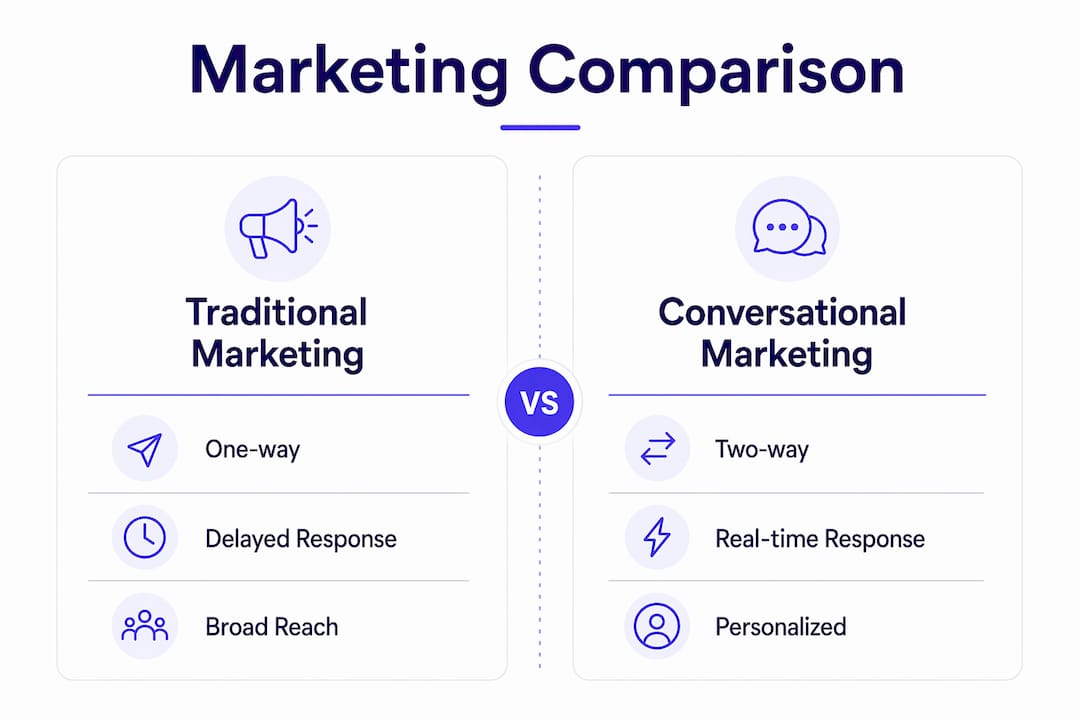
The shift in audience control is the most underappreciated difference. Prospects engage on their own terms, at any time, on any channel they prefer. That flexibility removes the friction that kills most inbound leads before a sales rep ever sees them.
What technologies power conversational marketing?
Conversational marketing runs on four core technologies working together: AI-powered chatbots, voice agents, messaging platforms, and CRM integration. Each plays a distinct role.
- AI chatbots handle text-based interactions on websites, apps, and social channels. They answer FAQs, qualify leads, and route complex requests to human agents.
- AI voice agents manage phone-based conversations, handling inbound calls with natural language understanding. Platforms like Monobot automate up to 80% of inbound calls, freeing human agents for high-value interactions.
- Messaging platforms extend conversations to channels customers already use, including SMS, WhatsApp, and in-app chat.
- CRM integration connects every conversation to a customer record, giving sales and support teams full context without requiring the customer to repeat themselves.
The combination of automation and human intervention creates the experience quality that customers expect. Automation handles volume and speed. Human agents handle nuance and empathy. Neither works as well alone.
Real-time personalization is what separates a high-performing conversational agent from a basic FAQ bot. When a returning customer starts a chat, the agent should already know their purchase history, open support tickets, and last interaction. That context makes every exchange feel relevant rather than generic. Monobot’s AI agent builder supports this kind of personalization without requiring custom code, which means marketing teams can configure and deploy agents without waiting on engineering.

Conversation analytics complete the picture. Every chat log and call transcript is a data source. Analyzing conversation flows reveals where customers drop off, which questions repeat most often, and where scripts need refinement. Teams that skip this step deploy agents that feel helpful on day one and frustrating by month three.
Pro Tip: Set up a monthly review of your top 20 conversation drop-off points. These are the exact moments where your bot is losing customers. Fixing them is faster than building new flows from scratch.
What are the benefits of conversational marketing?
The most direct benefit of conversational marketing is a shorter sales cycle. Traditional email follow-up sequences take days. A well-designed conversational agent qualifies a lead, answers objections, and schedules a sales call in under five minutes. That compression of time is the core business case.
Lead qualification is the second major benefit. Qualifying at the point of intent means asking targeted questions during the conversation itself, not in a follow-up form that 70% of prospects never complete. The result is a smaller, higher-quality lead list that sales teams can actually work. Fewer wasted calls. Higher close rates.
Customer engagement and loyalty improve because conversational marketing is, by definition, personal. A prospect who receives a relevant, timely response at 11 PM on a Saturday has a fundamentally different brand experience than one who submits a contact form and waits two business days. 24/7 availability through chatbots and voice agents removes the time constraint that has always limited customer service quality.
The first-party data advantage is less obvious but equally powerful. Every conversational interaction generates precise signals about customer intent, product confusion, pricing objections, and feature requests. These signals are more accurate than ad click demographics because they come directly from what customers say and ask. That data feeds product roadmaps, content strategy, and campaign targeting in ways that third-party data simply cannot.
Pro Tip: Export your monthly chat transcripts and tag recurring themes. Three months of tagging will reveal your top five product objections. Address those in your next content campaign and watch conversion rates move.
Additional benefits worth tracking:
- Reduced support costs through automation of routine inquiries
- Faster first-call resolution rates
- Higher customer satisfaction scores from immediate, relevant responses
- Richer segmentation data for downstream marketing campaigns
How to implement a conversational marketing strategy
A conversational marketing strategy fails most often not because of bad technology, but because of poor planning. Follow these steps to build one that performs from day one and improves over time.
-
Audit your current customer touchpoints. Map every place where customers currently contact you: website chat, phone, email, social media. Identify the top five questions or requests at each touchpoint. These become your first conversation flows.
-
Define your qualification criteria before you build. Know exactly what makes a lead sales-ready before you write a single bot message. If your sales team needs company size, budget, and timeline, build those questions into the flow from the start.
-
Start with one channel. Deploying across every channel simultaneously creates inconsistent experiences. Start with your highest-traffic touchpoint, typically your website or inbound phone line, and get that right before expanding.
-
Balance automation with a clear human escalation path. Every conversation flow needs an exit ramp to a live agent. Treating chat as a broadcast tool instead of a genuine dialogue is the most common failure mode. When a customer asks something outside the bot’s scope, the handoff to a human should be immediate and context-aware.
-
Integrate with your CRM on day one. A conversational agent that cannot access customer history creates friction. Connect your agent to your CRM before launch so every interaction is informed by existing data.
-
Launch, measure, and refine in 30-day cycles. Successful conversational marketing is a continuous feedback loop. Pull chat logs monthly, identify drop-off points and unanswered questions, and update your flows. Agents that are never refined become liabilities within six months.
-
Scale to additional channels once your core flow converts. Once your primary channel delivers measurable results, replicate the flow architecture on secondary channels. Multi-channel deployment respects customer preferences and increases overall engagement.
The most common pitfall is an overly scripted bot with no escalation path. Customers who hit a dead end in a chat flow do not try again. They leave. Build every flow with the assumption that some percentage of conversations will go off-script, and design for that reality from the start. Monobot’s voice analytics and dashboard analytics give teams the granular data needed to catch these dead ends before they become churn drivers.
Key Takeaways
Conversational marketing works because it replaces passive, delayed marketing with real-time dialogue that qualifies leads, builds loyalty, and generates first-party data in a single customer interaction.
| Point | Details |
|---|---|
| Core definition | Conversational marketing is real-time, two-way dialogue using chatbots, voice agents, and messaging apps. |
| Sales cycle impact | Moving prospects from engagement to qualification in one session removes the delays that kill inbound leads. |
| Technology stack | AI chatbots, voice agents, CRM integration, and conversation analytics work together to deliver quality at scale. |
| First-party data advantage | Every conversation generates precise intent signals that outperform third-party ad demographics for targeting. |
| Continuous improvement | Monthly audits of conversation flows separate high-performing agents from generic, frustrating bots. |
Why most conversational marketing programs underperform
Most conversational marketing programs fail quietly. They launch with a polished chatbot, generate some early engagement, and then plateau. The team celebrates the launch and moves on. Six months later, the bot is answering the same five questions it answered on day one, while customer needs have shifted entirely.
The mistake is treating conversational marketing as a deployment, not a discipline. The technology is the easy part. The hard part is building a culture of continuous conversation analysis. I have seen teams with enterprise-grade AI agents underperform teams using basic chat tools, simply because the latter group reviewed their transcripts every week and updated their flows accordingly.
The other underestimated challenge is the human side of the handoff. Customers accept automation for simple tasks. They reject it for complex, emotional, or high-stakes interactions. The teams that get this right define their escalation triggers precisely: specific keywords, sentiment signals, or conversation length thresholds that automatically route to a human agent. The teams that get it wrong let the bot keep trying until the customer gives up.
One more thing worth saying directly: conversational marketing and conversational commerce are related but not identical. Conversational commerce extends the dialogue into the transaction itself, handling payments and order management through the same channel. If your roadmap includes commerce, design your conversation architecture to support it from the start. Retrofitting is expensive.
The future of this discipline runs through AI personalization at scale. Models are improving fast enough that within two years, a well-configured AI agent will handle the majority of nuanced customer conversations without human intervention. The marketers who build strong conversation data sets now will have a significant advantage when that shift arrives.
— Alex
Monobot’s AI platform for conversational marketing
Monobot is an AI platform built specifically for voice and chat agents that handle real customer conversations at scale. It automates up to 80% of inbound calls and chats, handles appointment scheduling, lead qualification, and order inquiries, and routes complex cases to human agents with full context intact.
The platform deploys without custom code, which means your marketing team can build and launch a custom AI agent in minutes, not weeks. Real-time analytics surface conversation drop-offs, resolution rates, and customer sentiment so you can refine flows continuously. Industry templates for healthcare, retail, banking, and logistics give you a proven starting point. If you are ready to put conversational marketing into practice, explore Monobot and see how fast a well-built agent can move your metrics.
FAQ
What is conversational marketing in simple terms?
Conversational marketing is a real-time, two-way dialogue between a brand and a customer, delivered through chatbots, AI voice agents, or messaging apps. It replaces one-way broadcast messaging with personalized exchanges that qualify leads and resolve questions instantly.
How does conversational marketing differ from inbound marketing?
Inbound marketing is the broader strategy of attracting customers through content and SEO. Conversational marketing is a specific tactic within inbound, focused on real-time, interactive engagement rather than passive content consumption.
What are the main benefits of conversational marketing?
The primary benefits are shorter sales cycles, higher-quality lead qualification, 24/7 customer availability, and rich first-party intent data. Each benefit compounds: better data leads to better flows, which leads to higher conversion rates.
What tools are used in conversational marketing?
Core tools include AI chatbots, voice agents, messaging platform integrations, and CRM connectors. Analytics platforms that surface conversation drop-offs and resolution rates are equally critical for continuous improvement.
What is the difference between conversational marketing and conversational commerce?
Conversational marketing focuses on engagement, qualification, and relationship building through dialogue. Conversational commerce extends that dialogue to include transactions, payments, and order management within the same conversation channel.