



TL;DR:
- Customer retention automation uses AI and predictive analytics to identify at-risk customers and trigger personalized interventions before they leave. Effective automation relies on integrated data, real-time event triggers, and human oversight for complex cases, resulting in higher customer lifetime value and lower churn rates. The most successful businesses connect their data sources and combine automation with human judgment to proactively prevent customer loss.
Customer retention automation is defined as the use of AI, CRM workflows, and predictive analytics to identify at-risk customers and trigger personalized interventions before they leave. The role of automation in customer retention has shifted from a nice-to-have feature to a core business function. Companies using predictive retention workflows report up to 30% higher customer lifetime value. AI-driven churn prediction platforms deliver 30% reduction in gross revenue churn within 90 days. Those numbers reflect a fundamental change in how businesses protect and grow their customer base.
How does automation work in customer retention?
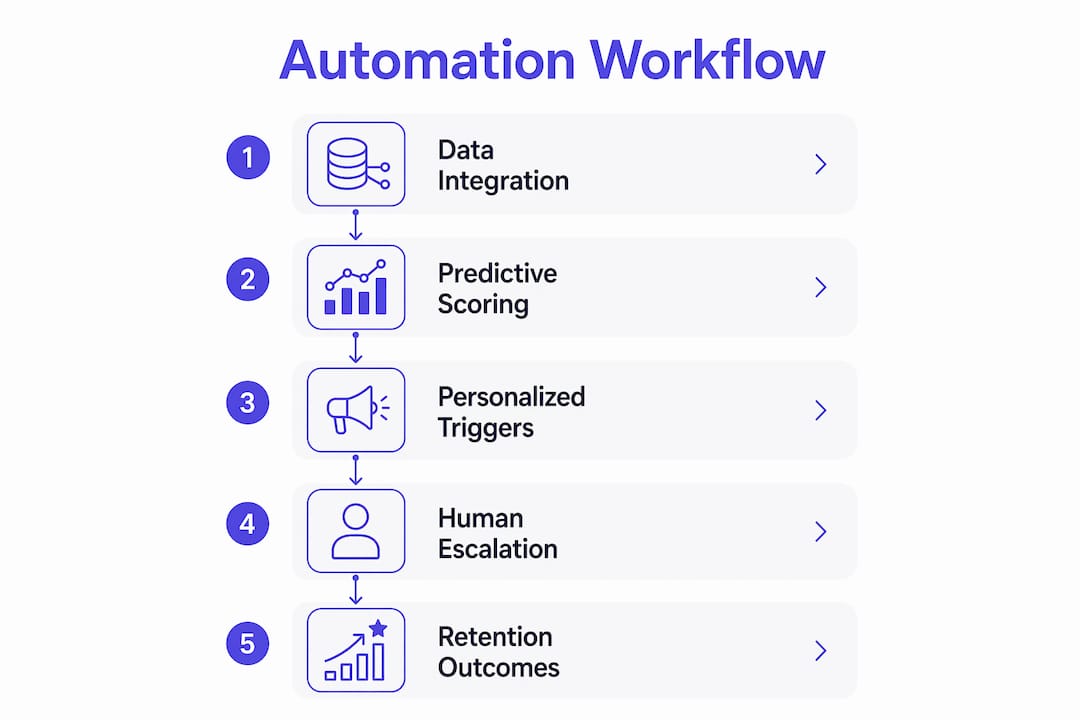
Retention automation works by aggregating customer data, scoring churn risk, and triggering personalized workflows the moment a risk threshold is crossed. The mechanism has three distinct layers: data integration, predictive scoring, and event-based execution.

Data integration is the foundation. True retention automation pulls unified data across CRM records, billing history, product usage logs, and support tickets. Without this unified view, churn models operate on incomplete signals and produce unreliable scores.
Predictive scoring converts that data into a customer health score. AI models analyze behavioral patterns, such as declining login frequency or missed payments, and assign each customer a risk level. AI-driven churn prediction platforms achieve over 94% predictive accuracy when trained on unified behavioral data. That level of precision means your team acts on real signals, not guesswork.
Event-based workflow execution is where automation delivers its clearest advantage. Event-driven workflows outperform fixed-interval email sequences because they respond to what a customer actually does, not to a calendar date. A drop in active usage triggers a re-engagement sequence. A failed payment triggers a retry and a proactive notification. Each response is contextual, not generic.
Real-time monitoring closes the loop. Automated platforms watch customer health scores continuously and escalate cases to human agents when complexity exceeds what automation can handle alone.
- CRM and billing data: Feeds the health score model with transactional history
- Product usage signals: Detects behavioral changes like reduced logins or feature abandonment
- Support ticket volume: Flags frustration patterns before they become cancellations
- Payment status: Triggers immediate recovery workflows on failed transactions
- Escalation rules: Routes high-risk, high-value customers to human agents automatically
Pro Tip: Set your escalation threshold based on customer lifetime value, not just churn risk score. A high-value customer at moderate risk deserves faster human attention than a low-value customer at high risk.
What are the most effective automation tools and tactics for retention?
The most effective customer retention strategies combine personalized messaging, predictive offers, and workflow automation across the full customer lifecycle. Each tactic works best when tied to a specific behavioral trigger rather than a broadcast schedule.
-
Personalized email and in-app messaging campaigns. Automated segmentation groups customers by behavior, usage tier, or purchase history. Each segment receives messages calibrated to their specific situation. A customer who has not used a key feature gets a tutorial. A customer approaching renewal gets a loyalty offer. Generic mass emails produce generic results.
-
Predictive upsell and cross-sell offers. Predictive analytics identify customers most likely to respond to an upgrade or add-on before they consider leaving. AI-powered retention solutions coordinate sales, success, and support teams on the same customer data, so outreach is synchronized and timely rather than duplicated or missed.
-
Renewal and payment failure automation. Subscription businesses reduce involuntary churn through automated payment retries, card update prompts, and proactive expiration notices. This category of automation addresses churn that has nothing to do with customer satisfaction. It is purely operational, and it is entirely preventable.
-
Satisfaction surveys and NPS triggers. Automated Net Promoter Score surveys fire after key moments: post-purchase, post-support interaction, or at the 90-day mark. Low scores trigger immediate follow-up workflows. High scores trigger referral or loyalty program invitations.
-
AI-driven lead nurturing for retention. Retention does not start at the renewal date. Effective lead nurturing through automated sequences builds customer confidence from the first interaction, reducing early-stage churn before it becomes a pattern.
Pro Tip: Audit your current email sequences and identify which ones fire on a fixed schedule. Replace at least three of them with event-based triggers tied to product usage data. You will see higher open rates and lower unsubscribe rates within 60 days.
What are common challenges and pitfalls in retention automation?
Retention automation fails most often because of data silos, over-automation, and static models that stop learning. Understanding these failure modes before you build saves significant time and cost.
-
Data silo problems. Automation built on partial data produces partial results. If your churn model only reads CRM data but ignores product usage and billing signals, it misses the behavioral patterns that actually predict departure. Integrated datasets across CRM, product analytics, and billing are not optional. They are the prerequisite for accurate retention triggers.
-
Over-automation and the loss of human touch. Automation handles low-complexity, high-volume tasks well. It does not handle nuanced, emotionally charged situations well. Sending an automated discount offer to a customer who just filed a serious complaint creates friction, not loyalty. Human oversight with clear escalation rules prevents this category of mistake.
-
Fixed-schedule workflows instead of event-driven ones. Sending a check-in email every 30 days regardless of customer behavior is not retention automation. It is scheduled broadcasting. Event-based triggers respond to what customers actually do, which makes every touchpoint relevant.
-
Static models without retraining. Customer behavior changes. A churn model trained on last year’s data may not reflect current usage patterns, pricing changes, or competitive shifts. Governance controls with manual override capabilities and scheduled model retraining keep your automation accurate over time.
-
No measurement framework. Automation without defined KPIs produces activity, not results. Track churn rate, customer lifetime value, reactivation rate, and first-contact resolution rate as your core retention metrics. Real-time campaign tracking tied to unified CRM data makes these metrics visible and adjustable.
How do businesses across sectors apply retention automation successfully?
Retention automation produces measurable results across industries when the workflows match the specific churn patterns of each sector. The applications differ, but the underlying logic is the same: detect risk early, respond immediately, and personalize the intervention.
| Sector | Primary churn trigger | Automation tactic | Outcome |
|---|---|---|---|
| Subscription / SaaS | Low product usage | Usage-based re-engagement sequence | Reduced feature abandonment |
| E-commerce / Retail | Cart abandonment, lapsed purchases | Automated replenishment and win-back offers | Higher repeat purchase rate |
| Financial services | Payment failure, account inactivity | Automated retry, proactive notifications | Lower involuntary churn |
| Healthcare | Missed appointments, low engagement | Reminder workflows, follow-up sequences | Improved patient adherence |
| Logistics / B2B | Declining order volume | Account health alerts, success team escalation | Early intervention before contract loss |
Subscription businesses provide the clearest example of automation’s financial impact. Payment automation prevents failed payment churn, which is entirely involuntary and entirely recoverable with the right workflow. SaaS companies use usage behavior signals to identify customers who have stopped engaging with core features, then trigger targeted education sequences before those customers start evaluating alternatives.
Retail and e-commerce teams apply automated replenishment reminders and personalized offers based on purchase history. A customer who buys a 90-day supply of a product gets a reorder prompt at day 75, not day 100. That timing precision is only possible with automation.
Customer success teams in B2B environments use a blended model. Automation handles routine check-ins, usage reports, and renewal reminders. Human account managers take over when health scores drop below a defined threshold. Learning how to automate customer inquiry responses effectively is the first step toward building that blended model at scale.
Proven retention strategies across industries consistently show that the businesses with the lowest churn rates are not the ones with the most automation tools. They are the ones with the most disciplined approach to when automation acts and when humans take over.
Key takeaways
Retention automation delivers its highest value when predictive scoring, event-based triggers, and human escalation rules work together as a single system.
| Point | Details |
|---|---|
| Unified data is non-negotiable | Integrate CRM, billing, and product usage data before building any churn model. |
| Event triggers beat fixed schedules | Behavioral triggers produce more relevant outreach and lower unsubscribe rates than calendar-based emails. |
| Automation and humans share the work | Route high-complexity, high-value cases to human agents; let automation handle volume. |
| Predictive accuracy drives ROI | AI churn models with 94%+ accuracy let teams act on real signals, not assumptions. |
| Measure retention KPIs in real time | Track churn rate, CLTV, and reactivation rate continuously to keep workflows calibrated. |
The shift I keep watching in retention strategy
The most significant change I have observed over the past few years is not the technology itself. It is the shift in mindset from reactive to proactive retention. Most businesses still treat churn as something to respond to. The ones pulling ahead treat it as something to predict and prevent.
The companies I see succeeding with retention automation are not the ones with the most tools. They are the ones who have done the hard work of connecting their data sources first. You cannot automate your way out of a data silo problem. The model is only as good as the signals it reads.
The human-in-the-loop question comes up constantly, and my position is clear. Automation should handle everything it can handle well: volume, timing, personalization at scale. The moment a customer interaction requires genuine empathy or a non-standard resolution, a human needs to take the wheel. The businesses that blur that line end up with automation that frustrates customers instead of retaining them.
The trend I am watching most closely is the convergence of CRM, AI, and real-time analytics into unified platforms. When those three systems share the same data layer, retention automation compresses intervention time from quarterly reviews to immediate daily actions. That compression is where the real competitive advantage lives. The businesses building that infrastructure now will have a structural retention advantage that is very difficult to replicate later.
— Alex
What Monobot brings to your retention workflows
Retention automation works best when your AI, integrations, and analytics operate from a single platform. Monobot is built for exactly that.
Monobot’s AI Agent Builder lets you create and deploy automated voice and chat agents that handle inbound inquiries, appointment reminders, and proactive outreach without writing a single line of code. The Integration Hub connects Monobot to your CRM, billing systems, and support tools, giving your retention workflows the unified data layer they need to trigger accurately. Real-time dashboard analytics surface customer health signals and campaign performance so your team can act on what matters. Monobot automates up to 80% of inbound calls and chats, freeing your team to focus on the high-value interventions that require a human touch.
FAQ
What is the role of automation in customer retention?
Automation identifies at-risk customers through predictive scoring and triggers personalized interventions in real time, reducing churn before it occurs. Companies using predictive retention workflows report up to 30% higher customer lifetime value.
How does churn prediction automation work?
Churn prediction models analyze behavioral signals like declining usage, payment failures, and support ticket volume to assign each customer a risk score. When a score crosses a defined threshold, an automated workflow fires immediately.
What data does retention automation require?
Effective retention automation requires unified data from CRM records, product usage logs, billing history, and support interactions. Automation built on siloed data produces inaccurate risk scores and misdirected outreach.
When should a human agent replace automation in retention?
Human agents should take over when a customer interaction involves a complaint, a non-standard resolution, or a high-value account at risk. Governance controls with manual override capabilities make this handoff clean and consistent.
How do subscription businesses use retention automation?
Subscription businesses use automated payment retries, card update prompts, and proactive expiration notices to prevent involuntary churn caused by failed transactions rather than customer dissatisfaction.