


Call center sentiment analysis uses AI to detect customer emotion across voice and text so teams can spot dissatisfaction and act before it escalates into churn. It works by combining speech recognition, text classification, and increasingly large language models to score how customers actually feel during a call, not just what they said. If you’re deciding whether to adopt it, the verdict is simple: run a focused 30-day pilot on your highest-volume queue before committing to a full rollout.
TL;DR:
- Running a 30-day pilot on your highest-volume queue is essential to accurately assess sentiment analysis effectiveness before full deployment.
- Combining acoustic features with transcript sentiment improves detection of negative emotions, with models achieving up to 0.88 F1 scores after optimization.
- Prioritize use cases like real-time escalation, coaching, and trend detection that directly impact key metrics such as escalation rate, QA coverage, and churn prevention.
- Focus on segment-level scoring and regular evaluation of precision, recall, and F1 on your specific call data to prevent accuracy issues caused by ASR noise and dialect variation.
- Ensure compliance and data privacy by implementing redaction and verifying that vendor processing aligns with your legal and security requirements from initial pilot stages.
Table of Contents
- What Are the Business Benefits of Call Sentiment Analysis?
- How Does Sentiment Analysis Actually Work in a Call Center?
- What Use Cases and KPIs Should You Track First?
- How Do You Implement Sentiment Analysis Without Wasting Six Months?
- How Accurate Is Sentiment Analysis, and How Do You Test It?
- Real-Time or Post-Call: Which Deployment Fits Your Team?
- What Mistakes Derail Sentiment Analysis Projects?
- What Privacy Rules Apply to Call Center Sentiment Analysis?
- Does Sentiment Analysis Work Across Languages and Dialects?
- What I’ve Learned Watching Sentiment Pilots Succeed and Stall
- Ready to Put Sentiment Analysis to Work?
- Sources
- FAQ
What Are the Business Benefits of Call Sentiment Analysis?
Sentiment scoring moves the needle on the metrics you already track. When a system flags rising frustration mid-call, a supervisor can intervene, a script can adjust, or a case can get flagged for priority follow-up. That single capability touches CSAT, churn, first-call resolution (FCR), and quality assurance (QA) efficiency all at once.
The mechanism is straightforward. Instead of waiting for a post-call survey that maybe 5% of customers complete, you get a read on emotion as the interaction happens or immediately after. That earlier signal is what drives the operational gains:
- Faster recovery: Agents or supervisors catch negative sentiment while the call is still live, not three days later in a review.
- Targeted coaching: QA teams stop reviewing calls at random and start reviewing the ones with the sharpest negative sentiment swings.
- Trend detection: Aggregated sentiment across weeks reveals whether a product change, price increase, or new IVR flow is quietly souring customer mood.
- Proactive retention: Enterprise deployments commonly use sentiment monitoring to flag at-risk accounts before a cancellation call ever happens.
Signal sources vary. Some systems lean on transcript sentiment alone; the stronger setups blend voice tone with text and aggregate across channels, including chat and email, for a fuller picture of how AI reshapes customer experience operations.
How Does Sentiment Analysis Actually Work in a Call Center?
The pipeline behind sentiment analysis for call centers has four stages: capture the audio, run automatic speech recognition (ASR) to produce a transcript, classify sentiment from both the text and the acoustic signal, then aggregate and visualize the results.
Text-based classifiers look at word choice, negation, and phrasing. Acoustic analysis looks at pitch, pace, volume, and pauses. That second layer matters more than most managers assume. A customer can say “that’s fine” in a flat, clipped tone that a transcript alone will never flag as negative. Experimental work on emotional speech datasets found that audio-feature approaches using MFCCs (mel-frequency cepstral coefficients) paired with convolutional neural networks can outperform transcript-only pipelines on certain datasets. If your system only reads words, it’s missing half the conversation.
LLMs have changed the accuracy math. Large language models now serve three roles in modern pipelines:
- Pre-annotating raw transcripts to speed up human labeling
- Expanding context windows so a model reads surrounding turns, not an isolated sentence
- Running self-refining loops where the model critiques and corrects its own first-pass label
The numbers behind this: One study testing Qwen2.5-32B-Instruct found it hit an F1 score of 0.91 on curated transcripts, but that dropped to roughly 0.76 once ASR noise degraded the text. Adding context expansion and a self-critiquing agentic loop pushed F1 back up to about 0.88, recovering most of the accuracy lost due to messy transcription.
That gap between 0.76 and 0.88 is the difference between a system you trust and one you quietly stop believing.
What Use Cases and KPIs Should You Track First?
Not every sentiment use case deserves equal budget. Prioritize the ones that connect directly to a metric your leadership already reviews.
- Real-time escalation and agent assist. Live sentiment scoring flags a deteriorating call so a supervisor can join or an agent gets a coaching prompt, tracked against escalation rate and AHT (average handle time) impact.
- QA at scale. Instead of sampling 2% of calls manually, sentiment scoring lets QA review 100% of calls and surface the worst 10% for human attention, tracked against QA coverage.
- Trend detection. Weekly or monthly sentiment averages by queue or product line reveal drift before it shows up in survey data, tracked against sentiment trend and its correlation to NPS.
- Coaching. Segment-level sentiment arcs show exactly where a call turned, giving coaches a specific moment to review rather than a vague “be more empathetic” note, tracked against FCR.
- Churn prevention. Accounts with repeated negative sentiment across calls get flagged for retention outreach before a cancellation request arrives.
Sentiment outputs are typically exposed at multiple levels of granularity, from word and sentence up through full segments, which is what makes fine-grained coaching workflows possible in the first place. Turning a score into action means wiring these signals into your existing routing or ticketing system so a threshold breach automatically creates a task, not just a data point sitting in a dashboard.
How Do You Implement Sentiment Analysis Without Wasting Six Months?
A pilot succeeds or fails based on decisions made in the first two weeks. Here’s the sequence that keeps risk low.
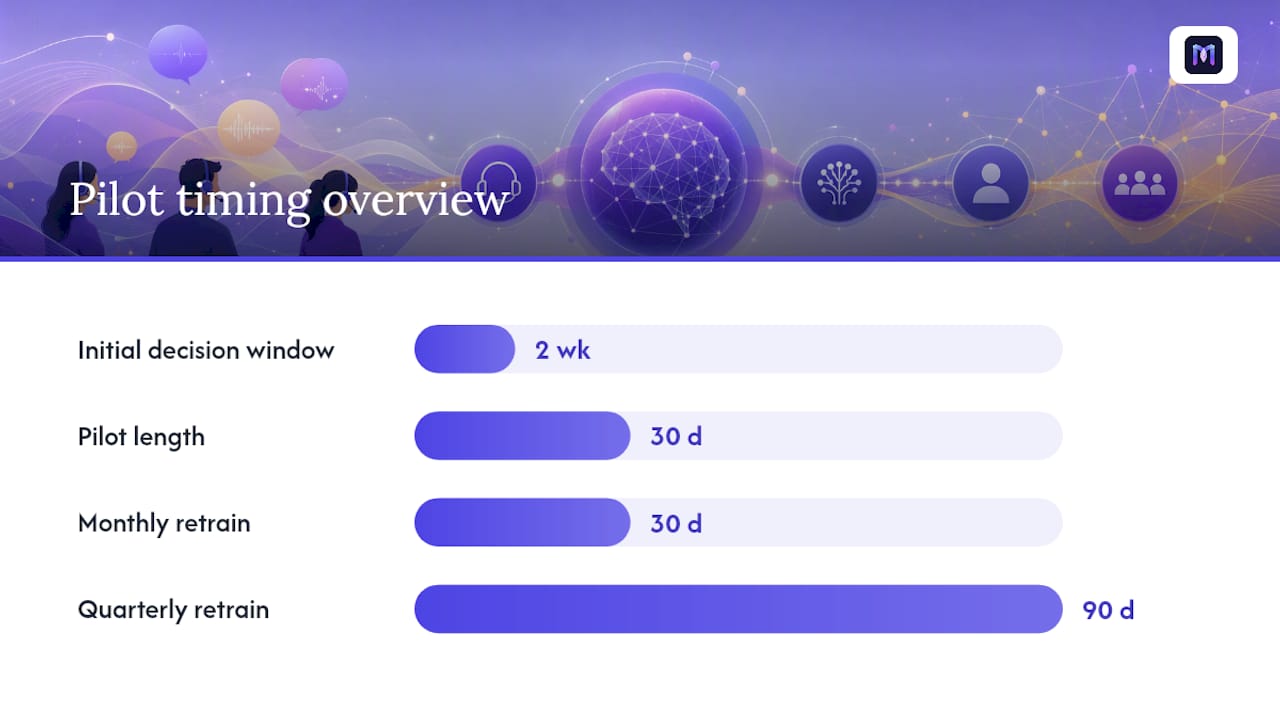
Start with data quality, not model selection. Pull a diverse sample of calls across agents, call types, and time of day. Skewed samples (all from one shift, one product line) produce a model that looks accurate in testing and falls apart in production.
Build annotation guidelines before you label a single call. Define exactly what “negative” means for your business. A customer venting about a shipping delay might be negative sentiment but not agent-caused; your guidelines need to capture that distinction.
- Use LLMs to pre-annotate the sample, then have a human reviewer verify or correct each label rather than starting from a blank slate.
- Design context windows that include adjacent turns, not isolated utterances; overlapping windows tend to preserve conversational context better than hard cutoffs.
- Set alert thresholds based on the use case: real-time escalation needs high precision (few false alarms interrupting supervisors), while trend detection can tolerate more recall-driven sensitivity.
- Wire alerts directly into routing and coaching workflows so a threshold breach triggers an action, not just a log entry.
- Establish a retraining cadence, feeding QA-reviewed misclassifications back into the model on a monthly or quarterly rhythm.
Pro Tip: Run your pilot on one queue for 30 days before touching a second one. A narrow pilot with a clean before/after comparison will win you more budget for phase two than a broad rollout that nobody can cleanly evaluate.
How Accurate Is Sentiment Analysis, and How Do You Test It?
Trust in sentiment scores comes down to three metrics: precision (how many flagged calls were actually negative), recall (how many truly negative calls got flagged), and F1 (the balance between the two). For multi-class sentiment (positive, neutral, negative), look at macro-averaged F1 and a full confusion matrix by class, not a single blended number that can hide a model that’s great at spotting positive sentiment and terrible at spotting negative.
Build a ground-truth set of manually labeled calls that never gets used for training, then hold it back for periodic re-evaluation as the model updates. Run A/B tests where possible, comparing agent outcomes on sentiment-flagged calls against a control group.
- Track F1, precision, and recall separately for each sentiment class, not just an overall average.
- Re-run your holdout evaluation quarterly to catch drift as call topics and customer language shift.
- Treat ASR noise as a first-class variable in testing, not an afterthought.
The research backs this up directly: LLM-based pre-annotation is measurably more robust to noisy ASR than older classifier approaches, and the context-expansion plus self-refining loop technique mentioned earlier is what closed most of the accuracy gap on degraded transcripts. If your vendor can’t show you F1 numbers broken out by clean versus ASR-degraded audio, ask why.
Real-Time or Post-Call: Which Deployment Fits Your Team?
Real-time streaming models are built for agent assist and live escalation. They need low latency, which usually means smaller, cheaper models rather than a full LLM running inference on every second of audio. Post-call batch scoring can afford heavier models and deeper analysis since there’s no live customer waiting on the other end.
Cost scales with volume fast. Running large language model inference across every call in a high-volume center gets expensive quickly, so many teams use LLMs for periodic sampling and model retraining while a lighter classifier handles day-to-day scoring.
- Use streaming, low-latency models for live agent assist and escalation alerts.
- Reserve heavier LLM-based analysis for post-call batch processing or sampled audits.
- Sample rather than score every call when cost is the binding constraint.
- Redact or minimize personally identifiable information (PII) before it enters any analysis pipeline, and treat your compliance team’s requirements as engineering constraints from day one, not a review step at the end.
What Mistakes Derail Sentiment Analysis Projects?
Most failures trace back to a handful of avoidable habits.
Relying on a single per-call aggregate score hides the moment that actually mattered. A call can average out to “neutral” while containing a sharp spike of frustration in the middle. Segment-level scoring that maps a sentiment arc across the call catches what an average erases.
- Sample your transcriptions regularly and check them against the actual audio to catch ASR drift.
- Retrain on in-domain audio, since accuracy depends heavily on your specific microphones, codecs, and accents.
- Use balanced sampling and, where feasible, blind annotation to prevent bias from creeping into your training labels.
What Privacy Rules Apply to Call Center Sentiment Analysis?
Sentiment analysis runs on customer voice recordings and transcripts, which puts it squarely inside existing call-recording and data-protection obligations rather than creating an entirely new legal category. If your center already records calls for quality purposes, you likely already have disclosure and consent processes in place; sentiment scoring extends what you do with that same data, so your existing compliance framework is the starting point, not a blank slate.
The practical risk points are specific. Transcripts and audio often contain account numbers, health details, or financial information spoken mid-call. Any pipeline that stores or forwards that content to a third-party model provider needs a policy for redaction or minimization before the data leaves your systems.
Work through these questions with legal or compliance before scaling past a pilot:
- Where is customer voice or transcript data stored, and for how long?
- Does your sentiment vendor process data in a way that satisfies your applicable data protection requirements (state, federal, or industry-specific, depending on where you operate and who you serve)?
- Is PII being redacted before transcripts are used for model training or third-party analysis?
- Do customers receive adequate disclosure that calls are analyzed for quality and sentiment, consistent with your existing call-recording notices?
Treat these questions as engineering requirements, not paperwork. Building redaction into the pipeline from the start costs far less than retrofitting it after a vendor contract is signed and data has already flowed through systems you don’t fully control.
Does Sentiment Analysis Work Across Languages and Dialects?
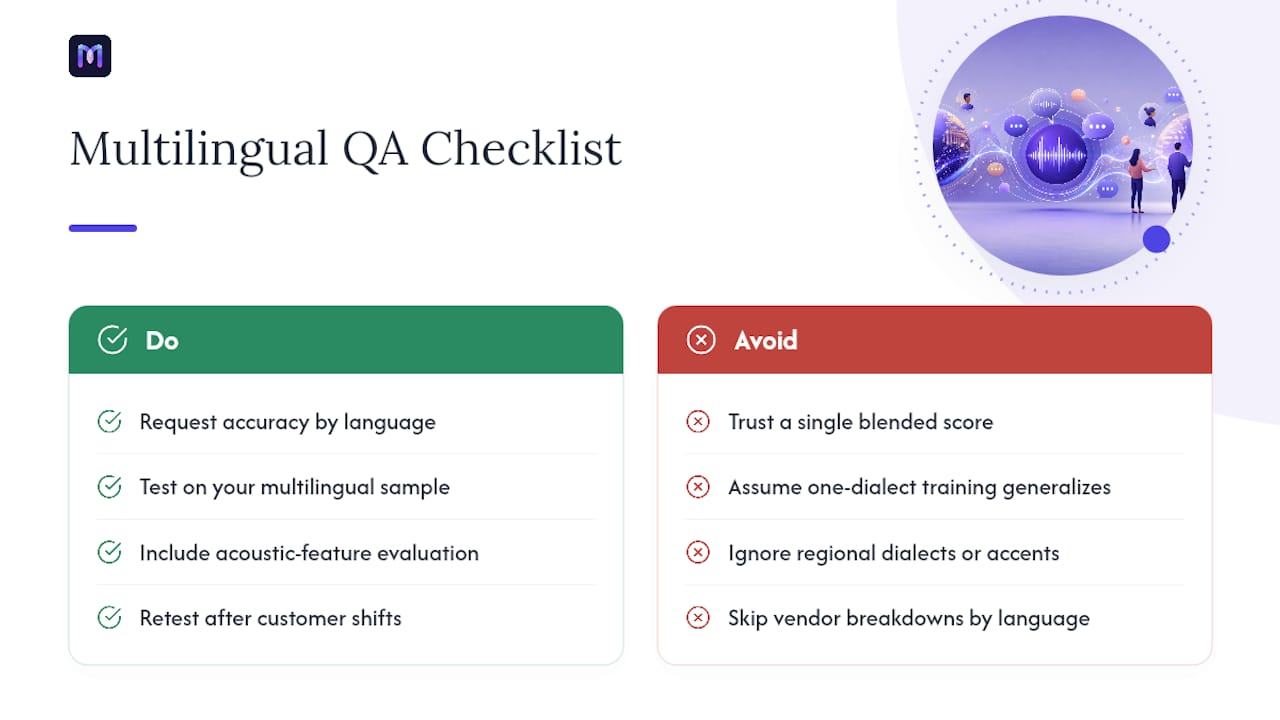
Accuracy drops when a model trained primarily on one language or dialect gets pointed at a different one. Sentiment isn’t just about vocabulary. Tone, pacing, and what counts as “polite distance” versus “genuine frustration” shift across languages and even across regional dialects of the same language.
A model trained mostly on North American English calls will often misread sentiment in a transcript from a customer speaking a regional dialect, an accented variety of English, or a different language entirely, simply because pitch patterns and phrasing conventions that signal frustration in one language don’t map cleanly onto another. This is exactly why acoustic features matter as much as text: tone of voice carries emotional information that survives translation better than word choice does, though it still needs to be trained on data that reflects your actual caller population.
If your call center serves a multilingual customer base, ask any vendor for accuracy numbers broken out by language, not a single blended score. A system that reports 90% overall accuracy could be hiding a version that performs at 95% on English calls and 70% on everything else. Test on your own multilingual sample before trusting an aggregate number, and revisit that testing whenever your customer base shifts meaningfully.
What I’ve Learned Watching Sentiment Pilots Succeed and Stall
The pilots that stick share one trait: a narrow scope with a clean before/after comparison. The ones that stall almost always tried to prove value across every queue at once, which buries the signal in noise nobody can act on. Scope a 30-day pilot on one high-volume queue, pull a balanced sample before you start, and define success with two or three metrics you already track. Everything else can wait.
— Alex
Ready to Put Sentiment Analysis to Work?
Monobot’s AI voice agents handle sentiment scoring as part of the same platform that runs your live transcription and voice analytics, so you’re not stitching together three vendors just to see how a call actually went.
The advantage for a team piloting this internally is speed: templates for healthcare, banking, retail, and other industries mean you’re not building an annotation pipeline and an integration layer from scratch. Live transcription feeds directly into dashboard insights that surface sentiment trends by queue, agent, or time period, so your pilot’s success metrics are visible from day one instead of buried in a spreadsheet somebody has to build by hand. Integrations connect to the CRM and QA tools you already run, which cuts weeks off a typical rollout.
If you’re ready to scope that 30-day pilot, start with a demo of the AI agent builder and walk through your highest-volume queue together to see what a working sentiment dashboard looks like before you commit to anything.
Sources
- Enhancing Call Centre Sentiment Analysis with Large Language Models: Annotation, Prediction and Robustness | IntechOpen
- Guide To Call Center Sentiment Analysis — Global Response
- ericphann/voice-sentiment-analysis — GitHub
FAQ
What Is the 80/20 Rule in Call Centers?
It’s a staffing and queue benchmark, not directly a sentiment metric, though missed service levels are one of the most common triggers for negative sentiment.
What Are the Five Key Performance Indicators of a Call Center?
The five most commonly tracked KPIs are first-call resolution (FCR), average handle time (AHT), customer satisfaction (CSAT), service level (calls answered within a target time), and escalation rate. Sentiment analysis feeds directly into CSAT prediction and escalation rate by flagging negative interactions in real time.
Can I Use ChatGPT for Sentiment Analysis?
General-purpose large language models like ChatGPT can classify sentiment reasonably well on clean text, but production call center systems need pipelines built for noisy ASR transcripts, acoustic features, and context windows across multiple call turns. Purpose-built pipelines that pre-annotate with an LLM and then apply context expansion and self-refining loops have shown meaningfully higher F1 scores on degraded call transcripts than a general-purpose model used on its own.
How Do I Know if My Sentiment Analysis Results Are Accurate?
Build a ground-truth holdout set of manually labeled calls and re-evaluate your model’s precision, recall, and F1 against it on a regular schedule, ideally quarterly. Test accuracy separately on clean versus ASR-degraded transcripts, since accuracy varies significantly with audio quality and accent, and validate on your own call recordings before trusting a vendor’s published benchmark.