



AI call analytics is the capability that turns recorded and live voice interactions into structured, rule-actionable signals: transcripts, intent classifications, sentiment scores, automated summaries, QA scores, and real-time alerts. If your contact center handles many calls weekly and still relies on manual spot-checking for quality assurance, this technology is worth deploying now.
The three most immediate benefits you’ll see:
- Coaching at scale: Automated QA scoring tied to transcript moments replaces random sampling with 100% call coverage, so supervisors spend time coaching rather than listening.
- Compliance risk detection: Category events and keyword triggers flag regulatory language, escalation signals, and script deviations the moment they occur, not days later in a manual review.
- Operational reporting: Structured call data feeds dashboards with AHT, FCR, sentiment trends, and call-driver breakdowns that were previously invisible or manually compiled.
Pro Tip: Before evaluating any vendor, document your top three use cases and the KPIs you’ll use to measure success. Vendors who can’t show you baseline-to-outcome metrics for those specific use cases during a demo are not ready for your operation.
Table of Contents
- How does AI call analytics turn a conversation into structured data?
- What features should you require in an AI call analytics platform?
- Which use cases deliver the fastest ROI?
- How do you deploy AI call analytics and integrate it with your stack?
- What data privacy and compliance controls should you verify?
- How do you evaluate vendors and run a structured RFP?
- What does real-time call analytics actually look like in production?
- How do you build a business case and measure ROI?
- Key Takeaways
- What vendors’ feature lists don’t tell you about real operations
- Monobot gives your contact center analytics and voice automation in one platform
- Useful sources
- FAQ
How does AI call analytics turn a conversation into structured data?
Every AI call analytics platform runs roughly the same pipeline, though the quality and configurability of each stage varies significantly between vendors.

Ingestion is the entry point: the system accepts either a recorded audio file (batch/post-call) or a live audio stream (real-time). Batch ingestion is simpler to implement; streaming requires a WebSocket or similar low-latency transport and introduces architectural complexity that affects alert timing.
Speech-to-text (STT) converts the audio waveform into a raw transcript. Accuracy here is the single biggest variable in downstream quality. Accents, background noise, domain vocabulary (medical codes, financial product names), and speaker overlap all degrade transcription if the model isn’t tuned. Amazon Transcribe Call Analytics uses a generative-AI-powered API to produce highly accurate transcripts alongside conversation insights, sentiment, call drivers, and generative summaries.
Natural language understanding (NLU) runs on top of the transcript to extract intent, named entities, sentiment per segment, and category matches. This is where pretrained models diverge from configurable ones. Out-of-the-box models cover broad patterns; custom vocabularies and category rubrics let you match your specific product names, compliance scripts, and escalation language.
Categorization and scoring apply your QA rubrics, compliance rules, and business logic to the enriched transcript. This produces structured outputs: a QA score, a set of matched categories, sentiment polarity by speaker and segment, and flagged moments.
Summarization and generative outputs are increasingly handled by large language models (LLMs) that produce a concise call summary, identified next steps, and a call-driver label. Real-time Call Analytics from AWS can emit category events and segment-level sentiment in streaming mode to support live alerts and supervision.
The critical distinction for your procurement decision is real-time vs. post-call. Real-time outputs (segment sentiment, category event triggers, issue detection) are emitted during the call and power live agent-assist prompts and supervisor alerts. Post-call outputs (full transcript, redacted artifacts, generative summary, QA score) are available after the call ends and feed coaching workflows and reporting dashboards.
| Pipeline Stage | Real-Time Available | Post-Call Available | Typically Configurable |
|---|---|---|---|
| Speech-to-text | Yes (streaming) | Yes (batch) | Custom vocabulary, language model |
| Intent / entity extraction | Partial (category events) | Full | Custom categories, rubrics |
| Sentiment scoring | Segment-level | Full call + per-segment | Threshold tuning |
| Summarization (LLM) | No | Yes | Prompt templates |
| QA scoring | Alert triggers only | Full rubric score | Rubric, weights, sampling |
| PII redaction | Identification only | Redacted artifacts | Entity types |
What features should you require in an AI call analytics platform?
Not every feature on a vendor’s spec sheet moves the needle equally. Here’s how to prioritize.
Table-stakes features (require these from every vendor, regardless of team size):
- Transcription with speaker diarization (customer vs. agent labeled separately)
- Sentiment scoring per segment, not just an aggregate call-level score
- Configurable categories and keyword/phrase matching
- PII detection with post-call redaction to separate storage artifacts
- CRM and telephony integrations via API or native connector
- Role-based access controls on raw vs. redacted artifacts
High-value differentiators for enterprise contact centers:
- Real-time agent assist: Live prompts, next-best-action suggestions, and escalation alerts delivered during the call, not after.
- Automated QA scoring with rubric linkage: Scores tied to specific transcript timestamps, not opaque aggregate numbers. Good QA systems link scores to transcript segments, provide calibration tools, and expose evaluation rubrics and sampling controls.
- Generative call summaries: LLM-produced summaries that capture the call driver, resolution, and next steps, reducing after-call work (ACW) significantly.
- Custom model training: The ability to fine-tune on your domain vocabulary and call types.
- Streaming event webhooks: Real-time category event delivery to external systems (supervisor dashboards, CRM triggers, escalation queues).
Feature trade-offs to weigh:
- Custom NLU models improve accuracy but add weeks to deployment and require labeled training data. Out-of-the-box models deploy in days but may miss domain-specific language.
- Real-time streaming adds infrastructure complexity (latency budgets, stream consumers, failover design). If your primary use case is post-call QA and coaching, batch processing is simpler and cheaper.
- Generative summaries are powerful but require prompt governance: without guardrails, LLM outputs can hallucinate details that end up in case notes.
Pro Tip: Ask vendors for a side-by-side of their out-of-the-box model accuracy vs. a custom-tuned model on a sample of your own call recordings. The delta tells you whether custom training is worth the implementation overhead for your call types.
Which use cases deliver the fastest ROI?
The use cases with the clearest, fastest payback share one characteristic: they replace a manual process that was already happening, just slowly and inconsistently.
Automated QA and agent coaching is the highest-payback early pilot for most contact centers. Manual QA typically samples a small portion of calls; automated scoring covers all calls with consistent rubrics. Supervisors shift from listening to coaching, and agents receive feedback tied to specific call moments rather than vague scores.

Compliance and risk detection is the highest-urgency use case for regulated industries. Category events flag script deviations, required disclosures, and prohibited language in real time, giving supervisors a chance to intervene before a call ends. For healthcare and financial services operations, this directly reduces regulatory exposure.
Conversational summaries and case notes cut after-call work. When an LLM produces an accurate call summary and next-step list automatically, agents spend less time typing and more time on the next interaction. This compresses AHT and reduces errors in CRM records.
Agent assist and live escalation routing use real-time sentiment and category signals to surface knowledge base articles, suggest responses, or alert a supervisor when a call is deteriorating. For AI-driven customer experience, this is the feature that most directly improves CSAT in the short term.
Voice-of-customer and product feedback is often underutilized. Call-driver data and sentiment trends across thousands of calls surface product issues, FAQ gaps, and policy friction points that no survey program captures at the same volume or speed.
For insurance teams specifically, AI customer engagement strategies show how call analytics can identify cross-sell signals and flag at-risk renewals, turning the contact center from a cost center into a revenue signal source.
How do you deploy AI call analytics and integrate it with your stack?
Deployment complexity is the most underestimated part of an AI call analytics rollout. The technology works; the integration work is where timelines slip.
Integration checklist:
- Telephony / recording source: Confirm your CCaaS or PBX can export audio in a supported format (typically PCM WAV or Opus) and whether it supports real-time streaming. This is the most common blocker.
- CRM connector: Map which call metadata fields (call ID, agent ID, queue, disposition) will be pushed to your CRM and whether you need bidirectional sync.
- Ticketing system: Determine whether call summaries and QA flags should auto-create or update tickets.
- BI / analytics destination: Decide whether structured call data goes to a data warehouse (Snowflake, BigQuery, Redshift) or a native dashboard.
- Real-time stream consumers: If you need live alerts, identify who consumes the event stream (supervisor dashboard, agent desktop, escalation queue) and verify latency requirements.
- Webhooks and APIs: Confirm the vendor supports event-driven webhooks for category matches and sentiment thresholds, not just polling.
Deployment options:
- Hosted SaaS: Fastest to deploy, lowest infrastructure overhead. Vendor manages the pipeline; you configure categories, rubrics, and integrations. Best for most contact centers.
- API / SDK embedding: You call the vendor’s API from your own infrastructure. More control over data routing and latency; requires engineering resources.
- Hybrid or on-premises: Relevant for regulated industries (healthcare, defense) where raw audio cannot leave your network. Expect longer deployment timelines and higher infrastructure costs.
Operational readiness factors that teams consistently underestimate:
- Agent training: Agents need to understand that calls are being analyzed and how scores are used. Transparency reduces resistance and improves data quality.
- Retention policies: Define upfront how long raw audio, raw transcripts, and redacted artifacts are retained. Storage costs and compliance obligations both depend on this.
- Role-based access: Not every user should see unredacted transcripts. Configure access tiers before go-live.
Pro Tip: Run a two-week technical POC before committing to a full deployment. Focus on one integration (telephony to transcript) and one use case (automated QA on a single queue). A narrow POC surfaces integration blockers faster than any vendor demo.
Monobot’s real-time analytics use cases documentation covers specific implementation patterns for agent-assist and live alert workflows, which is a useful reference when scoping your integration checklist.
What data privacy and compliance controls should you verify?
Privacy controls in AI call analytics are more nuanced than most vendor marketing suggests, and the gaps tend to appear after you’ve signed the contract.
How redaction actually works:
- Real-time streaming typically identifies PII (account numbers, SSNs, card numbers) but does not redact the live stream. Redaction is applied to stored artifacts post-call.
- Post-call redaction writes a separate redacted artifact (transcript and audio) to a different storage location. The original, unredacted artifacts still exist unless explicitly deleted.
- Redaction does not automatically satisfy HIPAA Safe Harbor de-identification standards. Access controls on the original artifacts must be verified separately.
What to ask every vendor:
- Which artifacts are retained: raw audio, raw transcript, analyzed transcript, redacted transcript?
- Where are each stored, and are they in separate buckets/prefixes with separate IAM or RBAC policies?
- Who in your organization (and the vendor’s) can access unredacted originals?
- What is the default retention period for each artifact type, and can it be shortened or zeroed out?
- For HIPAA-covered operations: does the vendor sign a Business Associate Agreement (BAA), and does their architecture support Safe Harbor de-identification (not just redaction)?
- For PCI DSS: is cardholder data redacted from both audio and transcript, and is the redaction verified with a test set?
Pro Tip: Request a test call with known PII patterns (a fake card number, a fake SSN) and verify that the redacted artifact contains no trace of the original values. Then check whether the unredacted original is still accessible via the storage path. This single test exposes more compliance gaps than any security questionnaire.
How do you evaluate vendors and run a structured RFP?
A structured evaluation prevents you from choosing the vendor with the best demo rather than the best fit for your operation.
Evaluation dimensions and what to request:
| Dimension | What to Request | Red Flag |
|---|---|---|
| Transcription & NLU accuracy | Sample transcripts from your call type; WER benchmark on domain vocabulary | No domain-specific accuracy data |
| Real-time vs. post-call | Latency numbers for category event emission; demo of live alert | “Real-time” defined as under 60 seconds |
| Feature coverage | Live demo of sentiment by segment, intent detection, QA scoring linked to transcript | Dashboard-only demo with no transcript drill-down |
| Integrations | API docs; native connector list; webhook event schema | Integration requires professional services only |
| Data handling & compliance | SOC 2 Type II report; BAA availability; artifact retention policy | Redaction described without artifact separation |
| Deployment & scalability | Concurrent call capacity; SLA for batch processing lag | No published SLA |
| Pricing & ROI | Per-minute or per-call pricing; volume tiers; ROI case study | Pricing only available after a sales call |
Questions to ask during a vendor demo:
- Show me a transcript from a call with background noise and a non-native speaker. What is the word error rate?
- How quickly does a category event fire after the trigger phrase is spoken? Show me the latency in a live stream.
- Walk me through how a QA score is linked to a specific transcript moment. Can I click a score and see the exact segment?
- What happens to the unredacted audio after redaction runs? Where is it stored and who can access it?
- What does your SOC 2 Type II report cover, and do you sign BAAs for HIPAA-covered customers?
- What is your typical deployment timeline for a contact center of our size, and what integration work falls on our team?
Scoring rubric approach: Score each vendor 1–5 on each dimension, weight the dimensions by your use-case priority (compliance-heavy operations should weight data handling higher; coaching-focused operations should weight QA scoring higher), and calculate a weighted total. Require vendors to provide evidence-backed QA scoring with rubric transparency before advancing to a contract stage.
What does real-time call analytics actually look like in production?
Real-time call analytics is architecturally distinct from post-call batch processing, and the operational implications are significant.
In streaming mode, AWS real-time Call Analytics emits category events (rule matches), issue detection signals, PII identification, and segment-level sentiment (positive, neutral, mixed, or negative) as the call progresses. These signals power two distinct workflows: supervisor monitoring (a live dashboard showing which calls are trending negative or have triggered a compliance category) and agent assist (real-time prompts delivered to the agent’s desktop based on detected intent or sentiment).
The operational consequence of real-time design is latency management. Category events must fire within seconds of the trigger phrase to be useful for live intervention. If a vendor’s “real-time” alert arrives 45 seconds after the trigger, it is effectively a post-call notification with extra infrastructure cost.
One important technical nuance: PII redaction in real-time mode applies to stored artifacts, not the live stream. The live transcript seen by a supervisor during a call may contain unredacted PII. This is a compliance exposure point that many teams discover only after go-live.
Real-time call analytics is most valuable when your operation has a defined intervention protocol. Alerts without a trained supervisor response process generate noise, not outcomes. Before deploying real-time features, map clearly who receives each alert type, what action they take, and how you measure whether that action happened.
Three things to test in a vendor POC for real-time capabilities:
- Alert latency: Speak a trigger phrase and measure the time to alert delivery on the supervisor dashboard. Target under 10 seconds for live intervention use cases.
- PII redaction verification: Confirm that the live stream transcript shown to supervisors handles PII appropriately for your compliance requirements, not just the stored artifact.
- Sentiment accuracy on your call type: Run 20–30 representative calls and manually validate segment-level sentiment labels against your own assessment. Accuracy below 80% on your specific call type is a deployment risk.
Monobot’s voice analytics use cases documentation provides additional patterns for integrating real-time signals into agent-assist workflows.
How do you build a business case and measure ROI?
A credible business case for AI call analytics requires baseline data, a clear formula, and a defined measurement window.
Operational metrics to track from day one:
- QA pass rate (baseline vs. post-deployment, same rubric)
- Average handle time (AHT) before and after automated summarization
- After-call work (ACW) time per call
- First-call resolution (FCR) rate
- Supervisor intervention rate per 100 calls
- CSAT score (survey-based, same methodology)
- Time-to-coach (days from call to agent feedback session)
Sample ROI formula for a pilot:
For example: if automated QA covers 100% of calls and saves a supervisor 8 minutes per call review versus manual listening, and your operation runs 10,000 calls per month at a supervisor cost of $35/hour, the QA time savings alone are substantial before you factor in ACW compression from generative summaries.
What counts as credible proof from a vendor:
- Before/after metrics from a comparable contact center (same industry, similar call volume)
- Baseline sampling methodology (how the pre-deployment baseline was measured)
- Validated transcript accuracy data from the customer’s own call recordings, not a generic benchmark
Monobot’s Dashboard Insights feature maps directly to these KPI tracking requirements, providing the reporting layer you need to measure pilot outcomes against your defined success criteria.
Key Takeaways
AI call analytics delivers measurable operational value only when the pipeline, features, and compliance controls are matched to your specific use cases and verified with real evidence before you commit.
| Point | Details |
|---|---|
| Verify real-time vs. post-call | Confirm whether alerts fire during the call or only after; latency under 10 seconds matters for live intervention. |
| Require transcript-linked QA scores | Scores tied to specific transcript moments are operationally useful; aggregate dashboard scores alone are not. |
| Redaction ≠ de-identification | Verify that unredacted originals have separate access controls; redaction alone does not satisfy HIPAA Safe Harbor. |
| Run a narrow POC first | Scope your pilot to one queue, one integration, and one use case before full deployment to surface blockers early. |
| Monobot as your evaluation benchmark | Monobot combines real-time analytics, agent assist, generative summaries, and Dashboard Insights in one platform built for contact centers. |
What vendors’ feature lists don’t tell you about real operations
The gap between a vendor’s feature list and what actually changes in your operation is wider than most buyers expect. Here’s the honest version.
Automated QA scoring is genuinely transformative, but only if the rubric is calibrated to your policy. Out-of-the-box rubrics score what the vendor thinks matters. Your compliance team, your QA leads, and your training materials define what actually matters in your operation. The platforms that let you configure rubrics, link scores to transcript timestamps, and run calibration sessions between automated and human scores are the ones that produce durable operational change. The ones that don’t are expensive dashboards.
Real-time agent assist is the feature that generates the most excitement in demos and the most disappointment in production. The reason is almost always the same: the alert fires, but there’s no trained response protocol. Supervisors see a red flag on a dashboard and don’t know whether to call the agent, transfer the call, or log the event. Before you deploy real-time features, write the response playbook first.
On industry-specific considerations: healthcare operations in the U.S. face the most complex compliance picture. HIPAA BAAs, Safe Harbor de-identification requirements, and state-level privacy laws (California’s CMIA, for instance) layer on top of each other. Redaction is a starting point, not a finish line. Financial services operations need to verify that PCI DSS scope is correctly defined: if cardholder data appears in call audio, the entire analytics pipeline may fall within PCI scope unless redaction is verified at the audio level, not just the transcript. Retail and e-commerce operations have the most flexibility but often underinvest in call-driver analytics, missing the product feedback signal that call volume contains.
The teams that get the most out of AI call analytics treat it as an operational change program, not a technology deployment. The technology is ready. The question is whether your processes, your rubrics, and your response protocols are ready to use it.
Monobot gives your contact center analytics and voice automation in one platform
Most contact centers evaluating AI call analytics end up managing two separate systems: one for analytics and one for the voice agents handling calls. Monobot eliminates that split.
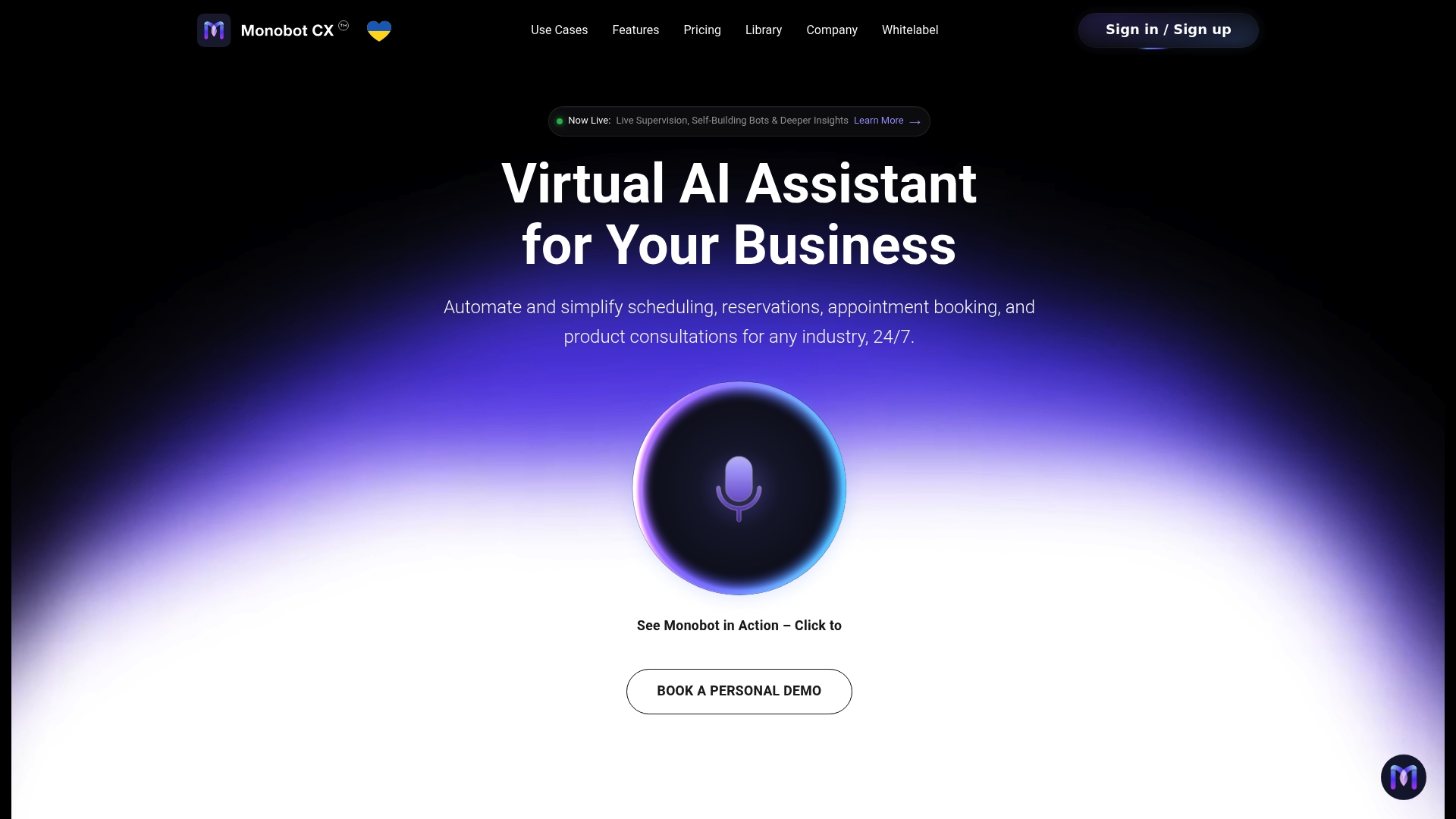
Monobot’s platform combines AI voice agent building, real-time analytics, agent assist, and Dashboard Insights in a single subscription, with industry-specific templates for healthcare, banking, retail, logistics, HR, and IT. You get the full analytics pipeline (transcription, sentiment, intent, summaries, QA support) alongside the automation layer that handles up to 80% of inbound calls, so your human agents handle the interactions that actually need them.
For a pilot, scope it to one queue, integrate your telephony source, and measure QA pass rate and ACW time over 30 days against your current baseline. Monobot’s no-code customization means your ops team can configure categories and rubrics without waiting on engineering. The AI analytics role in contact centers resource on Monobot’s site walks through the KPI mapping in detail.
Schedule a demo to see Dashboard Insights and the AI Agent Builder in action against your specific use case.
Useful sources
The sources below back the technical and compliance claims in this guide. Use them for specific verification tasks during your vendor POC.
- Amazon Transcribe Call Analytics: Primary reference for transcription accuracy, generative summaries, sentiment, and call-driver features. Use for benchmarking vendor claims against a known API.
- Real-time Call Analytics (AWS documentation): Detailed technical reference for streaming mode, category events, segment-level sentiment, and PII identification. Use when testing real-time latency and alert behavior in a POC.
- AWS re:Post: PII redaction and Contact Lens: Authoritative source on redaction artifact separation and the HIPAA Safe Harbor limitation. Use when verifying compliance controls with any vendor.
- Zapier AI Call Tracking Automation: Practical reference for CRM and workflow integration patterns. Use when mapping your integration checklist.
- CallEm Quality Review documentation: Reference for QA scoring rubric requirements and calibration workflows. Use when evaluating vendor QA capabilities.
- Monobot: AI Analytics in Call Centers: Product-aligned resource covering KPI mapping and implementation guidance for Monobot’s platform.
- Monobot Dashboard Insights: Product page for analytics and reporting features; use for POC success-criteria setup.
- Monobot Real-Time Analytics Use Cases: Implementation patterns for live alerts and agent-assist workflows.
- Dust Blog: How to use AI to analyze calls: General workflow reference covering capture, transcription, enrichment, and CRM routing.
FAQ
What is AI call analysis?
AI call analysis is the automated process of converting voice call recordings or live streams into structured data: transcripts, sentiment scores, intent classifications, QA scores, and summaries. It replaces manual call listening with consistent, scalable analysis across 100% of call volume.
Can AI track and analyze phone calls in real time?
Yes. Platforms like AWS real-time Call Analytics emit category events, segment-level sentiment, and PII identification during a live call, enabling supervisor alerts and agent-assist prompts before the call ends. Latency under 10 seconds is the practical threshold for live intervention use cases.
What is the difference between AI call analytics and speech analytics?
Speech analytics is the broader industry term for converting voice to text and extracting insights. AI call analytics typically refers to the same capability enhanced with machine learning for intent detection, generative summaries, and automated QA scoring. Both terms are used interchangeably in most vendor contexts.
What does AI call analytics actually improve in a contact center?
The most consistently measured improvements are QA coverage (from 1–5% manual sampling to 100% automated), after-call work time (reduced by automated summaries), and time-to-coach (faster feedback loops from transcript-linked scores). CSAT and FCR improvements follow when coaching and compliance workflows are built on the analytics output.
Does Monobot support AI call analytics for contact centers?
Yes. Monobot’s platform includes real-time analytics, agent assist, sentiment analysis, conversation intelligence, and Dashboard Insights for KPI reporting, alongside AI voice agents that automate inbound call handling. It is designed for contact centers that need both the analytics layer and the automation layer in one platform.