



TL;DR:
- AI should be your primary method for assigning call dispositions, providing standardized tags across all interactions.
- A successful pilot requires high-quality transcripts, structured summaries, clear tag definitions, and thorough audit logs before scaling up.
AI should be your primary method for assigning routine call dispositions. It delivers standardized, near-real-time tags across 100% of interactions while preserving agent review and full audit logs. The single recommended first step: run a short parallel pilot gated on transcript and summary quality, collect every agent override, and set explicit accuracy targets before promoting to production.
TL;DR:
- AI handles routine tagging at scale; agents review, override, and improve the model.
- After-call work (ACW) commonly constitutes a significant portion of average handling time (AHT).
- Automated disposition directly reduces that load.
- Gate your pilot on transcript quality and a well-defined tag taxonomy before anything else.
Table of Contents
- What is AI-driven call disposition tagging, and why does it matter?
- What do you need in place before enabling AI disposition tagging?
- How do you implement AI disposition tagging from capture to CRM?
- How do you validate AI tags and know when the model is ready?
- What risks should you plan for, and how do you mitigate them?
- Where does AI disposition tagging deliver the highest business impact?
- Key Takeaways
- What most teams get wrong about AI disposition tagging
- Monobot makes your disposition tagging pilot low-friction and fast
- FAQ
What is AI-driven call disposition tagging, and why does it matter?
Automated call disposition maps transcripts and conversation summaries to pre-defined disposition codes using NLP or LLM classifiers. Every call gets tagged the moment it ends, with no agent manually selecting from a dropdown. That consistency is the core operational win.
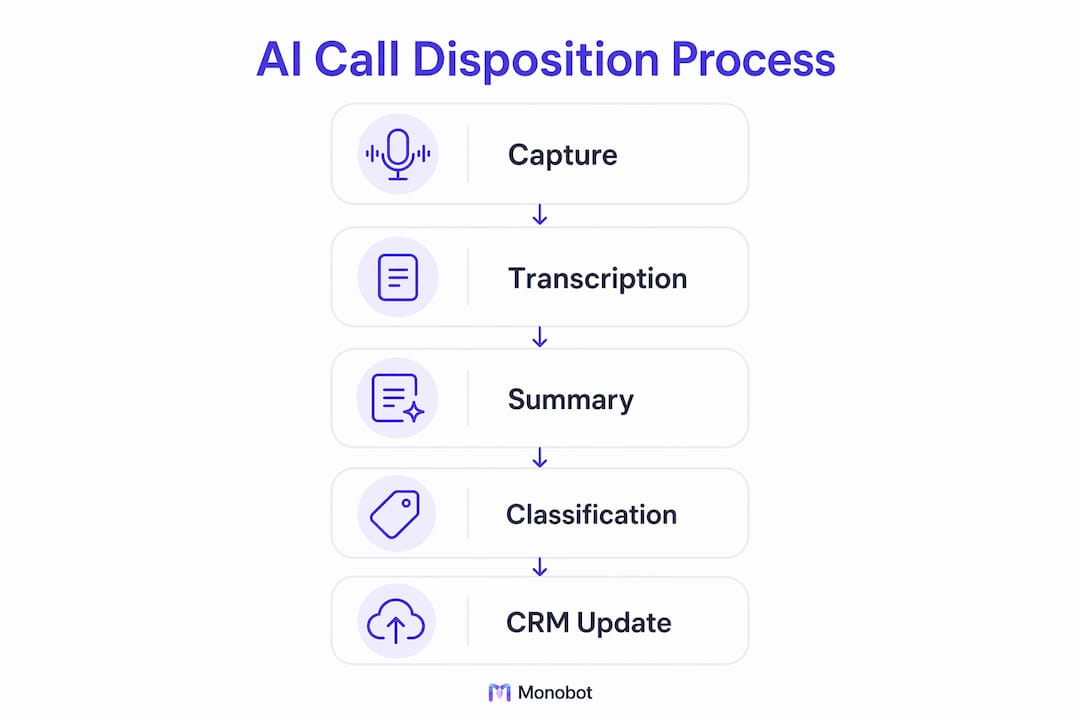
The pipeline is straightforward: voice or digital capture → transcription → summary generation → NLU/LLM classification → CRM field population → analytics. Each stage feeds the next, and the output is a structured, queryable record of every interaction your center handles.

The operational value goes well beyond cleaner reports. Tagged disposition data feeds predictive routing engines, triggers automated escalation workflows, and surfaces emerging complaint drivers days faster than manual sampling ever could. For AI in call center operations, that speed is the difference between catching a product bug in 48 hours versus three weeks.
What do you need in place before enabling AI disposition tagging?
Three inputs are non-negotiable: high-quality transcripts, LLM-ready summaries, and a clean tag taxonomy with plain-language definitions. Skip any one of them and your classifier will underperform regardless of model quality.
- High-precision transcription. Low word error rate (WER), accurate speaker diarization, and handling for accented or code-switched speech are required. Transcription quality directly bounds downstream classification accuracy — garbage in, garbage out applies here more than anywhere else in the pipeline.
- Conversation summaries. LLM-based auto-disposition requires a generated summary as a structured input alongside the raw transcript. Without it, the classifier lacks the condensed context it needs to assign codes reliably.
- A defined tag taxonomy with per-tag guidance. AI selects only from your existing tag list — it does not invent new codes. Each tag needs a short, specific description telling the model when it applies and, critically, when it does not. Some platforms support up to 25 custom tags per inbox; keep your library tight. Fewer, well-defined tags consistently outperform large, ambiguous ones.
- Audit logs and data governance controls. Every manual override must be preserved in a per-call audit trail. For US operations, enforce data retention policies, PII masking, and per-jurisdiction access controls before your first production call is tagged.
- Per-number or per-channel guidance scoping. AI suggestions can be scoped by phone number (DID), letting you apply different tagging logic to inbound sales lines versus support queues without maintaining separate models.
Pro Tip: Write each tag description the way you would explain it to a new agent on their first day. If the definition is ambiguous to a human, it will be ambiguous to the LLM. Specificity in the description is the single highest-leverage tuning lever you have.
How do you implement AI disposition tagging from capture to CRM?
The architecture has five stages, and the human-in-the-loop layer sits between classification and CRM write-back.
- Capture. Record voice or digital interactions with full metadata (DID, queue, timestamp, agent ID).
- Transcription. Pass audio through a high-precision STT engine with speaker diarization enabled. Flag low-confidence transcripts for manual review before they enter the classification stage.
- Summary generation. Run an LLM summarization step to produce a structured conversation summary. This is the required input for accurate auto-disposition — do not skip it.
- LLM/NLP classification. The classifier receives the transcript, summary, and tag definitions, then outputs a ranked disposition code. For multilingual call centers, use a multilingual transformer model (such as mBERT or XLM-R) or route non-English calls through a language-specific STT and summarization pipeline before classification.
- Agent review and CRM write-back. Surface the AI-suggested tag in the agent’s review workspace before or immediately after the call. Agents confirm, correct, or override. Manual tags take priority; every change is logged. Confirmed tags write to CRM fields via webhook or API connector.
For real-time workflows, fire webhooks on tag assignment to trigger downstream automations: escalation alerts, retention queue routing, or QA sampling. Post-call tagging is simpler to implement; real-time tagging requires lower-latency STT and a streaming classification layer.
Pro Tip: Run AI and manual tagging in parallel for your first 500–1,000 calls before switching to AI-primary. This parallel phase is your calibration window — not just a test.
During the pilot, collect every divergence between AI and agent tags. Those mismatches are your training signal. Feed confirmed overrides back into the model as labeled examples, and retrain or fine-tune on a regular cadence.
- Set a minimum sample size of 500 calls per major disposition code before drawing accuracy conclusions.
- Define acceptance criteria upfront: target accuracy per critical code, acceptable ACW reduction, and stakeholder signoff requirements.
- Promote to production only when acceptance criteria are met across all critical codes.
How do you validate AI tags and know when the model is ready?
Parallel testing against manual tags is the recommended validation method. Run both systems simultaneously on a representative call sample, then build a confusion matrix per disposition code to identify where the model diverges and why.
| KPI | What it measures | Target (pilot phase) |
|---|---|---|
| Tag accuracy per code | True positive rate by disposition | ≥ 90% on critical codes |
| Coverage | % of calls receiving an AI tag | 100% of interactions |
| False-positive rate | AI tags a code that does not apply | < 5% per critical code |
| ACW delta | Change in after-call work time | Measurable reduction vs. baseline |
| Routing error rate | Misrouted calls due to wrong disposition | Trending down week-over-week |
- Establish a baseline by measuring current manual tag accuracy and ACW before the pilot starts.
- Run parallel tagging for a minimum of two weeks across representative call types, languages, and queues.
- Analyze confusion matrices by intent category and by language or accent group to target corrections.
- Tune at the transcription layer first (WER improvements cascade downstream), then refine tag descriptions, then consider training data augmentation.
- Monitor for distribution drift in production: set automated alerts for sudden shifts in tag frequency that may signal a model or taxonomy problem. The analytics dashboard should surface these trends in near real time.
What risks should you plan for, and how do you mitigate them?
| Risk | Root cause | Mitigation |
|---|---|---|
| Low transcript quality | Accents, background noise, code-switching | Invest in high-precision STT; flag low-confidence transcripts for manual review |
| Inconsistent human labels | Agents interpret criteria differently | Plain-language tag definitions; periodic rater calibration sessions |
| Taxonomy bloat | Too many tags reduce precision | Keep the tag library to 25 or fewer; consolidate overlapping codes |
| Model bias on edge cases | Underrepresented call types in training data | Identify sensitive categories; add manual review rules for high-risk codes |
| Privacy and compliance gaps | PII in transcripts, retention violations | Enforce masking, audit logs, and data retention policies per US jurisdiction |
Inconsistent human labeling is the most common practical obstacle. Agents skip fields or interpret the same code differently across shifts. AI enforces consistency by applying the same model to every interaction, but only if the underlying taxonomy is unambiguous.
- For multilingual centers: use language detection before transcription and route each call to the appropriate STT and summarization model. Do not run Spanish or Mandarin calls through an English-only pipeline.
- For high-risk disposition codes (escalation, legal complaint, churn intent): add a mandatory human review step before the tag writes to CRM.
- For US compliance: align data retention and PII masking policies with applicable federal and state requirements, and document your audit trail for each tagged interaction.
Where does AI disposition tagging deliver the highest business impact?
The AI analytics capabilities that disposition data feeds are only as good as the tags themselves. Get the tagging right, and these use cases become immediately accessible:
- Escalation detection and routing. AI tags escalation intent in real time, triggering priority queue routing and cutting time-to-escalation without agent intervention.
- Product bug and complaint surfacing. Tagged complaint clusters surface new issue drivers days faster than manual QA sampling, giving product and ops teams an early warning system.
- Cancellation prevention. Churn-intent tags fire retention workflows automatically, routing at-risk customers to specialized agents before they reach a cancellation decision.
- Quality assurance and coaching. Disposition tags drive objective QA sampling, ensuring coaches review calls that actually match the behavior they are targeting rather than random selections. For AI-handled inquiry examples, tagged data makes it easy to isolate specific interaction types for review.
- FCR improvement. Accurate disposition data reveals which call types are most likely to repeat, letting you redesign self-service flows or agent scripts to resolve them on first contact.
Key Takeaways
AI-driven call disposition tagging delivers consistent, scalable coverage across 100% of interactions when built on high-quality transcripts, concise summaries, and a tightly defined tag taxonomy with plain-language guidance.
| Point | Details |
|---|---|
| Gate on transcript quality | Low WER and speaker diarization are prerequisites; poor transcription breaks downstream classification. |
| Keep the taxonomy tight | Fewer than 25 well-defined tags outperform large, ambiguous libraries every time. |
| Run parallel testing first | Validate AI against manual tags on 500+ calls per code before promoting to production. |
| Preserve every override | Agent corrections are training data; audit logs are your compliance record. |
| Monobot as your pilot platform | Monobot provides high-precision transcription, LLM classification, CRM connectors, and audit logs in one platform for fast pilot deployment. |
What most teams get wrong about AI disposition tagging
The conventional wisdom says the hard part is choosing the right AI model. It is not. The hard part is taxonomy governance, and most teams discover this only after a failed pilot.
Operations teams routinely build tag libraries with 40, 60, sometimes 80 codes, convinced that granularity equals insight. What they get instead is a classifier that cannot distinguish between “billing inquiry” and “billing dispute” because their own agents cannot agree on the difference. The AI does not create that ambiguity. It inherits it.
The second surprise is agent adoption friction. Agents who have been manually selecting dispositions for years often distrust AI suggestions, especially early in a rollout. The fix is not better accuracy numbers on a slide deck. It is giving agents a fast, visible override path and showing them that their corrections actually change future suggestions. When agents see their input reflected in the model, adoption follows.
The teams that get this right treat the pilot not as a test of the AI but as a test of their own taxonomy. They come out of it with fewer tags, sharper definitions, and a model that actually reflects how their center operates. That is the version worth scaling.
Monobot makes your disposition tagging pilot low-friction and fast
Cutting after-call work by automating disposition tagging is one of the fastest operational wins available to a contact center today. Monobot brings together the full pipeline in one platform: high-precision STT transcription, LLM-based summary generation, customizable tag classification, native CRM connectors, and per-call audit logs that satisfy US compliance requirements.
Your pilot can be scoped to a single queue or call type, run in parallel with your existing manual process, and measured against clear acceptance criteria before any production change. Monobot’s prebuilt voice templates accelerate setup, and the platform’s real-time analytics surface tag accuracy and ACW delta from day one. When you are ready to see the numbers for your own center, schedule a demo with Monobot and get a pilot scoped to your specific call types and taxonomy.
FAQ
What does AI do in call disposition tagging?
AI classifies each call against a pre-defined tag taxonomy using the call transcript and summary as inputs, assigning disposition codes automatically after the call ends. Agents can review and override any AI suggestion, with all changes logged.
How accurate is AI call tagging compared to manual tagging?
Accuracy depends primarily on transcript quality and tag definition clarity. Parallel testing against manual tags is the standard validation method; well-configured systems typically target 90% or higher accuracy on critical disposition codes during the pilot phase.
What are the must-have prerequisites for automated call disposition?
High-quality transcripts with low WER, LLM-ready conversation summaries, and a clearly defined tag taxonomy with plain-language per-tag descriptions are all required. Without all three, LLM-based auto-disposition will not function reliably.
How long does a disposition tagging pilot typically take?
A well-scoped parallel pilot covering a representative call sample generally runs two to four weeks before you have enough data to evaluate accuracy by code and make a production decision.
Can Monobot handle multilingual call disposition tagging?
Monobot’s platform supports multilingual transcription and classification pipelines, routing calls through language-appropriate STT and summarization models before classification to maintain accuracy across different languages and accents.