



Yes, GDPR applies to your chatbot the moment it interacts with anyone in the EU, whether that person is a customer, a job applicant, or someone just poking around your website out of curiosity. If that’s your setup, two things need to happen before you read another paragraph: add a clear, non-skippable AI disclosure in the chat window, and confirm which legal basis under GDPR Art. 6 justifies the data you’re collecting. A documented DPIA should follow shortly after for anything touching sensitive categories. Platforms like Monobot build disclosure and consent controls into deployment specifically because these two steps are where most compliance gaps start.
GDPR applies when your chatbot does any of the following:
- Targets or serves people located in the EU, regardless of where your company is based
- Monitors behavior of EU residents (tracking, profiling, personalization)
- Processes identifiers like names, IP addresses, device IDs, or session metadata
- Stores chat transcripts, even briefly, for training or quality review
Key Takeaways
GDPR compliance for chatbots succeeds when disclosure, legal basis, and retention controls are implemented as product features rather than documented as policy afterthoughts.
| Point | Details |
|---|---|
| Confirm applicability fast | GDPR applies if your chatbot targets, monitors, or processes data from anyone in the EU. |
| Disclose the AI upfront | Add a persistent, non-skippable notice on first interaction, not a buried footer link. |
| Match legal basis to purpose | Use contract necessity for transactions, consent for marketing or training uses. |
| Lock down vendor contracts | Require a signed DPA, subprocessors list, and retention terms before deployment. |
| Automate retention and deletion | Set a defined window (commonly 30 to 90 days) with automatic purging, not manual cleanup. |
This article is general information, not a substitute for advice from a qualified lawyer. Consult a qualified legal professional about your own circumstances before acting on anything here.
Table of Contents
- When Does GDPR Apply to Chatbot Interactions?
- What Are the Core GDPR Obligations for Chatbots?
- How Do You Manage Cross-Border Data Transfer Risk?
- Which Technical and Organizational Controls Reduce Risk Fastest?
- What Does a GDPR Compliance Process Look Like in Practice?
- How Does a GDPR-Aligned Chatbot Platform Work in Practice?
- The Checklist Approach Beats the Policy Approach
- Sources
- FAQ
When Does GDPR Apply to Chatbot Interactions?
GDPR jurisdiction hinges on three triggers: offering goods or services to people in the EU, monitoring their behavior, or processing their personal data regardless of where your servers sit. A Texas company with EU website visitors filling out a lead form through a chatbot is squarely inside GDPR’s reach, even without a single European employee or office.
Certain chatbot use cases carry outsized risk. Health triage bots collecting symptom descriptions touch special category data under Article 9. Eligibility screening for credit, insurance, or employment can trigger Article 22 profiling rules. Lead qualification bots that infer income, health status, or political views from casual conversation often collect more than anyone realizes, including the business running it.
The line gets blurry with session-only chats that vanish when the browser closes versus stored transcripts kept for six months versus logs later reused to fine-tune a model. Each represents a different risk tier, and treating them identically is a common compliance shortcut that backfires.
Multi-jurisdictional deployments compound the problem. A single chatbot serving customers across Germany, France, and California can trigger GDPR, individual EU member state rules, and U.S. state disclosure laws like the Colorado AI Act and Utah’s AIPA amendments simultaneously.
Pro Tip: Map every chatbot deployment against a simple grid: who accesses it, what data it collects, and where it’s stored. Most scope confusion disappears once that grid exists on paper.
What Are the Core GDPR Obligations for Chatbots?
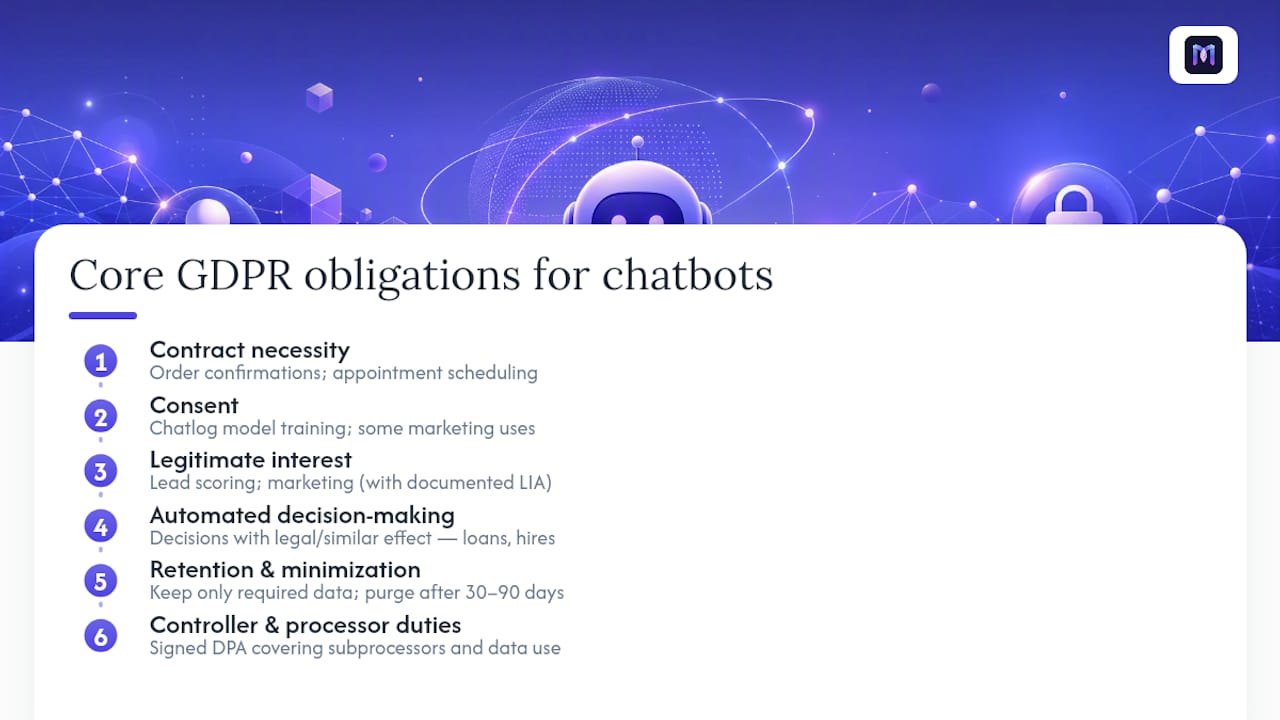
Six obligations map directly to how chatbots function, and each one requires a specific product or process response rather than a generic privacy policy update.
Legal basis. Pick one basis per purpose, not one basis for the whole bot. Order confirmations and appointment scheduling usually rest on contract necessity (Art. 6(1)(b)). Marketing follow-ups or lead scoring typically need a documented legitimate interest assessment (Art. 6(1)(f)) or explicit consent (Art. 6(1)(a)). Using chat logs to train a model almost always needs consent, since legitimate interest rarely survives scrutiny for that purpose.
Transparency. Articles 13 and 14 require you to tell people what’s happening with their data before or at the point of collection. In practice, that means an in-chat notice on first message, a link to the full privacy policy, and a plain-language line explaining that automated logic drives responses.
Data subject rights. Access, rectification, erasure, portability, and objection all apply to chat data, and you have 30 days to respond to a request. Building a simple DSAR intake flow, even a basic form tied to your ticketing system, saves you from scrambling when the first request lands.
Automated decision-making. Article 22 kicks in when a chatbot’s output alone triggers a decision with legal or similarly significant effect, like denying a loan application or rejecting a job candidate. That requires either meaningful human review before the decision is final or explicit consent from the person affected.
Retention and minimization. Keep only what the purpose requires. A support chatbot resolving a shipping question doesn’t need transcripts stored for two years; 30 to 90 days with automatic purging is defensible for most use cases, longer only when there’s a documented reason.
Controller and processor duties. If you deploy the bot and a vendor processes the data, Article 28 requires a signed data processing agreement covering subprocessors and data use. Skipping this step is one of the most common findings in GDPR enforcement actions tied to third-party AI tools.
Regulators are watching output accuracy too. Generative models built on large language models carry a higher risk of producing inaccurate or misleading statements that regulators now treat as company representations, not disclaimers waiting to be ignored.
How Do You Manage Cross-Border Data Transfer Risk?
A transfer happens the moment chatbot data leaves EU borders, whether that’s a European customer’s message routed to a U.S.-hosted API or logs synced to a support platform based in Ohio. If your vendor’s LLM runs on U.S. infrastructure, you need Standard Contractual Clauses or another approved mechanism to cover that transfer legally.
Before signing with any chatbot or LLM vendor, work through this list:
- Does the vendor offer a signed DPA covering all subprocessors, not just the primary provider?
- Is there a public subprocessors list you can review and monitor for changes?
- Does the contract specify whether your data trains the vendor’s models, and can you opt out?
- What’s the default retention period, and can you shorten it?
- Does the vendor offer EU-hosted instances or Data Privacy Framework certification?
| Transfer Scenario | Typical Risk Level | Mitigation |
|---|---|---|
| EU-hosted instance, no U.S. routing | Low | Standard DPA, retention policy |
| U.S.-hosted vendor with SCCs in place | Moderate | Transfer Impact Assessment, encryption |
| U.S.-hosted vendor, no SCCs, unclear subprocessors | High | Renegotiate contract or switch vendors |
A Transfer Impact Assessment documents whether the destination country’s laws undermine the protections SCCs promise, and what supplementary measures close that gap. Encryption at rest, strict access logging, and pseudonymizing identifiers before data crosses the border are the standard supplementary measures referenced in GDPR-compliant architecture guidance. When a vendor can’t guarantee EU residency, routing EU traffic to a region-locked instance and stripping identifiers before export are the two moves that actually reduce exposure rather than just documenting it.
Which Technical and Organizational Controls Reduce Risk Fastest?
Not every control matters equally on day one. This is the order that actually reduces exposure fastest, based on where enforcement and audit findings concentrate:
- Add the AI disclosure. A visible, persistent notice that users are talking to an AI system, shown on first interaction, not buried in a footer.
- Write the retention policy. Define how long transcripts live and automate deletion. Manual cleanup never survives more than two quarters.
- Run the DPIA. Required whenever the chatbot processes special category data, profiles users at scale, or makes automated decisions.
- Lock in the DPA. No vendor relationship touching EU personal data should run without one, subprocessors included.
- Test model outputs regularly. Sample conversations monthly for hallucinated claims, especially in regulated categories like health or finance.
- Add human-in-loop for high-risk interactions. Anything resembling a legal, medical, or financial decision needs a person reviewing before it’s final.
Underneath that checklist sit the technical mechanics that make each item enforceable. Encrypt data in transit with TLS and at rest with AES-256. Apply role-based access so support staff see only what their job requires. Pseudonymize identifiers before telemetry data leaves EU infrastructure, and keep audit logs that show who accessed what and when, a requirement Monobot’s platform supports through built-in dashboard analytics that track access and interaction history automatically.
On the operational side, vendor due diligence isn’t a one-time checkbox. Subprocessor lists change, contracts lapse, and a vendor’s training practices can shift quietly between renewal cycles. An annual contract review catches most of this before it becomes a problem. Output testing deserves the same rigor: regulators increasingly treat chatbot statements as binding company representations, and the FTC has opened formal inquiries into consumer-facing bots that make deceptive or unsupported claims.

Pro Tip: Build a “safety filter” that flags any chatbot response touching medical, legal, or financial advice for human review before it reaches the user. It’s a small engineering investment that closes one of the biggest liability gaps in deployed bots.
What Does a GDPR Compliance Process Look Like in Practice?
Compliance isn’t a document, it’s a sequence. Here’s the order that holds up under audit:
- Inventory every chatbot deployment and the data each one touches.
- Decide if a DPIA is required based on data sensitivity and processing scale.
- Run the DPIA if triggered, documenting risks and mitigations.
- Update or sign DPAs with every vendor in the chain, including subprocessors.
- Implement technical controls: encryption, pseudonymization, retention automation.
- Set up logging and reporting so evidence exists before a regulator asks for it.
Ownership matters as much as sequence. A data controller lead (usually a compliance officer or legal counsel) owns the DPIA decision. Security owns encryption and access controls. Product owns the in-chat disclosure and consent flows. Vendor management owns the DPA lifecycle. If your organization has a DPO, they sign off on the whole chain before launch.
Keep these records on file, not just referenced:
- Records of Processing Activities (ROPA) entries for each chatbot use case
- DPIA documentation with dated risk assessments
- Signed DPAs and current subprocessor lists
- Output testing logs showing regular review cadence
Breach notification runs on a hard clock: 72 hours to notify the relevant supervisory authority once you become aware of a personal data breach. Internal SLAs should target detection-to-notification well under that window, since 72 hours includes weekends and holidays, not just business days.
How Does a GDPR-Aligned Chatbot Platform Work in Practice?
Ask any chatbot or LLM vendor for four things before you sign: a data residency option for EU traffic, a no-training or zero-retention setting for user inputs, a current subprocessors list, and audit rights written into the contract. Vendors that hesitate on any of these four are telling you something.
A platform built with GDPR obligations in mind should offer per-tenant EU hosting, configurable retention windows, exportable audit logs for DSAR responses, role-based access controls, and clear escalation paths to human agents for sensitive interactions. Monobot’s architecture supports several of these directly: the AI agent builder includes configurable escalation flows for human-in-loop review, and its analytics dashboard exports interaction logs that double as audit evidence during a DSAR or regulatory inquiry.
Pro Tip: When evaluating a chatbot vendor, ask to see their subprocessors list before the demo, not after the contract. It tells you more about their compliance maturity than any sales deck will.
The Checklist Approach Beats the Policy Approach
Most GDPR advice for chatbots reads like a law school syllabus: dense, abstract, and disconnected from what a product team actually builds on a Tuesday, but understanding why optimize for ChatGPT can help align compliance with marketing strategy. That’s backwards. The businesses that stay out of enforcement headlines treat GDPR as a sequence of product decisions, not a document sitting in a shared drive nobody reads twice.
The conventional advice overindexes on writing the perfect privacy policy and underindexes on the boring mechanics: does the retention job actually run, does the DPA cover the subprocessor your vendor added last quarter, does anyone check chatbot outputs for hallucinated claims. Those unglamorous checks matter more than policy language, because that’s where enforcement actions and lawsuits actually originate.
If you deploy chatbots with third-party LLMs, prioritize in this order: disclosure first, legal basis second, DPA and retention third, DPIA fourth. Everything else, including the elegant privacy policy your legal team wants to draft, can wait. Get the mechanics right and the paperwork follows naturally. Get the paperwork right without the mechanics, and you have a document that looks compliant but isn’t.
Sources
- AI chatbot compliance: key legal risks and regulatory considerations for businesses in 2026 | Arnall Golden Gregory LLP
- GDPR Compliant AI Chat: Requirements, Architecture & Setup 2026 — PreMAI
FAQ
Does GDPR Apply to a Chatbot Hosted in the United States?
Yes, if it interacts with people located in the EU, processes their personal data, or monitors their behavior, regardless of where the company or servers are based.
What Legal Basis Should a Support Chatbot Use?
Contract necessity under Art. 6(1)(b) typically covers transactional interactions like order status or appointment scheduling, while marketing uses generally require consent.
How Long Can a Company Keep Chatbot Transcripts?
There’s no fixed number in GDPR itself, but 30 to 90 days with automated deletion is defensible for most support use cases unless there’s a documented business reason for longer retention.
Does the EU AI Act Change GDPR Chatbot Requirements?
The EU AI Act adds a separate disclosure duty under Article 50, requiring clear notice that users are interacting with AI starting August 2, 2026, and this applies alongside existing GDPR obligations, not instead of them.
What Triggers a DPIA for a Chatbot?
Processing special category data, large-scale profiling, or automated decisions with legal or similarly significant effects on individuals all trigger a mandatory DPIA under GDPR.
Ready to see how privacy-aligned chatbot controls work inside a real platform? Explore Monobot’s AI agent builder to see escalation flows, retention settings, and audit logging in action.