



TL;DR:
- Conversational AI understands natural speech to resolve customer queries independently of traditional phone menus. It offers significant cost savings, enhances customer experience, and increases agent productivity by automating routine interactions. Implementing it involves phased planning, integrating backend systems, and designing effective conversational flows.
Conversational AI is defined as technology that understands natural speech to resolve customer queries end-to-end, without routing callers through rigid phone menus. This is the core reason how conversational AI replaces IVR: traditional Interactive Voice Response systems route calls but rarely resolve them, while AI-powered agents handle the full interaction from first word to final answer. The shift matters for your bottom line. Gartner projects that AI handling routine interactions could reduce contact center agent labor costs by $80 billion globally by 2026. For customer service leaders weighing IVR vs conversational AI, that number signals a structural change, not a minor upgrade.
How conversational AI replaces IVR: the core difference
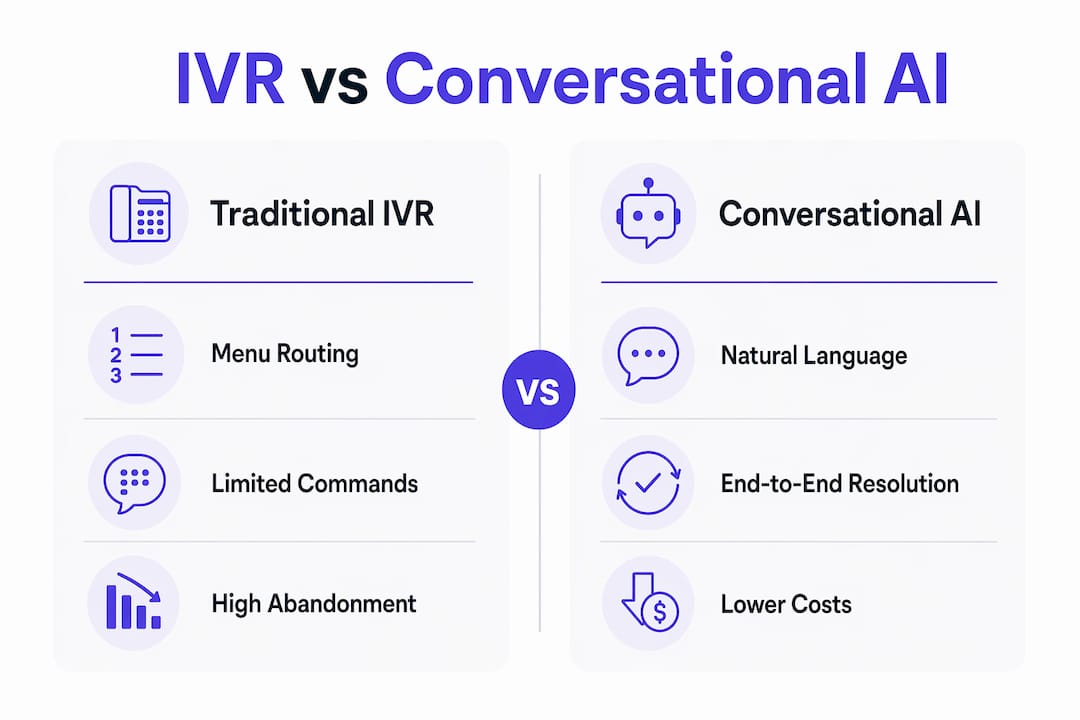
Traditional IVR systems route callers through numbered menus and require button presses or single-word voice commands. They do not understand intent. They do not adapt. A caller who says “I need help with my last invoice” gets the same menu tree as someone who says “billing.” The system cannot tell the difference.

Conversational AI uses Natural Language Processing (NLP) and Large Language Models (LLMs) to detect intent from full sentences. It asks clarifying questions, holds context across multiple turns, and connects to backend systems to complete transactions. The result is end-to-end resolution without a human agent ever picking up the phone. That is the operational shift: from routing to resolving.
The industry term for the upgrade path is “conversational IVR,” which describes AI-powered voice systems that accept natural speech instead of keypad inputs. Full conversational AI goes further by managing dynamic dialogue, not just speech recognition. Understanding that distinction helps you set the right expectations before you invest.
What limitations of traditional IVR drive the shift?
IVR systems fail in predictable ways. Recognizing these failure points tells you exactly where conversational AI delivers the most value.
- Rigid menu trees. Callers must fit their problem into a predefined category. If their issue falls between categories, they get stuck or transferred repeatedly.
- Poor natural language understanding. Basic voice IVR recognizes keywords, not meaning. A caller who says “I want to cancel my subscription but keep the hardware” confuses most IVR systems completely.
- High drop-off and abandonment. Callers who cannot navigate menus hang up. That call becomes a lost customer or an expensive callback.
- No context retention. When a caller reaches a human agent after navigating IVR, they repeat their entire story. Agents start from zero every time.
- Zero resolution capability. IVR routes. It does not answer questions, update accounts, or schedule appointments. Every resolved interaction still requires a human.
The frustration is not just a customer experience problem. Every abandoned call and every agent-handled routine inquiry carries a direct cost. Conversational AI addresses all five failure points simultaneously.
How does conversational AI work to replace IVR?
The technology stack behind conversational AI has four layers that work together to replace what IVR cannot do.
- Intent detection with NLP. The AI parses the caller’s words and identifies what they actually want. “I haven’t received my order” maps to an order status intent, not a generic support bucket.
- Context management across turns. Conversational AI maintains context, asks clarifying questions, and adapts based on each response. If a caller says “the blue one,” the AI knows which product they mean from earlier in the conversation.
- Backend integration for resolution. The AI connects to your CRM, order management system, or scheduling platform to pull live data and complete actions. It can confirm a shipment, reschedule an appointment, or update a billing address without transferring the call.
- Human agent handoff. When a query exceeds the AI’s scope, it transfers the caller to a human agent with full context attached. The agent sees the entire conversation history and picks up mid-resolution, not from the beginning.
A practical example: a healthcare contact center using conversational AI handles appointment rescheduling in under 90 seconds. The caller states their name, confirms their date of birth, says they need to move their Thursday appointment, and picks a new slot. No menu. No hold music. No agent involved. The same flow in a traditional IVR would require at least three menu levels and likely a transfer.
Pro Tip: Design your conversational flows around your top five call reasons first. Automating those alone typically covers the majority of your inbound volume and delivers measurable cost reduction within the first quarter.
What are the key advantages conversational AI offers over IVR?
The benefits of conversational AI over traditional IVR fall into three categories: customer experience, operational cost, and agent productivity.
Customer experience gains:
- Callers speak naturally and get answers faster. No memorizing menu options.
- Conversations feel continuous. The AI remembers what was said two turns ago.
- 24/7 availability means customers get help at midnight without waiting for business hours.
- Call abandonment drops because callers reach resolution faster.
Operational cost reduction:
Gartner’s projection of $80 billion in labor cost savings by 2026 is driven by one mechanism: AI handles routine interactions at scale without adding headcount. Volume spikes during holidays or product launches no longer require emergency staffing. The AI scales instantly.
Agent productivity:
Conversational AI automates routine interactions, freeing your human agents for complex, emotionally sensitive, or high-value conversations. An agent who previously spent 60% of their day on order status calls can now focus on retention conversations, escalations, and upsell opportunities. That is a direct improvement in both agent satisfaction and revenue per agent.
The combined effect is a contact center that costs less to run, serves customers better, and gets more value from every human on the floor.
How to implement conversational AI as an alternative to IVR?
Transitioning from IVR to conversational AI is a phased process. Rushing it creates gaps. Following a structured approach delivers results.
Phase 1: Assess your current IVR performance.
Pull your call data. Identify your top call reasons, your abandonment rates by menu level, and your average handle time for routine queries. These numbers become your baseline. Monitoring conversational AI performance against this baseline is how you prove ROI.
Phase 2: Map your integration requirements.
Conversational AI needs to connect to your CRM, ticketing system, and any platform it will query or update. Backend system connectivity is not optional. An AI that cannot pull live data cannot resolve queries. It just becomes a more expensive IVR.
Phase 3: Design conversational flows for your top use cases.
Start with your five highest-volume call types. Build conversation flows that handle the full range of responses a caller might give. Test edge cases. A caller who says “I don’t know my account number” needs a graceful path, not an error.
Phase 4: Train, monitor, and improve.
Implementing conversational AI requires continuous monitoring and model refinement. Review transcripts weekly in the first month. Identify where callers drop off or get misunderstood. Adjust intent models and dialogue paths accordingly.
- Set clear escalation triggers so the AI hands off to a human agent at the right moment.
- Use voice analytics to track sentiment, resolution rates, and call duration trends.
- Measure first-call resolution as your primary success metric.
Pro Tip: Build your fallback strategy before you go live. Define exactly which intents always route to a human, and make sure the handoff includes full conversation context. A bad handoff erases the goodwill the AI built in the first 60 seconds.
Conversational AI also extends beyond voice. AI agents for support handle chat, email, and messaging channels with the same intent detection and context management. Deploying across channels from a single platform reduces training overhead and keeps your customer experience consistent.
Key takeaways
Conversational AI replaces IVR by resolving customer queries end-to-end through natural language understanding, backend integration, and context-aware dialogue, delivering measurable cost savings and better customer outcomes.
| Point | Details |
|---|---|
| IVR routes; AI resolves | Traditional IVR moves callers through menus. Conversational AI completes the transaction. |
| NLP and context management | AI detects intent, holds context across turns, and adapts dialogue based on each response. |
| $80 billion cost opportunity | Gartner projects this in global contact center labor savings by 2026 through AI automation. |
| Phased implementation wins | Start with your top five call types, integrate backend systems, then monitor and refine continuously. |
| Agents gain, not lose | Automation of routine calls lets human agents focus on complex, high-value interactions. |
The uncomfortable truth about IVR replacement
I have watched contact center leaders approach conversational AI the same way they approached IVR upgrades in the 2000s: as a technology swap. They replace the phone tree with an AI model, declare success, and move on. Six months later, containment rates are flat and customer satisfaction scores have barely moved.
The problem is not the technology. The problem is that IVR was designed to deflect, and teams carry that mindset into AI deployment. They build flows that push callers toward self-service without genuinely solving their problems. Conversational AI built on a deflection philosophy performs like expensive IVR.
The contact centers that see real gains treat AI deployment as a service redesign. They ask: “What does this caller actually need, and how do we give it to them in this conversation?” That question produces different flows, different integrations, and different success metrics than “How do we keep callers off the phone with an agent?”
The balance between automation and human touch matters more than most vendors admit. Callers in distress, callers with complex billing disputes, callers who are elderly or not tech-comfortable: these groups need a human faster than your AI’s confidence threshold suggests. Building generous escalation paths is not a failure of AI. It is good service design.
The future of voice interfaces goes well beyond replacing IVR menus. AI voice agents will proactively reach out to customers, manage ongoing relationships, and surface insights that your team acts on. The organizations building that capability now are not just replacing IVR. They are rebuilding what a contact center does.
— Alex
Monobot: your next step beyond IVR
Monobot is an AI platform built specifically for contact centers ready to move past traditional IVR. The AI agent builder lets you design and deploy custom voice and chat agents without writing code, with industry templates for healthcare, banking, retail, and logistics available out of the box.
Monobot’s dashboard analytics give you real-time visibility into containment rates, resolution times, sentiment trends, and agent handoff frequency. You see exactly where your AI performs and where it needs refinement. Real-time transcription and voice analytics add a layer of call intelligence that no IVR system can match. If you are evaluating conversational IVR alternatives for your contact center, Monobot’s platform is built to handle the full transition.
FAQ
What is the main difference between IVR and conversational AI?
IVR routes callers through fixed menus using keypad inputs or basic voice commands. Conversational AI understands natural speech, detects intent, and resolves queries end-to-end without requiring callers to navigate predefined options.
How does conversational AI reduce contact center costs?
By automating routine interactions at scale, conversational AI eliminates the need to add headcount during volume spikes. Gartner projects this approach could save contact centers $80 billion in global labor costs by 2026.
Can conversational AI hand off to a human agent?
Yes. Well-designed conversational AI transfers callers to human agents when queries exceed its scope, passing full conversation context so agents do not need to ask callers to repeat themselves.
What use cases should I automate first?
Start with your highest-volume, lowest-complexity call types: order status, appointment scheduling, account balance inquiries, and password resets. These deliver the fastest containment gains and the clearest ROI.
Does conversational AI work for both voice and chat?
Conversational AI applies the same NLP and intent detection to voice calls, web chat, and messaging channels. Deploying from a single platform keeps the customer experience consistent across every channel.