



TL;DR:
- AI analytics have become essential for real-time insights and automation in high-performing call centers. They analyze customer interactions across channels, improving efficiency, agent support, compliance, and revenue through advanced NLP and machine learning. Implementing AI tools reduces wait times, enhances satisfaction, and enables proactive staffing and personalized customer experiences.
AI analytics have moved from a nice experiment to the operational backbone of high-performing call centers. The core role is straightforward: ingest every conversation across voice, chat, and email, then surface real-time insights that help supervisors and agents act faster and smarter. Centers that deploy these systems analyze interactions for sentiment, compliance, and agent effectiveness the moment a call ends, or even while it is still happening.
The technology stack behind this includes natural language processing (NLP), natural language understanding (NLU), large language models (LLMs), and machine learning. Together, they convert raw audio and text into structured intelligence: keyword flags, sentiment scores, compliance alerts, and coaching cues. That is what separates a modern AI-powered call center from one still relying on manual QA sampling and end-of-month spreadsheets.
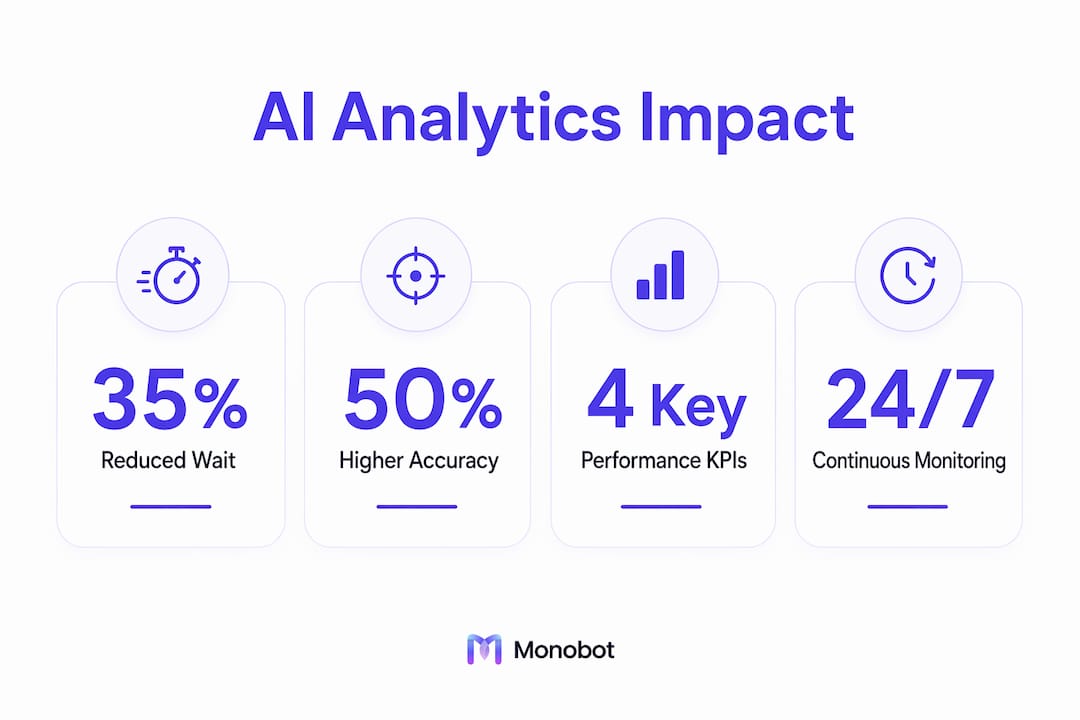
A few numbers frame the stakes. Voice AI can reduce average wait times by up to 30% and lift customer satisfaction ratings by a comparable margin. A majority of companies using AI in their contact centers report positive returns on investment, and many say AI is handling increasingly complex problems compared to the previous year. These are not projections. They reflect what centers are already seeing in production.
Key functions AI analytics deliver today:
- Conversation transcription and indexing across every channel, making calls searchable in seconds
- Sentiment analysis that flags frustrated callers before they escalate
- Keyword spotting for compliance triggers, competitor mentions, or product issues
- Real-time agent assist that surfaces relevant knowledge articles mid-call
- Predictive analytics that forecast call volume and staffing needs
- Compliance recording with automated flagging of at-risk interactions
- Live dashboards showing KPIs, trending topics, and agent performance in real time
What is the role of AI analytics in call centers?
AI analytics in call centers function as a continuous intelligence layer sitting on top of every customer interaction. The system ingests data from calls, chats, and emails simultaneously, then applies NLP and machine learning to extract meaning: what the customer wanted, how the agent responded, whether the outcome was successful, and whether any compliance risk appeared. Supervisors get that picture in real time rather than waiting for a weekly QA review.

The integration with operational workflows is what makes this practically useful. AI analytics connect directly to CRM platforms and business intelligence tools via APIs, so the insights do not stay siloed in a call center dashboard. Customer service data flows into product and marketing decisions, turning call transcripts into a feedback loop for the whole organization. A pattern of callers struggling with a specific feature, for example, becomes a product team alert rather than a buried QA note.
Compliance monitoring is another core function that often gets underestimated. AI automatically flags conversations that contain regulatory triggers, generates compliance reports, and integrates those alerts into existing workflows without requiring a human to listen to every call. That shift from sampling to full coverage is one of the most concrete operational gains AI analytics deliver.
Key features and capabilities you should know
The feature set of modern AI analytics platforms spans several distinct capability layers, each solving a different operational problem.
Conversation analytics sits at the foundation. This covers real-time transcription, keyword spotting, and sentiment scoring applied to every interaction. Advanced AI systems use NLP, NLU, LLMs, and machine learning to analyze calls and generate reports that would take a human QA team weeks to produce manually. Call categorization happens automatically, so supervisors can filter by topic, outcome, or risk level without listening to recordings.

Call recording and AI-assisted indexing transforms what used to be an archive into a searchable asset. Instead of pulling a random sample of calls for review, managers can search by keyword, sentiment score, or agent ID and retrieve exactly the interactions they need. This makes coaching conversations specific and evidence-based rather than impressionistic.
Real-time agent assist is where AI analytics shift from retrospective to live. The system listens to a call as it happens and pushes relevant knowledge articles, suggested responses, or compliance reminders directly to the agent’s screen. This reduces errors, shortens handle time, and gives newer agents the confidence of a more experienced colleague sitting beside them.
Agent well-being analytics is a newer capability that tracks sentiment and workload signals across an agent’s shift. If an agent handles a disproportionate share of escalations or shows consistent stress indicators in their voice patterns, the system surfaces that to a supervisor before burnout becomes a retention problem.
| Feature Category | Core Capability | Operational Impact |
|---|---|---|
| Conversation analytics | Transcription, keyword spotting, sentiment scoring | Full interaction coverage vs. manual sampling |
| Compliance recording | Automated flagging, risk reports | Regulatory adherence without manual review |
| Real-time agent assist | Live knowledge surfacing, suggested responses | Faster resolution, fewer errors |
| Live dashboards | KPI tracking, trending topics, agent metrics | Instant operational visibility |
| Chat and meeting analytics | Cross-channel conversation analysis | Unified view of customer journey |
| Predictive analytics | Call volume forecasting, staffing models | Better scheduling, reduced understaffing |
| Agent well-being analytics | Sentiment and workload monitoring | Early burnout detection, retention support |
Chat and meeting analytics extend the same intelligence to digital channels. A customer who contacts you via chat and then calls back within 24 hours is a pattern worth catching. AI analytics that span both channels surface that journey automatically, giving supervisors a unified view rather than fragmented channel reports.
Live dashboards pull all of this together into a single operational view. Supervisors see call volume, average handle time, sentiment trends, and agent performance metrics updating in real time, not at the end of a shift. That visibility changes how quickly a manager can respond to a spike in frustrated callers or a compliance flag.
How AI analytics benefit your call center operations
The benefits of AI analytics in call centers fall into three categories: operational efficiency, agent performance, and revenue generation. Each one is measurable, and the numbers from centers already running these systems are compelling.
Operational efficiency gains show up most clearly in handle time and wait time. Philippine Airlines reduced its average contact center wait time to under one minute and cut monthly customer service costs by 30% after deploying AI. That kind of reduction comes from a combination of faster agent resolution and call deflection, where routine inquiries are handled by virtual agents before they ever reach a live person.
Agent performance improves because AI removes the guesswork from coaching. Automated performance feedback during and after calls means agents get specific, timely guidance rather than a quarterly review based on a handful of monitored calls. Real-time agent assist reduces errors and helps agents resolve issues faster, which directly raises first-call resolution rates. When agents feel supported rather than monitored, job satisfaction tends to follow.
Revenue generation is the benefit that surprises most call center managers who still think of their operation as a cost center. AI analytics identify upsell opportunities and proactive outreach moments during live conversations. Shifting from a cost center to a retention engine is now a documented outcome, not a marketing claim. Philippine Airlines, for instance, uses AI to identify passengers who have not purchased checked baggage and trigger an outbound message before they reach the airport.
Additional benefits worth tracking in your own operation:
- Reduced call volume through self-service deflection, leaving live agents to handle genuinely complex issues
- Improved CSAT scores from faster, more accurate resolutions
- Lower QA overhead as automated monitoring replaces manual call sampling
- Better scheduling through predictive staffing models that anticipate volume peaks
- Reduced agent stress by automating wrap-up summaries and after-call work
Many organizations have seen a substantial increase in employee efficiency with AI usage in contact centers. That figure reflects both the time saved on manual tasks and the faster resolution enabled by real-time assistance.
Common use cases where AI analytics make the biggest difference
Knowing the features is one thing. Knowing where to apply them first is where most call center managers get stuck. These are the use cases with the clearest, fastest return.
Predictive staffing and volume forecasting is often the first place AI analytics pay off. AI analyzes historical data to identify volume trends and anticipate peaks, giving workforce management teams the data they need to schedule accurately. Understaffing is one of the biggest drivers of agent burnout and long wait times. Getting ahead of it with predictive models rather than reacting to it after the fact changes the dynamic entirely.
Virtual agents handling routine inquiries free your live agents for the calls that actually require human judgment. An AI voice agent can handle flight status checks, order updates, appointment scheduling, and account balance inquiries without any human involvement. How voice AI handles inbound calls at this level of sophistication is no longer experimental. Centers deploying these agents at scale are targeting 80% automation of routine inbound volume.
Real-time call monitoring and agent coaching is where AI analytics shift from reporting to intervention. A supervisor watching a live dashboard sees a sentiment score drop mid-call and can join, whisper-coach, or send a knowledge article to the agent without the customer knowing. That kind of in-the-moment support was impossible before AI made real-time transcription and sentiment scoring practical at scale.
Sentiment analysis driving customer experience improvements works at two levels. At the individual call level, it flags at-risk interactions before they escalate. At the aggregate level, it reveals patterns: which product issues generate the most frustration, which agent behaviors correlate with high CSAT, which call types consistently end in escalation. Those patterns inform training, product decisions, and process changes.
Compliance and risk management use cases are particularly valuable in regulated industries like banking, healthcare, and insurance. AI automatically monitors every call for required disclosures, prohibited language, and regulatory triggers, then generates audit-ready reports. Compliance recording powered by AI flags risky interactions and integrates those alerts into operational workflows without adding headcount to your QA team.
CRM and BI integration closes the loop between what happens on calls and what the rest of the business knows about customers. APIs allow AI data to flow into CRM and business intelligence platforms, so a pattern of callers asking about a specific product issue becomes a data point in your product team’s dashboard, not just a note in a call log.
Proactive outreach and upselling rounds out the use case picture. AI analytics identify moments in a conversation where a customer is likely to respond positively to a relevant offer. That intelligence can trigger an outbound message, a chat prompt, or a live agent suggestion, turning an inbound support call into a revenue moment.
How Monobot puts AI analytics to work for your call center
Monobot is built specifically for the use cases described above, with an architecture that lets you deploy AI voice and chat agents quickly and customize them without writing code. The platform automates up to 80% of inbound calls and chats, which means your live agents spend their time on the interactions that genuinely require human judgment.
The analytics layer is where Monobot goes beyond basic automation. Real-time dashboards give supervisors granular visibility into call volume, sentiment trends, agent performance, and resolution rates, all updating live. That visibility is not just for reporting. It feeds directly into the real-time agent assist capability, where Monobot acts as a copilot, surfacing relevant knowledge articles, suggested responses, and compliance reminders to agents mid-call.
Monobot’s industry templates cover healthcare, banking, retail, logistics, and more, so you are not starting from a blank configuration. Each template is pre-built with the conversation flows, compliance considerations, and integration points relevant to that vertical. Deployment that used to take months now takes days, and often less.
Key Monobot capabilities for call center operations:
- AI voice agent builder for creating and deploying custom voice agents without engineering resources
- Live transcription and speech-to-text for real-time interaction detail and post-call analysis
- Dashboard analytics with granular KPI tracking and trend visualization
- No-code customization for rapid iteration on agent scripts and workflows
- Third-party integrations with CRM, ticketing, and BI platforms via API
- Multi-industry templates for healthcare, banking, retail, logistics, and more
Monobot also supports AI chatbot development workflows for teams that want to build grounded, customized assistants alongside their voice agents, keeping both channels under a unified analytics view.
Pro Tip: Start your Monobot deployment with one high-volume, highly deterministic workflow, such as order status or appointment confirmation. Refine the analytics and resolution rates there before expanding to more complex conversational tasks. This pyramid approach consistently delivers faster ROI and cleaner data for coaching.
Monobot’s voice analytics capabilities give you the call analysis depth to move from reactive QA to proactive performance management. If you want to see what that looks like in your environment, the AI analytics dashboard is the right place to start.
Key Takeaways
AI analytics transform call center operations by converting every customer interaction into structured intelligence that drives faster resolutions, better coaching, and measurable revenue opportunities.
| Point | Details |
|---|---|
| Full interaction coverage | AI monitors every call, chat, and email for sentiment, compliance, and performance, replacing manual sampling. |
| Wait time and cost reduction | Voice AI can reduce average wait times by up to 30% and cut customer service costs by a comparable margin. |
| Agent performance lift | Real-time assist and automated feedback raise first-call resolution rates and reduce errors during live calls. |
| Revenue generation | AI identifies upsell and proactive outreach moments during conversations, shifting call centers from cost centers to retention engines. |
| Predictive staffing | AI analyzes historical call volume to forecast peaks and improve scheduling, reducing understaffing and agent burnout. |
FAQ
How is AI being used in call centers right now?
AI handles routine inquiries through virtual agents, assists live agents with real-time knowledge surfacing and suggested responses, monitors every interaction for sentiment and compliance, and forecasts staffing needs using historical volume data. Contact center AI automates both customer-facing and behind-the-scenes tasks to improve efficiency across the operation.
What are the four most common KPIs AI analytics track in call centers?
The four KPIs most consistently tracked are average handle time, first-call resolution rate, customer satisfaction score (CSAT), and agent utilization rate. AI analytics measure these in real time and surface trends that manual reporting would catch only after the fact.
What is speech analytics in call centers?
Speech analytics is the technology that transcribes and analyzes spoken conversations to extract keywords, sentiment, compliance signals, and performance data. It applies NLP and machine learning to convert audio into structured insights that supervisors and coaches can act on immediately.
What role does AI play in contact center analytics broadly?
AI processes large volumes of unstructured interaction data, including calls, chats, and emails, and converts it into patterns, scores, and alerts that humans can use to make decisions. Deloitte research frames AI as a copilot that enhances human capacity rather than replacing agents, enabling more empathetic, high-value customer interactions.
How does AI analytics support call center cost reduction?
AI reduces costs by deflecting routine calls to virtual agents, cutting average handle time through real-time assist, automating after-call wrap-up, and replacing manual QA sampling with full-coverage automated monitoring. The combined effect lowers the cost per interaction while maintaining or improving resolution quality.