



AI handles a wider range of customer inquiries than most customer service managers realize. Today’s AI agents autonomously manage everything from basic account lookups to multi-turn troubleshooting conversations, with real-time escalation to human agents when complexity demands it. Here is a quick snapshot of the inquiry types AI resolves without human involvement:
- Account and subscription details (plan status, billing cycles, membership tier)
- Order tracking and shipment updates (real-time status, estimated delivery, carrier info)
- Billing and payment questions (invoice clarification, refund eligibility, payment method updates)
- Password resets and authentication issues
- FAQ and policy lookups (return windows, cancellation terms, coverage rules)
- Appointment scheduling and rescheduling
- Lead qualification and intake forms
- Multi-turn troubleshooting flows (device setup, connectivity issues, step-by-step guidance)
- Case creation and ticket logging with full context preserved
- Escalation handoffs to human agents, with conversation history transferred intact
The complexity ranges from a single-turn FAQ response to a five-step guided troubleshooting session. What makes modern AI different from legacy IVR menus is context retention: the AI remembers what the customer said two turns ago and adjusts its next response accordingly.
How AI handles routine customer inquiries at scale
Routine inquiries make up the bulk of contact center volume, and they are exactly where AI delivers the fastest return. These are the interactions where the answer is deterministic: look up a record, apply a rule, return a result.
- Order status tracking: A customer asks where their package is. The AI queries the order management system in real time, retrieves the carrier tracking number, and returns an estimated delivery window, all within seconds. StubHub reduced wait times from over 20 minutes to near-instant responses by deploying an AI assistant that handles order tracking, ticket access, and policy questions end-to-end.
- Account information updates: Customers asking to change an address, update a phone number, or switch a payment method. TransferGo’s multilingual virtual agent handles these self-serve intents in 11 languages without routing to a human.
- Billing and invoice questions: AI pulls the relevant invoice, explains line items, and confirms refund eligibility based on policy rules retrieved from a live knowledge base.
- Password resets: A classic high-volume, zero-judgment task. AI verifies identity through a defined flow and triggers the reset automatically.
- Appointment scheduling: The AI checks availability in real time, books the slot, and sends a confirmation, with no agent involvement.
What separates AI from a basic FAQ bot here is the live system integration. The AI does not guess. It reads from your CRM, your order management platform, or your inventory system and returns a verified answer. That is why first contact resolution rates improve so sharply when AI handles these inquiry types.
Pro Tip: Start your AI deployment with the three highest-volume, most repetitive inquiry types. Nail those before expanding to more complex flows. Siemens followed exactly this approach, beginning with intelligent call routing before extending to employee lookup and outbound campaigns.

Advanced AI use cases: when conversations get complex
Beyond the basics, AI now manages interactions that require context, judgment, and multi-step reasoning. These are the use cases that separate a capable AI platform from a simple chatbot.
- Multi-turn troubleshooting: A customer reports a connectivity issue. The AI asks clarifying questions, walks through a diagnostic sequence, and adjusts its guidance based on each response. If the issue persists after three steps, it creates a support ticket with the full conversation log attached.
- Policy explanations with personalization: Rather than returning a generic policy page, the AI retrieves the customer’s specific account tier, applies the relevant policy rules, and explains exactly what applies to their situation. Finnair’s AI assistant, Sisu, does this by combining a customer’s booking reference with live knowledge articles to turn a general policy answer into a trip-specific one.
- Case creation and escalation: When a query exceeds the AI’s confidence threshold, it does not drop the customer. It classifies the issue by intent and sentiment, creates a case, and routes to the appropriate human agent with the full conversation context pre-loaded. The customer never repeats themselves.
- Outbound proactive engagement: Siemens’ outbound campaign AI agent pulls a customer’s purchase history from the CRM at call time, delivers a personalized product recommendation, and logs the outcome automatically. The AI handles initial qualification; a human sales representative takes over once genuine interest is confirmed.
- Sentiment-driven preemption: Uber uses AI-driven sentiment analysis and behavioral data to identify dissatisfied customers before they contact support, resolving issues proactively rather than reactively.
- Backend task execution: AI does not just answer questions. It takes actions. An e-commerce AI agent can initiate a return, trigger a refund via Shopify API, update a shipping address, and send a confirmation email, all within a single conversation thread.
- Employee and directory lookups: Siemens’ employee lookup AI agent collects the caller’s request, queries an internal directory in real time, and orchestrates a callback automatically without placing the caller on hold or disclosing private employee details.
The thread connecting all of these is context awareness. The AI knows what was said earlier in the conversation, what the customer’s account history shows, and what the policy says for their specific situation. That combination is what makes advanced AI interactions feel like talking to a knowledgeable colleague rather than navigating a menu tree.

What AI technologies actually power these interactions
Understanding the technology stack helps you evaluate which platforms can genuinely handle the inquiry types you care about.
Conversational AI and natural language processing (NLP) sit at the foundation. NLP handles intent detection (what does the customer want?) and entity recognition (which order number, which product, which date?). Amazon Lex, for example, powers Siemens’ intent detection layer, allowing callers to state their reason for calling in plain language with no DTMF menus required.
Machine learning for sentiment analysis and routing adds a layer of emotional intelligence. The system classifies not just what a customer is asking but how they feel about it. Upset customers, complex complaints, and anything outside defined guardrails route directly to a human agent, with full conversation context pre-loaded. This triage function is what prevents AI from making a frustrated customer more frustrated.
Retrieval-Augmented Generation (RAG) is the technology that keeps AI responses accurate. Instead of relying on static training data, RAG architecture grounds every response in live company data: your CRM, your knowledge base, your inventory system. StubHub’s AI assistant uses a RAG pipeline to pull real-time knowledge base data, customer details, and order context before generating a response. The result is accuracy without hallucination.
Backend system integrations are what allow AI to take action, not just answer. AWS Lambda functions, Shopify APIs, Zendesk connectors, and CRM write-backs let the AI update records, initiate transactions, and log outcomes autonomously. Without these integrations, an AI agent is limited to conversation. With them, it becomes an operational tool.
Pro Tip: When evaluating AI platforms, ask specifically how they handle knowledge base updates. A platform using RAG with live data connections will stay accurate as your policies change. A platform using static training data will drift.
Monobot combines all of these layers into a single platform, with AI voice and chat agents that connect to your existing CRM, support tools, and backend systems without requiring custom code. Deployment typically takes minutes, not months.
What the data says: real results from AI-handled inquiries
The business case for AI-handled inquiries is no longer theoretical. The numbers from production deployments are specific and consistent.
| Company | Inquiry Type Automated | Key Result |
|---|---|---|
| Siemens | Inbound call routing, employee lookup, outbound campaigns | 90% of calls handled autonomously in production |
| StubHub | Order tracking, ticket access, policy questions | Wait times dropped dramatically to near-instant; costs reduced by over 30% |
| Lyft | Fare disputes, account questions, driver onboarding | Resolution time cut substantially; decision accuracy improved by over 30% |
| BinaryBits e-commerce client | Order tracking, returns, payment confirmations | — |
| The Well Spa Hotel | Guest inquiries and service requests | — |
“Claude handles the full customer journey for routine cases, from inquiry to resolution. This goes beyond automation to streamline our entire support ecosystem.” — Addison, StubHub
The BinaryBits case is worth examining closely. An e-commerce brand receiving hundreds to over a thousand support tickets per day deployed a GPT-4o and RAG-powered agent. Within 30 days of full deployment, the AI handled a major sale event entirely autonomously, processing thousands of tickets in a single day without additional hires. The CSAT scores for AI-resolved conversations exceeded the historic human-agent average. Customers valued instant, accurate responses over waiting hours for a human reply.
Lyft’s results tell a similar story from a different angle. Resolution times dropped by over 87%, and the shift changed what it means to be a support agent at Lyft. Agents now handle one customer at a time instead of juggling multiple chats, with room to think critically and anticipate what else a customer might need. AI handling routine inquiries did not eliminate agent value. It concentrated it where it matters most.
Research from Harvard Business School confirms the pattern: AI chatbots that resolve inquiries quickly and accurately consistently produce higher customer satisfaction scores for routine interactions, often outperforming human agents on speed and precision. The human agents freed from repetitive tasks then perform better on the complex cases that reach them.
For customer service managers evaluating AI for call centers, the pattern across these deployments is consistent: start with your highest-volume routine inquiry types, integrate with live data systems, set clear confidence thresholds for escalation, and measure CSAT from day one.
Try Monobot for your customer inquiry automation
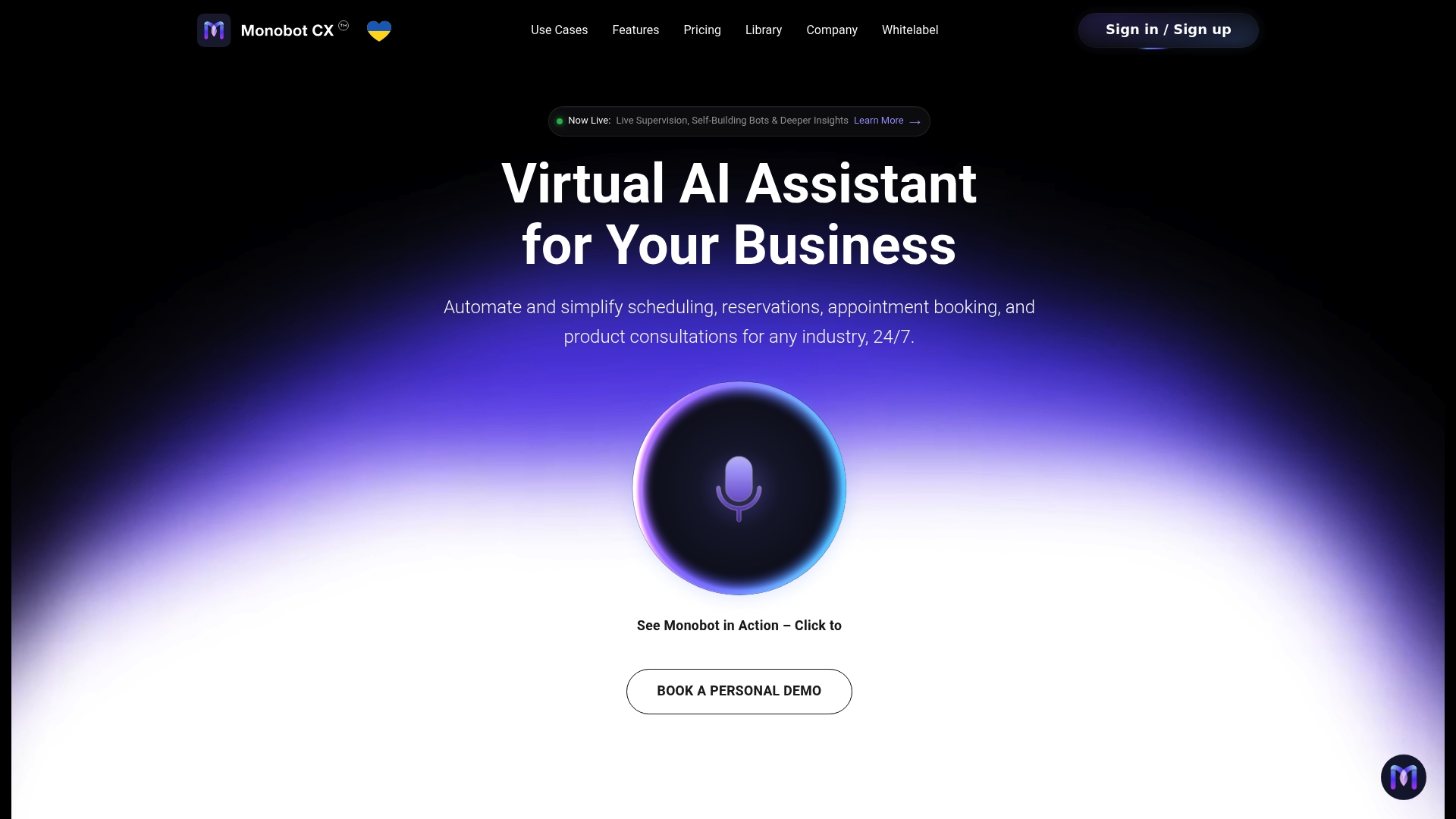
Monobot’s platform gives your team a direct path from evaluation to deployment. The AI agent builder lets you configure voice and chat agents for your specific inquiry types, connect them to your existing CRM and support tools, and go live without writing code. Industry templates for healthcare, banking, retail, logistics, and more mean you are not starting from scratch.
Monobot reports automating a high percentage of inbound calls and chats for its customers, with real-time analytics that show exactly which inquiry types are being resolved, which are escalating, and where the gaps are. Every interaction is logged, every escalation is tracked, and your human agents get the context they need before they say hello.
Schedule a demo at monobot.ai and see how your top inquiry types map to AI automation in your first conversation.
Key Takeaways
AI handles routine and complex customer inquiries autonomously when backed by live data integrations, NLP-driven intent detection, and clear escalation thresholds that preserve full conversation context for human agents.
| Point | Details |
|---|---|
| Routine inquiries resolve fastest | Order tracking, billing, password resets, and account updates are the highest-ROI starting points for AI automation. |
| RAG prevents hallucination | Grounding AI responses in live CRM and knowledge base data keeps answers accurate as policies change. |
| Siemens handles 90% of inbound calls autonomously. Starting with one high-volume use case and expanding incrementally is the proven deployment model. | |
| AI CSAT can exceed human averages | BinaryBits’ deployment led to AI-resolved conversations exceeding the historic human-agent average in CSAT scores. |
| Escalation quality matters as much as automation rate | Transferring full conversation context to human agents eliminates customer repetition and raises resolution quality. |
FAQ
What types of customer inquiries can AI handle autonomously?
AI handles order tracking, billing questions, password resets, account updates, appointment scheduling, policy lookups, and multi-turn troubleshooting without human involvement. More advanced deployments also manage case creation, outbound engagement, and sentiment-driven escalation.
What is an example of AI customer service in practice?
StubHub’s AI assistant resolves order tracking, ticket access, and policy questions end-to-end, cutting wait times from over 20 minutes to near-instant responses while reducing operational costs by over 30%.
How does AI know when to escalate to a human agent?
AI platforms use confidence scoring and sentiment classification to detect when a query exceeds their resolution capability or involves an emotionally distressed customer. When that threshold is crossed, the system routes to a human agent with the full conversation context pre-loaded, so the customer never has to repeat themselves.
How does AI avoid giving customers wrong information?
Retrieval-Augmented Generation (RAG) grounds AI responses in live company data, such as your CRM, knowledge base, and inventory system, rather than relying on static training data. This architecture prevents the AI from generating plausible-sounding but inaccurate answers.
How quickly can a business deploy an AI customer service agent?
Deployment timelines vary by platform and integration complexity. Monobot’s no-code agent builder allows businesses to configure and launch AI voice and chat agents in minutes using pre-built industry templates, with CRM and backend integrations handled through the platform.