



TL;DR:
- An AI-driven customer engagement strategy uses artificial intelligence to automate personalized interactions that boost loyalty and revenue. Successful implementation requires unified customer data, modular content, and rigorous governance to avoid data silos and inaccuracies. This approach enables rapid deployment, measurable revenue uplift, and a shift from static to dynamically assembled customer journeys.
An AI-driven customer engagement strategy is the proactive use of artificial intelligence to orchestrate personalized, automated customer interactions that increase loyalty, retention, and revenue. This is the industry’s shift from static campaign management to dynamic, agentic AI systems that respond to real-time customer signals. Organizations with unified data sources see measurable revenue uplift within 8–12 weeks of deploying AI journey orchestration. BCG and Deloitte both identify predictive analytics and agentic AI as the two defining components of modern customer engagement. For customer experience leaders and marketing professionals, this is not a future consideration. It is the current competitive standard.
What does an AI-driven customer engagement strategy require?
The foundation of any AI-driven engagement program is a unified identity graph. This means combining online behavioral data, offline purchase history, and real-time signals into a single customer profile. Without this layer, AI agents make decisions on incomplete information, and personalization breaks down fast.

Composable content shelves are the second prerequisite. Instead of building rigid campaign flows, your team curates a library of modular content assets, each tagged with rich metadata. The AI agent then selects and sequences these assets dynamically based on context. This shifts the marketer’s role from journey architect to content curator.
The third requirement is an API-first, modular tool architecture. Systems that bolt AI onto legacy platforms create data silos. Modular systems allow you to layer AI capabilities without replacing core infrastructure. Composable, API-first tools let personalized programs launch in hours rather than weeks.
The speed advantage of this approach is real. Macy’s deployed a multimodal AI shopping concierge in 4 weeks using modular architecture and well-curated content assets. The result was a 4.75x revenue per visit increase among users who engaged with the agent. That outcome is not exceptional. It is repeatable when the prerequisites are in place.
Key prerequisites at a glance:
- Unified identity graph: Combines behavioral, transactional, and real-time data into one customer profile
- Metadata-rich content library: Modular assets the AI agent can assemble dynamically
- Agentic orchestration layer: The AI logic that sequences actions based on real-time context
- API-first integrations: Connects data sources, channels, and tools without rebuilding core systems
- Governance framework: Escalation rules and accuracy checks before any agent goes live
Pro Tip: Start with one high-volume use case, such as cart abandonment or failed payment recovery, before scaling to full journey orchestration. Focused deployments build confidence and surface data quality issues early.
How to build and execute your AI engagement strategy step by step
Building an effective AI engagement program follows a clear sequence. Skipping phases creates technical debt that compounds quickly.
-
Audit and unify your data. Map every customer data source your organization holds. Identify gaps between online behavior, CRM records, and purchase history. Build or integrate a unified identity layer before any AI agent touches customer interactions. This phase typically takes 4–8 weeks for mid-size organizations.
-
Build your modular content and offer library. Create atomic content units: a single headline, a product image, a discount offer, a support article. Tag each asset with attributes like customer segment, intent signal, and channel. The AI agent needs this metadata to make good decisions. A library of 200 well-tagged assets outperforms a library of 2,000 untagged ones.
-
Design the agentic orchestration layer. This is the decision engine. Agentic AI orchestration enables agents to autonomously select tools and content based on real-time context, moving beyond rigid pre-planned journeys. Define which signals trigger which agent actions, and set clear boundaries for what the agent can decide independently versus what requires human review.
-
Deploy AI agents for 24/7 personalized interaction. Start with channels where volume is high and queries are predictable, such as chat support, appointment scheduling, or order status updates. Platforms like Monobot’s AI agent builder let teams deploy voice and chat agents without writing code, which cuts time to production significantly.
-
Run continuous experimentation. Use incrementality testing to measure the true causal impact of each AI interaction, not just correlation. Compare outcomes for customers who received AI-driven interactions against a holdout group. This tells you what the AI is actually generating in revenue, not what it coincidentally occurred alongside.
-
Refine governance and escalation design. Define the exact conditions under which an AI agent hands off to a human. Enterprise-grade AI agents that handle complex queries, routing, and escalation reduce customer effort and transfers. Build this logic before launch, not after your first escalation failure.
Pro Tip: Map your escalation triggers to specific customer emotion signals, not just query complexity. A customer who has repeated the same question three times needs a human, regardless of how simple the question is.
Understanding how AI scales customer interactions across service teams gives you a practical model for phasing this rollout across departments.
What are the most common pitfalls in AI engagement implementation?
The most damaging mistake is treating AI as a layer you add on top of existing systems. Bolted-on AI creates data silos where the agent operates on a different view of the customer than your CRM, your email platform, and your support desk. The customer experiences this as repetition, irrelevance, and broken context.
The second major risk is unclear knowledge bases. AI scales confusion when processes or knowledge bases are unclear, producing inaccurate responses that damage customer trust faster than human errors do. If your internal documentation is outdated or contradictory, the AI will surface those contradictions at scale, to every customer who asks.
“The greatest risk in AI customer engagement is the ‘confidently wrong’ response. An AI agent that delivers an incorrect answer with high confidence causes more trust damage than a human who says ‘I’m not sure, let me check.’ Accuracy measures and escalation design are not optional features. They are the foundation of any sustainable AI deployment.” — Deloitte, AI and Customer Experience
Personalization and privacy create a third tension point. Customers want relevant interactions, but they also expect transparency about how their data is used. The organizations that get this right disclose their data practices clearly and give customers meaningful control. Those that do not face both regulatory risk and customer backlash.
The final pitfall is poor handoff design between AI and human agents. Smooth AI-to-human transitions require the human agent to receive full context from the AI interaction before picking up the conversation. Without this, customers repeat themselves, frustration spikes, and the efficiency gains from AI evaporate. You can learn more about AI in customer experience and call centers to see how leading teams design these handoffs.
Which KPIs actually measure AI engagement success?
Vanity metrics like chatbot deflection rates tell you very little about business impact. The metrics that matter connect AI interactions directly to customer behavior and revenue.
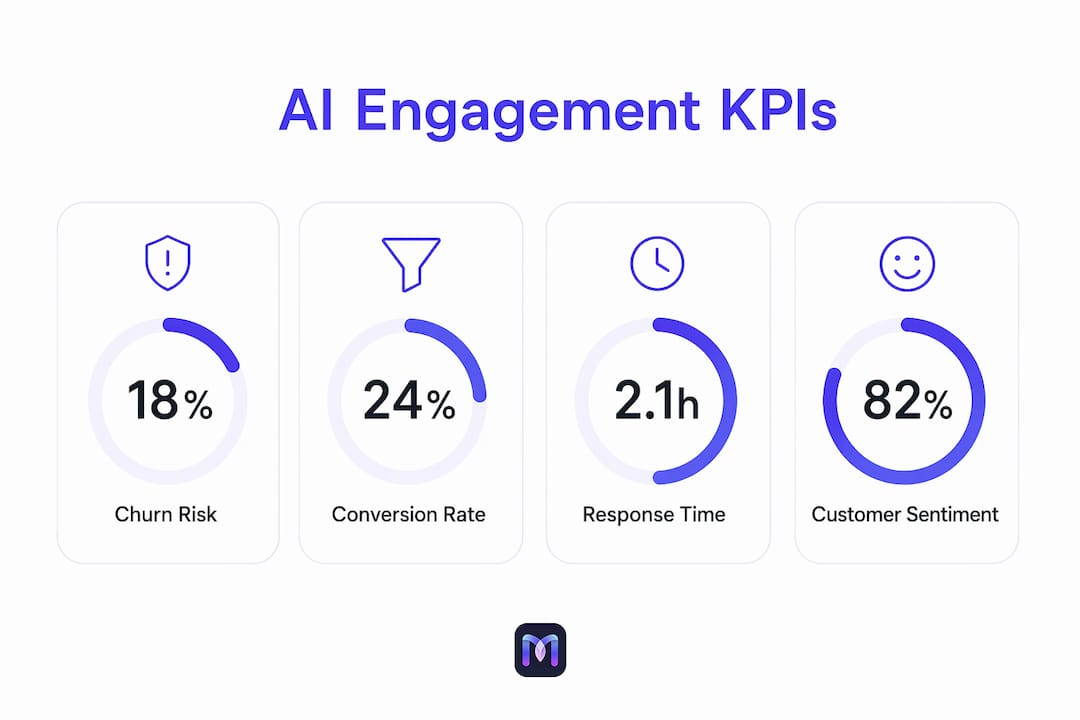
| KPI | What it measures | Why it matters |
|---|---|---|
| Churn risk score | Predicted probability of customer leaving within 60 days | Enables proactive intervention before churn occurs |
| Customer lifetime value (CLV) | Projected revenue from a customer over their full relationship | Tracks whether AI engagement increases long-term value |
| Repeat purchase rate | Frequency of return purchases within a defined window | Measures loyalty impact of personalized AI interactions |
| Failed payment recovery rate | Percentage of failed payments recovered via AI-driven outreach | AI-driven dunning achieves 55–80% recovery versus 15–25% with standard methods |
| First-contact resolution rate | Percentage of issues resolved in a single AI interaction | Measures agent quality and knowledge base accuracy |
Predictive churn risk scoring with 60-day intervention windows significantly lowers churn costs compared to reactive campaigns. This means your AI system needs to flag at-risk customers before they cancel, not after. Building this model requires at least 90 days of behavioral data to produce reliable predictions.
Attribution is the hardest measurement problem in AI engagement. Multi-touch attribution models distribute credit across every interaction that preceded a conversion. Incrementality testing goes further by isolating the causal contribution of a specific AI interaction. Use both methods together to get an accurate picture of what your AI program is actually generating.
Pro Tip: Set up a feedback loop where AI interaction data flows back into your customer health scoring model weekly. Static models decay fast. A model trained on data from six months ago misses behavioral shifts that predict churn today.
The role of AI in marketing strategies has expanded to include these measurement frameworks, making marketing teams directly accountable for revenue outcomes rather than just campaign metrics.
Key Takeaways
An AI-driven customer engagement strategy delivers measurable revenue and retention gains only when built on unified data, modular architecture, and rigorous governance from the start.
| Point | Details |
|---|---|
| Unified data is the prerequisite | Build a single customer identity layer before deploying any AI agent or personalization logic. |
| Modular content libraries outperform static journeys | Tag assets with metadata so AI agents can assemble personalized interactions dynamically. |
| Governance prevents trust damage | Define escalation triggers and accuracy checks before any agent goes live with customers. |
| Churn risk scoring beats reactive campaigns | Predictive models with 60-day windows let you intervene before customers decide to leave. |
| Incrementality testing reveals true AI impact | Measure causal revenue contribution, not just correlation, to justify and scale AI investment. |
Why the shift to agentic AI changes everything for marketing leaders
I have watched marketing teams spend months building elaborate customer journey maps, only to see them obsolete within a quarter. The static journey model assumes you can predict what a customer needs at each stage. Agentic AI exposes that assumption as fiction.
The shift that actually matters is not from manual to automated. It is from pre-planned to dynamically assembled. Agentic AI reveals customer intelligence that traditional analytics cannot surface, including the underlying motivations behind purchase decisions and where your offerings fall short. That is genuinely new information, and it belongs in your product roadmap, not just your campaign reports.
The teams I see struggling with AI engagement share one pattern: they treat AI as a shortcut to skip the hard work of data unification and process design. AI amplifies what already exists in your systems. If your knowledge base is a mess, your AI agent will confidently deliver that mess to every customer who asks a question.
The teams winning with AI engagement treat it as an amplifier, not a replacement. They invest in clean data, modular content, and clear governance first. Then they deploy agents that get measurably better every week because the feedback loops are designed to feed model updates. The improvement in user engagement that follows is not accidental. It is the compounding return on infrastructure investment.
My honest prediction: within two years, agent-mediated decision making will handle the majority of routine customer interactions across retail, financial services, and healthcare. Marketing leaders who have built the data and content infrastructure now will have a durable advantage. Those who wait for a turnkey solution will spend years catching up.
— Alex
How Monobot fits into your AI engagement program
Building an AI engagement program requires a platform that handles voice, chat, and analytics without forcing you to stitch together five separate tools.
Monobot gives customer experience teams a single environment to build, deploy, and monitor AI voice and chat agents across every channel. The AI Voice Agent Builder lets you create custom agents for appointment scheduling, lead qualification, order updates, and support without writing code. Monobot automates up to 80% of inbound calls and chats, which frees your human agents for the interactions that actually require judgment. Real-time dashboard analytics give you the interaction data and performance metrics you need to run continuous improvement cycles. If you are ready to move from static customer journeys to dynamic, AI-curated engagement, Monobot’s platform is built for exactly that transition.
FAQ
What is an AI-driven customer engagement strategy?
An AI-driven customer engagement strategy uses artificial intelligence to automate, personalize, and orchestrate customer interactions across channels in real time. It combines predictive analytics, agentic AI, and unified customer data to increase retention and revenue.
How long does it take to see results from AI engagement?
Organizations with unified identity graphs and integrated data sources typically see measurable revenue uplift within 8–12 weeks of deploying AI journey orchestration. Focused use cases like failed payment recovery can show results faster.
What is agentic AI in customer engagement?
Agentic AI refers to AI systems that autonomously decide which tools, content, and actions to use based on real-time customer context. Unlike rule-based automation, agentic AI sequences interactions dynamically rather than following a pre-planned script.
How do I measure the ROI of AI customer engagement?
Use incrementality testing to isolate the causal revenue contribution of AI interactions, and track KPIs like churn risk score, repeat purchase rate, and first-contact resolution rate. Pairing multi-touch attribution with holdout group testing gives the most accurate picture.
What is the biggest risk in deploying AI for customer engagement?
The greatest risk is a “confidently wrong” AI response that damages customer trust. Rigorous escalation design, accurate knowledge bases, and continuous model updates are the core defenses against this failure mode.