



TL;DR:
- Automated post-call surveys trigger immediately after interactions to collect customer feedback through IVR, SMS, or email. They improve response rates, data accuracy, and enable faster coaching by integrating responses directly into call center analytics. Using AI-driven sentiment analysis alongside traditional methods ensures comprehensive, real-time insights for service improvement.
Post-call survey automation is defined as an automated feedback mechanism that triggers immediately after a customer call ends to collect satisfaction data through IVR, SMS, or email. The industry also refers to this as automated post-interaction surveying. Customer service leaders use it to capture CSAT, NPS, and CES scores at scale, without relying on manual follow-up. Automated systems reach response rates of up to 20%, outperforming traditional manual methods. That gap matters because higher response volume means more statistically reliable data for coaching, benchmarking, and service improvement.
What is post-call survey automation and how does it work?
Post-call survey automation works by connecting your telephony system to a survey delivery engine that fires the moment a call disconnects. The trigger is automatic. No agent action is required.
The most common delivery path is IVR, where the caller stays on the line and answers questions by pressing keypad digits. An IVR post-call survey typically asks two or three questions, and 70–80% of callers participate when prompted during the call flow. That participation rate is far above what any manual outreach achieves. For callers who hang up before completing an IVR survey, SMS and email serve as secondary channels, sending a short survey link within minutes of call completion.
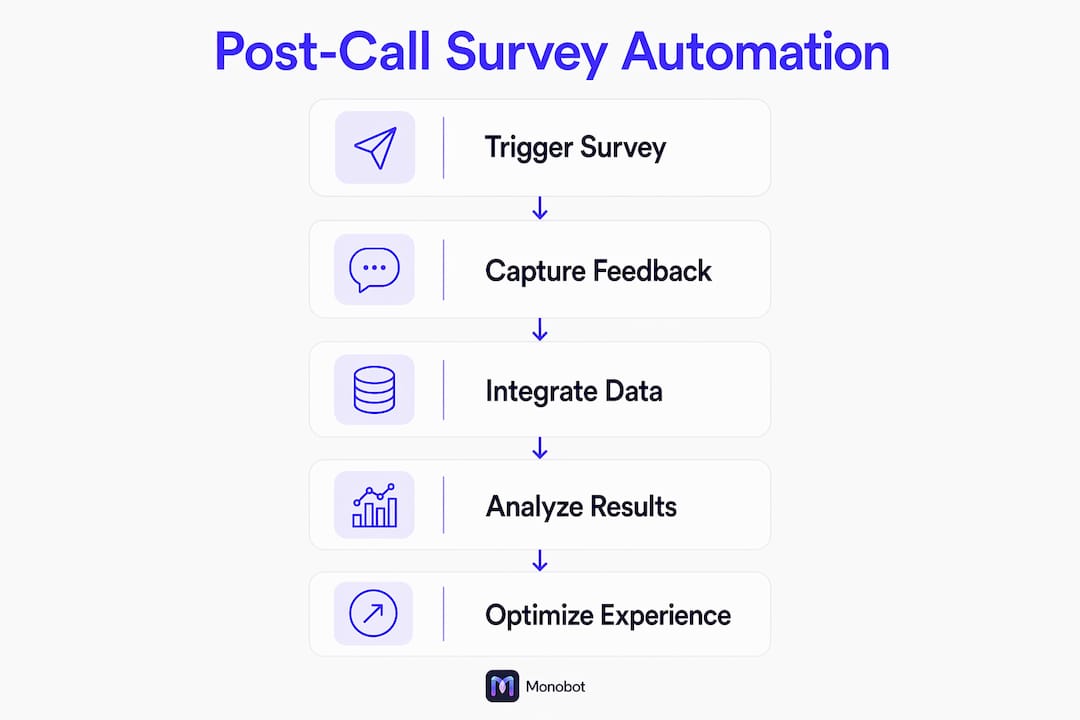
Here is how a standard automated post-call feedback process runs from start to finish:
- Call ends. The telephony platform detects the disconnect event and passes call metadata (agent ID, call duration, queue) to the survey engine.
- Channel selection. The system checks caller preferences or defaults to IVR, then routes to SMS or email if IVR is unavailable.
- Survey delivery. The caller receives one to three questions covering CSAT, NPS, or CES, depending on your configuration.
- Response capture. Keypad inputs, text replies, or form submissions are recorded and tagged to the specific call record.
- Data routing. Responses flow into your call center software or analytics dashboard for real-time review.
- Reporting. Aggregated scores appear in QA reports, agent scorecards, and trend dashboards.
Integrations with call center software allow survey responses to flow directly into QA reports and dashboards, cutting the lag between feedback collection and coaching decisions. This is the step most organizations underestimate. Without tight integration, survey data sits in a silo and loses its operational value.
Pro Tip: Set your IVR survey trigger to fire only on calls that lasted more than 60 seconds. Very short calls rarely reflect a full service interaction, and including them skews your CSAT scores downward.

What are the key benefits of automating post-call surveys?
Automating call feedback delivers four concrete advantages that manual processes cannot replicate at scale.
- Higher response volume. Automated delivery reaches response rates up to 20% compared to manual follow-up. More responses mean more reliable trend data and fewer decisions based on anecdotal feedback.
- Better data accuracy. Surveys initiated immediately after calls benefit from high recall accuracy, capturing genuine sentiment rather than faded or biased memory. A customer surveyed two days later remembers the outcome, not the experience.
- Consistent coverage. Post-call surveys activate immediately after the call, eliminating the inconsistency of manual outreach. Every qualifying call gets a survey, not just the ones an agent remembers to flag.
- Faster coaching cycles. When scores and comments land in dashboards in real time, supervisors can address performance issues the same day rather than waiting for weekly QA reviews.
- Qualitative depth alongside scores. Automated systems capture open-text comments and call recordings alongside numeric scores, giving managers both the “what” and the “why” behind customer sentiment.
The efficiency gain is especially significant for high-volume contact centers. A team handling 5,000 calls per day cannot manually survey even a fraction of those callers. Automation makes full-coverage feedback operationally possible for the first time.
One underappreciated benefit is the reduction in recall bias. Voice-based feedback engines automatically capture real-time sentiment during or immediately after live calls, producing richer and more immediate insights than delayed email surveys. The customer’s emotional state at the moment of interaction is the data point you actually want.
What tools and technologies power post-call survey automation?
Three technology categories handle the core work of automating post-interaction feedback, and most enterprise contact centers use all three in combination.
IVR platforms
Interactive Voice Response platforms are the oldest and most widely deployed post-call survey tool. They intercept the caller at the end of the call flow and present keypad-based questions. IVR works well for CSAT and NPS because the questions are short and the response mechanism requires no typing. The limitation is that callers who hang up immediately are unreachable by this channel alone.
SMS and email survey platforms
SMS surveys send a short link within seconds of call completion. Response rates for SMS are generally higher than email because the message arrives on the same device the customer just used to call. Email surveys work better for complex feedback or when you need open-text responses longer than a few words. Both channels integrate with CRM systems to tag responses to customer records automatically.
AI-driven survey and sentiment tools
AI-powered tools now support dynamic question generation and sentiment analysis to enhance the relevance and depth of feedback. More significantly, AI-driven sentiment analysis can cover close to 100% of interactions without requiring any caller participation. This is the most important shift in the field. Traditional surveys depend on voluntary responses. AI sentiment analysis reads every call transcript and scores it automatically, giving you a complete picture rather than a sample.
The role of AI in product development mirrors what is happening in customer feedback: machine learning now generates insights from data that previously required human review.
Pro Tip: Use AI sentiment analysis as your baseline coverage layer, then treat IVR and SMS surveys as your voluntary opt-in layer. The combination gives you 100% coverage plus the direct customer voice.
Security and compliance matter here. Any platform collecting call recordings or personal feedback data must align with regulations like GDPR, CCPA, and PCI DSS depending on your industry. Verify that your survey platform encrypts data in transit and at rest, and that it supports data retention policies your legal team requires.
How to set up effective post-call surveys for your organization
Setting up a post-call feedback process that actually drives decisions requires more than flipping a switch. Follow these steps to build a system worth running.
-
Define your objectives first. Decide whether you are measuring agent performance, product satisfaction, or issue resolution. Your objective determines which metric to prioritize: CSAT for interaction quality, NPS for loyalty, or CES for effort. Mixing all three in one survey dilutes focus.
-
Choose your delivery channel based on your caller profile. If your customers are primarily mobile users, SMS outperforms IVR for completion rates. If your contact center handles complex B2B calls, email with open-text fields captures more nuanced feedback. Match the channel to the audience, not to what is easiest to configure.
-
Design questions for brevity. A well-designed post-call survey takes under 90 seconds to complete. Limit yourself to two or three questions maximum. One closed-ended rating question and one optional open-text question is a proven format. Every additional question reduces completion rates.
-
Configure your triggers precisely. Set minimum call duration thresholds to exclude misdials and very short calls. Exclude calls that were transferred more than twice, since those callers are already frustrated and their scores reflect the transfer experience, not the final resolution. Work with your telephony team to map trigger logic before going live.
-
Integrate with your QA and coaching workflow. Survey data has no value sitting in a standalone report. Connect your survey platform to your call center analytics tools so scores appear alongside call recordings and agent metrics. Supervisors should see a customer’s score and the call transcript in the same view.
-
Analyze and iterate monthly. Review response rate trends, score distributions, and open-text themes every month. If response rates drop, shorten the survey or switch channels. If scores plateau, examine whether your questions are measuring the right thing. Automated feedback is only as good as the questions driving it.
The organizations that get the most from post-call survey tools are the ones that treat survey design as an ongoing discipline, not a one-time configuration task.
Key Takeaways
Post-call survey automation delivers its highest value when it combines immediate triggering, tight integration with QA systems, and AI-driven sentiment analysis to cover every interaction, not just voluntary respondents.
| Point | Details |
|---|---|
| Define before you deploy | Set a clear objective (CSAT, NPS, or CES) before configuring any survey trigger or channel. |
| Brevity drives completion | Surveys under 90 seconds consistently outperform longer formats in response rate and data quality. |
| AI covers what surveys miss | Sentiment analysis scores 100% of calls automatically, filling the gap left by voluntary survey responses. |
| Integration is non-negotiable | Survey data only drives decisions when it flows directly into QA dashboards and agent scorecards. |
| Iterate monthly | Response rates and score trends signal when your survey design needs adjustment. |
Why most teams are measuring the wrong thing
After years of working with contact center data, the pattern I see most often is this: teams spend months configuring their survey platform and almost no time deciding what the scores actually mean. They celebrate a CSAT of 4.2 out of 5 without asking whether that score reflects the call quality or the product the customer called about.
The real power of automating post-call feedback is not the score itself. It is the combination of the score, the call transcript, and the agent’s behavior on that specific call. When you see a low CES score alongside a transcript where the agent transferred the customer three times, you have a coaching moment. When you see a high NPS score on a call where the agent deviated from the script, you have a best-practice example worth sharing.
Survey fatigue is also a genuine risk that most implementation guides underplay. Customers who receive a survey after every single interaction start ignoring them within weeks. The fix is not to survey less. It is to survey smarter: rotate question sets, vary channels, and suppress surveys for customers who responded within the last 30 days.
The future of this field sits squarely with AI-enhanced personalization. Systems that adjust question wording based on call context, customer history, and sentiment detected during the call will outperform static survey templates by a wide margin. The organizations building that capability now will have a significant data advantage in 24 months.
What I tell every customer service leader who asks about this: start with the simplest possible survey, get your integration right, and then layer in complexity. The teams that try to build the perfect survey on day one almost always end up with data they cannot act on.
— Alex
Monobot’s approach to post-call feedback and voice analytics
Customer service leaders who want to move beyond static surveys need a platform that connects feedback collection directly to voice intelligence.
Monobot’s AI voice agent builder integrates automated survey triggers directly into call flows, so feedback collection happens without any manual configuration per call. The platform’s real-time speech-to-text transcription captures every interaction and feeds it into sentiment analysis automatically. Scores, transcripts, and agent metrics appear together in the analytics dashboard, giving supervisors a single view for coaching decisions. Monobot automates up to 80% of inbound call handling, which means your team spends less time on routine interactions and more time acting on the feedback data that actually improves service quality. Schedule a demo at monobot.ai to see the full feedback loop in action.
FAQ
What is post-call survey automation?
Post-call survey automation is an automated system that triggers a customer feedback survey immediately after a call ends, using IVR, SMS, or email to collect CSAT, NPS, or CES scores without manual agent involvement.
What response rate can I expect from automated post-call surveys?
Automated post-call surveys reach response rates of up to 20%, which outperforms manual follow-up methods. IVR surveys see 70–80% participation when callers are prompted during the call flow.
How long should a post-call survey be?
A well-designed post-call survey takes under 90 seconds to complete. Two to three questions is the standard format for maintaining completion rates without sacrificing useful data.
Can AI replace traditional post-call surveys entirely?
AI sentiment analysis can score close to 100% of calls without requiring any customer participation, but it does not replace the direct customer voice. The best approach combines AI coverage with voluntary survey responses for both scale and authenticity.
How do I integrate post-call survey data with my QA workflow?
Connect your survey platform to your call center software so responses tag automatically to call records and agent profiles. Survey responses flowing directly into QA dashboards reduce the lag between feedback collection and coaching action.