


Most chatbot pricing today falls into five models: per-resolution, per-seat, usage-based, flat or tiered subscription, and custom build. Entry-level subscriptions start around $50 to $500 a month, but usage-based and voice pricing can push enterprise bills into five figures fast. The two levers that decide which side you land on are model output pricing and conversation length. Add voice, and per-minute session billing (including idle time) becomes the third.
TL;DR:
- Usage-based billing is ideal for unpredictable chat volumes, while flat or tiered subscriptions suit steady performance patterns and simpler budgeting.
- High-volume enterprise deployments may cost $8,000 to $30,000 or more monthly, with costs heavily influenced by model choice, conversation length, and added voice components.
- Output token length significantly impacts costs, as verbose responses can increase expenses several times over brief answers, especially when voice adds session time charges.
- Forecasting monthly costs requires detailed inputs including conversation count, token volume, resolution rate, and fixed fees; a two-week trial helps refine estimates.
- Vendors should clearly explain billing mechanics, track session and idle time charges, and provide logs to avoid hidden costs and surprises on invoices.
Table of Contents
- What Are the Five Chatbot Pricing Models?
- How Much Does a Chatbot Cost at Different Scales?
- Why Does Model Choice Change the Price So Much?
- How Do You Forecast Your Monthly Chatbot Bill?
- How Do You Choose the Right Plan and Avoid Vendor Traps?
- Why Consider Monobot for Voice and Chat Automation?
- Sources
- FAQ
What Are the Five Chatbot Pricing Models?
Every chatbot quote you get boils down to one of five billing structures, and knowing which one you’re looking at changes how you negotiate. Metageeks’ breakdown of 2026 chatbot pricing groups the market this way, and it holds up across nearly every vendor you’ll evaluate.
- Per-resolution: You pay per conversation the bot closes successfully, often a moderate amount per resolution. Predictable per unit, but costs scale directly with success. The catch: the better your bot performs, the more it costs you, unless your contract includes volume discounts.
- Per-seat: You pay per human agent or admin seat, typically a modest monthly fee per seat, regardless of chatbot volume. Great for teams with steady headcount and unpredictable chat volume, since usage spikes don’t hit your bill.
- Usage or token-based: You pay for actual model consumption, measured in tokens or API calls. Depending on volume and tokens per exchange, model costs can vary significantly.
- Flat or tiered subscription: A fixed monthly rate that includes a usage cap, then overage fees or a forced upgrade past that cap, generally suitable for small and mid-size deployments.
- Custom build: A negotiated enterprise contract typically includes dedicated infrastructure, custom models, and support SLAs, with costs varying widely.
If your volume is spiky, usage-based pricing protects you from paying for idle capacity. If it’s steady, a flat tier is simpler to budget against.
How Much Does a Chatbot Cost at Different Scales?
The honest answer is that the same chatbot capability can cost $50 a month or $50,000, depending entirely on volume and model choice and market scale. Worked cost breakdowns for 2026 chatbot deployments show the spread isn’t linear. It jumps in steps as you cross tier thresholds and model tiers.
Here’s how that plays out across three common deployment sizes:
- Small business, roughly 1,000 conversations a month: Expect $50 to $300 monthly on a flat subscription tier, or $500 to $1,500 if billed per-resolution at $0.50 to $1.50 each. Setup fees, if any, usually run $0 to $500 one time.
- Mid-size operation, roughly 10,000 conversations a month: Usage-based billing typically lands between $800 and $3,500 monthly, depending on average conversation length and model tier. Per-seat plans for a five-agent team supervising the bot might add $200 to $500 on top.
- Enterprise deployment, roughly 100,000 conversations a month: Custom builds and high-volume usage contracts commonly run $8,000 to $30,000+ monthly, with premium model access, dedicated integrations, and analytics dashboards baked in.
What rarely shows up on the headline quote: setup and integration fees, premium model surcharges, advanced analytics add-ons, and concurrency limits that force an upgrade the moment you exceed a set number of simultaneous chats. CNET’s pricing comparison of consumer and business AI chatbots found that paying more almost always buys access to a better underlying model and higher usage ceilings, not just extra features bolted on top. That’s worth remembering before you dismiss a higher tier as padding.
Why Does Model Choice Change the Price So Much?
Output tokens, not input tokens, are usually what drains your budget. When a chatbot generates a long, detailed answer, it can burn far more in output pricing than the customer’s short question cost to process. On rate cards that separate the two, output pricing frequently runs several times higher than input pricing per token, meaning a chatbot that writes verbose responses costs meaningfully more than one trained to answer tightly.
Voice pricing adds a second layer entirely. Instead of tokens, you’re billed by session time.
Rate Card Example: AssemblyAI’s Voice Agent API bills at roughly $4.50 per hour, or about $0.075 per minute, bundling speech-to-text, the language model, and text-to-speech into one session rate. A support line handling 3,000 minutes of calls a month lands near $225, before any per-seat or platform fees.
Voice billing carries its own gotchas that catch buyers off guard:
- Idle WebSocket time counts. Deepgram’s documentation confirms that session duration billing runs from connection open to close, so a call center that leaves sockets open between calls pays for dead air.
- Multichannel audio bills per channel. A stereo call recording two audio channels can double the billable minutes versus mono.
- Add-ons stack silently. Sentiment analysis, transcription storage, and premium voice models often bill as separate line items layered on top of the base per-minute rate.
None of this is hidden maliciously. It’s just rarely explained until the first invoice arrives.
How Do You Forecast Your Monthly Chatbot Bill?
Forecasting a chatbot bill comes down to six inputs and a handful of multiplications. Get the inputs right, and the math takes ten minutes.
- Gather your inputs: conversations per month, average turns per conversation, tokens per turn (or seconds per session for voice), the percentage the bot resolves without a human, number of agent seats, and any fixed contract or add-on fees.
- Calculate token cost: multiply tokens per turn by turns per conversation, then by conversations per month, then by your model’s per-token rate. Remember output tokens usually cost more than input tokens, so weight the calculation toward output volume.
- Calculate voice cost, if applicable: multiply average call minutes by your per-minute rate, then by call volume. Add a buffer for idle session time if your platform doesn’t auto-close sockets.
- Add fixed and semi-fixed costs: seat fees, platform subscription tiers, setup charges amortized over the contract term, and any analytics or integration add-ons.
- Sum the line items and compare against the vendor’s quoted flat rate, if one exists, to see whether usage-based billing or a tiered plan is cheaper at your volume.
Text-only scenario: 8,000 conversations monthly, 4 turns per conversation, 300 tokens per turn, at a blended rate of $0.50 per million tokens. That’s 9.6 million tokens monthly, landing around $5 to $15 depending on output weighting, plus a $200 platform fee. Total: roughly $215 to $225.
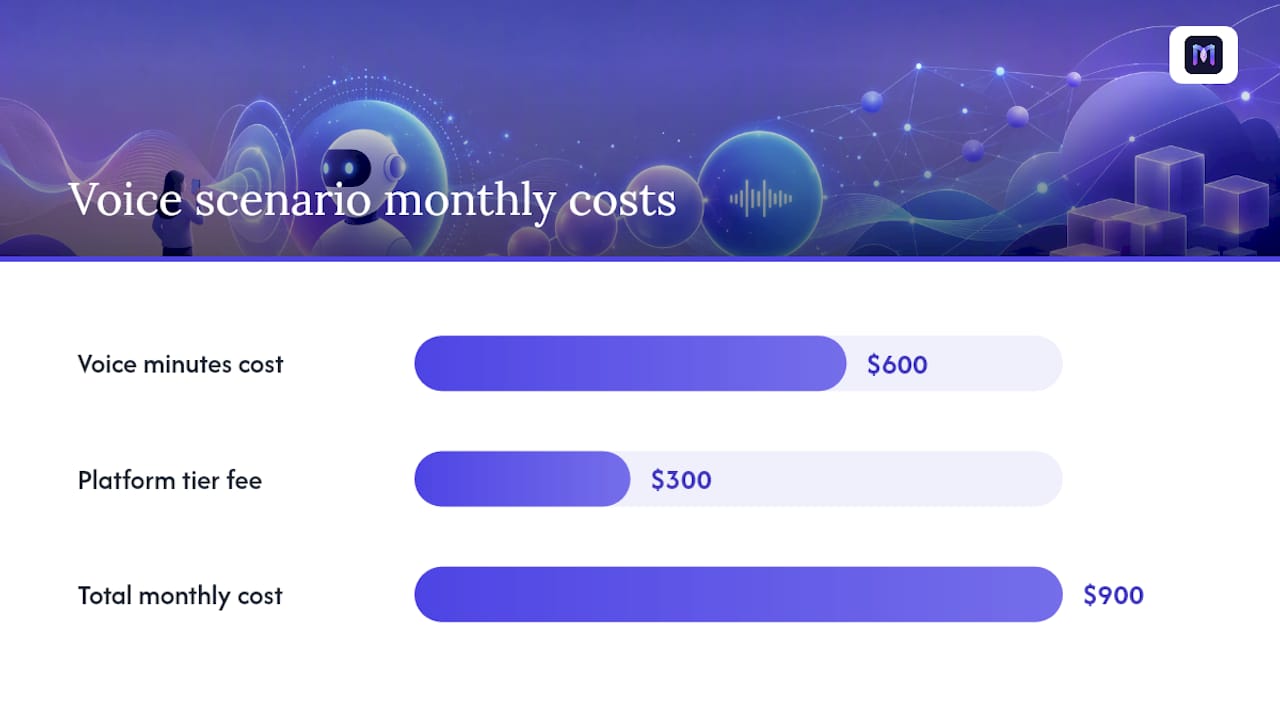
Voice-enabled scenario: 2,000 calls monthly, averaging 4 minutes each, at $0.075 per minute. That’s 8,000 minutes, or $600, plus a $300 platform tier. Total: roughly $900.
Pro Tip: Run a two-week baseline sample before you commit to a contract. Forecasting research on chatbot deployments recommends measuring actual turns per conversation, then adding a 20% buffer, since buyers consistently underestimate how chatty real customers get.
How Do You Choose the Right Plan and Avoid Vendor Traps?
Start with your own volume profile before you look at a single quote. A business with steady, predictable ticket volume fits a per-seat or flat subscription. One with unpredictable seasonal spikes fits usage-based billing better, since you’re not paying for capacity you don’t use most of the year.
Before signing anything, ask every vendor these questions directly:
- How exactly do you count a “resolution” or a “conversation” for billing purposes?
- Does billing continue during idle sessions or open connections with no active dialogue?
- What are your concurrency limits, and what happens automatically when I exceed them?
- What’s the overage rate once I cross my plan’s usage cap?
- Can I audit my own usage logs against your invoice?
Watch for a few recurring red flags: pricing pages that hide add-on costs until the demo call, per-resolution contracts with no volume discount as you scale, and combined seat-plus-resolution billing that charges you twice for the same interaction. If a vendor can’t explain their billing mechanics in plain language on the first call, that’s information too. Monobot’s own pricing overview lays out tiering and enterprise terms directly, which is the standard every quote should be held to.
Why Consider Monobot for Voice and Chat Automation?
If you’ve read this far, you already know the real cost driver isn’t the subscription line. It’s usage patterns, model choice, and billing mechanics you can’t see until the invoice lands. Monobot is built to keep that math predictable from the start.
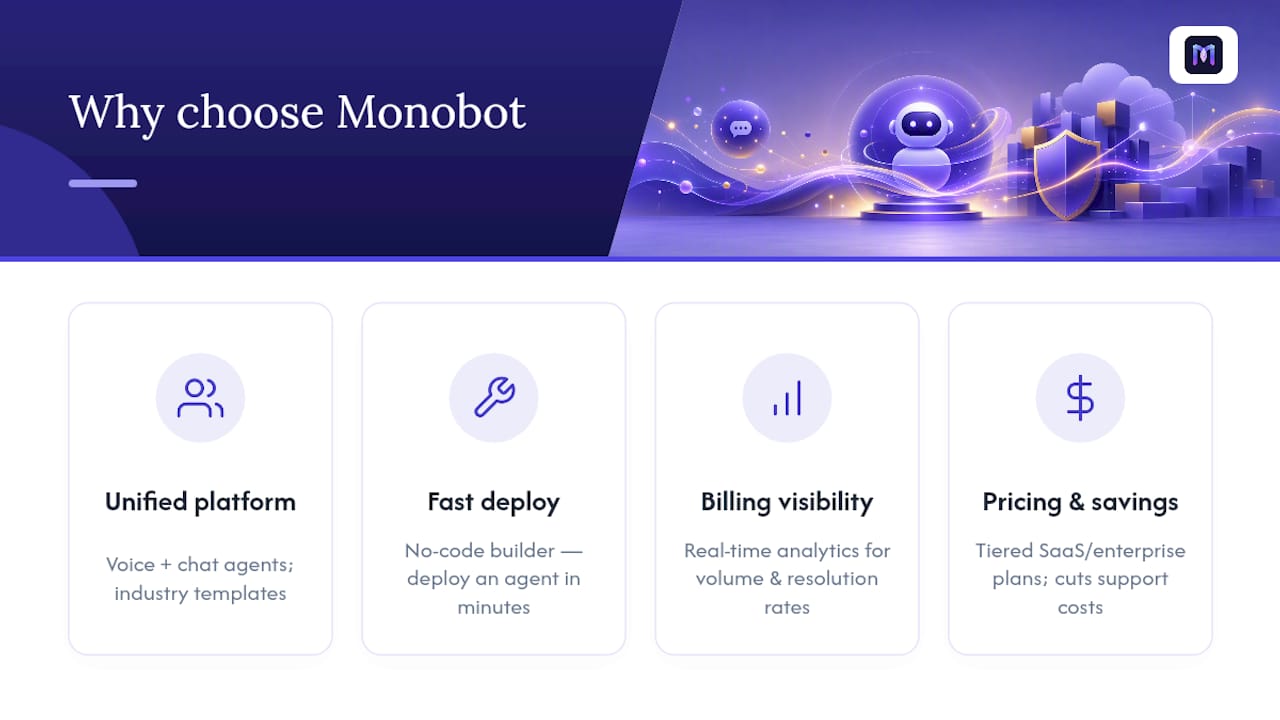
Monobot combines voice and chat agents in one platform, with industry-specific templates for healthcare, banking, retail, logistics, HR, and IT support, so you’re not stitching together separate tools with separate bills. The no-code builder lets you deploy an agent in minutes, and real-time analytics give you visibility into resolution rates and conversation volume, the exact inputs you need to forecast your own costs accurately instead of guessing after the fact. Monobot runs on subscription SaaS pricing with tiered plans based on usage and features, plus enterprise contracts for higher-volume deployments, and automating routine inquiries can meaningfully reduce the operational costs tied to inbound call and chat volume.
Before you sign anything, check the AI agent builder to see how deployment actually works, or claim free setup to get a live quote based on your real conversation volume rather than a generic rate card.
Lessons from watching buyers get chatbot pricing wrong
Two mistakes repeat constantly: buyers estimate turns per conversation from a demo instead of real traffic, and they never ask whether idle session time bills the same as active minutes. Both assumptions get expensive fast once volume scales beyond the pilot.
— Alex
Sources
- Chatbot Pricing Models 2026: Per-Resolution vs Seat vs Usage | Metageeks
- AI Chatbot Costs 2026: Real Monthly Pricing at Scale | AI Cost Check
- Deepgram Pricing | Scalable Speech-to-Text, Text-to-Speech & Voice Agent APIs
- AI Chatbot Pricing Comparison: Here’s What You Get When You Pay – CNET
FAQ
How Much Do Chatbots Cost?
Costs range from $50 to $500 monthly for small-business subscription plans to $8,000 to $30,000 or more monthly for enterprise custom builds, depending on volume, model choice, and whether voice is included.
Can I Buy My Own AI Chatbot?
Yes. Platforms like Monobot let you build and own your chatbot configuration through a no-code builder, with subscription pricing rather than a one-time purchase, so you control the setup without hiring developers.
Which AI Chatbot Is the Cheapest?
Flat or tiered subscription plans are usually the cheapest entry point for low-volume needs, but per-resolution and usage-based models can end up cheaper at very low volume since you only pay for what you use. The right answer depends on your monthly conversation count, not the sticker price alone.
How Much Does It Cost to Develop a Chatbot?
Building a custom chatbot from scratch typically runs into custom-build territory often costing several thousand dollars depending on complexity, versus using a pre-built platform where setup fees run $0 to $500 and monthly usage costs replace development costs entirely.