


Choose a chatbot vendor by passing it through a procurement scorecard and a short real-world pilot, not by how smooth its demo looks. A defensible chatbot vendor evaluation follows a three-step flow: score every candidate against a weighted rubric, run a 30-day pilot on live traffic, and only sign when the vendor clears your KPI thresholds. Gartner recommends exactly this pilot-first sequence for AI customer service tools, and Monobot builds its onboarding around that same test-before-you-commit logic.
TL;DR:
- Running a 30-day pilot on actual traffic with clear success and failure criteria provides a more reliable measure of chatbot performance than demo appearances.
- Evaluate vendors by live testing their AI with your real customer messages, ensuring accuracy, governance, and knowledge updates before signing any contract.
- Track containment rates, resolution rates, handle time, and fallback frequencies over at least 500 conversations to accurately assess chatbot effectiveness.
- Confirm native system integrations, security documentation, and compliance measures before deployment to avoid shadow IT and compliance risks.
- Prioritize vendors that openly share analytics dashboards, versioned knowledge management, and continual performance data for ongoing evaluation beyond initial signing.
Table of Contents
- Why Chatbot Vendor Evaluation Needs a Scorecard, Not a Gut Check
- How Do You Run a 30-Day Chatbot Pilot?
- Which KPIs Actually Predict Chatbot Success?
- What Belongs on Your Integration Checklist?
- What Security and Compliance Evidence Should You Require?
- How Should You Compare Chatbot Pricing Models?
- What Red Flags Show Up in a Chatbot Demo?
- How Does Monobot Fit This Evaluation Framework?
- What the Checklist Misses if You Stop at Signing
- See How Monobot Handles the Categories You Just Scored
- Where to Read More Before You Decide
- Sources
- FAQ
Why Chatbot Vendor Evaluation Needs a Scorecard, Not a Gut Check
Most procurement teams still choose based on the demo. That’s backwards. A polished demo tells you how well a vendor’s sales engineer can script a conversation, not how the bot handles your customers’ actual phrasing, your CRM’s field structure, or your compliance requirements. Chatbot selection criteria need to be written down and scored before anyone sits through a pitch, because a checklist filled out after the fact just rationalizes whichever tool felt most impressive.
Here’s the prioritized scorecard. Score each category from 0 to 5 during vendor interviews, demos, and any sandbox access you’re granted.
- Accuracy and NLU (weight: heavy). Ask the vendor to run 20 to 30 of your real customer messages, including typos and slang, live during the call. Score based on correct intent capture, not just a coherent-sounding reply.
- Governance and hallucination controls (weight: heavy). Demand to see how the bot handles a question outside its knowledge base. A vendor that can’t show a confidence threshold or an “I don’t know” fallback path is not ready for regulated industries.
- Knowledge management. Test how fast the vendor can update an answer from a document you provide, and whether that update needs a developer.
- Automation and workflows. Score whether the bot can actually complete a task (reschedule an appointment, check an order) versus just answer a question about it.
- Integrations. Confirm native connectors to your CRM and helpdesk exist, not just “API access.”
- Analytics and optimization. Ask for a sample dashboard. Can you see intent-level drop-off, not just total conversation count?
- Security and compliance. Request documentation, not verbal assurance.
- Scalability and pricing. Model your busiest month, not your average one.
- Vertical fit. Ask for a template or workflow specific to your industry, whether that’s healthcare intake or retail order tracking.
A vendor that scores high on analytics but low on hallucination controls is not a safe bet for anything customer-facing.
Pro Tip: Bring the same 25 real customer messages to every vendor demo. Comparing five vendors against five different question sets tells you nothing about vendor evaluation for chatbots. Comparing them against identical input tells you everything.
How Do You Run a 30-Day Chatbot Pilot?
A pilot is not a longer demo. It’s a controlled trial on real traffic, and it’s the single best predictor of post-purchase regret or satisfaction.
- Define scope tightly. Pick one channel (chat widget or one phone line), 2 to 3 ticket types you already understand well, and decide upfront whether the pilot runs in a sandbox or against production data with guardrails.
- Set success criteria before you start. A reasonable target is 30 to 50% containment on the ticket types you selected, a CSAT score for bot-handled sessions within 10 points of your human-agent baseline, and clean handoffs when the bot escalates.
- Assign roles. Decide who monitors daily (usually your team, not the vendor’s), who owns the knowledge base updates, and who has authority to pull the plug if performance drops.
- Log everything. Every transcript, every fallback, every escalation. This becomes your evidence set for the final KPI review.
- Set exit criteria. Write down, in advance, exactly what a pass and a fail look like. Don’t let a vendor talk you into extending a pilot that’s clearly underperforming.
Avoid demo bias by testing during your actual peak volume window, not a quiet Tuesday afternoon the vendor suggested. Gartner’s guidance on AI in customer service points to the same conclusion: operational metrics from real usage beat any pre-sale presentation.
Which KPIs Actually Predict Chatbot Success?
Five metrics separate a working deployment from an expensive mistake, and each needs a precise definition or your comparisons across vendors will be meaningless.
- Containment/deflection rate: the percentage of conversations the bot resolves without human involvement. Track this per intent category, not as one blended number.
- Resolution rate: distinct from containment. A bot can “contain” a conversation by ending it without actually solving the customer’s problem.
- Handle time: for bot-assisted human handoffs, measure whether the agent spent less time because the bot pre-gathered context.
- CSAT for bot-only sessions: segment this separately from your overall CSAT, or a strong human-agent score will mask a weak bot score.
- Intent recognition accuracy and fallback frequency: how often the bot correctly identifies what the customer wants, and how often it has to punt.
Run these numbers over at least 500 to 1,000 conversations before drawing conclusions. Smaller samples swing wildly, and research on evaluating LLM-based assistants shows that answer-quality measurement requires enough volume to separate a real pattern from noise.
What Belongs on Your Integration Checklist?
A chatbot that can’t talk cleanly to your existing stack becomes shadow IT within a quarter. Gartner’s customer service technology guidance treats integration depth as one of the biggest long-term determinants of whether a deployment survives past year one.
- Confirm which systems have native connectors versus which require custom API or webhook work, and get a field-mapping document showing exactly how customer data flows between the bot and your CRM.
- Require that every bot conversation transcript link back to the correct customer record automatically, with clear routing rules for who owns follow-up and how SLA timers start.
- Ask about single sign-on and role-based access control for your internal team, plus audit logs showing who edited the knowledge base and when.
- Confirm how knowledge updates get versioned. If someone can edit a live answer with no change history, you have no way to trace a bad response back to its source.
Monobot’s own CRM integration patterns illustrate the level of field-mapping detail worth requesting from any vendor during this stage.
What Security and Compliance Evidence Should You Require?
Don’t accept a verbal “yes, we’re secure” as an answer. Require documentation for every item below before signing.
- Encryption in transit and at rest, with the vendor naming the specific standard used, not just claiming “bank-level security.”
- SOC 2 or ISO reports, and HIPAA-specific controls if any conversation might touch protected health information.
- A direct answer on training data: does the vendor ever use your customer conversations to train a shared model that benefits other clients? Get this in writing.
- A signed data processing addendum, a stated data retention window, and a documented incident response commitment with timelines.
The Consumer Financial Protection Bureau’s chatbot issue spotlight specifically flags weak governance and unclear training-data practices as consumer-harm risks, which is exactly why these questions belong in every vendor conversation, not just ones in regulated industries.
How Should You Compare Chatbot Pricing Models?
Pricing structure tells you almost as much about a vendor as its product does.
- Per-conversation pricing scales predictably but punishes high-volume deployments. Per-resolution pricing rewards actual outcomes but requires a clear definition of “resolved.” Per-seat pricing fits agent-assist tools better than pure automation. Flat enterprise pricing works when volume is high and stable.
- Watch for hidden costs: custom integration work, model retraining fees, cold storage for transcripts, and premium support tiers that aren’t in the base quote.
- A workable ROI formula: (monthly ticket volume × containment rate × average handle time × loaded agent cost per hour) minus the vendor’s monthly fee. If that number is negative in month one, ask what month the vendor projects it turning positive, and get that projection in writing.
What Red Flags Show Up in a Chatbot Demo?
- A scripted demo that never breaks. Ask the vendor to run your own transcripts live, on the spot. Hesitation here is the single clearest signal.
- No visibility into missed-intent metrics. If a vendor can’t show you what percentage of conversations the bot fails to categorize correctly, they likely aren’t tracking it internally either.
- No sandbox access before contract signing. A vendor confident in its product will let you test it.
- Vague answers about training data and model updates. Opacity here usually means there’s something in the answer they’d rather you not ask about.
- No escalation carryover test. Send a bot into a fallback, then check whether the human agent actually receives the full conversation context or starts blind.
Accept only concrete evidence: exported transcripts, a live sandbox login, or a signed SLA document. Verbal reassurance is not evidence.
How Does Monobot Fit This Evaluation Framework?
Running Monobot through its own checklist is a useful exercise, since the platform was built around the same categories procurement teams score. The AI agent builder uses no-code configuration, which shortens the knowledge-management scoring step since non-technical staff can update answers without a developer ticket. Voice and chat agents run from the same backend, which matters for the integrations category if your operation spans both channels.
- Analytics and optimization: the interaction-details dashboard surfaces transcript-level data, the exact evidence a scorecard review needs.
- Automation and workflows: automation flows handle appointment scheduling and order-status tasks natively rather than just answering questions about them.
- Vertical fit: industry templates for healthcare, banking, retail, and logistics give a starting point for the vertical-fit score rather than a blank canvas.
- Voice use cases: voice analytics supports call-based scoring alongside chat.
Pro Tip: Score Monobot, or any vendor, on the same 0 to 5 rubric you built in the checklist section above. A vendor’s own feature list is a starting point for your questions, never a substitute for scoring it yourself.
What the Checklist Misses if You Stop at Signing
The scorecard and pilot get you to a good decision on day one. What most teams underestimate is how fast a “passing” bot can drift into a failing one without anyone noticing. Intent gaps widen as your product catalog changes, new slang enters customer messages, and nobody’s watching the fallback rate creep upward month over month.

The real discipline isn’t the initial chatbot vendor evaluation. It’s building a habit of reviewing intent-gap reports monthly and re-scoring the vendor against the same rubric at the six-month mark, not just at renewal time when you’re already committed. Vendors that resist ongoing access to their own performance data after signing are telling you something they didn’t say in the demo.
Buy on the pilot. Govern past the pilot. That second part is where most deployments quietly fail.
— Alex
See How Monobot Handles the Categories You Just Scored
If governance, integration depth, and analytics visibility are the categories carrying the most weight on your scorecard, Monobot is worth putting in front of your team, since it was built to satisfy exactly those checks rather than retrofit them later. Deployment typically takes minutes rather than weeks because the agent builder requires no code, and the same platform runs both voice and chat so you’re not scoring two separate vendors for one use case.
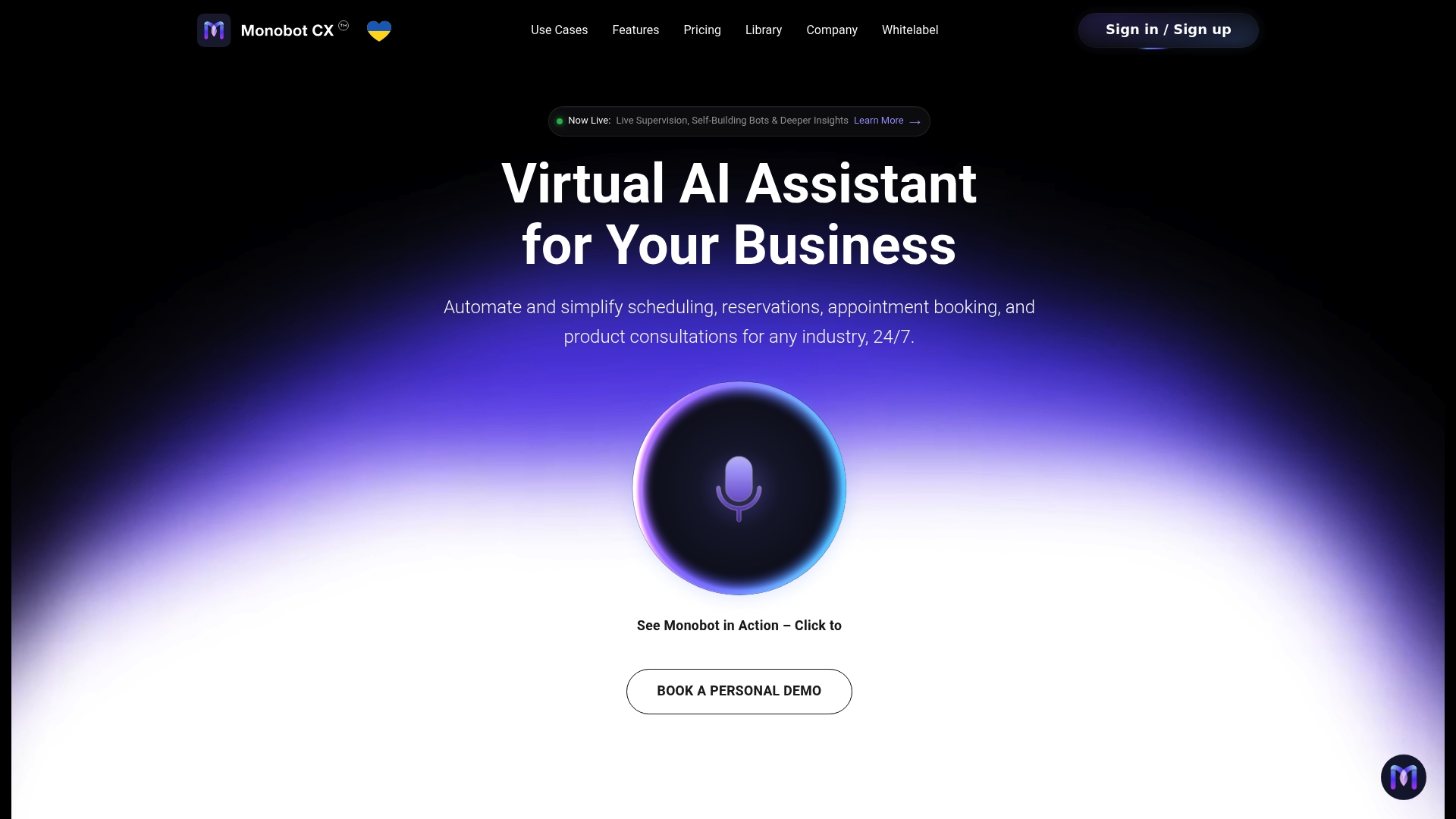
The dashboard analytics give your team the intent-level reporting a proper KPI review needs from week one of a pilot, not six months into a contract when you’re already locked in. If your scorecard is built and you’re ready to see how a real deployment performs against it, book a Monobot demo and bring your own transcripts to test live, the same way this article recommends testing any vendor.
Where to Read More Before You Decide
- CFPB’s issue spotlight on chatbots covers governance and consumer-protection risk.
- Gartner’s AI in customer service coverage details pilot-first adoption guidance.
- Zoho’s chatbot buying checklist offers a vendor-neutral comparison model.
- ArXiv’s benchmarking research documents newer chatbot failure modes and guardrail needs.
Sources
- CFPB: Chatbot issue spotlight (June 2023)
- Gartner: AI in customer service
- ArXiv: Assistant safety and benchmarking (2025)
- Zoho SalesIQ: Chatbot buying checklist
FAQ
How Do You Evaluate Chatbot Performance?
Measure containment rate, resolution rate, CSAT for bot-only sessions, and intent recognition accuracy over at least 500 to 1,000 conversations, ideally gathered during a real-traffic pilot rather than a scripted demo.
How Do You Evaluate Vendor Performance Overall, Not Just the Bot?
Score the vendor against a weighted checklist covering accuracy, governance, integrations, analytics, security, and pricing, then confirm the score holds up during a 30-day pilot on your own traffic.
How Can I Evaluate AI-Based Chatbots Before Signing a Contract?
Request sandbox access, run your own real customer transcripts live during the demo, and insist on a defined pilot with pass/fail KPI thresholds before any long-term commitment; platforms like Monobot are built to support exactly this kind of pre-contract testing.
What Are the Top Considerations When Comparing Chatbot Providers?
Prioritize accuracy and hallucination controls first, since a bot that answers confidently but incorrectly creates more risk than one that escalates appropriately, followed by integration depth, security documentation, and transparent pricing that scales predictably with volume.