



A targeted hybrid AI pilot — AI handling Tier‑1 containment, a lean human team managing Tier‑2 escalations — can significantly reduce your total support costs within a single quarter. Industry data shows AI resolves routine queries at $0.50–$0.70 per interaction versus $8–$25 for a human agent. Three key metrics to watch from day one:
- Cost per contact — your baseline dollar figure per resolved ticket
- Autonomous resolution rate — the share of tickets AI closes without human touch
- First-response time — the gap between ticket creation and first substantive reply
Get these three numbers before you launch anything. They are your before/after proof.
Table of Contents
- What does the ROI model actually look like?
- How do you roll out AI support without stalling?
- What outcomes should you realistically expect?
- How do you run a focused pilot and know when to scale?
- Key Takeaways
- The case for starting hybrid, not going all-in
- Monobot gets your pilot live faster than you’d expect
- FAQ
What does the ROI model actually look like?
Here is a concrete before/after using real hybrid cost data:
| Metric | Human-Only | 50% AI Containment |
|---|---|---|
| AI-handled tickets | 0 | — |
| Cost per AI interaction | — | $0.50–$0.70 |
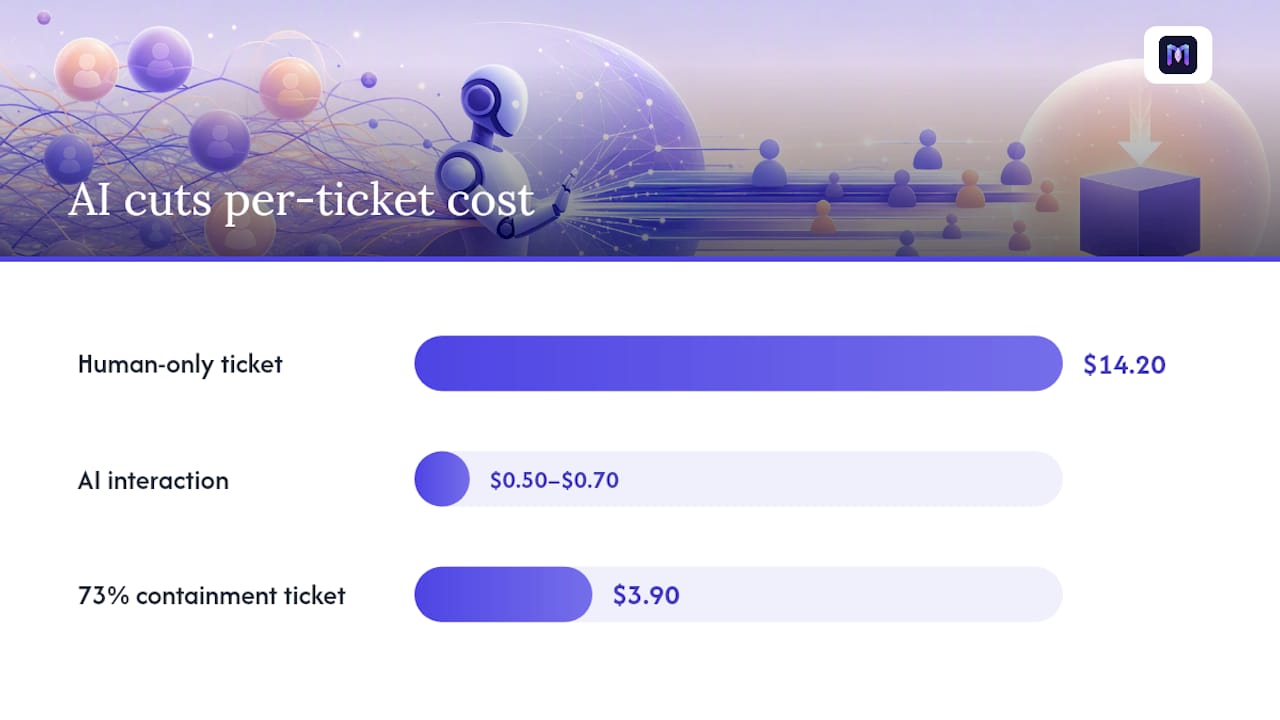
Push containment to 73%, as one SaaS deployment documented, and the numbers sharpen further: cost per ticket fell from $14.20 to $3.90, first-response time dropped from 4.3 hours to 47 seconds, and annual savings reached $188,400 with payback in roughly 10.7 months.
Core KPIs to track:
- Cost per contact (before and after, by channel)
- Containment/autonomy rate (% tickets closed by AI alone)
- Average handle time for Tier‑2 agents
- First-response time
- CSAT and churn delta post-deployment
For FTE modeling, the same SaaS case pegged the fully loaded cost of a US-based support agent at a substantial annual figure including benefits and tooling. At that figure, redeploying even two agents to higher-value work pays for most mid-market AI platform subscriptions.
A well-implemented hybrid program typically achieves around 30% total support cost reduction — and teams that push containment above 70% often see payback inside 12 months.
How do you roll out AI support without stalling?
A four-phase roadmap keeps the pilot tight and the decision gates clear.
-
Assess (Week 1–2): Pull 90 days of ticket data. Profile by type, volume, and resolution path. Flag any tickets touching PHI or regulated data (HIPAA applies to healthcare channels). Inventory your CRM, telephony stack, and knowledge base. You need to know which Tier‑1 types are safe to automate before you write a single dialog.
-
Pilot design (Week 2–3): Scope to 10–20 high-frequency issue types. Set a minimum volume threshold (at least 500 tickets per type over the pilot window). Choose your channel mix — start with chat if voice feels complex, or run both in parallel if your telephony supports it. Assign a pilot owner, a QA reviewer, and a clear escalation path. Use a no-code agent builder to cut engineering time to days, not weeks.
-
Run and gate (Weeks 3–8): Check containment rate and CSAT at Week 2 (is AI resolving or just deflecting?), Week 4 (is cost per contact trending down?), and Week 6 (is CSAT holding?). If containment is below 40% at Week 4, pause and audit failed conversations before continuing.
-
Scale (Week 9+): Add ticket types, expand to voice, and redeploy freed agents to Tier‑2 or proactive outreach. Change management here is real: agents need retraining on escalation handling, not ticket volume.
Pro Tip: Train your Tier‑2 agents on the escalation playbook before the pilot starts, not after. Agents who understand what the AI will and won’t handle adapt faster and generate better QA feedback.
What outcomes should you realistically expect?
Containment benchmarks vary by vertical. Retail and e-commerce typically see 50%–70% AI containment on order and returns queries. SaaS and tech support lands in the 60%–75% range for password, billing, and status tickets. Healthcare scheduling and triage runs 40%–60% given compliance constraints. Financial services sits lower, around 30%–50%, because of regulatory sensitivity.
Monobot automates up to 80% of inbound calls and chats across voice and chat channels — a figure that aligns with the upper end of industry benchmarks for well-scoped, high-volume Tier‑1 deployments.
The SaaS case cited earlier is the clearest benchmark available: 73.4% autonomous resolution, cost per ticket from $14.20 to $3.90, $188,400 in annual savings. That is not an outlier for a well-scoped pilot — it is what happens when the ticket mix is profiled correctly and the KB is seeded before launch.
For AI chatbot cost reduction tactics by vertical, Monobot’s library covers the dialog patterns and KB structures that drive those containment numbers.
How do you run a focused pilot and know when to scale?
Pilot checklist before Week 1:
- Ticket types selected (10–20, Tier‑1 only)
- Volume baseline confirmed (500+ tickets per type)
- Control group defined (10%–20% of volume routed to human for comparison)
- KPI tracking live: cost per contact, containment rate, CSAT, first-response time
- Escalation path documented and tested
Weekly measurement gates:
- Week 2: Containment rate above 35%? First-response time improving? If not, audit the top 10 failed conversations.
- Week 4: Cost per contact trending toward target? CSAT within 5 points of baseline? Green on both = proceed.
- Week 8: Final containment rate, cost delta, CSAT delta. Scale decision based on these three numbers.
| Pilot Gate | Success Criteria | Action if Missed |
|---|---|---|
| Week 2 | Containment ≥ 35% | Audit failed dialogs, expand KB |
| Week 4 | Cost per contact trending down | Review triage logic and escalation routing |
| Week 8 | Containment ≥ 60%, CSAT stable | Scale to additional ticket types and voice channel |
A/B test your escalation routing: compare “offer human now” versus “try one more AI step” to find the UX threshold where customers prefer the handoff. That single test often lifts CSAT by several points without touching containment.
Key Takeaways
A hybrid AI pilot targeting Tier‑1 containment is the fastest path to measurable support cost reduction, with payback typically inside 12 months when containment exceeds 60%.
| Point | Details |
|---|---|
| Start with ticket profiling | Map your top 20 Tier‑1 ticket types before building any dialog or KB. |
| Per-interaction cost gap | AI resolves at $0.50–$0.70 per interaction; human agents cost $8–$25 for the same contact. |
| Pilot gates matter | Check containment at Weeks 2, 4, and 8 — scale only after hitting 60% containment with stable CSAT. |
| Compliance first | Flag HIPAA-relevant channels during assessment; confirm BAA availability before piloting in healthcare. |
| Monobot as your pilot platform | Monobot automates up to 80% of inbound calls and chats with a no-code agent builder, CRM integrations, and analytics dashboards built for KPI tracking. |
The case for starting hybrid, not going all-in
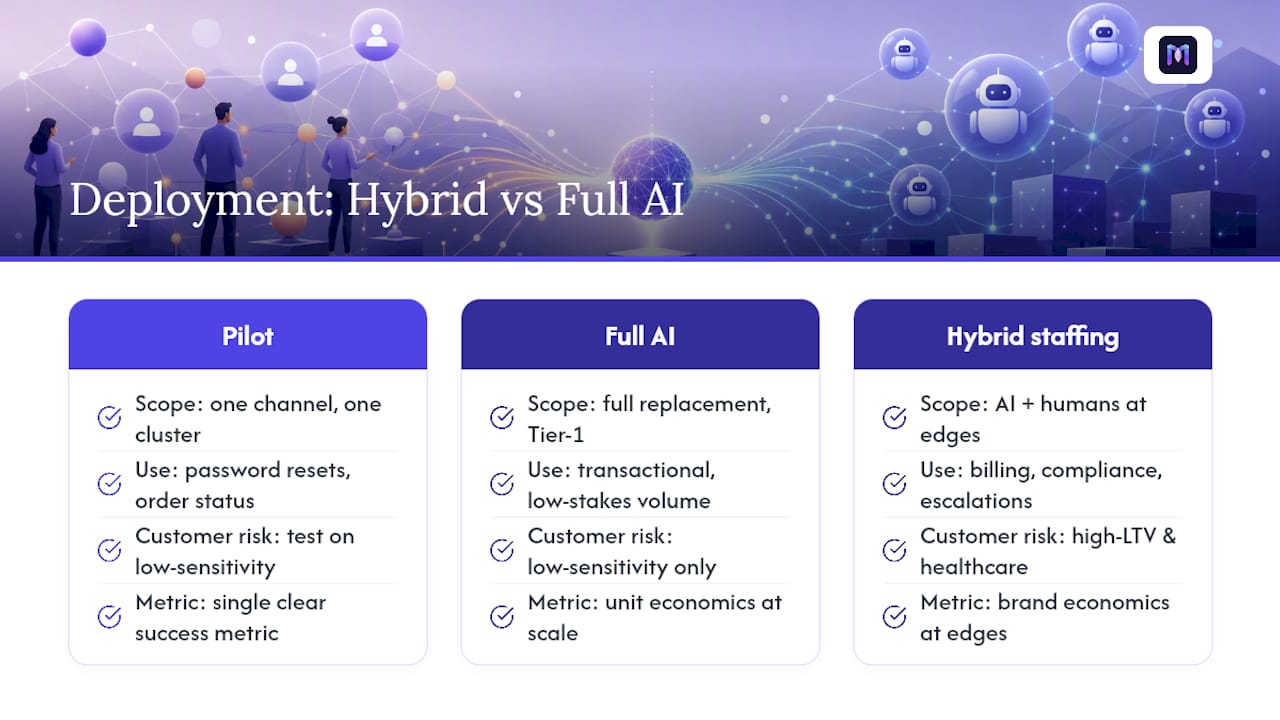
The instinct to automate everything at once is understandable — the per-interaction cost math is compelling. But the teams that see the fastest payback almost always start narrow: one channel, one ticket cluster, one clear success metric. They prove containment on password resets or order status before touching billing disputes or complaint handling.
What most articles miss is the brand sensitivity variable. For high-LTV customers or healthcare interactions, a bad AI experience does not just hurt CSAT — it accelerates churn in a segment where a single customer may be worth thousands of dollars annually. The cost-per-contact savings evaporate if you lose two enterprise accounts because the escalation UX was clunky.
Full AI replacement makes sense for genuinely transactional, low-stakes Tier‑1 volume. Hybrid staffing is the right model for anything touching billing exceptions, compliance-adjacent queries, or customers who have already escalated once. The unit economics favor AI heavily at scale, but the brand economics favor human judgment at the edges.
Monobot gets your pilot live faster than you’d expect
Cutting support costs with AI does not require a six-month integration project. Monobot’s AI Agent Builder lets your team configure voice and chat agents without writing code — you can have a Tier‑1 pilot running on your top ticket types within days, not weeks. The platform connects to your CRM, telephony stack, and knowledge base out of the box, and the analytics dashboard surfaces cost per contact, containment rate, and CSAT in real time so your decision gates are data-driven, not guesswork.
Industry templates for healthcare, retail, SaaS, and logistics mean you are not starting from a blank dialog. Real-time agent assist keeps your Tier‑2 team sharp during the transition. And because Monobot automates up to 80% of inbound calls and chats, the ROI math from this playbook applies directly to what you deploy. Request a demo at monobot.ai and bring your ticket-mix data — the pilot scope practically writes itself.
FAQ
How much can AI reduce customer support costs?
A well-scoped hybrid AI deployment typically cuts total support costs by around 30%, and teams that push containment above 70% often see payback inside 12 months. Per-interaction AI costs run $0.50–$0.70 versus $8–$25 for human agents.
How long does an AI support pilot take to show ROI?
Most pilots show measurable cost-per-contact improvement within 4–6 weeks. Full payback on platform investment typically lands around 10–12 months, based on documented SaaS deployments.
What is a realistic AI containment rate for Tier‑1 support?
Containment rates range from 30%–80% depending on vertical and ticket mix. SaaS and e-commerce commonly reach 60%–75% on well-scoped Tier‑1 ticket types; healthcare typically lands in the 40%–60% range.
Does Monobot require coding to set up AI agents?
No. Monobot’s AI Agent Builder uses a no-code workflow, so your team can configure and deploy custom voice and chat agents without engineering resources, which significantly shortens pilot setup time.
What KPIs should I track to prove AI support savings?
Track cost per contact, autonomous resolution rate, average handle time, first-response time, and CSAT delta. These five metrics together give you a complete picture of both cost reduction and customer experience impact.