


Retail chatbots move the needle most reliably when they handle product discovery, order tracking (WISMO), checkout and cart recovery, returns and self-service, and personalized upsell. Each of these flows needs a direct integration into your commerce and order systems, not a bolt-on widget. Done right, expect faster response times, measurable deflection of routine tickets, and a real lift in conversion and average order value.
TL;DR:
- Starting with WISMO and FAQ automation offers the lowest risk and fastest measurable impact, with up to 69.2% of retail chats suitable for automation.
- Integration with existing systems such as order management, inventory, and payment gateways is essential to ensure accurate, real-time responses and build trust.
- Personalization increases checkout success and upsell opportunities by leveraging structured product data, browsing history, and loyalty information.
- Pilot success depends heavily on deep system integration and effective conversation design that retains context and smoothly escalates to human agents.
- Scaling involves expanding from initial low-effort flows to more complex interactions like product discovery and omnichannel in-store capabilities.
Table of Contents
- Retail Chatbot Use Cases Across the Customer Journey
- How to Implement a Retail Chatbot: Integrations and Best Practices
- What Enterprise Retail Platforms Bring to These Use Cases
- Where Retail Chatbot Priorities Are Headed in 2026
- Piloting Retail Chatbot Use Cases With Monobot
- Sources
- FAQ
Retail Chatbot Use Cases Across the Customer Journey
Retail chatbot applications tend to cluster around a handful of moments where shoppers get stuck or support teams get buried. The strongest programs pick two or three of these to start, wire them into existing systems, and expand from there.
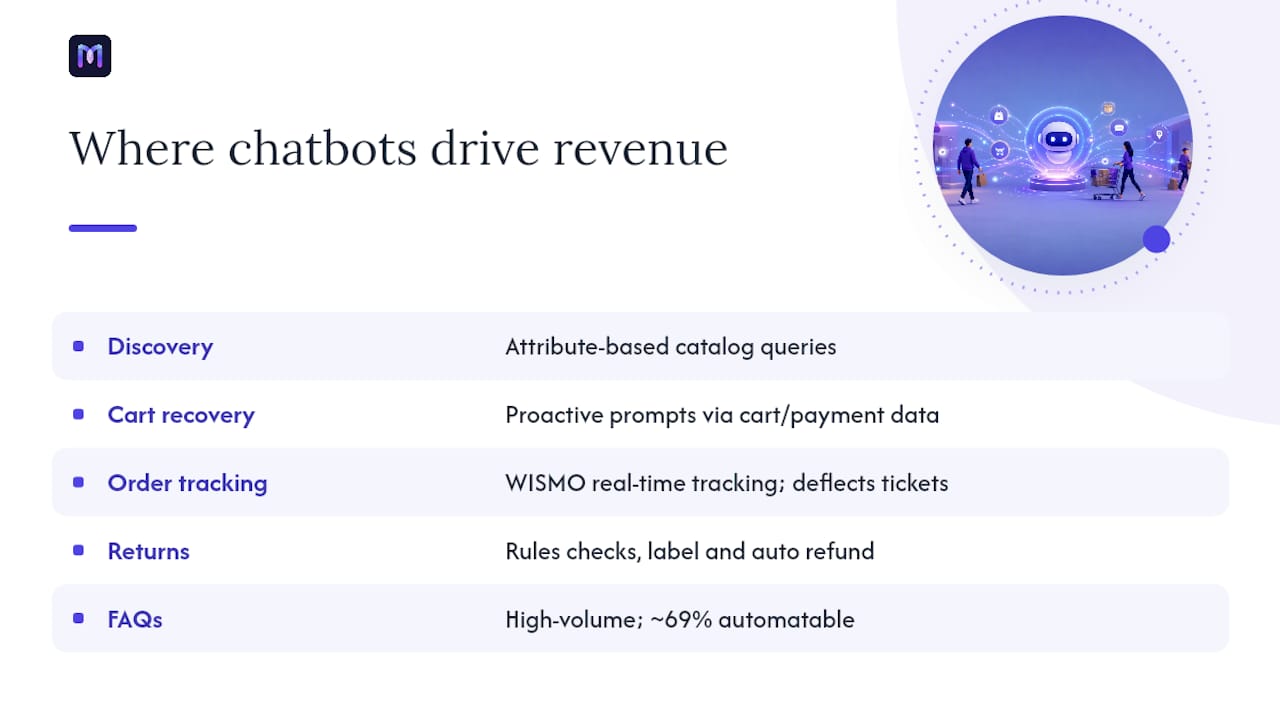
Product discovery and personalized recommendations. A shopper types “waterproof hiking boots under $150 for wide feet” and the bot should query your catalog by attribute, not just keyword match. That requires structured product data (size, material, price tier) plus behavioral signals like browsing history or past purchases. Retailers using this pattern typically see recommendation-driven sessions convert at a noticeably higher rate than unassisted browsing, because the bot narrows a thousand SKUs down to three relevant options in seconds.
Checkout assistance and cart recovery. Cart abandonment triggers, someone lingers on a payment field for 90 seconds, closes a tab with items still in cart, or hits a shipping cost surprise, can prompt a chat proactively rather than waiting for an email three hours later. This requires integration with your cart and payment gateway so the bot can see live cart contents and offer a specific incentive or answer a specific objection, not a generic “still interested?” nudge.
Order tracking (WISMO) and post-purchase updates. “Where is my order” remains the single highest-volume support query in retail, and it’s also the easiest to fully automate. Connecting the bot to your order management system and carrier APIs lets it pull real-time tracking status without a human touching the ticket. IBM’s e-commerce chatbot research documents WISMO as one of the most consistently deployed use cases in online retail, and it’s usually the fastest path to measurable deflection.
Returns and exchanges. A rules engine checks eligibility (return window, item condition, original payment method) and, if approved, generates a shipping label and kicks off the refund automatically. This is where a lot of manual back and forth disappears, since the bot can answer “can I return this” and “how do I return this” in the same conversation.
Customer support and FAQs. Sizing charts, shipping policies, store hours: these are high-frequency, low-complexity questions that should never reach a live agent. LivePerson’s retail analysis found that up to 69.2% of retail conversations are suitable candidates for automation, which makes FAQ deflection one of the clearest wins for a first pilot.
Promotions, loyalty, and upsell. When a bot knows a shopper’s loyalty tier and current cart, it can surface a relevant offer (“free shipping if you add $12 more”) instead of a blanket discount code. Tying the bot into your loyalty platform turns a support interaction into a small revenue event.
In-store and omnichannel flows. Checking whether a size is in stock at a nearby store, or confirming a buy-online-pickup-in-store order is ready, requires a live connection to inventory and POS data. Retailers that skip this step end up with a bot that gives confident, wrong answers about stock, which erodes trust fast.
Lead capture and high-consideration flows. For big-ticket items (furniture, appliances, financed purchases), the bot’s job shifts from answering to qualifying: asking budget, timeline, and use case, then routing to a sales rep with that context attached.
Pro Tip: Start with WISMO and FAQs before touching product discovery. They’re the lowest-risk, highest-volume wins, and the deflection data you collect from them builds the internal case for funding the harder integrations.
Chatbots for Retail: Types, Use Cases, and Examples breaks down several of these patterns with additional detail on channel placement, and examples of AI in eCommerce offers a useful outside view on how discovery and recommendation flows get built in practice.
How to Implement a Retail Chatbot: Integrations and Best Practices
A chatbot pilot succeeds or fails on integration depth, not on how clever the conversation script sounds in a demo. Intermedia’s analysis of retail chatbot deployments points to the same pattern: bots that connect into existing systems reduce support costs and lift conversion, while standalone widgets mostly just look busy.
Integration checklist:
- CRM, so the bot knows who it’s talking to and their purchase history.
- Order management and fulfillment systems, for real-time WISMO accuracy.
- Inventory and POS, so in-store availability answers are actually true.
- Payment gateway, for cart recovery and checkout assistance.
- Helpdesk or ticketing platform, for clean escalation.
Design matters as much as plumbing. The bot needs to retain session context across a conversation, and when it escalates to a human, it must hand off full conversation history and case details so the shopper never repeats themselves. That single design choice is one of the biggest drivers of lower average handle time in escalated cases.
Train the bot on real ticket and chat logs, not hypothetical scripts, and pair that with product metadata for accurate discovery answers. Run synthetic testing against edge cases before launch. For measurement, track deflection rate, CSAT, average handle time, conversion lift, and average order value, and validate each new flow with a short A/B test before rolling it out broadly. Build in a cadence for updating promotions and policy content, and set clear privacy and data permission rules before the bot touches order or payment data.
What Enterprise Retail Platforms Bring to These Use Cases
Some AI platforms build no-code, industry-specific templates for retail covering product inquiries, order status, appointment-style scheduling for services, and lead qualification, with real-time analytics and agent assist layered on top. Deployment is designed to take minutes rather than weeks, and integrations connect the bot into the systems already running your store.
Automating routine inbound calls and chats can free human agents to handle the exceptions that actually need a person, rather than repeating tracking numbers and return policies all day. Some platforms are built around automating a large portion of inbound retail calls and chats, according to their reported figures.
Case study and testimonial data specific to individual retail deployments will be added here as pilots complete. The operational logic holds regardless: faster deployment plus continuous analytics means a pilot’s weak points surface quickly, and scaling from one flow to five becomes a configuration exercise, not a rebuild.
Where Retail Chatbot Priorities Are Headed in 2026
Gartner has projected that chatbots become a primary customer service channel within a few years of that forecast, and retail is already living that shift. Major retailers, Target among them, are folding conversational AI directly into shopping flows rather than treating it as a side channel, linking chat to loyalty accounts and payment methods so the assistant becomes a real commerce touchpoint, not just a help desk.
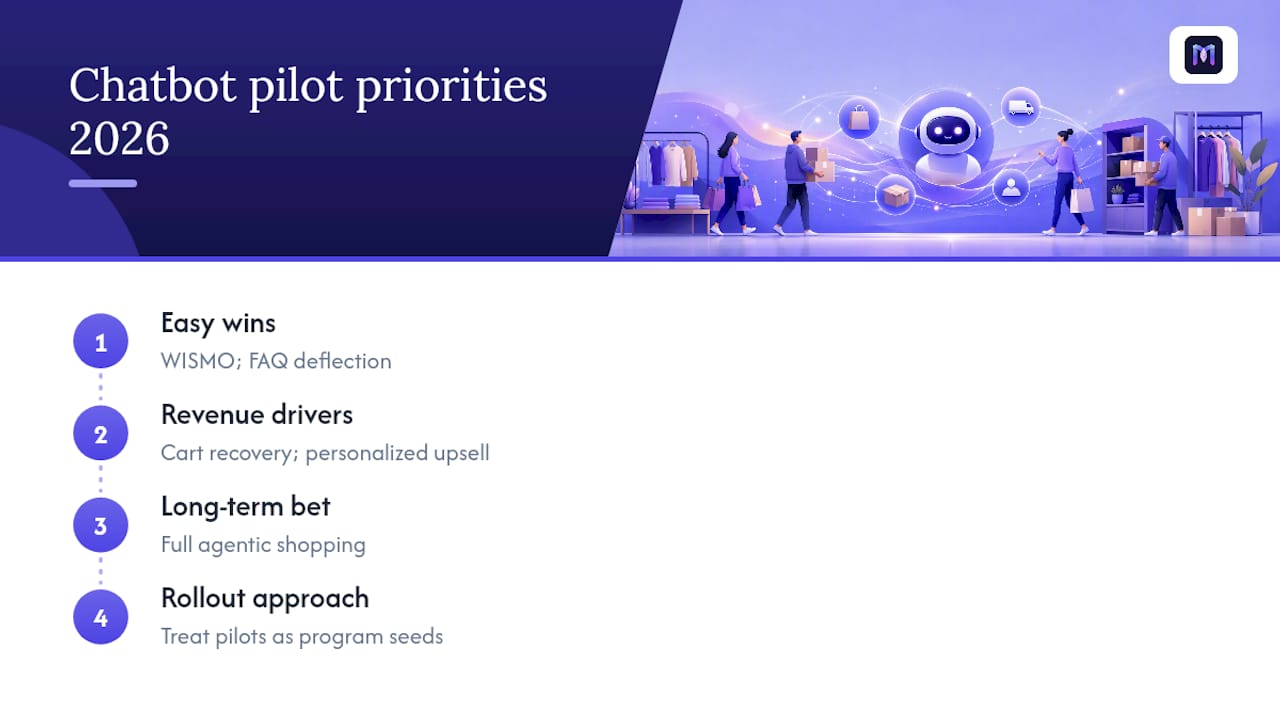
For prioritization, sequence your pilots by effort versus payoff. WISMO and FAQ deflection are the easy operational wins. Cart recovery and personalized upsell carry the highest direct revenue impact once the data plumbing exists. Full agentic shopping, where the bot completes a purchase end to end, is the long-term bet worth watching but not the place to start. Treat every successful pilot as the seed of a broader program, not a one-off project. Our guide to conversational commerce covers how that shift plays out in more detail.
Piloting Retail Chatbot Use Cases With Monobot
Monobot gives you a faster starting line than building an integration from scratch: no-code Ready-to-Use Templates for retail come preconfigured for flows like order status, product inquiries, and lead qualification, so you’re not writing conversation logic from a blank page.
A sensible pilot scope is one or two use cases, WISMO deflection and cart recovery conversion lift are good starting metrics, run for a few weeks against a clear baseline. Plans run from Starter at $200 per month up through Business at $1,000 per month, with Enterprise pricing available on request for larger retail deployments, and add-ons like a dedicated phone number at $2.50 per month per number for voice flows. If you run a larger operation or an agency serving multiple retail brands, the white-label and OEM options let you offer this under your own name. Request a demo or start from a retail template to see how a WISMO or FAQ flow performs against your own ticket volume before committing to a broader rollout.
Sources
- Chatbots for Retail: Types, Use Cases, and Examples
- E-commerce chatbots: Benefits & use cases | IBM
- Chatbots in Retail: Uses and Benefits | Intermedia
FAQ
What are some real-life examples of chatbot use cases in retail?
Real deployments include order tracking bots that pull live carrier data, product recommendation bots that filter a catalog by size and price, and cart recovery bots that message shoppers who abandon checkout. IBM’s e-commerce chatbot guide documents these as some of the most common patterns across online retailers.
What are some examples of AI use cases in the retail industry beyond chat?
Retail AI extends into inventory forecasting, dynamic pricing, and in-store associate tools that check stock in real time. Chatbots remain the customer-facing layer most closely tied to conversion and support costs, since they touch the moments where a shopper is deciding whether to buy or abandon.
What are the four types of chatbots used in retail?
Retail generally uses rule-based bots for simple FAQ and policy questions, AI-driven conversational bots for open-ended discovery and support, hybrid bots that escalate to a human when needed, and voice-based assistants for phone and in-store interactions. Most mature retail programs combine at least two of these types across channels.
How much does a retail chatbot platform cost?
Monobot’s plans start at $200 per month for Starter, scaling to $500 for Growth and $1,000 for Business, with Enterprise pricing available on request. Add-on fees, like phone numbers at $2.50 per month, apply for voice-enabled retail deployments.
What’s the fastest chatbot use case to deploy for measurable ROI?
Order tracking (WISMO) and basic FAQ deflection are typically the fastest to show results, since they rely on data you already have and don’t require rebuilding checkout logic. LivePerson’s analysis found up to 69.2% of retail conversations fit this kind of automation, which is why most pilots start there.