


Call deflection should optimize for confirmed resolution, not just fewer rings. The right approach is operational: diagnose why calls happen before you route them elsewhere, then pilot narrow automation on high-volume, low-complexity intents. Do this well and you should see two measurable shifts within a quarter: fewer repeat contacts and a climbing first-call resolution rate.
TL;DR:
- Call deflection should focus on confirmed resolution rather than just routing calls away from agents to prevent repeat contacts and frustration.
- Conduct an audit to identify high-cost, high-volume issues before deploying automation, and tailor self-service tools to actual customer questions in their language.
- Use real-time, instrumented pilots with clear success thresholds for confirmed resolution and re-contact rates to evaluate automation effectiveness.
- Prioritize fixing product or UX issues that generate repeat contacts, as automation alone cannot resolve fundamental underlying problems.
- Monobot offers a no-code platform with AI voice agents, chat automation, and analytics that enable quick, resolution-first call deflection pilots.
Table of Contents
- What Are Call Deflection Strategies, Really?
- A Prioritized Playbook for Reducing Call Volume
- How Do You Measure Call Deflection Success?
- Where Call Deflection Backfires (And How to Fix It)
- Building Your Call Deflection Pilot: A Step-by-Step Plan
- Where AI and Voice Agents Actually Help
- Applying the Playbook: What This Looks Like in Practice
- What Success Actually Requires
- Start Your Call Deflection Pilot With Monobot
- Sources
- FAQ
What Are Call Deflection Strategies, Really?
Most contact centers treat call deflection as a routing problem: push the caller to a web form, a chatbot, or an app, and count that as a win. That’s avoidance, not deflection. Resolution-first deflection asks a harder question: did the customer’s issue actually get solved somewhere other than a live agent?
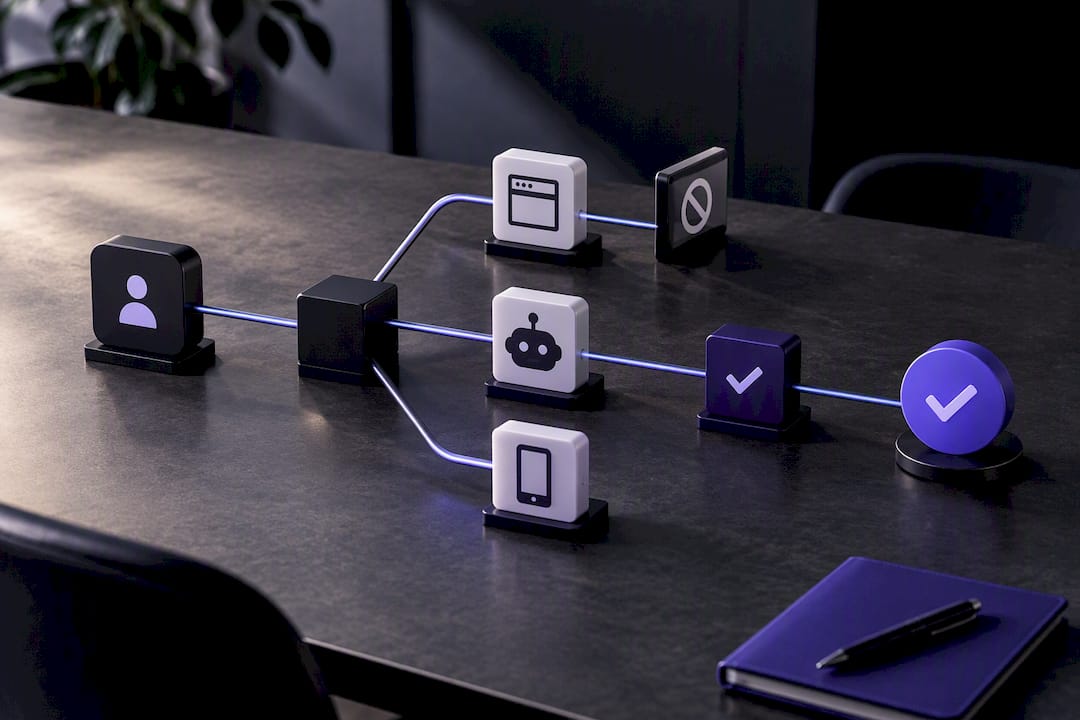
The distinction matters because Gartner found that only 14% of customer service issues are fully resolved in self-service. If your deflection channel doesn’t close the loop, the customer just comes back through a different door, often angrier and now needing more agent time than if they’d called in the first place.
The channels themselves aren’t new. What changes is how rigorously you hold each one to a resolution standard:
- Searchable knowledge bases and in-product help written in plain, customer-facing language
- Modernized IVR menus that offer real self-service, not just longer hold music
- Chatbots and AI voice agents scoped to narrow, completable tasks
- Proactive SMS and email alerts timed around predictable events
- Customer community forums for peer-driven troubleshooting
A Prioritized Playbook for Reducing Call Volume
Strategies work in a specific order. Skip the audit and jump straight to a chatbot, and you’ll automate the wrong problems faster.
- Audit failure demand before touching a channel. Chattermill recommends unifying feedback across calls, tickets, and surveys to separate failure demand (calls caused by something broken) from value demand (calls that are a normal part of doing business). Transcript analysis usually surfaces three or four drivers responsible for a disproportionate share of volume.
- Rank those drivers by cost, not just count. A composite score weighing volume, sentiment negativity, and cost per contact tells you which fixes free up the most agent capacity, according to Chattermill’s operational framework. A driver with moderate volume but high negative sentiment can outrank a bigger, calmer one.
- Send proactive messages before the call happens. Shipping delays, billing cycle changes, and outage windows are predictable. An SMS or email sent ahead of the event, with a clear resolution path, prevents the call rather than redirecting it.
- Build self-service that answers the actual question. InMoment’s guide to reducing inbound volume lists knowledge-base quality as a top lever, but only when articles are written in the customer’s own vocabulary rather than internal jargon.
- Rebuild IVR menus around self-service, with escalation one step away. The New Jersey Office of Innovation’s human-centered IVR guidance warns against nested menus that trap callers, and recommends letting people resolve simple requests, like texting an account balance, without ever reaching a human.
- Deploy chatbots and AI agents on narrow, completable intents only. An agent that can check order status, reschedule an appointment, or reset a password end-to-end removes real volume. One that just repeats FAQ text often results in the caller needing to call back immediately.
- Give human agents tools to finish the deflection, not restart it. Callback scheduling and agent-assist prompts let a live rep pick up exactly where the bot left off instead of asking the customer to explain everything again.
- Fix the product or UX issue causing repeat contacts. Practitioner case studies have found that repeat callers can make up as much as 32% of inbound volume at some organizations. No deflection channel fixes a broken checkout flow. Only engineering does.
Pro Tip: Pull your top five contact reasons and ask, for each one, “could this customer have solved this without contacting us at all if we’d told them something sooner?” If the answer is yes, that’s a proactive-messaging opportunity, not an automation one.
How Do You Measure Call Deflection Success?
Deflection rate is the metric everyone tracks and the one most likely to mislead you. It’s calculated as:
Deflection rate = (Contacts resolved outside a live agent ÷ total contact attempts) × 100
The problem is that this number counts a customer who bounced off a chatbot and called anyway as a success, right up until they call. That’s why confirmed resolution rate matters more: it only counts a self-service interaction as a win when the customer’s issue was actually closed, verified against account activity or a follow-up survey.
- Re-contact rate (24 to 72 hours): the share of “resolved” contacts that generate a follow-up call on the same issue.
- CSAT by channel: satisfaction scores broken out per deflection channel, not blended into one company-wide average.
- ASA (average speed of answer): how deflection load affects wait times for calls that do reach an agent.
- FCR (first-call resolution): whether the agent call that does happen gets closed on the first try.
Instrument every pilot with a persistent conversation ID linked to your CRM record, so a customer’s journey across channels is traceable end to end, and set alert thresholds before launch so a spike in re-contact rate triggers a review rather than getting buried in a monthly report.
Where Call Deflection Backfires (And How to Fix It)
Deflection efforts fail in predictable ways, and most of them trace back to treating the channel as the goal instead of the resolution.
- Deflecting to a dead end. Sending a customer to a form with no confirmation or next step just delays the call. Build one-click resolution flows that end in a verifiable outcome, like a confirmation email or an account update the customer can see immediately.
- IVR traps. Nested menus that never offer a human option, or bury it five layers deep, are the single fastest way to spike abandonment and complaints. The NJ human-centered IVR guidance is blunt about this: escalation should always be one step away.
- Lost context across handoffs. When a chatbot hands off to a live agent without passing along the conversation ID, intent, and last action taken, the customer has to repeat everything. Practitioner guidance on deflection design treats context transfer as a measurable requirement, not a nice-to-have.
- Chasing vanity metrics. A rising deflection rate paired with a rising re-contact rate is not progress. It’s cost shifted downstream.
Pro Tip: Before scaling any deflection channel, run 50 real transcripts through it and count how many ended in a verified resolution versus a customer giving up or calling back. That number tells you more than any dashboard.
Building Your Call Deflection Pilot: A Step-by-Step Plan
A pilot succeeds or fails based on what you choose to automate first, and how closely you watch it.
- Pick intents that are high-volume, low-complexity, and expensive per contact. Password resets and order-status checks are classic starting points. Anything requiring judgment calls or exceptions stays with agents for now.
- Run the pilot for six to eight weeks. Practitioner playbooks recommend daily monitoring in the first two weeks, watching confirmed resolution rate, re-contact rate, and ASA before pulling back to weekly reviews.
- Instrument everything before launch. Persistent conversation IDs, CRM linkage, and agent tools that surface prior bot interactions are non-negotiable, not phase-two additions.
- Set decision gates in advance. Define the confirmed resolution and re-contact thresholds that trigger expansion, and the ones that trigger rollback, before you see a single day of live data.
| Pilot signal | Expansion threshold | Rollback threshold |
|---|---|---|
| Confirmed resolution rate | Meets or exceeds baseline agent resolution | Falls significantly below baseline |
| Re-contact rate (24 to 72 hrs) | Stable or declining over 3 weeks | Rising for 2+ consecutive weeks |
| ASA for remaining live calls | Flat or improved | Increases due to escalation backlog |
Where AI and Voice Agents Actually Help
AI agents earn their place in a deflection strategy only when they complete a transaction, not when they just answer a question and stop. Practitioner analysis of AI-driven volume reduction points to task-completing agents, ones that can actually check an order, reschedule an appointment, or update an account, as the ones that remove volume durably. A voice agent scoped to those tasks behaves differently from a general chatbot; you can compare the two models in this breakdown of AI chatbots versus traditional call center workflows.
- Scope each agent to a small set of well-defined, completable intents rather than open-ended conversation.
- Design fail-open behavior: if the agent can’t complete the task, escalation to a human happens in one step, with context intact.
- Use agent-assist features and conversation analytics to improve agent-side FCR, not just automate the caller’s side.
- Set governance up front: monitoring dashboards, prompt controls, defined rollback triggers, and privacy safeguards for regulated data like health or financial information.
Pro Tip: If your AI agent can’t tell you, in plain terms, what “success” looked like for the last 100 conversations it handled, it isn’t ready to scale past a pilot.
Applying the Playbook: What This Looks Like in Practice
A resolution-first deflection stack usually combines a few specific capabilities: no-code templates for common intents, AI voice agents that can complete transactions rather than just answer questions, and real-time analytics that flag when confirmed resolution starts slipping. Monobot’s platform is built around that combination, letting teams stand up a narrow pilot, an appointment-scheduling flow or an order-status agent, within minutes rather than weeks, and watch its resolution numbers from day one.
- No-code deployment means a pilot for a single high-volume intent can launch without a development sprint.
- Industry templates across retail, healthcare, banking, and logistics give a starting structure rather than a blank canvas.
- Real-time dashboards surface re-contact spikes early enough to intervene before a rollback becomes necessary.
- Agent-assist tools carry conversation context into live handoffs, addressing the exact failure mode that undermines most deflection programs.
What Success Actually Requires
Lower repeat contact and better first-call resolution are realistic outcomes, but they depend on more than picking the right software. Data integration between your CRM and whatever channel you deploy has to happen first, and so does a real commitment to fixing the product issues generating your top contact drivers. Automation without an engineering partner willing to close the underlying gaps just moves the same problem to a new channel.
— Alex
Start Your Call Deflection Pilot With Monobot
Monobot gives contact center teams a way to run that resolution-first pilot without a multi-month build cycle. Instead of stitching together a chatbot vendor, an IVR provider, and a separate analytics tool, you get AI voice agents, chat automation, and real-time dashboards in one platform, deployable from a no-code template in minutes.
That matters most in the first six to eight weeks of a pilot, when you need to see confirmed resolution and re-contact numbers fast enough to decide whether to scale or roll back. Monobot’s interaction dashboards track exactly those signals, and the AI voice agent builder lets you scope an agent to one narrow, completable intent, like appointment scheduling or order status, before expanding to anything more complex. Plans start with the Starter tier at $200 per month, with Growth and Business tiers scaling as pilot volume grows. If you’re ready to test a resolution-first flow on your highest-volume, lowest-complexity intent, visit the Monobot pricing page and start a pilot this week.
Sources
- Gartner survey: only 14% of customer-service issues fully resolved in self-service
- How to Reduce Inbound Call Volume in a Contact Center Without Hurting CX – InMoment
- Call Deflection Strategies That Actually Resolve, Not Just Redirect
- How to Reduce Contact Center Call Volume Using Customer Feedback Insights
- Human-centered IVR design guide — New Jersey Office of Innovation
FAQ
What Are Some Effective Call Control Techniques?
Effective call control starts before the call even happens: proactive messaging for predictable events, well-written self-service content, and IVR menus that resolve simple requests without a human. During the call itself, agents trained to confirm the actual issue in the first thirty seconds close cases faster and reduce re-contacts.
What Are Some Best Practices for Call Centers Trying to Reduce Volume?
The strongest practice is fixing failure demand before automating anything. Chattermill’s approach unifies feedback across channels to find the handful of root causes driving most repeat contacts, then applies self-service or automation only to what’s left.
How Do You Decide When It’s Time to Escalate a Call?
Escalate when the interaction requires judgment, an exception to standard policy, or emotional de-escalation that a script can’t handle. Good IVR and chatbot design build that decision point in from the start, keeping human escalation one step away rather than buried behind multiple menus.
How Do You Handle an Angry Customer on a Call?
Acknowledge the specific problem before offering any solution. Agents who repeat the issue back accurately and skip the script tend to defuse frustration faster, and giving the agent full context from any prior self-service attempt prevents the customer from having to repeat their story.
Does Monobot Offer Call Deflection Tools?
Monobot provides AI voice agents, chat automation, and real-time analytics designed for resolution-first deflection pilots, deployable through no-code templates. Current pricing is available on the Monobot pricing page.