



TL;DR:
- Customer engagement automation uses AI and behavioral data to personalize interactions at scale with minimal manual effort. It outperforms rule-based systems by delivering real-time, omnichannel messages that adapt to customer behavior and improve continuously. Proper data quality and focus on relevant customer milestones enable automation to drive higher retention and revenue.
Customer engagement automation is defined as the technology-enabled process of using AI and behavioral data to deliver personalized interactions with customers at scale, without manual effort for each touchpoint. The industry term for this practice is “customer engagement automation,” though you will also hear it called customer relationship automation or automated marketing engagement. E-commerce brands using autonomous AI-driven agents achieve cart recovery rates of 30–40%, compared to the 10–15% industry average with traditional methods. That gap shows exactly what separates modern AI-native platforms from legacy rule-based tools. For customer service managers and marketing teams, understanding this distinction is the foundation for every automation decision you make in 2026.
What is customer engagement automation and how does it work?
Customer engagement automation works by collecting real-time behavioral data from multiple customer touchpoints, then using AI to decide what message to send, through which channel, and at what moment. The data sources include website clicks, app sessions, purchase history, support tickets, and voice call transcripts. Each signal feeds a decision engine that acts without waiting for a human to trigger it.

Traditional automation relied on static decision trees. A customer abandons a cart, a timer fires, an email goes out. AI-native architectures replace those manual decision trees with autonomous agents that customize engagement in real time per customer, removing the workflow overhead entirely. The agent learns continuously from outcomes, so its decisions improve without anyone rewriting rules.
Omnichannel execution is the delivery layer. Cross-channel orchestration enables consistent experiences across email, SMS, push notifications, live chat, and voice calls. A customer who ignores an email but responds to SMS gets routed to SMS automatically. The system adapts the channel mix based on each person’s actual behavior, not a marketer’s assumption.
- Behavioral triggers: Actions like page views, product searches, or support requests fire automated responses in real time.
- AI decision rules vs. autonomous agents: Rule-based systems follow fixed logic; autonomous agents weigh context and history dynamically.
- Omnichannel delivery: Messages reach customers on email, SMS, push, chat, or voice based on where they engage most.
- Continuous learning: AI agents update their models from every interaction, improving personalization without manual A/B testing.
Pro Tip: Map your top three customer drop-off points before building any automation. Automation applied to the wrong moment wastes budget and annoys customers.
What are the main types of customer engagement automation?
The clearest way to categorize automation is by how decisions get made: rule-based workflows versus AI-native agentic models.
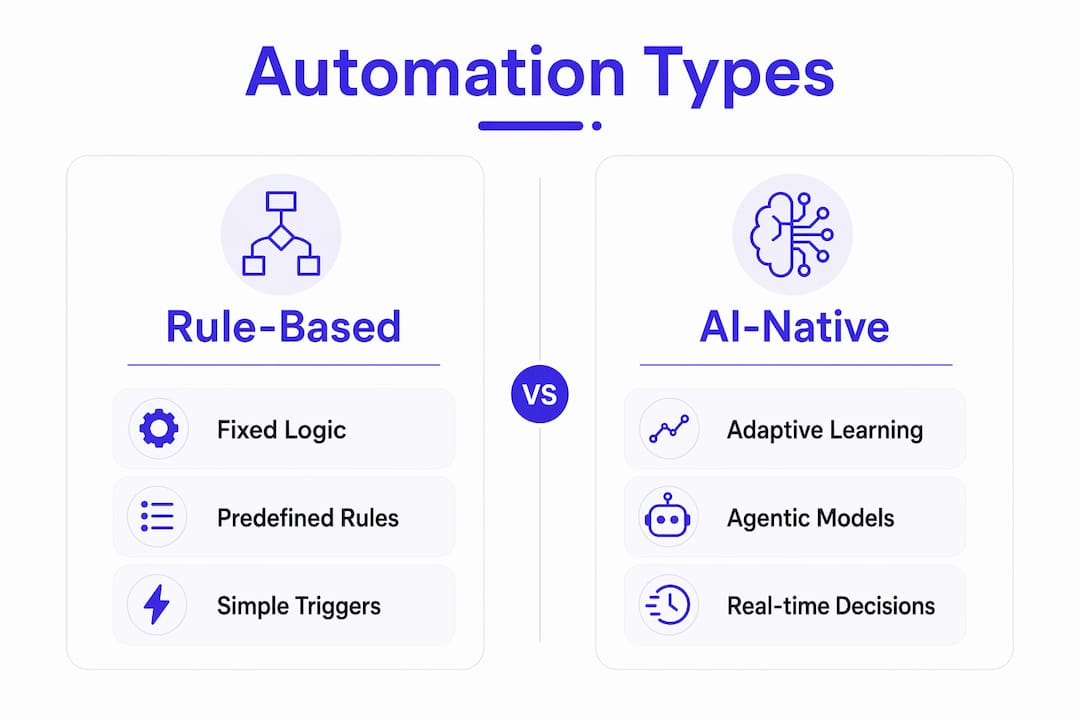
Rule-based workflows define every condition in advance. If a customer has not purchased in 30 days, send a discount email. These systems are predictable and easy to audit, but they break down when customer behavior does not fit the preset conditions. They also require constant manual updates as products, prices, and customer segments change.
AI-native agentic models operate differently. Modern autonomous platforms generate individual AI agents that personalize customer journeys based on real-time behavior patterns and context, eliminating the need for manual workflow creation. Each customer gets a path shaped by their own history, not a segment average. This is the shift that makes personalization genuinely scalable.
The 4 P’s of customer engagement provide a practical framework for building your strategy regardless of which automation model you use:
- Personalization: Tailor every message to the individual’s behavior, preferences, and stage in the journey.
- Predictive Analytics: Use historical data to anticipate what a customer needs before they ask.
- Proactivity: Reach out before a customer churns or escalates, not after.
- Partnership: Treat the customer relationship as collaborative, not transactional.
Understanding the difference between a CRM and a Customer Engagement Platform (CEP) also matters here. CEPs differ from CRM systems by enabling real-time behavioral engagement and orchestrating complex customer journeys based on user actions, not just storing customer data. A CRM holds the record. A CEP acts on it.
| Automation method | Core mechanism | Best use case |
|---|---|---|
| Rule-based workflows | Fixed if/then logic | Predictable, high-volume triggers |
| AI-native agentic models | Autonomous real-time decisions | Complex, personalized journeys |
| CEP-driven orchestration | Behavioral data across channels | Omnichannel customer lifecycle |
| CRM-triggered sequences | Stored profile data | Sales follow-up and nurture |
How to implement customer engagement automation effectively
Effective implementation starts with identifying what practitioners call “Aha Moments.” Focusing automation on key milestones accelerates progression from acquisition to loyalty. An Aha Moment is the specific point where a customer first experiences real value from your product or service. Automate the path to that moment, and you accelerate every metric that follows.
- Audit your customer journey. Identify the three to five moments where customers either commit or disengage. These are your highest-value automation targets.
- Build a unified customer profile. Pull data from your CRM, support platform, e-commerce system, and communication tools into a single record. Fragmented data produces fragmented messages.
- Start with event-triggered automation. Automation driven by behavioral signals rather than calendar dates results in more relevant, event-driven engagement that outperforms traditional batch marketing. Replace your weekly newsletter blast with a trigger that fires when a customer views a product three times.
- Set clear success metrics. Track conversion rate, retention rate, and engagement rate separately. Each tells a different story about whether your automation is working.
- Review and retrain regularly. AI agents improve with data, but they also drift if the underlying customer behavior changes. Schedule monthly reviews of your top-performing and worst-performing flows.
Pro Tip: Avoid automation bloat. Maintaining a unified, current data foundation is what keeps automated messages relevant and prevents them from feeling robotic. Stale data is the fastest way to destroy the customer experience you built.
Data quality is the most underrated factor in automation success. A message triggered by outdated information, like a discount for a product a customer already bought, signals that your system does not know them at all. That erodes trust faster than no automation would.
What impact does customer engagement automation have on business outcomes?
The business case for automation is concrete. Automation reduces workload, enabling marketing and service teams to focus on strategy and quality interactions rather than manual administrative tasks. That shift in focus compounds over time because teams get better at the work that actually requires human judgment.
AI enables marketers to scale highly personalized communication at speeds and granularity impossible to replicate manually. A team of five can manage personalized journeys for 500,000 customers when AI handles the decision layer. Without automation, that same team would be limited to batch campaigns with minimal personalization.
“Automation is most effective when triggered by real-time customer behavior rather than fixed schedules, emphasizing personalized, context-aware messaging.”
The revenue impact shows up most clearly in retention and recovery metrics. Cart recovery rates of 30–40% with AI-driven agents versus 10–15% with traditional methods represent a direct revenue difference. For a retailer processing $10 million in abandoned carts annually, that gap translates to millions in recovered revenue.
| Business outcome | Traditional automation | AI-native automation |
|---|---|---|
| Cart recovery rate | 10–15% | 30–40% |
| Personalization scale | Segment-level | Individual-level |
| Workflow maintenance | Manual updates required | Continuous self-learning |
| Team focus | Administrative tasks | Strategy and quality |
Customer loyalty and lifetime value also improve when automation is done well. Customers who receive relevant, timely communication are more likely to return and less likely to churn. You can learn more about sustaining engagement growth and the behavioral patterns that drive long-term retention.
Key takeaways
Customer engagement automation delivers its highest returns when AI-native platforms replace static workflows and act on real-time behavioral data rather than fixed schedules.
| Point | Details |
|---|---|
| Define before you build | Customer engagement automation uses AI and behavioral data to personalize interactions at scale without manual effort per touchpoint. |
| AI-native beats rule-based | Autonomous AI agents outperform static workflows by adapting to each customer’s real-time context and history. |
| Data quality is non-negotiable | Stale or fragmented data causes automation bloat, producing robotic messages that damage customer trust. |
| Target Aha Moments first | Automating the path to a customer’s first value experience accelerates conversion and loyalty faster than automating everything. |
| Measure outcomes, not activity | Track conversion, retention, and engagement rates separately to understand what your automation actually achieves. |
The uncomfortable truth about automation I keep seeing ignored
Most teams I talk to treat automation as a volume problem. They want to send more messages to more customers with less effort. That framing produces exactly the kind of robotic, irrelevant communication that makes customers unsubscribe.
The teams that get real results treat automation as a relevance problem. The question is not “how do we automate more?” It is “how do we make every automated message feel like it was written for this specific person at this specific moment?” That requires a fundamentally different approach to data, triggers, and measurement.
The shift from manual workflows to autonomous AI agents is real and accelerating. But the technology only works if the data underneath it is clean, current, and unified. I have seen companies deploy sophisticated AI platforms on top of fragmented CRM data and wonder why their engagement rates do not improve. The AI is only as good as what it knows about your customers.
The other thing most articles skip: change management. Your marketing and service teams need to trust the automation enough to let it run. That means building in human oversight at the right points, not eliminating it entirely. Platforms like Monobot handle this well by letting human agents take over calls or chats in real time when the situation warrants it. That balance between autonomous operation and human judgment is where the best implementations live.
If you are just starting out, focus on AI-driven follow-up automation before trying to automate your entire customer journey. Get one flow working well, measure it, and build from there.
— Alex
How Monobot puts customer engagement automation to work
Monobot’s AI agent builder lets your team create and deploy autonomous voice and chat agents without writing a single line of code. Each agent handles appointment scheduling, order status updates, lead qualification, and inbound inquiries in real time across your channels. Monobot automates up to 80% of inbound calls and chats, freeing your team to focus on the interactions that require human expertise. Built-in real-time analytics give you granular visibility into every conversation, so you can measure engagement rates, identify drop-off points, and continuously improve your automation. Industry templates for healthcare, banking, retail, and logistics mean you can go from setup to live deployment in minutes.
FAQ
What is the difference between a CRM and a customer engagement platform?
A CRM stores customer data and manages relationships. A Customer Engagement Platform (CEP) acts on that data in real time, orchestrating personalized journeys based on actual customer behavior across channels.
How does behavioral data improve automated customer interactions?
Behavioral data tells the automation system what a customer just did, not just who they are. Triggers based on real-time actions, like a product view or a support request, produce more relevant responses than calendar-based campaigns.
What are the main benefits of engagement automation for marketing teams?
Automation lets marketing teams scale personalized communication to large audiences without proportional increases in headcount. It also shifts team focus from repetitive tasks to strategy and creative work.
What is automation bloat and how do you avoid it?
Automation bloat happens when messages fire based on outdated or incomplete customer data, producing irrelevant or poorly timed communication. Avoiding it requires maintaining a unified, current customer profile that feeds every automated trigger.
How quickly can a business deploy customer engagement automation?
Deployment time depends on the platform and the complexity of your customer journeys. AI-native platforms with pre-built industry templates, like Monobot, can go live in minutes for standard use cases such as appointment scheduling or inbound inquiry handling.