



TL;DR:
- Automated appointment scheduling calls use AI to replace manual booking, improving accuracy and operational resilience. They reduce errors, enforce compliance, and enhance customer and employee satisfaction by providing seamless, multichannel booking and real-time updates. Implementing these systems requires upfront rule definition, integration, and staff training to maximize benefits and avoid new friction.
Automated appointment scheduling calls are defined as AI-driven systems that replace manual phone-based booking with intelligent agents that handle confirmation, rescheduling, and reminders without human intervention. The case for automating appointment scheduling calls is clear: manual processes create errors, drain staff time, and leave customers waiting. Automated scheduling merges operational demand, compliance rules, and staff availability into one coherent plan. That integration is what separates a truly automated system from a simple digital calendar. Businesses that make this shift gain speed, accuracy, and the kind of operational resilience that keeps them running even when demand spikes.
Why automate appointment scheduling calls: the efficiency case
Manual scheduling is not just slow. It is a source of compounding operational risk. When coordinators juggle spreadsheets, phone calls, and email threads, errors accumulate fast. Unpaid overtime, double bookings, and compliance violations are the most common outcomes, and each one carries a financial cost that compounds over time.
Automated scheduling prevents compliance violations by enforcing labor laws and predictive scheduling mandates at the point of booking. That means the system rejects a booking that would create an illegal shift overlap before it ever reaches a manager’s desk. One compliance audit can cost more than years of automation software subscriptions. That single fact reframes the ROI conversation entirely.
The efficiency gains go beyond compliance. Automated systems provide:
- Conflict detection: Real-time alerts flag scheduling overlaps before they become problems.
- Audit trails: Every booking, change, and cancellation is logged automatically.
- Demand forecasting: Algorithms match appointment slots to predicted demand, not guesswork.
- Fair allocation: Shift and slot distribution follows predefined rules, removing human bias from the equation.
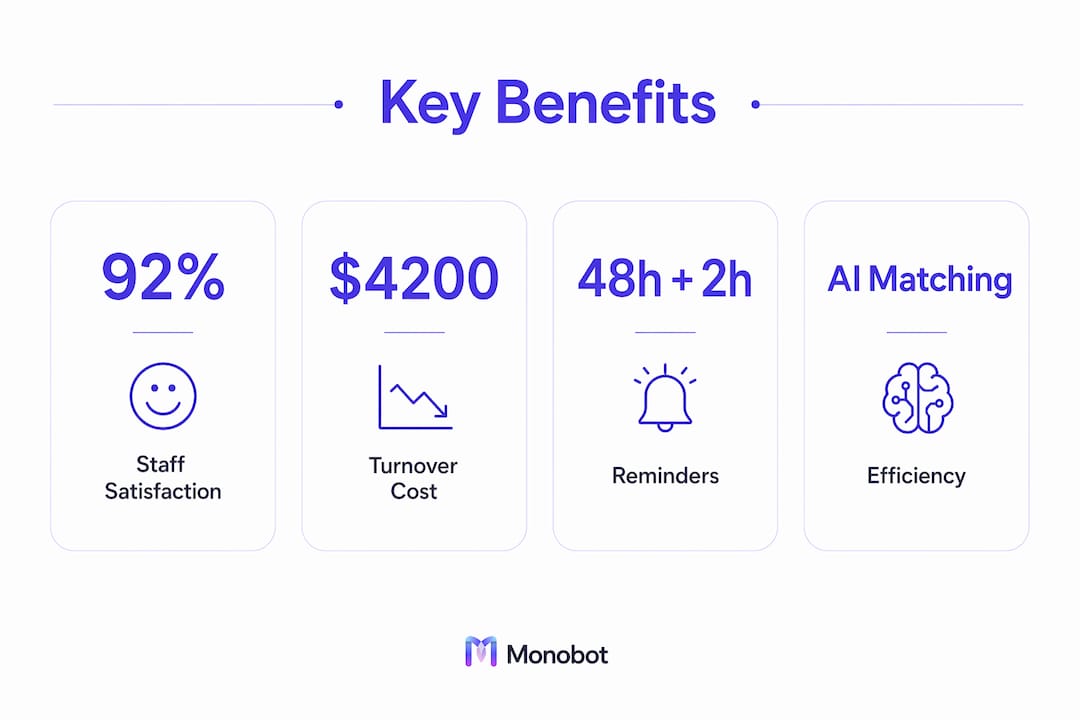
Turnover costs can reach $4,200 per employee. Poor scheduling is one of the leading drivers of burnout and resignation. Automation prevents that by giving staff predictable, transparent schedules they can plan their lives around.
Pro Tip: Define your compliance constraints before you configure any scheduling system. Rules around overtime, rest periods, and advance notice requirements should be built into the system’s logic from day one, not patched in after launch.
What are the key benefits of automating appointment scheduling calls?
The benefits of automated scheduling fall into three categories: customer experience, employee satisfaction, and operational cost. Each one reinforces the others.
Customer experience
AI-powered scheduling ensures customers can book anytime via multiple channels, improving satisfaction and loyalty. That means a patient can confirm a clinic appointment at 11:00 PM on a Sunday without waiting for an office to open. Automated reminders reduce no-shows by prompting customers at the right intervals before their appointment. Fewer no-shows means higher revenue per available slot and less wasted staff time.
“Centralized automation reduces disconnected scheduling problems significantly. When every booking flows through one system, customers get consistent confirmations, staff see accurate availability, and managers spend less time firefighting.”
Employee satisfaction
In healthcare, automated scheduling improved staff satisfaction to 92% by replacing reactive manual tasks with transparent workflows. That number reflects a broader truth: employees perform better when they trust the system managing their time. Automated scheduling prevents bias in shift allocation, which drives higher engagement and reduces quiet quitting. When staff see that assignments follow consistent rules rather than a manager’s preferences, workplace culture improves measurably.

Operational cost
Employees can submit PTO requests and receive confirmations without manager phone tag. That single change eliminates hours of back-and-forth communication per week across a mid-sized team. For businesses running HR automation with AI, the administrative load reduction is immediate and visible in the first billing cycle. The time saved compounds: fewer manual tasks mean managers focus on team leadership, not calendar management.
Pro Tip: Use automated reminders at two touchpoints: 48 hours before the appointment and again 2 hours before. This two-stage approach captures both the planners who need advance notice and the last-minute cancelers who forget.
What features and technologies enable effective automated scheduling?
Not all scheduling systems deliver the same results. The difference between a system that merely digitizes a paper calendar and one that truly automates appointment scheduling calls comes down to four core capabilities.
AI-driven matching
Effective systems use algorithms to match open slots with incoming demand in real time. They factor in staff availability, skill requirements, and compliance constraints simultaneously. This is not rule-based scheduling with a digital interface. It is genuine decision-making at machine speed.
Self-service and multichannel access
Customers expect to book through the channel they prefer, whether that is a phone call, a chat widget, or a web form. Real-time updates and a single source of truth for staff availability prevent the double-booking problem that plagues systems where phone and online bookings are managed separately.
Integration with existing tools
A scheduling system that does not connect to your calendar, CRM, and SMS platform creates more work, not less. The best platforms integrate natively with these tools and push updates across all of them simultaneously. For businesses exploring AI-driven follow-up automation, this integration layer is what makes post-appointment engagement automatic rather than manual.
Voice agents for phone-based booking
Many customers still prefer to book by phone. AI voice agents handle these calls without a human operator, collecting booking details, checking availability, and confirming appointments in real time. This is the technology that makes true 24/7 phone-based booking possible without staffing a call center around the clock. Businesses building scalable AI automation strategies increasingly treat voice agents as a core channel, not a backup option.
The table below contrasts two common system categories by capability:
| Capability | Basic digital scheduling | Fully integrated AI platform |
|---|---|---|
| Conflict detection | Manual review required | Automatic, real-time alerts |
| Compliance enforcement | User-dependent | Built into booking logic |
| 24/7 availability | Web form only | Voice, chat, and web |
| Staff availability sync | Manual updates | Live sync across channels |
| Audit trail | Partial or none | Complete and automatic |
How to implement automated appointment scheduling calls in your business
Adopting automated scheduling calls requires more than selecting software. The implementation process determines whether the system delivers its full potential or creates new friction.
-
Audit your current process. Map every step of your existing booking workflow. Identify where errors occur most often, where staff spend the most time, and where customers experience delays. This baseline shapes every configuration decision that follows.
-
Define your scheduling rules upfront. Before you configure any system, document your compliance constraints, availability windows, and booking policies. Systems that enforce rules they were never given create gaps that surface at the worst possible moments.
-
Select a platform with native integrations. Your scheduling system must connect to your calendar, CRM, and communication tools without custom development. Platforms like Monobot offer pre-built integrations that reduce setup time and eliminate sync errors between systems.
-
Communicate the change to your team. Automation adoption fails most often not because of technology, but because of change management. Staff need to understand what the system does, why it was introduced, and how it affects their daily workflow. Training sessions and clear documentation prevent resistance.
-
Protect customer data from the start. Scheduling systems collect personal information including names, contact details, and appointment history. Confirm that your chosen platform complies with applicable data privacy regulations before you go live. This is not a post-launch consideration.
-
Run a pilot before full deployment. Test the system with one team or one location first. Collect feedback, identify gaps, and adjust configuration before scaling. A pilot reduces risk and builds internal confidence in the technology.
-
Monitor performance with analytics. Track no-show rates, booking completion rates, and staff utilization after launch. AI analytics and reporting tools surface these metrics automatically, giving you the data to refine the system over time.
Key Takeaways
Automating appointment scheduling calls is the most direct path to reducing errors, enforcing compliance, and improving both customer and employee satisfaction simultaneously.
| Point | Details |
|---|---|
| Compliance is the strongest ROI driver | One audit can cost more than years of automation software, making compliance enforcement the clearest financial argument. |
| 24/7 booking access reduces no-shows | Customers who book and receive reminders through automated channels show up at higher rates. |
| Employee satisfaction rises with fairness | Transparent, rule-based scheduling improved staff satisfaction to 92% in healthcare settings. |
| Implementation requires upfront rule definition | Scheduling constraints and compliance rules must be configured before launch, not added later. |
| Voice agents extend automation to phone channels | AI voice agents handle phone-based bookings around the clock without human operators. |
Automation’s real value is resilience, not just savings
The conversation about automating appointment scheduling calls usually starts with cost. That framing is understandable but incomplete.
What I have seen consistently across businesses that make this shift is that the most valuable outcome is not the money saved on admin hours. It is the operational resilience that comes from removing human error and reactive decision-making from the scheduling process. When a system handles bookings, conflicts, and reminders automatically, managers stop spending their mornings fixing yesterday’s scheduling mistakes. They start spending that time on the work that actually requires human judgment.
The fairness dimension is also underestimated. Bias in scheduling, even unintentional bias, erodes trust faster than almost any other management failure. When staff see that a transparent algorithm governs their schedule rather than a manager’s preferences, the dynamic shifts. Engagement goes up. Complaints go down. Retention improves.
The mindset shift I would encourage is this: stop thinking about automation as a cost-cutting tool and start thinking about it as a foundation for sustainable operations. Businesses that treat scheduling as a strategic function, not an administrative chore, build teams that are more stable, more satisfied, and more productive. That is the outcome worth pursuing.
— Alex
How Monobot’s AI voice agents handle appointment scheduling
Monobot’s AI voice agent builder lets you create custom phone-based agents that handle appointment booking, confirmation, and rescheduling calls without a human operator. The platform connects to your existing calendar and CRM tools, enforces your scheduling rules automatically, and delivers real-time updates across every channel your customers use. Monobot reports that its automation handles up to 80% of inbound calls, which means your team focuses on complex cases while the system manages routine bookings. You can deploy a fully configured voice agent in minutes, with no coding required. If you are ready to see what automated scheduling looks like in practice, the Monobot AI platform is built to get you there fast.
FAQ
What is automated appointment booking?
Automated appointment booking is a system where AI-driven software handles the full booking process, including availability checks, confirmations, and reminders, without requiring manual staff involvement.
How does automation reduce no-shows?
Automated systems send reminders through SMS, voice, or chat at preset intervals before an appointment. Consistent, timely reminders are the most effective method for reducing no-show rates.
Can automated scheduling enforce labor law compliance?
Automated scheduling platforms enforce compliance by building labor law constraints directly into the booking logic, rejecting any schedule that would violate overtime, rest period, or advance notice requirements before it is confirmed.
What industries benefit most from automated scheduling calls?
Healthcare, banking, retail, and logistics see the strongest results because they handle high appointment volumes, strict compliance requirements, and diverse customer communication preferences simultaneously.
How long does it take to implement an automated scheduling system?
Implementation timelines vary by platform complexity and integration requirements. Platforms like Monobot support deployment in minutes for standard configurations, though full enterprise integration with compliance rules and multichannel setup typically takes days to weeks.