



BPO firms should adopt AI agents now for high-volume, rules-based work. The immediate next step: pick one use case (inbound status inquiries, claims intake, or IT first-touch), define three KPIs (cost-to-serve, first contact resolution, and average handle time), and launch a time-boxed 8–12 week pilot. Forrester confirms that BPO is shifting from resource-centric delivery to AI-augmented operating models where clients buy outcomes rather than hours. HFS Research reports that only a minority of enterprises have reached full AI implementation, yet enterprises expect significant productivity gains over the next few years. That gap is your window. Monobot is one platform purpose-built to shorten the distance from pilot to production.
Key Takeaways
AI agents deliver the most value in BPO when deployed on high-volume, rules-based contacts with clean data, defined KPIs, and a governance framework that tracks every agent from build to retirement.
| Point | Details |
|---|---|
| Start with a targeted pilot | Pick one high-volume use case, set cost-to-serve, FCR, and AHT baselines, and run an 8–12 week pilot before scaling. |
| Governance prevents agent sprawl | Every deployed agent needs a catalog entry, a named owner, and written retirement criteria before it goes live. |
| Workforce reskilling is non-negotiable | Train frontline staff for supervision and prompt engineering roles; measure operator acceptance as a formal KPI. |
| Shift to outcome-based contracts | Forrester and HFS Research both show clients want BPO partners who own results, not just headcount — price accordingly. |
| Monobot accelerates pilot-to-production | Monobot’s no-code agent builder, real-time analytics, and industry templates let BPO teams deploy and govern agents without long implementation cycles. |
Table of Contents
- What are AI agents and how do they differ from RPA?
- High-impact BPO use cases that deliver measurable value
- What BPOs gain from agents: KPIs, ROI, and caveats
- What platform capabilities and integrations should you require?
- How should you manage the agent lifecycle and governance?
- What does a practical pilot-to-operate roadmap look like?
- How do you manage risk and lead the workforce through the change?
- An editorial perspective on what BPO leaders actually get wrong
- Monobot cuts the distance from pilot to production
- Sources
- FAQ
What are AI agents and how do they differ from RPA?
AI agents are autonomous, goal-driven software programs that perceive inputs, reason over context, and chain actions across multiple systems to complete a task. They are not the same as robotic process automation (RPA) or simple rule-based chatbots, and the distinction matters when you are scoping a BPO deployment.
RPA executes deterministic, scripted steps on structured data. A chatbot responds to a matched intent with a fixed reply. An AI agent, by contrast, can hold context across a multi-turn conversation, call external APIs mid-task, decide which step to take next, and hand off to a human when it hits a boundary condition. That combination of language understanding, memory, and multi-step orchestration is what makes agents useful for the messy, variable interactions that fill BPO queues.
| Dimension | RPA | Rule-based chatbot | AI agent |
|---|---|---|---|
| Autonomy | None — scripted | Low — intent-matched | High — goal-driven |
| Context retention | None | Single turn | Multi-turn, cross-session |
| Multi-step orchestration | Fixed sequence | No | Yes — dynamic |
| Language understanding | No | Pattern matching | LLM-based NLU |
| Acts on behalf of user | Limited | No | Yes |
Four agent types are most relevant to BPO operations:
- Voice agents handle inbound and outbound calls using speech-to-text (STT) and text-to-speech (TTS) with natural turn-taking.
- Chat copilots assist human agents in real time by surfacing knowledge base articles, suggesting responses, and auto-completing after-call work.
- Task-orchestrating agents chain actions across CRM, ERP, and ticketing systems to complete end-to-end workflows without human intervention.
- Monitoring and observability agents watch live interactions, flag anomalies, and trigger escalations based on sentiment or compliance signals.
High-impact BPO use cases that deliver measurable value
AWS Builder’s catalog of generative AI use cases for BPO and contact centers shows that the highest-value applications combine language understanding with data integration. The use cases below are where that combination pays off fastest.
- Inbound customer support (status/FAQ/triage): An agent authenticates the caller, queries the OMS for order status, and resolves the inquiry without a human. Auto-resolution rates on these contacts typically reach 60–80% in mature deployments.
- Claims intake and validation: An agent collects claimant details, cross-checks policy data, flags missing fields, and creates a pre-populated ticket. Handle time on intake drops significantly when structured data collection is fully automated.
- Finance ops (AP/AR reconciliation): An agent matches invoices to POs, identifies discrepancies, and routes exceptions to the right analyst. Error rates on manual matching fall when the agent handles the comparison logic.
- HR admin (onboarding, payroll queries): An agent answers benefits questions, triggers onboarding workflows, and updates HRIS records. HR BPO teams see a meaningful reduction in repetitive inbound volume when these queries are automated.
- IT helpdesk first-touch: An agent triages tickets, runs standard diagnostics (password reset, VPN connectivity), and resolves Tier 1 issues without escalation. First contact resolution on Tier 1 IT contacts improves when agents handle the full resolution path rather than just logging the ticket.
- Order status and fulfillment exceptions: An agent proactively notifies customers of delays, offers rebooking options, and updates the OMS. Outbound proactive contacts reduce inbound call volume on the same issue.
A concrete example of end-to-end agent activity: a retail BPO receives an inbound call about a delayed shipment. The voice agent authenticates the caller via account number, queries the OMS, detects a carrier exception, offers a reship or refund, processes the customer’s choice, and sends a confirmation SMS, all without a human agent touching the interaction. That is the full task-orchestrating loop that BPO voice agent deployments now make operationally viable.
What BPOs gain from agents: KPIs, ROI, and caveats
The KPIs that matter most for an AI agent deployment in BPO are:
- Cost-to-serve (fully loaded cost per resolved contact)
- Average handle time (AHT) for assisted and automated contacts
- First contact resolution (FCR) rate
- CSAT and NPS lift measured against a pre-automation baseline
- Throughput (contacts handled per hour, per agent FTE equivalent)
- Error and exception rates on automated tasks
- Time-to-resolution for multi-step workflows
ROI shapes differently at pilot scale versus enterprise scale. A pilot on a single contact type with 5,000 monthly contacts will show cost-per-contact reduction quickly, often within the first 4–6 weeks of live traffic. Enterprise-scale deployments across multiple lines of business take 6–12 months to stabilize because integration overhead, model tuning, and change management compound. Plan for that curve rather than projecting pilot economics linearly.
Two caveats deserve attention. First, tokenomics: LLM inference costs scale with conversation length and complexity, so a poorly designed agent that asks unnecessary clarifying questions can erode margin faster than the automation saves it. Design agents to be concise. Second, integration overhead: the connectors between your agent platform and CRM, telephony, and OMS systems are where most pilot delays occur.
Stat to anchor expectations: HFS Research finds only about 15% of enterprises are in the run-state of full AI implementation, which means most BPO clients are still in early or mid-adoption. That creates a real opportunity for BPO providers who can offer pre-built AI assets and outcome ownership rather than just labor capacity.
What platform capabilities and integrations should you require?
Evaluating an AI agent platform for BPO means checking two layers: the technical integration surface and the security/compliance posture. Workato’s analysis of agentic AI in BPO highlights that integration depth and orchestration tooling are the practical differentiators between platforms that work in production and those that stall in pilot.
Integration checklist:
- CRM connectors (Salesforce, ServiceNow, Zendesk, or custom APIs)
- Telephony/IVR/CTI support (SIP trunking, WebRTC, softphone integration)
- OMS and ERP connectors for order and fulfillment data
- Identity and access management (SSO, OAuth 2.0, SCIM)
- Secure data pipelines (S3-compatible, data lake ingestion, event streaming)
- Webhook and event support for real-time triggers
- Real-time analytics and interaction dashboards for live monitoring
Security and compliance checklist:
- Encryption in transit (TLS 1.2+) and at rest (AES-256)
- Role-based access controls and audit logs
- PII detection, masking, and retention policies
- SOC 2 Type II certification (required for most enterprise clients)
- HIPAA-eligible infrastructure for healthcare BPO verticals
- Data residency options for clients with geographic restrictions
Deployment and operational requirements:
- Multi-tenant SaaS with dedicated tenant isolation options
- VPC or on-premises deployment for clients with strict data sovereignty needs
- Latency SLAs under 300ms for voice agent turn-taking (critical for natural conversation)
- Multilingual STT/TTS support for BPOs serving non-English markets
- Model hosting flexibility (hosted LLM vs. bring-your-own model)
Pro Tip: Require a vendor to demonstrate a live integration with your CRM in a sandbox environment before signing. Promises in a sales deck and a working connector in your environment are two different things.
How should you manage the agent lifecycle and governance?
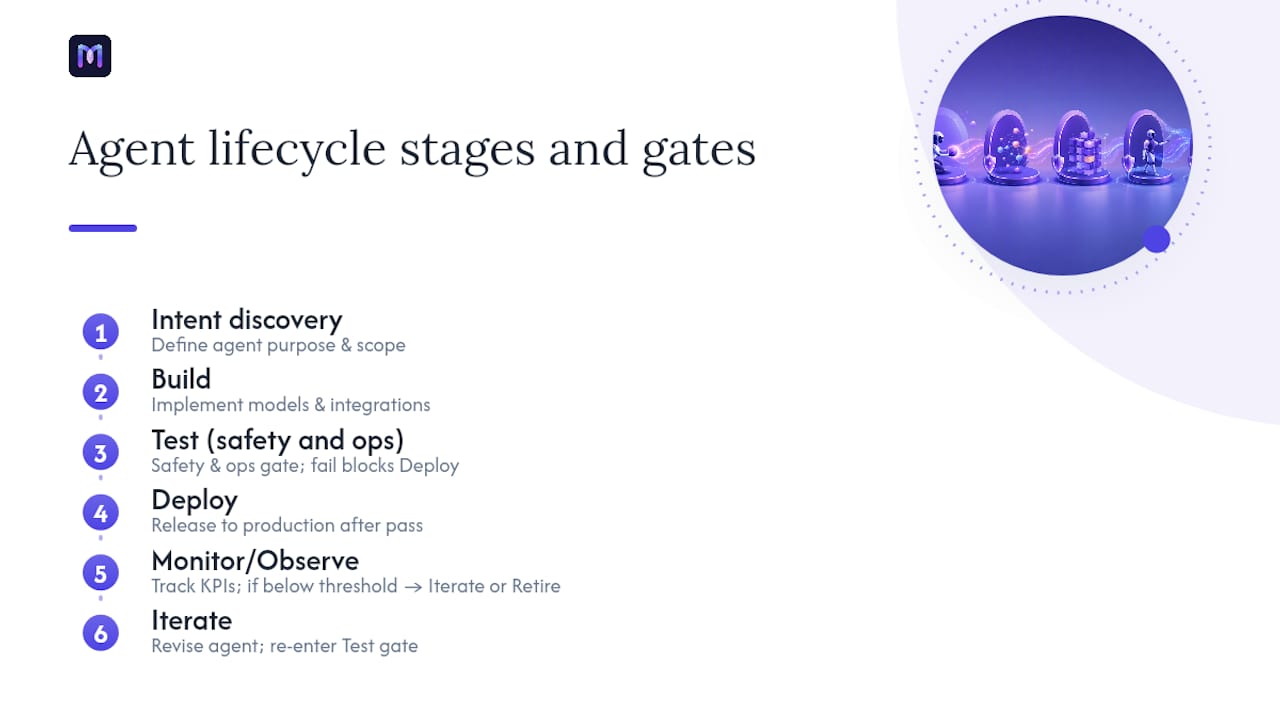
Agentic AI demands orchestration and lifecycle management rather than simple plug-and-play automation. Every agent your BPO deploys needs a defined owner, a documented purpose, and an explicit retirement policy. Without that structure, you accumulate agent sprawl: dozens of overlapping automations with no clear accountability, conflicting data sources, and no one who knows which agents are still in production.
Agent lifecycle stages
Intent discovery → Build → Test (safety and ops) → Deploy → Monitor/Observe → Iterate → Retire. Each stage has a gate. An agent that fails safety testing does not move to deploy. An agent whose KPIs have degraded below threshold moves to iterate or retire, not just monitor.
Agent catalog template
Track every deployed agent in a central catalog. The minimum fields:
| Field | Description |
|---|---|
| Agent ID | Unique identifier tied to version control |
| Purpose | One-sentence business outcome the agent delivers |
| Owner | Named process sponsor and technical owner |
| Data sources | Systems and datasets the agent reads or writes |
| Models used | LLM, STT, TTS versions and hosting location |
| ROI estimate | Baseline KPI vs. current KPI with measurement date |
| Last test date | Date of most recent safety and ops QA pass |
| Retirement criteria | Specific conditions that trigger decommission |
Governance best practices
Ownership must be explicit: every agent has a named process sponsor (business side) and a named technical owner (engineering side). Logging and observability are non-negotiable — every agent action, API call, and escalation decision should be recorded and queryable. Data lineage documentation tells you exactly what data an agent read when it made a decision, which is essential for audit and for diagnosing errors.
Change control applies to agents the same way it applies to production software. A model version update is a change. A new data source is a change. Both require a QA pass before they reach live traffic. Retirement policy should be written before an agent is deployed, not after it starts underperforming.
Pro Tip: Assign a single “agent registry owner” across your BPO operation. This person approves new agent requests, checks for duplication against the catalog, and runs quarterly retirement reviews. Without this role, agent sprawl is nearly inevitable within 12 months of scaling.
What does a practical pilot-to-operate roadmap look like?
Turn the strategy into an executable plan with four phases. Each phase has a defined output and a go/no-go gate before the next phase begins.
-
Discovery (2–4 weeks). Map your highest-volume, most rules-based contact types. Quantify current cost-to-serve, AHT, and FCR for each. Identify data readiness gaps (CRM completeness, API availability). Output: a prioritized use-case shortlist with baseline KPIs and a data readiness assessment. Go/no-go gate: at least one use case with clean data, a reachable API, and a defined success threshold.
-
Pilot (8–12 weeks). Build and deploy the agent on the selected use case. Run live traffic alongside the existing human workflow (shadow mode for the first 2 weeks, then live with human fallback). Measure KPIs weekly. Output: a pilot performance report against the baseline. Go/no-go gate: KPI improvement at or above the defined threshold, integration stability confirmed, no unresolved safety or compliance findings. Automating data entry and routine interactions during this phase accelerates the learning curve.
-
Scale (3–9 months). Expand to additional use cases and contact volumes. Introduce the agent catalog and governance framework. Begin reskilling frontline staff for supervision and exception-handling roles. Output: a multi-agent production environment with a live catalog, monitoring dashboards, and a trained operations team. Go/no-go gate: adoption rate above 70% of targeted contact volume, cost-to-serve trending down, no critical incidents in the prior 30 days.
-
Operate (ongoing). Run quarterly agent reviews against the catalog. Retire underperforming agents. Introduce new use cases through the discovery gate. Shift commercial conversations with clients toward outcome-based contracts, which Forrester recommends as the natural evolution once AI automates transactional work and domain expertise becomes the provider’s differentiator.
Owner roles across phases: process sponsor (business), data owner, AI engineer, product manager, operations manager, security/compliance lead, and change lead. Each phase needs all seven roles active, not just engineering.
How do you manage risk and lead the workforce through the change?
Risk in an AI agent deployment falls into four categories, each with a specific mitigation path.
Model risk (hallucination and accuracy): LLMs can generate plausible but incorrect responses. Mitigate with constrained output formats, retrieval-augmented generation (RAG) tied to your verified knowledge base, red-team testing before go-live, and human-in-loop escalation for any response the agent rates below a confidence threshold.

Data risk (PII leakage and data quality): Agents that read CRM and OMS data can expose sensitive information if access controls are misconfigured. Mitigate with least-privilege API access, PII masking at the data pipeline layer, and audit logs that record every data access event. Data quality issues (incomplete records, stale data) cause agent errors that look like model failures. Fix the data before blaming the model.
Operational risk (downtime and orchestration failures): A multi-step agent that fails mid-task can leave a customer interaction in an inconsistent state. Mitigate with idempotent API design, runbooks for common failure modes, and a graceful fallback to a human agent when the orchestration layer times out.
Vendor lock-in and tokenomics cost risk: Proprietary agent platforms can create switching costs, and LLM inference costs can spike with volume. Mitigate by requiring open API standards, monitoring token consumption per agent weekly, and building cost-per-contact into your agent ROI model from day one.
Workforce transition and reskilling
The agents handle volume. Your people handle judgment. That reframe is the foundation of a credible change management plan. HFS Research’s fusion team model recommends cross-functional teams that pair domain experts with technical staff to keep agents aligned with business goals. In practice, that means:
- Training frontline staff in agent supervision: reviewing flagged interactions, correcting agent errors, and feeding corrections back into the knowledge base.
- Creating prompt engineering roles for staff who understand both the business process and how to instruct the LLM.
- Measuring operator acceptance formally (adoption rate, escalation rate, agent override rate) and tying it to team performance reviews.
- Communicating the reskilling path before deployment, not after. Staff who see a defined career path toward AI supervision roles adopt faster than those who see only job displacement.
An editorial perspective on what BPO leaders actually get wrong
Most BPO leaders frame AI agent adoption as a cost-reduction exercise. That framing is not wrong, but it is incomplete, and it tends to produce the wrong pilot design. When cost reduction is the only lens, teams pick the cheapest use case to automate rather than the one with the most data readiness and the clearest success criteria. Pilots stall, not because the technology failed, but because the use case was chosen for its cost profile rather than its fit.
The more durable frame is outcome ownership. Forrester’s analysis and HFS Research’s findings both point in the same direction: clients want BPO partners who accept end-to-end accountability for a business result, not just a headcount reduction. That means your AI agent strategy needs to be legible to your clients as an outcome story, not an efficiency story. The difference is subtle but commercially significant.
The second thing leaders underestimate is governance debt. Building agents is fast. Governing them is slow. Every agent you deploy without a catalog entry, a named owner, and a retirement criterion is a liability that compounds. The BPO firms that will lead in this market are not the ones that deploy the most agents. They are the ones that can demonstrate, to an enterprise client’s procurement and compliance teams, exactly which agents are running, what data they touch, and what happens when one underperforms.
Monobot cuts the distance from pilot to production
BPO firms that have mapped their use cases and defined their KPIs need one thing next: a platform that moves at the speed of a real pilot, not a 12-month implementation. Monobot’s AI agent builder lets your team configure voice and chat agents without writing code, deploy against your existing telephony and CRM stack, and go live in days rather than months.
The platform covers the full lifecycle your governance framework requires: agent versioning, real-time interaction analytics, sentiment analysis, and an operator workspace where your supervision team can review flagged calls, override agent decisions, and feed corrections back into the knowledge base. Industry templates for healthcare, banking, retail, logistics, HR, and IT mean your pilot starts from a working baseline rather than a blank canvas. Ready to see it against your use case? Schedule a demo and bring your baseline KPIs.
Sources
These are the primary analyst and practitioner sources that informed this playbook. Use them to build internal business cases and vendor RFPs.
- AI Is Redefining BPO: Trends (Re-)Shaping The Industry
- Recast BPO as AI stewardship: The new mandate for enterprise reinvention – HFS Research
- Generative AI and AI Use Cases in BPO and Contact Centers
FAQ
Can BPO be replaced by AI?
AI agents automate high-volume, rules-based tasks well, but BPO providers who own outcomes, manage agent governance, and apply domain expertise are positioned to grow rather than be displaced. The risk is to labor-arbitrage-only models, not to outcome-focused BPO firms.
What are AI agents and how do they differ from simple bots?
AI agents are autonomous, goal-driven programs that chain actions across systems, retain context across turns, and use LLM-based language understanding. Simple rule-based bots match patterns and return fixed responses without multi-step reasoning or system integration.
What are the most common types of AI agents used in BPO?
The four types most relevant to BPO are voice agents (inbound/outbound calls), chat copilots (real-time human agent assistance), task-orchestrating agents (end-to-end workflow automation), and monitoring agents (sentiment and compliance flagging).
How long does an AI agent pilot typically take in a BPO environment?
A well-scoped pilot runs 8–12 weeks: roughly 2 weeks in shadow mode alongside existing workflows, then live traffic with human fallback, with weekly KPI reviews throughout.
What KPIs should BPO leaders track for AI agent deployments?
Track cost-to-serve, average handle time, first contact resolution rate, CSAT/NPS, throughput, error and exception rates, and time-to-resolution. Establish baselines before the pilot starts so improvements are measurable from week one.