



Don’t let a bot end on “I’m sorry.” The highest-performing playbook is a short, ranked sequence: a clarifying question first, adjacent knowledge-base surfacing second, and a context-preserving human handoff third. If you implement one thing today, set a confidence threshold that fires a logged fallback event paired with a clarifying prompt, so you capture the miss and give the user a path forward in the same breath.
TL;DR:
- Clarifying questions should be used first and are generally inexpensive to implement, but they recover most ambiguous intents.
- Surfacing relevant knowledge-base articles is effective when intent confidence is moderate, reducing the need for escalation.
- Human handoff should be reserved for sensitive issues such as billing disputes or security, where accuracy and compliance are critical.
- Setting confidence thresholds between 0.7 for clarifications and 0.4 for escalation optimizes fallback effectiveness and reduces unnecessary triggers.
- Logging fallback events with action tags and performance metrics helps identify recurring issues and prioritize improvements for high-impact queries.
Table of Contents
- Ranked fallback strategies and when to use each
- Engineering checklist for threshold tuning and webhook reliability
- Human handoff: what agents need before they say hello
- Turning fallback failures into a gap-loop that improves the bot
- Where fallback design goes wrong
- Monobot’s applied blueprint for resilient fallbacks
- Weighing trade-offs when you can’t build everything at once
- Deploying fallback flows without building from scratch
- Docs and research worth bookmarking before you build
- Sources
- FAQ
Ranked fallback strategies and when to use each
Not every fallback deserves equal weight. Some recover the conversation cheaply; others cost more engineering effort but save the relationship with a frustrated user. Here is a practical ranking by recovery impact versus implementation cost:
- Clarifying question: cheapest to build, highest recovery rate for genuinely ambiguous intents (“Did you mean your invoice or your subscription plan?”).
- Adjacent KB surfacing: when intent confidence is moderate, surface the two or three closest knowledge-base articles instead of a dead end.
- Human handoff: reserve for billing disputes, account security, or anything with compliance exposure, where getting it wrong costs more than a few extra seconds of wait time.
- Alternate channel offer: route to SMS, email, or callback when voice or chat clearly is not working for the query type.
- Schedule callback: useful for complex technical errors that need investigation time rather than an immediate answer.
- Gap-loop logging: not user-facing, but every unresolved fallback should write a structured log entry for later triage.
Choosing between them depends on domain. Billing questions often resolve with KB surfacing since policies are documented. Account issues lean toward handoff because of identity verification. Technical errors frequently need a callback once a human has reproduced the problem.
A few template patterns worth testing directly:
- Clarifying: “I want to get this right. Are you asking about a refund or a delayed shipment?”
- KB surfacing: “Here are two articles that match what you’re describing. Did either of these solve it?”
- Handoff: “I’m connecting you with a specialist who has your full conversation history, so you won’t need to repeat anything.”
Engineering checklist for threshold tuning and webhook reliability
Fallback quality is mostly a tuning and reliability problem, not a conversation-design problem. Start with a multi-threshold flow rather than a single cutoff: one tier triggers a clarifying question, a lower tier offers escalation, and a very low tier auto-hands off without asking. A reasonable starting heuristic, drawn from Dialogflow ES webhook guidance, is to clarify below 0.7 confidence and offer escalation below 0.4, then adjust using recovery rate and repeat-fallback data.
- Set longer timeouts on webhook calls and retry automatically on non-terminal errors rather than failing silently.
- Implement idempotency keys so a retried webhook call never double-books an appointment or double-charges a fee.
- Deduplicate retries at the request level, not just the response level, to avoid race conditions during high traffic.
- Log the specific failure reason (no match, validation failed, tool error) so triage does not start from scratch.
For generative fallback, Dialogflow CX’s documentation describes LLM-backed responses for no-match events, bounded by configurable prompts and safety checks; if generation fails or hits a banned phrase, the agent falls back to a prescribed response instead of improvising.
Pro Tip: Keep a banned-phrase list for generative fallback and test it in staging with adversarial inputs before it ever reaches production traffic.
Human handoff: what agents need before they say hello
A handoff that forces a user to repeat themselves erases whatever trust the bot earned. Google Cloud’s walkthrough on self-escalating chatbots shows how summarizing conversation history and triggering a webhook to notify an agent reduces resolution time and improves agent readiness.
Minimum payload to pass at handoff:
- Full transcript and the intents the bot matched along the way.
- Extracted parameters (order number, account ID, dates mentioned).
- Confidence scores for the final few turns.
- Links to any KB articles already surfaced and rejected.
A one-paragraph LLM summary template works well as a cover note: state the user’s goal, what the bot tried, why it fell short, and any sensitive flags. IBM’s Watson Assistant documentation frames this as context-preserving handoff, built specifically so agents do not ask users to start over.
Causal-aware handoff research from CEM shows that modeling user state alongside labor cost makes handoff decisions cost-aware, cutting wasted agent time while improving overall handoff accuracy. Auto-escalate on repeated fallbacks or clear frustration signals; keep it opt-in for lower-stakes queries.
Turning fallback failures into a gap-loop that improves the bot

Every fallback is a data point if you log it correctly. Track fallback rate, recovery rate, escalation rate, repeat-fallback rate, and the shift in CSAT around fallback events. These five numbers tell you whether your playbook is working or just moving the frustration downstream.
Structure each fallback log entry with consistent tags: the triggering intent, the confidence score, which strategy fired (clarify, KB, handoff), and the outcome. IBM’s operational guidance recommends treating fallbacks as first-class telemetry, reviewed on a weekly cadence rather than left to accumulate.
- Tag by root cause: missing intent, ambiguous phrasing, or a genuine tool error.
- Flag high-frequency, high-impact fallbacks for immediate KB edits.
- Reserve intent retraining for patterns that recur across many users, not one-off phrasing quirks.
Prioritize fixes by frequency multiplied by business impact. A rare fallback on a low-value query can wait; a common one on checkout or billing cannot.
Where fallback design goes wrong
The most damaging pattern is a fallback that ends on a bare apology with no next step. Practitioner guidance from IBM is blunt about this: every fallback should present at least one actionable path, whether that’s a clarifying question, a KB link, a handoff, or an alternate channel.
- Repeating the same fallback message twice in a row reads as the bot ignoring the user; vary the phrasing or escalate instead.
- Thresholds set too low trigger fallback noise on queries the bot could have handled.
- Thresholds set too high let the bot wander through several failed turns before offering help.
- Generative fallback without a banned-phrase check risks off-brand or unsafe output reaching the user.
Pro Tip: If a user hits fallback twice on the same intent, skip straight to handoff. A third attempt rarely succeeds where the first two failed.
Monobot’s applied blueprint for resilient fallbacks
Some chat and voice agents follow this exact sequence in practice: confidence threshold triggers a clarifying prompt, unresolved queries surface adjacent knowledge-base entries, and anything still unresolved hands off with full context attached.
- Handoff payload includes transcript, matched intents, extracted parameters, and confidence scores, built into Monobot’s interaction dashboards.
- Agent-summary generation can condense the conversation into a short brief so human agents start with context, not a blank transcript.
- Industry templates for healthcare, banking, retail, and logistics sometimes include fallback sequences pre-configured for each domain’s common failure points.
Weighing trade-offs when you can’t build everything at once
Clarifying prompts and KB surfacing cost little to build and recover a large share of ambiguous queries, so start there. Auto-escalation costs more in agent time but pays off fast on billing, security, and anything regulated. Generative fallback needs the most guardrails and training data, so treat it as a later addition once your logging pipeline is mature enough to catch unsafe outputs quickly.
— Alex
Deploying fallback flows without building from scratch
Teams rebuilding fallback logic from zero usually lose weeks to webhook plumbing and confidence tuning that some platforms ship pre-configured. Monobot’s Ready-to-Use Templates include fallback sequences with clarifying prompts, KB surfacing, and handoff already wired, so you tune thresholds instead of writing integration code from scratch.
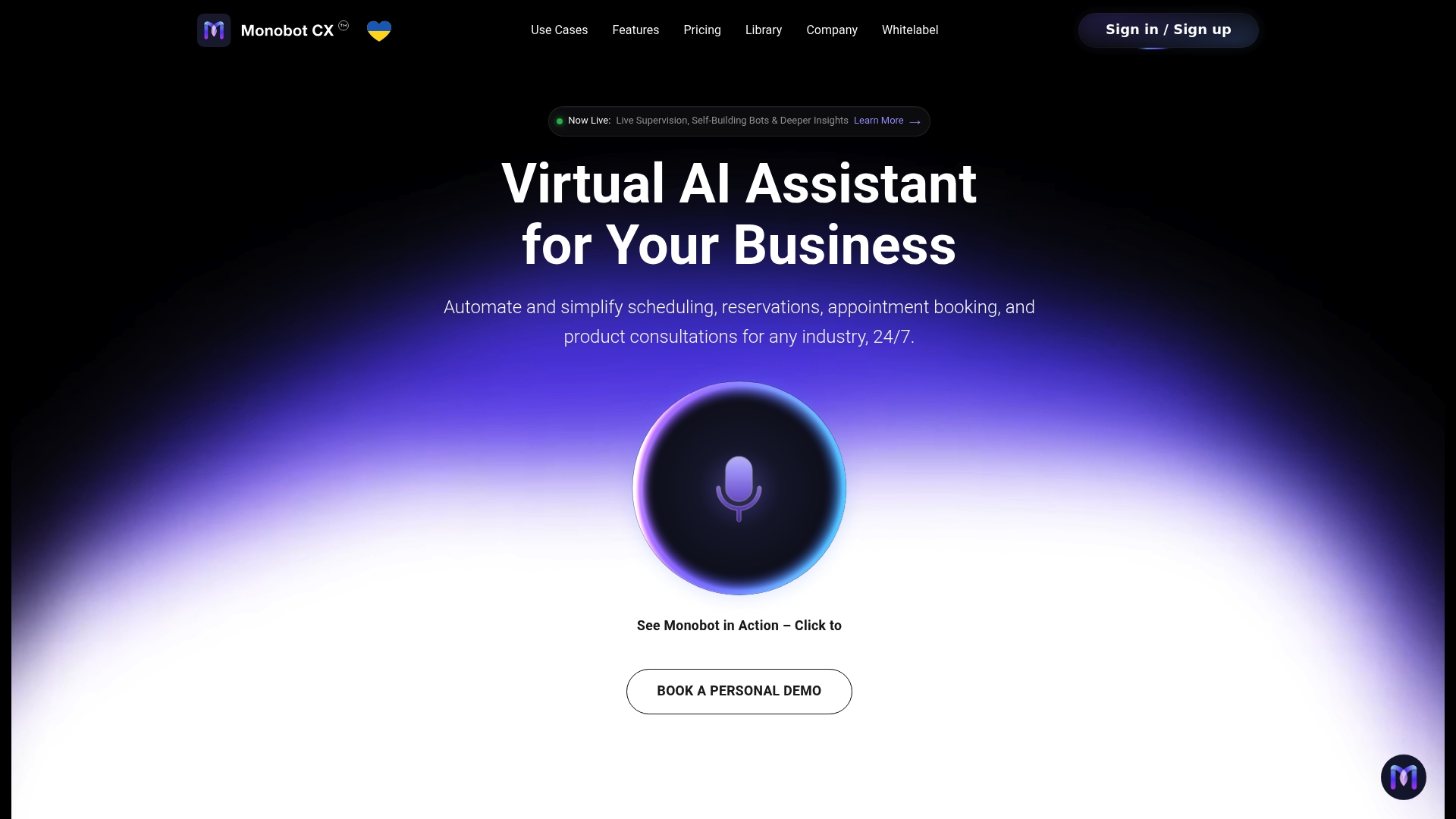
- No-code customization lets product teams adjust fallback copy and thresholds without a deployment cycle.
- Built-in webhook integrations handle retries and timeouts so tool errors do not silently drop conversations.
- Real-time analytics on the dashboard surface fallback rate and recovery rate without custom reporting.
Check the Monobot pricing page for Starter, Growth, Business, and Enterprise plans, or request a demo to see a fallback sequence configured for your industry.
Docs and research worth bookmarking before you build
- Dialogflow ES webhook documentation: retry and idempotency guidance for non-terminal errors.
- Dialogflow CX generative fallback docs: safe LLM-backed fallback design.
- Google Cloud’s self-escalating chatbot guide: webhook-triggered escalation with summaries.
- IBM Watson Assistant handoff docs: context-preserving handoff payloads.
- CEM research on causal-aware handoff: cost-aware escalation modeling.
- Summit Studio’s chatbot component showcase: UI patterns for KB surfacing and alternate channels.
Sources
- Webhook service | Dialogflow ES | Google Cloud Documentation
- Webhooks | Dialogflow CX | Google Cloud Documentation
- Create a self-escalating chatbot in Conversational Agents using Webhook and Generators | Google Cloud Blog
- IBM Cloud Docs — Watson Assistant human agent handoff
- CEM: Machine-Human Chatting Handoff via Causal-Enhance Module
FAQ
What is a fallback strategy in a chatbot?
A fallback strategy is the sequence a bot follows when it cannot confidently match a user’s intent, typically starting with a clarifying question, then surfacing relevant knowledge-base content, then handing off to a human if needed. The goal is to recover the conversation rather than end it on an apology, as IBM’s practitioner guidance emphasizes.
What kind of question tends to break an AI chatbot?
Ambiguous phrasing, multi-part requests, and queries that mix two intents in one sentence are the most common triggers for low-confidence matches. Highly specific account or billing details that require real-time lookups also tend to push bots toward fallback if the underlying webhook integration fails or times out, which is why retry and idempotency practices matter.
What should you avoid discussing with a chatbot?
Avoid sharing full payment card numbers, government identification numbers, or detailed medical history in an open chat field unless the platform explicitly states it handles that data securely. Sensitive legal matters and anything requiring immediate human judgment, like a safety emergency, are better routed directly to a human channel rather than resolved through a bot.
How do you choose the first fallback strategy to implement?
Start with a clarifying question paired with adjacent knowledge-base surfacing, since both are inexpensive to build and recover a large share of ambiguous queries. Add human handoff next for any domain involving billing, security, or compliance, where getting the answer wrong costs more than a short wait.
How do you measure whether a fallback strategy is working?
Track fallback rate, recovery rate, escalation rate, and repeat-fallback rate alongside any shift in CSAT around fallback events. A strategy is working when recovery rate rises and repeat-fallback rate on the same intent falls over time.