



Voicebots can run securely when you treat every call as a sequence of gated actions rather than open conversation. That means defense-in-depth guardrails that screen transcripts before the model ever sees them, minimal context windows, per-action authorization, encryption on every recording, and recurring adversarial testing baked into your release cycle. Procurement should require input guardrails, action-level authentication, full logging, a written retention policy, and red-team results before signing.
TL;DR:
- Voice security relies on layered guardrails, including transcript screening, minimal context, and strict access controls, to prevent prompt injection and data leaks.
- Real-time transcription must include sensitive data detection and redaction before responses are generated to avoid information leaks in spoken output.
- Authentication should combine voice biometrics with liveness checks and second-factor verification for high-risk actions, not relying solely on voiceprints.
- Each third-party component, like speech-to-text providers and integrations, requires strict authentication, validation, and contractual security measures to prevent supply chain attacks.
- Regular adversarial testing, including prompt injection and jailbreak attempts, is critical before deployment and after significant changes to patch vulnerabilities.
Table of Contents
- Why voicebots carry a different risk profile than chatbots
- Defense-in-depth architecture for secure realtime voice AI
- Prompt injection and LLM-specific threats: what actually stops them
- Identity, authorization, and per-action controls
- Data protection: recording, retention, encryption, and minimization
- Testing, validation, and adversarial assessment
- Monitoring, logging, and incident response for voicebots
- Compliance and contracts: HIPAA, BAAs, and vendor review
- How Monobot builds these controls into production deployments
- Voice-specific authentication: biometrics and liveness checks
- Securing the APIs and third-party services your voicebot depends on
- Mitigating replay attacks in voice interactions
- Secure update and patch management for voicebot components
- User education and awareness on voicebot security risks
- Hybrid versus fully managed: choosing your deployment posture
- Putting these controls into practice with Monobot
- FAQ
- Sources
Why voicebots carry a different risk profile than chatbots
Voice adds a layer of risk that text interfaces don’t have: once a model generates a spoken response, it’s already in the caller’s ear. There’s no edit window, no chance to catch a leaked system prompt or an unauthorized account action before it lands. That constraint changes where you place your guardrails. Screening has to happen on the transcript before it reaches the model, not after the response is drafted.
Attackers targeting voicebots tend to go after a few specific outcomes:
- Prompt injection that overrides the bot’s instructions through spoken input or an uploaded document referenced mid-call.
- System-prompt leakage, where a caller coaxes the bot into revealing its own configuration or hidden rules.
- Tool enumeration, probing which backend actions the bot can trigger (refunds, account changes, scheduling) to find one worth exploiting.
- Data poisoning through retrieval-augmented generation (RAG) sources or uploaded files that quietly corrupt future responses.
The attack surface extends past the model itself; see Orchard’s security and data handling for detailed controls on managing conversation data and compliance requirements. Speech-to-text (STT) providers, RAG document stores, file upload endpoints, third-party CRM or scheduling integrations, and the recording and transcription pipeline are all places where sensitive data moves outside your direct control. Each one needs its own access policy, not a blanket assumption that “the model is secure, so the pipeline is secure.”
Defense-in-depth architecture for secure realtime voice AI
Realtime voice security works best as a stack, with each layer catching what the one before it missed.
- Media layer. Secure transport over WebRTC or TLS, client-side hardening, and voice activity detection (VAD) to filter noise and silence before any audio reaches your pipeline.
- Transcription and guardrail layer. Run fast local classifiers against the transcript for PII, PHI, or PCI data and redact or block it before the content ever reaches the model. Reference implementations for realtime voice recommend classifying transcripts for sensitive data before model handoff specifically because spoken outputs happen instantly, with no review step.
- Context builder. Pass the model a structured, minimal context rather than raw sensitive spans of text, and enforce a token budget so unrelated history doesn’t leak into the current turn.
- Provider boundary. Decide deliberately what stays on infrastructure you control versus what goes to a cloud provider, and enforce your policy as close to the realtime path as possible. For regulated flows, the same reference guidance suggests keeping redaction and audit logic under your own control rather than delegating it entirely to a third party.
- Tool policy layer. Put a policy enforcement point and policy decision point (PEP/PDP) between the model and any action it can take, scoping each tool to the least privilege it needs.
Monobot’s live transcription feature illustrates the transcription layer in practice: text is available in real time, which is exactly the point where PII and PHI screening needs to happen before a response gets generated.
Prompt injection and LLM-specific threats: what actually stops them
Prompt injection comes in two forms. Direct injection is a caller telling the bot outright to ignore its instructions. Indirect injection is more dangerous because it’s hidden: malicious text embedded in a document, a web page the bot retrieves, or even a spoken phrase crafted to look like a system command. Natural-language guardrails alone, the kind that just tell the model “don’t reveal your instructions,” are not an authorization boundary. OWASP’s prompt injection guidance is explicit that these instructions can be talked around, and that actual restrictions need to be enforced technically, through API policies and step-up authentication, not through phrasing.
Mitigations worth prioritizing:
- Structured prompts that separate system instructions from user input so the model can’t confuse one for the other.
- Input sanitization and encoding detection to catch obfuscated instructions hidden in Unicode tricks or unusual formatting.
- A quarantined LLM pattern: a smaller model summarizes and labels untrusted input into a sanitized structured form before a privileged model ever sees it.
- Output screening before anything is spoken, checking for leaked instructions, unauthorized claims, or policy violations.
- Validation of any action or parameter the model wants to pass to a tool, never trusting the model’s own judgment as the final check.
OWASP’s research notes that rate limiting and keyword filters typically only slow down a determined attacker, so layered checks with repeat adversarial validation matter more than any single filter.
Pro Tip: Treat your guardrail model as a second attack surface, not a solved problem. Log every guardrail decision, and reserve the heaviest checks for your highest-risk call flows rather than applying uniform friction everywhere.
Identity, authorization, and per-action controls
A voicebot that can reschedule an appointment or process a refund is an identity that performs actions, and it should be governed the same way you’d govern any service account. OWASP’s agentic application guidance recommends mapping each bot to a non-human IAM principal with short-lived tokens bound to a signed intent, rather than a static credential that lives forever in a config file.
- Issue short-lived, scoped tokens for each session instead of long-lived API keys shared across every call.
- Require explicit re-authentication or human approval for high-risk actions like payments, account closures, or data exports.
- Apply role-based access control (RBAC) to admin consoles, and layer separate access tiers for raw recordings versus redacted transcripts.
The same OWASP guidance stresses that prompts should never be treated as an authorization mechanism: enforcement belongs at the identity layer, the API gateway, and the tool itself. Monobot’s authentication automation patterns show how identity verification steps can sit ahead of any action a bot is permitted to take.
Data protection: recording, retention, encryption, and minimization
Encrypt recordings and transcripts both in transit and at rest, using an enterprise key management system (KMS), and restrict who can rotate or access those keys to a small, audited group.
- Encrypt every recording and transcript in transit and at rest, and rotate KMS keys on a defined schedule.
- Never send raw identifiers like full names, account numbers, or medical record numbers directly into an LLM prompt. Use tokenized placeholders and resolve them only inside your own controlled systems.
- Set a retention window that matches your actual business and legal need, honor redaction requests, and keep audit trails that log access without storing raw PII inside the log itself.
Monobot’s guide on data security in AI chatbots covers these same minimization principles for conversational data more broadly.
Testing, validation, and adversarial assessment
Security testing for a voicebot needs a defined scope before anyone runs a single probe.
- Define test intents. System-prompt leakage, jailbreak attempts, tool enumeration, and data exfiltration are the four categories OWASP’s testing guidance identifies as core assessment areas, alongside insecure output handling and excessive agency.
- Build a techniques and evasions matrix. Pair each intent with the methods attackers actually use (encoding tricks, multi-turn manipulation, role-play framing) so testers aren’t improvising.
- Combine automated scans with human red teams. Automated checks catch known patterns quickly; human testers find the creative paths that scripts miss. Run both before launch and again after any material change to the prompt, model, or tool set.
- Document everything that’s reproducible. Record the exact payload, what detection gap it exposed, the fix applied, severity, and the result of the re-test.
This cadence matters because jailbreak attempts against language models succeed at a meaningfully high rate in published research, which is why OWASP’s guidance treats defense-in-depth and continuous validation as the baseline, not a one-time project.
Monitoring, logging, and incident response for voicebots
Logging needs to capture enough to investigate an incident without becoming its own liability. Log guardrail decisions, every tool call with its parameters, and session metadata, but avoid storing raw sensitive content unless you have a specific business reason, and encrypt whatever you do keep with strict, audited access.
- Set alerts for behavioral anomalies: a sudden surge in guardrail refusals, unusual chaining of tool calls, or an unexpected spike in token usage on a single session.
- Align your incident response plan with vendor obligations and the notification timelines your contracts and applicable privacy laws require.
- Rehearse your runbooks on a schedule, not just after something breaks, so the team isn’t improvising during a live incident.
NIST’s AI Risk Management Framework recommends aligning monitoring and incident response directly with vendor contract provisions, including clear SLAs for security notification, so a provider-side issue doesn’t become a surprise on your end.
Compliance and contracts: HIPAA, BAAs, and vendor review
If a voicebot creates, receives, maintains, or transmits electronic protected health information (ePHI) on behalf of a covered entity, HHS guidance generally requires a business associate agreement (BAA) with the provider, one that explicitly assigns responsibility for authentication, access controls, encryption, and incident handling. Don’t assume a vendor’s general security posture covers this unless the BAA says so in writing.
- Confirm whether your voicebot provider will sign a BAA before any health-related call flow goes live.
- Ask for SOC reports, summaries of recent penetration tests, and SLAs covering both security performance and incident notification timing.
- Require a contract clause obligating the vendor to notify you of material model or configuration changes that could affect your risk posture.
NIST’s AI guidance frames this the same way: translate privacy obligations into concrete operational constraints, retention windows, data flow maps, and access controls, rather than leaving them as abstract policy language.
How Monobot builds these controls into production deployments
Monobot’s platform is designed around the same layered approach this guidance describes. Real-time transcription gives teams visibility into conversations as they happen, which is the point where PII and PHI screening needs to occur before a response generates.
- Industry-specific templates for healthcare, banking, and other regulated sectors start from flows built around the sensitive data those industries actually handle.
- Role-based access and live supervision let human agents and administrators monitor conversations and step in on flagged interactions.
- Interaction dashboards and analytics give security and operations teams a continuous view of call volume, outcomes, and flagged events rather than a blind spot.
- A dedicated HIPAA fee tier on Monobot’s pricing page reflects the added safeguards healthcare deployments require.
These features map directly to the architecture and monitoring practices described above, without requiring a custom build from scratch.
Voice-specific authentication: biometrics and liveness checks
Voice interfaces need authentication methods that fit how people actually interact with them, which usually rules out typed passwords. Voice biometrics compare a caller’s vocal characteristics against an enrolled voiceprint, giving you a factor that doesn’t require the caller to remember anything. On its own, though, a voiceprint can be vulnerable to a recorded sample or a synthetic voice clone, which is why liveness detection matters as a companion control. Liveness checks verify that the voice being heard is coming from a live speaker in real time rather than a playback or a generated clip, often by prompting for a randomized phrase or analyzing subtle acoustic patterns that are hard to fake.
Neither method should stand alone for high-risk actions. Pair voice biometrics and liveness detection with a second factor, a one-time code sent to a known device, or a knowledge-based check tied to account history, before authorizing anything sensitive like a payment or an account change. For lower-risk interactions, like checking an order status, a single voice-based factor is often proportionate to the risk.

Build in a fallback path for callers whose voice has changed due to illness, accent variation the model wasn’t trained on, or a poor connection. A bot that locks out legitimate callers over a noisy line creates its own support burden, so route failed voice-authentication attempts to a human agent or an alternate verification method rather than a dead end.
Securing the APIs and third-party services your voicebot depends on
Every integration point, your STT provider, your CRM, your scheduling system, your SMS gateway, is a door into your voicebot’s data. Treat each one with the same scrutiny you’d apply to the bot itself.
Authenticate every API call with short-lived credentials rather than static keys that sit in a configuration file indefinitely. Scope each integration to the minimum set of endpoints and data fields it actually needs, and reject the temptation to grant a broad token because it’s convenient during development. Monobot’s workflow automation integrations illustrate this kind of tool gating in practice, where each backend action the bot can trigger is defined and scoped rather than left open.
Validate every response coming back from a third-party service before it reaches the model or the caller. A compromised or misconfigured integration can feed malformed or malicious data into your pipeline just as easily as a malicious caller can. Log every API call with its parameters and response status, and monitor for unusual patterns, like a sudden spike in calls to a rarely used endpoint, that might indicate a compromised credential or a misbehaving integration.

Contractually, ask every third-party service in your voice pipeline the same compliance questions you’d ask your core voicebot vendor: SOC reports, incident notification timelines, and whether they’ll commit to notifying you of material changes to their own systems.
Mitigating replay attacks in voice interactions
A replay attack uses a recorded snippet of a legitimate caller’s voice, sometimes captured without their knowledge, to trick a voice authentication system into granting access. Because voice is inherently a recordable signal, this risk is specific to voice interfaces in a way it isn’t for typed passwords.
Liveness detection is the primary defense: systems that require a response to a randomized prompt, rather than a fixed passphrase, make a pre-recorded clip far less useful to an attacker. Avoid static voice passphrases entirely for any high-risk action, since a phrase repeated the same way every time is exactly what a recording can capture and replay.
Session-level protections add another layer. Bind each authentication attempt to a unique session token and timestamp, so even a perfectly captured recording can’t be reused in a different call. Rate-limit authentication attempts per account and flag repeated failures for review rather than allowing unlimited retries, which gives an attacker working from a recorded sample more chances to succeed.
Combine voice-based checks with a device or network signal where possible, like confirming the call originates from a previously associated phone number, since a replayed recording played into a new, unrecognized channel is a meaningful anomaly worth flagging on its own.
Secure update and patch management for voicebot components
A voicebot is a stack of moving parts: the STT engine, the LLM or its API wrapper, the guardrail classifiers, the TTS engine, and the integrations tying it all together. Each one needs its own patch cycle, and a vulnerability in any single component can undermine the rest.
Maintain an inventory of every software component and its version, similar to a software bill of materials (SBOM), so you know immediately what’s affected when a vulnerability is disclosed. OWASP’s agentic application guidance recommends AI-specific bill-of-materials tracking for exactly this reason: agentic systems depend on models and tool integrations that change independently of your own codebase.

Test updates in a staging environment that mirrors production before pushing them live, particularly for guardrail classifiers and model versions, since a model update can shift behavior in ways a simple version bump doesn’t capture. Re-run your adversarial test suite after any component update, not just after changes to your own code, since a new model version or an updated STT engine can reopen a vulnerability your previous testing closed.
Subscribe to security advisories from every vendor in your pipeline, and build a defined process for emergency patching when a critical vulnerability is disclosed, rather than waiting for your next scheduled release cycle.
User education and awareness on voicebot security risks
The people operating and overseeing a voicebot need to understand its specific risks, not just the general security training most staff members already receive. Contact center managers and support agents should know what a prompt injection attempt sounds like on a live call, so a strange or manipulative phrasing from a caller gets flagged rather than treated as an odd but harmless request.
Train agents who monitor live supervision queues to recognize the signs of an attempted jailbreak: a caller asking the bot to “ignore previous instructions,” to role-play as a different system, or to repeat its own configuration back. Give them a clear escalation path when they spot one.
For end users and customers, clear communication about what a voicebot can and can’t do sets expectations and reduces social engineering risk. A caller who understands that a bot will never ask for a full card number over an unverified channel is less likely to be tricked by a spoofed call mimicking your own system.
Internally, make sure IT and security teams reviewing voicebot deployments understand that the risks here differ from traditional web application security: the realtime nature of voice, the lack of a review step before output, and the specific threat of prompt injection all call for training that goes beyond a standard security awareness course.
Hybrid versus fully managed: choosing your deployment posture
Keep transcription and PII filtering local when you’re handling regulated data and need audit control over every redaction decision. Cloud-provider guardrail features are reasonable for lower-risk flows, like general FAQ bots, where the cost of a mistake is low.
Start new deployments with conservative gatekeeping on any high-risk flow, tight tool scopes, mandatory human approval, limited model autonomy, and expand access only as your red-team results and monitoring data support it. Set gating milestones in advance: a defined volume of clean production calls, a passed adversarial test round, and a monitoring threshold for false positives, before moving a flow from supervised to more autonomous operation. Monobot’s comparison of AI chatbots against traditional call centers walks through this kind of staged trade-off in more detail.
— Alex
Putting these controls into practice with Monobot
Building every layer described here from scratch, transcription screening, token scoping, audit logging, retention policy, takes real engineering time most contact centers don’t have to spare. The platform bundles real-time transcription, role-based access, live supervision, and industry templates for healthcare and financial flows into a configurable solution.
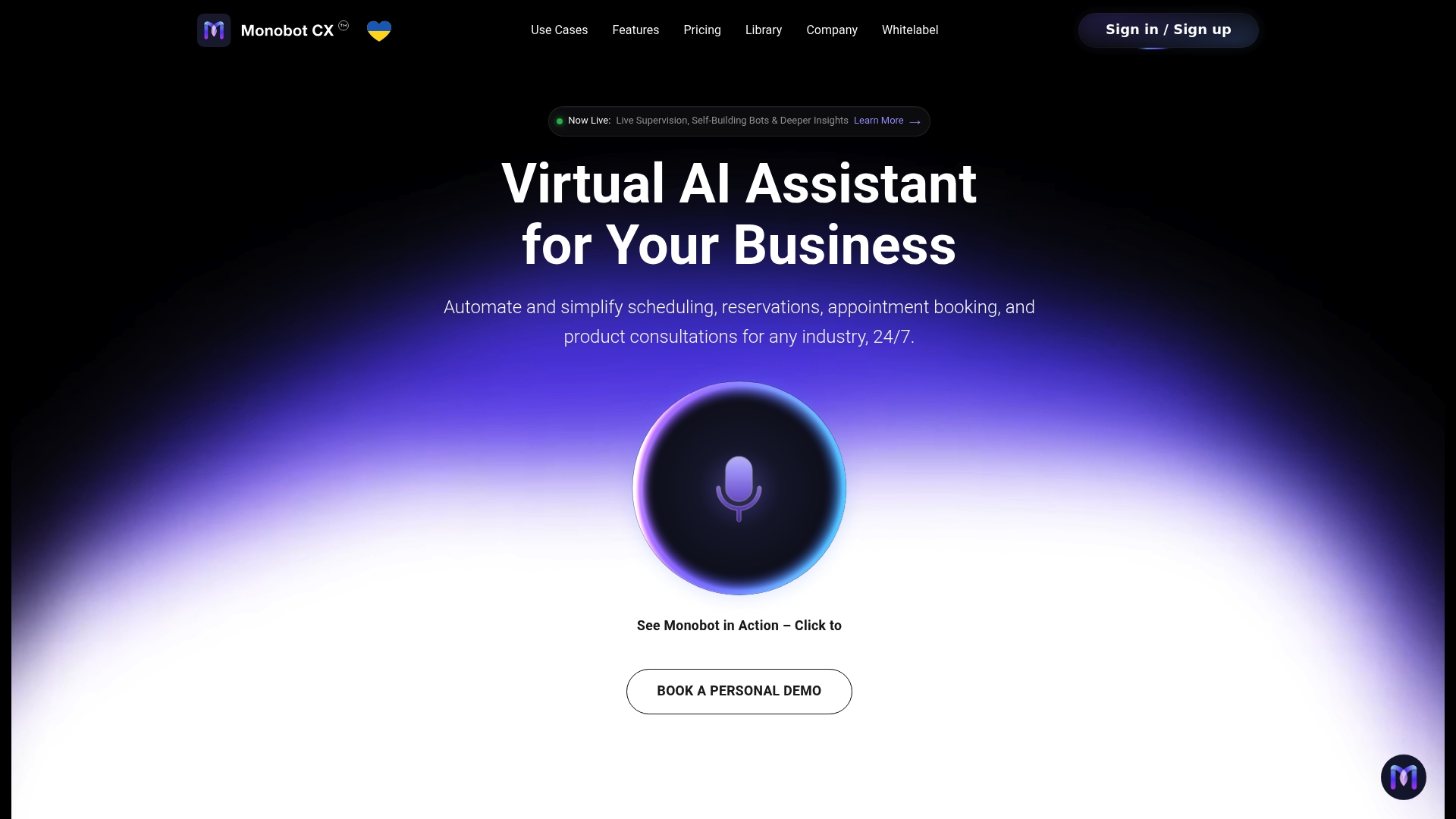
Ready-to-use templates give regulated teams a starting point that already reflects the data flows those industries handle, and the dashboard analytics keep security and operations teams watching the same data without separate tooling. Check Monobot’s pricing for plan details, or get a free setup to see how the guardrails above map onto your own call flows.
FAQ
What is the single most important voicebot security control?
No single control covers every risk, but per-action authorization, requiring explicit permission before the bot executes any sensitive action, stops the most damage once other defenses fail. Pair it with input screening before the model sees a transcript, since that combination addresses both the injection and the authorization problem at once.
When does a voicebot provider need a HIPAA business associate agreement?
A BAA is generally required when a provider creates, receives, maintains, or transmits electronic protected health information on behalf of a covered entity or another business associate, according to HHS guidance. The agreement should explicitly assign responsibility for safeguards like encryption, access control, and incident response rather than leaving those duties implied.
How often should a voicebot go through adversarial testing?
Test before any new flow launches and again after any material change to the prompt, model version, or tool permissions, since each of those changes can reopen a previously closed gap. OWASP’s testing guidance treats prompt injection, system-prompt leakage, and tool enumeration as the core areas to probe in every round.
Can voice biometrics alone secure a voicebot authentication flow?
Voice biometrics identify who is speaking, but a recorded sample or a synthetic clone can defeat that check on its own, so liveness detection and a second factor are necessary for any high-risk action. Reserve single-factor voice authentication for lower-risk interactions where the consequence of a mistaken match is limited.
Does Monobot support HIPAA-compliant voicebot deployments?
Monobot offers a dedicated HIPAA fee tier alongside its standard plans, reflecting the added safeguards healthcare call flows require, as listed on Monobot’s pricing page. Confirm the specific terms and BAA coverage directly with Monobot before deploying any flow that handles protected health information.
Sources
- Hhs
- LLM prompt injection prevention – OWASP Cheat Sheet Series
- Artificial Intelligence Risk Management Framework (AI RMF) — NIST
- OWASP Top 10 For Agentic Applications 2026
- Webrtc