



Adopt an agentic AI containment strategy built around end-to-end resolution, not deflection, and your first move this week is to map your top ten inbound intents, pick the two highest-frequency, lowest-risk ones, and set a containment rate target alongside a first-call resolution (FCR) baseline. That combination gives you a pilot scope you can staff, measure, and defend to finance. Monobot’s AI platform is designed to accelerate exactly this kind of focused deployment.
Key Takeaways
The most effective call containment automation strategy measures resolved intent, not deflected volume, and uses agentic AI with full context handoffs to keep both containment rate and CSAT moving in the same direction.
| Point | Details |
|---|---|
| Define containment correctly | A contained call completes a configured workflow with no human transfer; false containment inflates the metric without delivering value. |
| Track six KPIs together | Containment rate, FCR, AHT, escalation quality, CSAT, and cost per contact must be monitored as a set, not in isolation. |
| Pilot high-frequency, low-risk intents first | Appointment booking, order status, and balance inquiries are the fastest path to measurable containment gains with minimal compliance risk. |
| U.S. compliance is non-negotiable | TCPA consent, PCI scoping, state recording laws, and CCPA data handling must be addressed before any outbound or PII-touching flow goes live. |
| Monobot as your deployment platform | Monobot’s no-code builder, industry templates, and agent-assist workspace reduce pilot build time and eliminate cold-start escalations. |
Table of Contents
- What is call containment automation, and why does resolution beat deflection?
- Why call containment automation matters: KPIs, benchmarks, and business outcomes
- Tactical ways to raise containment without harming CX
- Step-by-step rollout plan from discovery through scale
- Telephony, data, and U.S. legal considerations for safe deployments
- How to measure success, iterate, and keep containment improving
- What typically goes wrong and how to prevent it
- How Monobot’s capabilities map to containment needs
- The shift that actually matters in call containment
- Monobot accelerates your containment pilot from day one
- Useful sources
- FAQ
What is call containment automation, and why does resolution beat deflection?
Call containment automation is the practice of using AI voice agents, automated call management workflows, and self-service logic to complete a customer’s request without transferring to a human agent. The industry standard definition: a call is “contained” when it finishes a configured workflow with no human transfer. The containment rate formula is straightforward: (contained calls ÷ answered calls) × 100.
Deflection simply pushes the caller away. Resolution completes the task. A caller who books an appointment, gets a balance, or confirms a shipment through an AI voice agent and hangs up satisfied is a contained call. A caller who hits an IVR dead end and calls back is a deflection failure dressed as a metric win. CX industry thinking has shifted toward end-to-end task completion as the key KPI, with context preserved through escalation so customers never repeat themselves.
A concrete example: a patient calls to reschedule an appointment. An agentic AI voice agent authenticates the caller, checks the scheduling system, offers available slots, confirms the new time, and sends an SMS confirmation. No human involved. That is a resolved, contained call.
Why call containment automation matters: KPIs, benchmarks, and business outcomes
The financial case for automated call management rests on six KPIs. Each one connects directly to cost, staffing, or revenue.
| KPI | How It’s Calculated | Why Finance and Ops Care |
|---|---|---|
| Containment rate | (Contained calls ÷ answered calls) × 100 | Directly reduces FTE hours required per call volume |
| First-call resolution (FCR) | Resolved calls ÷ total calls handled | Higher FCR cuts repeat contacts and lowers cost per contact |
| Average handle time (AHT) | Total handle time ÷ calls handled | Lower AHT means more capacity without added headcount |
| Escalation quality | % of escalations with full context passed | Prevents cold starts; reduces agent ramp time per call |
| CSAT | Post-interaction survey score | Tracks whether automation helps or frustrates customers |
| Cost per contact | Total contact center cost ÷ total contacts | The bottom-line measure linking all other KPIs |
Monobot’s platform positions up to 80% automation of inbound calls and chats as a directional performance signal for well-configured deployments. Even at more conservative rates, the operational math is compelling.
Key business impacts from efficient call handling include:
- Reduced FTE demand: contained calls require no agent time, freeing staff for complex work
- Extended coverage hours: AI agents handle volume at 2 AM without overtime costs
- Faster service: automated workflows complete transactions in seconds, not minutes
- Improved FCR: agentic AI that resolves rather than deflects raises first-contact resolution rates
Tactical ways to raise containment without harming CX
Start with the tactics that deliver the fastest containment lift at the lowest risk.
High-priority pilots (start here):
- Agentic AI voice agents for appointment booking, order status, and account balance inquiries
- IVR redesign focused on intent capture rather than menu navigation
- Knowledge base integration so the AI can answer policy and FAQ questions end-to-end
- Proactive outbound notifications (appointment reminders, delivery updates) to deflect inbound volume before it arrives
Mid-tier targets:
- Self-service transactions within defined risk limits (password resets, address updates)
- AI-powered chatbot integration for digital channels alongside voice
Reserve for later (higher risk):
- PII-heavy flows like full account changes or payment disputes
- High-stakes verification workflows until identity-check integrations are fully tested
| Dimension | Entry-level automation | Targeted agentic AI pilots | Enterprise unified automation |
|---|---|---|---|
| Speed to deploy | Days to weeks | Several weeks | Several weeks |
| Context continuity | Low (IVR only) | Medium (intent + partial CRM) | High (full CRM + ticketing sync) |
| Integration effort | Minimal | Moderate | High |
| Risk level | Low | Medium | Medium-high |
Pro Tip: Use warm transfer metadata to pass the caller’s verified intent, authentication status, and conversation summary to the live agent before the call connects. This eliminates the cold-start problem entirely and cuts agent ramp time per escalated call.
Step-by-step rollout plan from discovery through scale
A realistic containment deployment moves through six phases. Treat the timelines below as directional estimates, not fixed commitments.
| Phase | Estimated Duration | Key Deliverable |
|---|---|---|
| Discovery (intent mapping, data audit) | 2–4 weeks | Top-intent list, data access confirmed |
| Design (workflows, prompts, flows) | 2–4 weeks | Tested workflow drafts |
| Integrations (CRM, telephony, ticketing) | 2–4 weeks | Webhook connections live |
| Pilot (limited traffic routing) | 4–8 weeks | Containment delta vs. baseline |
| Tune (confidence thresholds, prompts) | 2–6 weeks | False-containment rate below target |
| Scale (governance, full rollout) | 3–12 weeks | Full deployment with monitoring |
Pilot success criteria to clear before scaling: a measurable containment rate increase over baseline, FCR holding steady or improving, CSAT scores within 5% of pre-pilot levels, and a false-containment rate (interactions marked resolved with unmet intent) below your agreed threshold. IT sign-off on integrations and compliance review of any PII-touching flows are required gates before moving to scale.
Telephony, data, and U.S. legal considerations for safe deployments
Technical requirements:
- SIP/telephony connectivity and real-time transcription (STT) for voice agent operation
- CRM and ticketing webhooks for live data access during calls
- Identity verification integration before any account-level transaction
- Encrypted webhooks and audit logging for every handoff decision
U.S. legal flags:
- TCPA: outbound automated calls require prior express written consent; review your consent capture process before any proactive notification campaign
- PCI DSS: payment card flows must be scoped out of AI handling or routed through a PCI-compliant vault; never log raw card data
- State recording consent: California, Florida, and ten other states require all-party consent for recorded calls; your IVR disclosure must be jurisdiction-aware
- CCPA: callers in California have data access and deletion rights; your retention and deletion policies must cover AI-generated transcripts
- Voice biometrics: Illinois BIPA and Texas CUBI impose specific consent and data-handling requirements if you use voiceprint authentication
Security checklist: encryption in transit and at rest, role-based access control (RBAC) for workflow edits, full audit trails on every escalation decision, and documented retention policies for transcripts and recordings.
Force a handoff whenever PII confidence is low, the transaction value exceeds your defined risk threshold, or the caller explicitly requests a human. Log the trigger reason for every forced handoff to support compliance audits.
How to measure success, iterate, and keep containment improving
Build your measurement stack around these dashboard widgets from day one.
| Widget | Data Source | Business Question It Answers |
|---|---|---|
| Contained vs. human-handled volume (real-time) | Call routing logs | Is automation absorbing the volume we planned? |
| Containment rate by intent/workflow | AI agent logs + CRM | Which workflows are performing and which need tuning? |
| FCR trend | Post-call survey + repeat-contact flag | Is automation resolving or just deferring? |
| CSAT by channel | Post-interaction survey | Are customers satisfied with automated interactions? |
| Escalation quality score | Agent feedback + context-pass rate | Are handoffs arriving with full context? |
| False-containment alerts | Confidence threshold logs | Is the system marking unresolved calls as contained? |
Monobot’s real-time dashboards surface containment rate, escalation volume, and conversation outcomes in one view, making this monitoring stack practical to build without custom BI work.
Run A/B tests on prompt wording every 4–6 weeks. Adjust confidence thresholds when false-containment alerts spike. Retrain intent models quarterly or after any significant product or policy change. Set automated alerts for containment rate drops greater than 5 percentage points in a 24-hour window, and maintain a runbook that routes those alerts to the operations team with a defined response service level agreement.
What typically goes wrong and how to prevent it
- Over-deflection: high containment rate, low resolution. Fix: track FCR alongside containment rate; never optimize one without the other.
- False containment: the system marks a call resolved when the customer’s intent was never met. Fix: calibrate confidence thresholds so a call is only marked contained when required fields and verification steps are complete.
- Cold-start at handoff: the agent receives no context and the customer repeats everything. Fix: implement warm transfers with full metadata (intent, auth status, conversation summary).
- Insufficient guardrails on sensitive intents: PII flows handled without proper verification. Fix: mandatory identity check before any account-level action; force handoff if verification fails.
- Agent resistance: staff fear automation will replace them. Fix: frame automation as handling repetitive volume so agents focus on complex, higher-value interactions. Involve agents in prompt design and pilot feedback loops from week one.
Change management is not optional. Ops teams that brief agents early, share containment metrics transparently, and tie automation wins to reduced after-hours burden see faster adoption and fewer escalation-quality problems.
How Monobot’s capabilities map to containment needs
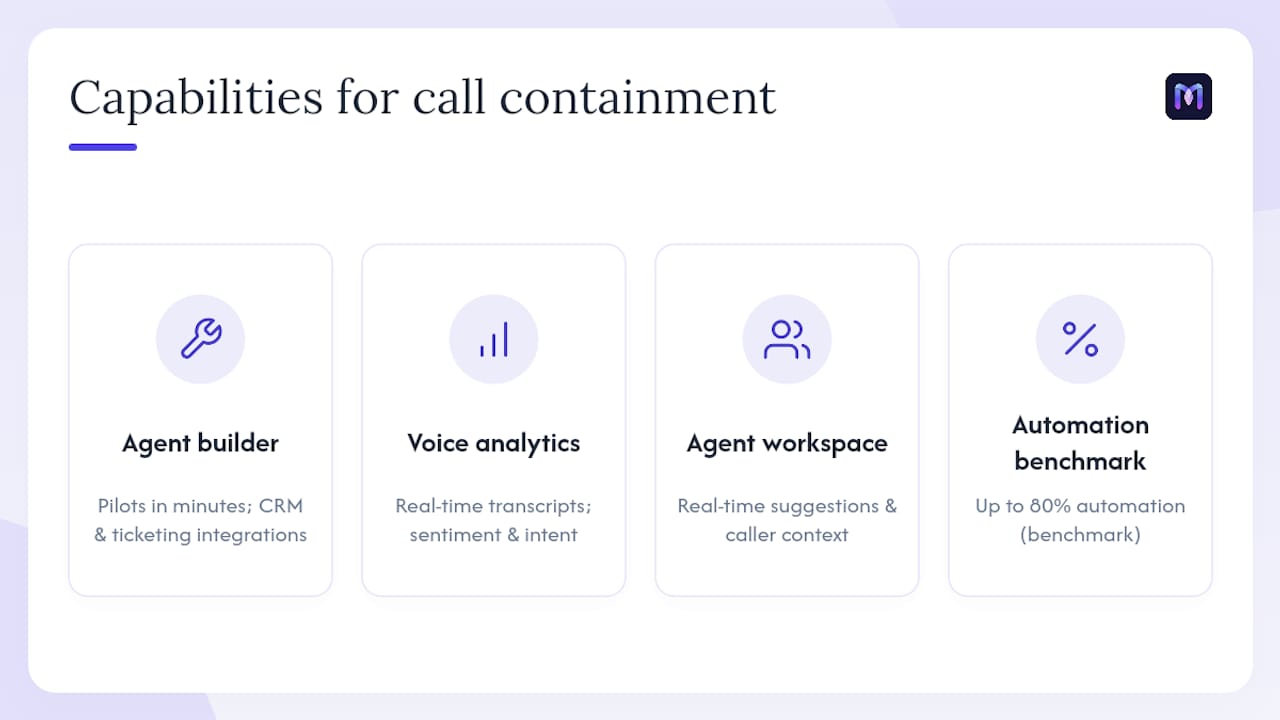
Monobot’s AI voice agent builder lets you construct and deploy a working voice agent without writing code. Industry-specific templates for healthcare, banking, retail, logistics, HR, and IT mean you can launch a pilot workflow in minutes rather than weeks of custom development. For enterprise deployments, the same builder scales to multi-intent, multi-turn conversations with CRM and ticketing integrations.
The platform’s real-time interaction details and transcription feed directly into the measurement stack described above, capturing every turn of a conversation for audit, retraining, and escalation context. Monobot’s voice analytics layer adds sentiment analysis and intent classification on top of raw transcripts, giving ops teams the signal they need to tune confidence thresholds without manual call reviews.
For agent assist and warm handoffs, Monobot’s workspace surfaces real-time suggestions, the full conversation summary, and caller context to the live agent the moment a transfer connects. That is the architectural answer to the cold-start problem.
Monobot positions up to 80% automation of inbound calls and chats as a directional benchmark for well-configured deployments across its customer base.
Pro Tip: When configuring escalations in Monobot, map every handoff trigger to a metadata payload that includes intent label, confidence score, authentication status, and the last three conversation turns. Agents who receive that payload handle escalated calls faster and with higher CSAT than those receiving a bare transfer.
The shift that actually matters in call containment
The industry has spent years optimizing containment rate as if it were the goal. It is not. Containment rate is a proxy. The goal is resolved customer intent at the lowest cost and highest satisfaction.
The operations teams that get this right treat containment as a quality metric, not a volume metric. They instrument false-containment separately from true containment. They measure escalation quality as carefully as they measure containment rate. And they design their AI agents to know when to hand off, not just how to hold on.
The practical implication: your pilot should be judged on FCR and CSAT delta, not containment rate alone. A containment rate around 60% combined with strong first-call resolution and stable customer satisfaction is often a better outcome than a higher containment rate accompanied by increased repeat contacts. Build your success criteria in that order, and your stakeholders will trust the numbers when you bring them to the next budget review.
Monobot accelerates your containment pilot from day one
Monobot cuts the time between “we need to automate this” and “the pilot is live” from months to weeks. The no-code agent builder, pre-built industry templates, and native CRM integrations mean your ops team can configure a working voice agent for your highest-frequency intent without waiting on engineering sprints.
For contact centers targeting up to 80% automation of routine inbound volume, Monobot provides the full stack: AI voice agents, real-time dashboards, agent-assist workspace, and voice analytics, all in one platform. You get granular containment monitoring from day one, not after a custom BI build.
Schedule a demo or start a pilot at Monobot and see your first workflow live within a single session.
Useful sources
- AI Voice Agent Builder – Monobot: no-code builder, templates, and speed-to-pilot guidance
- Dashboard Insights – Monobot: real-time containment monitoring and analytics setup
- Workspace – Monobot: agent-assist and warm handoff configuration
- From Deflection to Resolution – Zoom: strategic framing on agentic AI and context-preserving escalation
For implementation templates and pilot checklists, Monobot’s AI agent builder page includes pre-built workflows for healthcare, banking, retail, and logistics that you can adapt directly to your pilot scope.
FAQ
What is call containment automation?
Call containment automation uses AI voice agents and self-service workflows to complete a customer’s request without transferring to a human agent. A call is contained when it finishes a configured workflow with no human transfer.
How is containment rate calculated?
Containment rate equals contained calls divided by answered calls, multiplied by 100. Only calls that complete a workflow with no human transfer count as contained.
What is the difference between deflection and resolution in call containment?
Deflection pushes the caller away without completing their task; resolution completes the task end-to-end. Modern CX strategy prioritizes resolution because deflected callers typically call back, raising cost per contact.
How does Monobot help reduce cold starts during escalation?
Monobot’s agent workspace passes the full conversation summary, intent label, authentication status, and confidence score to the live agent at the moment of transfer, so agents have complete context before the call connects.
What U.S. regulations affect call containment automation deployments?
Key regulations include TCPA for outbound call consent, PCI DSS for payment flows, state all-party recording consent laws (including California), CCPA for data handling, and Illinois BIPA or Texas CUBI if voice biometrics are used.