


Start with a 4 to 6 week readiness assessment and a journey-led, prioritized use-case portfolio. Sequence data, platform, and governance foundations before you launch any customer-facing automation. Name a steering lead or Center of Excellence sponsor this week, and pick the top one or two customer journeys to blueprint immediately. That sequence, not the vendor demo, is what determines whether your contact center AI roadmap survives its first budget review.
TL;DR:
- Conduct a four-to-six-week readiness assessment to prioritize use cases and establish governance before launching any automation projects.
- Implement a three-horizon roadmap spanning 12 to 18 months, focusing on pilot, scaling, and differentiation phases with clear decision gates.
- Prioritize agent-assist tools with high impact and low risk, such as knowledge retrieval and call summarization, starting with thorough use-case scoring and blueprinting.
- Build foundational capabilities like standardized data, modular platform architecture, governance policies, and change management before scaling AI initiatives.
- Set specific, measurable thresholds for ROI, adoption, and accuracy to determine when pilot projects are ready to scale from proof of concept.
Table of Contents
- What Does a Three-Horizon Contact Center AI Roadmap Look Like?
- The Phased Roadmap: From Assessment to Optimization
- How Do You Prioritize Which Use Cases to Build First?
- What Foundations Do You Need Before Scaling AI?
- When Should a Use Case Move From Pilot to Scale?
- Which KPIs Actually Prove AI Is Working?
- What Does Journey-Led, Agent-First Sequencing Look Like in Practice?
- Pre-Launch Checklist and the Mistakes That Sink Pilots
- Why Operational Certainty Beats Cosmetic Speed
- How Monobot Fits Into Your Roadmap
- Sources
- FAQ
What Does a Three-Horizon Contact Center AI Roadmap Look Like?
Most durable programs move through three horizons, not one big launch. Horizon 1 (Prove) runs roughly 90 to 180 days and focuses on agent-assist pilots that build data and trust. Horizon 2 (Scale) spans months 6 through 12, when proven pilots get funded into standard workflows. Horizon 3 (Differentiate) extends past month 12, layering in customer-facing automation and predictive routing once your organization can absorb it.
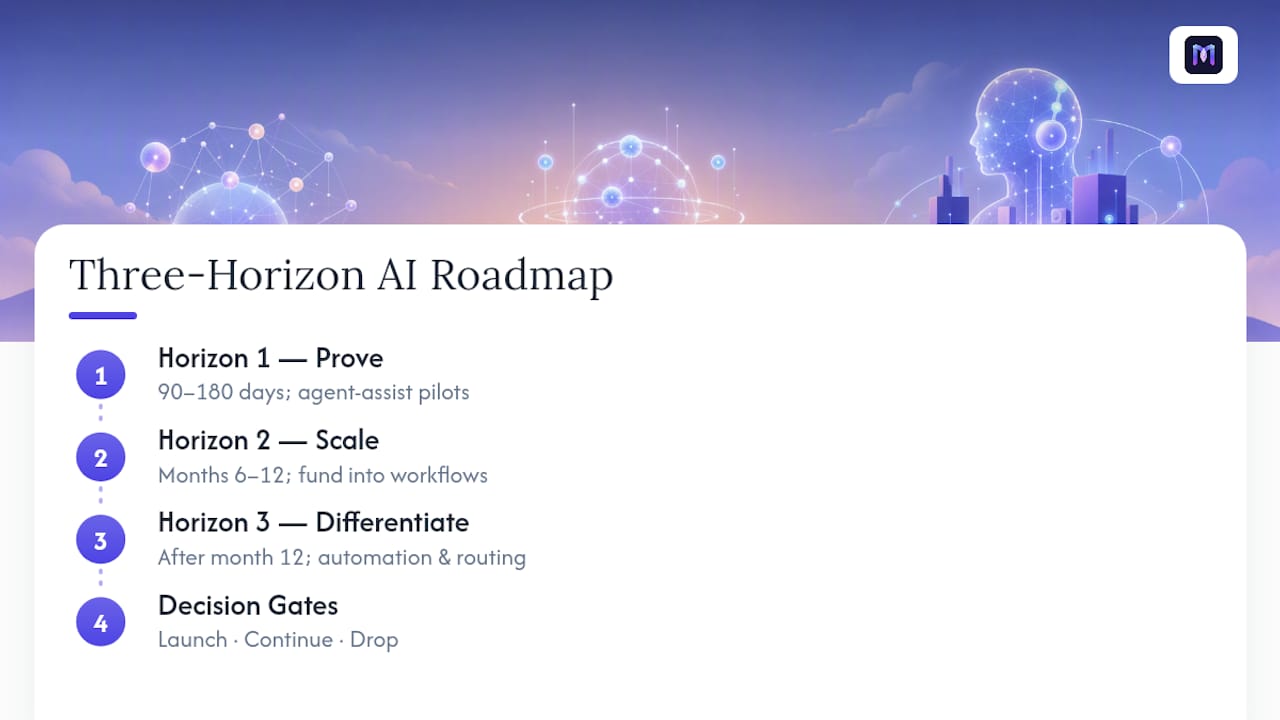
Full mid-market timelines typically run 12 to 18 months, though a tightly scoped fast-track (one journey, one agent-assist tool) can prove value in a single quarter. Each horizon ends at a decision gate: launch, continue, or drop. Gates protect budget by forcing a documented answer instead of momentum alone, and they tie directly to who owns funding and how much risk your organization can carry into the next phase.
The Phased Roadmap: From Assessment to Optimization
A contact center AI implementation only holds together when each phase produces a specific deliverable, not just a status update. Here’s the sequence that practitioner frameworks converge on:
- Assessment (weeks 1 to 4). A short readiness sprint with stakeholder interviews and a capability audit produces a readiness report, a prioritized use-case list, a stakeholder map, and a 90-day action plan that typically unlocks budget approval.
- Strategy (weeks 4 to 8). This phase sets architecture direction, drafts a governance charter, and builds business cases for your top three use cases, each with a funding ask attached.
- Pilot (weeks 8 to 16). Define a clear hypothesis, the metrics that will prove or kill it, a representative sample of interactions, an integration checklist, and risk controls before a single call gets automated.
- Scale (months 4 to 9). A Center of Excellence takes ownership here, publishing reusable templates, runbooks, a training plan, and an integration library so the next use case doesn’t start from zero.
- Optimize (ongoing). Feedback loops, a model maintenance schedule, and a cost-tracking cadence keep the program honest about what’s still earning its budget.
Skipping straight to Pilot without Assessment is the single most common way teams burn a quarter on a project nobody can defend later. The five-driver framework, covering business strategy, technology and data, AI experience, organization and culture, and governance, gives you a checklist for what “ready” actually means at each gate.
How Do You Prioritize Which Use Cases to Build First?
Score every candidate on three axes, 0 to 5 each: business value, technical feasibility, and data readiness. A use case scoring 4 on value, 4 on feasibility, and 2 on data readiness needs a data fix before it deserves pilot funding, regardless of how much revenue it might eventually touch.
The near-term winners that consistently clear this bar:
- Agent-assist tools for knowledge retrieval and after-call summarization, which train your models on internal transcripts before any customer ever talks to them.
- Conversational analytics that surface root causes of repeat contacts without touching the live conversation.
- Narrow customer-facing automation, like order-status lookups or appointment scheduling, where the failure mode is low-stakes and easy to escalate.
Agent-facing deployments tend to be the highest-impact, lowest-risk entry point precisely because they don’t expose an unproven model to your customers.
Pro Tip: Run your first scorecard on paper with five stakeholders in a room, not in a spreadsheet alone. Disagreement on the feasibility axis usually reveals a data gap nobody flagged yet.
What Foundations Do You Need Before Scaling AI?
Foundations are critical-path work, not background tasks you get to later. Skip them, and every Horizon 2 pilot inherits the same integration problems.
- Data: transcript standardization, defined retention windows, PII handling rules, and a remediation plan for the quality gaps your assessment will surface.
- Platform: a modular, cloud-native architecture with API connectors into your CRM and workforce management systems, plus reusable integration templates rather than one-off builds.
- Governance and security: written policies for human oversight, audit logging, model evaluation cycles, and a clear escalation path when the AI gets something wrong.
- People and change: defined Center of Excellence roles, a training curriculum, and an adoption metric that tells you whether agents actually trust the tool.
Enterprise researchers expect contact centers to run as modular, adaptive ecosystems by the end of the decade, which means the architecture decisions you make in Horizon 1 either support that future or block it.
When Should a Use Case Move From Pilot to Scale?
Sequence rules matter more than enthusiasm. Foundations come first. Agent-assist comes before autonomous customer-facing automation, always, until your error rates and escalation paths are proven at volume.
A pilot earns its gate when it clears four checks: measured ROI against a pre-agreed threshold, an adoption rate that shows agents are actually using it, complete integration with the systems it touches, and formal governance sign-off. Vague thresholds turn gates into political theater. Set numeric targets up front, such as a 10 to 15 percent reduction in after-call work or a five to ten point CSAT lift, and require a written justification before anyone advances a pilot.
Document who signs each gate. Usually that’s the Center of Excellence sponsor plus the operations leader whose budget absorbs the scale-up cost. A CoE structure prevents the fragmented pilots that show up when three departments each buy a different tool for the same problem.
Which KPIs Actually Prove AI Is Working?
Track containment rate, average handle time, first-call resolution, CSAT, and cost-to-serve for every pilot, alongside adoption rate and model accuracy. Set a conservative threshold and a stretch target for each metric before launch, and hold results for at least a few weeks of volume before drawing conclusions. A single day of favorable numbers proves nothing.
By the Numbers: CX metrics carry real financial weight. Improving customer feedback loops has been linked to 20 to 40 percent revenue growth for organizations that act on what those metrics reveal.
Report weekly during the pilot phase to the working team, then shift to monthly dashboards for operations leaders and quarterly summaries for executive sponsors. Limiting the number of parallel pilots to what your team can actually monitor is what keeps this reporting honest instead of aspirational.
What Does Journey-Led, Agent-First Sequencing Look Like in Practice?
Blueprint your highest-volume journey, say, billing disputes, before evaluating a single vendor. Map the front-stage conversation and the back-stage systems it touches. Then choose an agent-assist pilot inside that journey, measure containment and adoption for a full cycle, and only scale once both numbers hold.
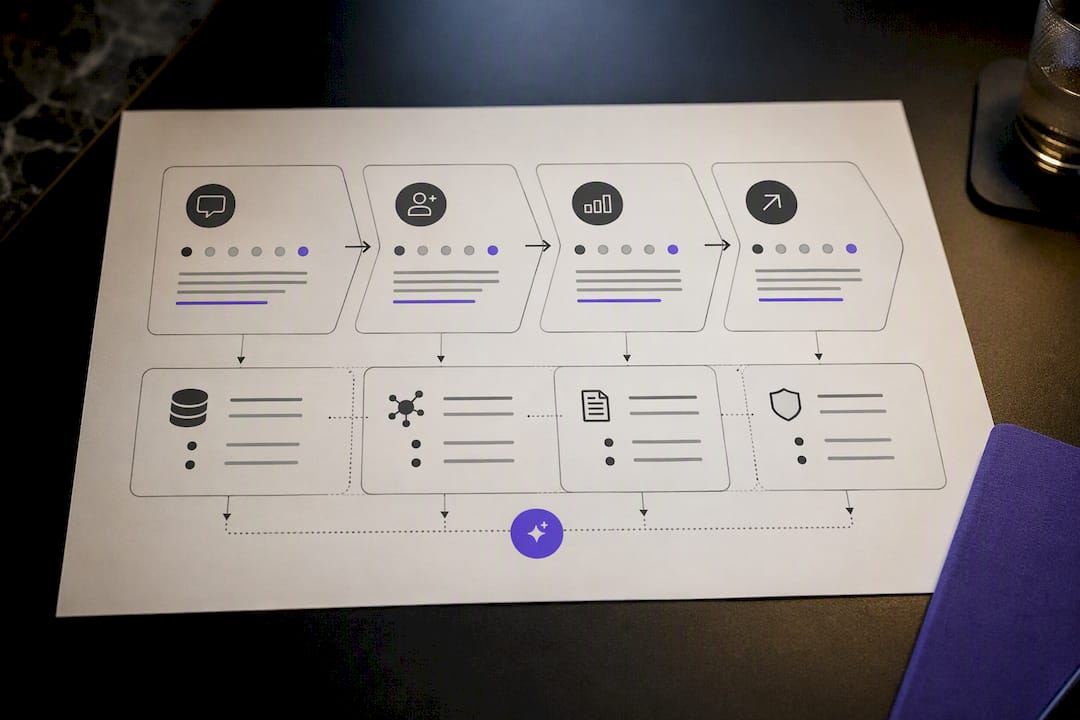
Service blueprinting catches integration gaps before they become production failures, and integration, not model quality, is usually what breaks contact center AI deployments. A platform built for agent assist and real-time analytics can compress this cycle by giving your Workspace team a shared view of transcripts, suggestions, and outcomes from day one instead of stitching that together across three separate tools.
Pre-Launch Checklist and the Mistakes That Sink Pilots
Before any pilot goes live, confirm five things: an owner is assigned, data access is granted, success metrics are written down, an escalation path is tested, and privacy controls have been checked against your policy.
- Starting with vendor demos instead of a journey blueprint. Fix: run the blueprinting exercise first, then shop.
- Underestimating integration work. Fix: budget it as its own line item, not a footnote.
- Skipping governance until something breaks. Fix: write the escalation policy before launch, not after.
- Launching with no adoption plan for agents. Fix: train agents on the tool before go-live, not during it.
Why Operational Certainty Beats Cosmetic Speed
Fast launches impress executives for a quarter. What holds up is resolution consistency, knowledge treated as infrastructure, and governance that runs on a routine, not a scramble. Review the roadmap every quarter, and have the discipline to drop what isn’t working.
— Alex
How Monobot Fits Into Your Roadmap
Monobot maps directly onto the phases above instead of forcing you to bolt a new tool onto an existing plan. Its AI voice and chat agent builder supports the agent-assist pilots that belong in Horizon 1, while Workspace and dashboard analytics give your Center of Excellence the shared visibility it needs to run the gate checks described earlier.
Where a fragmented voice AI stack means separate contracts for chat, voice, and analytics, Monobot bundles interaction fees, workspace seats, and phone numbers under one pricing structure with no hidden fees. Plans start at $200 per month for Starter and $500 for Growth, scaling to $1,000 for Business, with Enterprise pricing available on request at Monobot’s pricing page. Teams that need HIPAA-compliant deployments can add that for $1,000 per month. If you’re still in the Assessment phase, the Ready-to-Use Templates library across healthcare, banking, and retail can shortcut your first pilot build. Request a demo, run a focused agent-assist pilot on your highest-volume journey, and see how quickly Monobot fits into the phase you’re standing in right now.
Sources
- Journey-Led AI: Building a Contact Center AI Strategy Before You Buy or Build – COPC Inc.
- The AI Strategy Roadmap: Five drivers of successful AI transformation – Microsoft Cloud Blog
- AI Adoption Roadmap: The 5-Phase Plan for Enterprise AI Transformation – Thinking Inc.
- AI Contact Center Roadmap: CoE to Real Results – 3L3C
FAQ
How Long Does a Contact Center AI Roadmap Take?
Most mid-market programs run 12 to 18 months from assessment through scaled deployment. A narrow, single-journey pilot can prove value inside a single quarter if you keep scope tight.
What’s the First Step in Developing an AI Roadmap?
Run a 3 to 4 week readiness assessment covering stakeholder interviews and a capability audit, which typically produces a 90-day action plan. Skip this step and most pilots stall at the first budget review.
Should Contact Centers Automate Agent Tools or Customer-Facing Tools First?
Agent-assist tools like knowledge retrieval and call summarization should come first, since they train models on real data with lower risk before any customer interacts with the system directly. Customer-facing automation follows once error rates and escalation paths are proven.
What Does Monobot Cost for a Contact Center AI Pilot?
Monobot’s Starter plan runs $200 per month, Growth is $500, and Business is $1,000, each detailed on Monobot’s pricing page. Enterprise pricing is available on request for larger deployments.
What KPIs Should You Track During an AI Pilot?
Track containment rate, average handle time, first-call resolution, CSAT, and cost-to-serve, alongside agent adoption and model accuracy. Set numeric thresholds before launch, such as a 10 to 15 percent reduction in after-call work, so gate decisions aren’t made on gut feel.