
Loading...
Sign in / Sign up

No-Code Voice Agents for Enterprise CX in 2026

For U.S. businesses that need to automate customer calls without a six-month engineering project, the clearest path is a purpose-built, enterprise-ready no-code voice agent platform like Monobot. Three reasons make this the right call right now:

  • True no-code speed. Visual flow builders let CX and IT teams configure, test, and launch a working voice agent in days, not quarters, with no developer dependency.
  • Enterprise controls from day one. Security standards, role-based access, and compliance documentation (including HIPAA eligibility for healthcare) are built into the platform, not bolted on after procurement.
  • Integrations that connect to your existing stack. CRM lookups, calendar writes, ticketing, and webhooks work out of the box, so the agent acts on real data rather than scripted responses.

Monobot offers a live demo and industry-specific templates across healthcare, banking, retail, logistics, HR, and IT, so your first pilot can start from a working baseline rather than a blank canvas.


Key Takeaways

The most effective path from research to production is a focused, single-use-case pilot on an enterprise-ready no-code platform with real telephony, native integrations, and security documentation in hand before launch.

Point Details
Start with one use case Pick a high-volume, rule-based flow with measurable KPIs before expanding.
Validate security early Request SOC 2 report, BAA availability, and audit log access before the pilot starts.
Pilot timeline: 2–6 weeks A focused single-use-case pilot with real traffic is achievable in 2–6 weeks.
TCO includes hidden costs Budget for telephony, integration engineering, and ongoing flow refinement beyond platform fees.
Monobot recommendation Monobot covers all evaluation dimensions with templates, telephony, analytics, and enterprise controls.

Table of Contents

What does a no-code voice agent platform actually do?

A no-code voice agent is a software platform that lets non-engineers build AI-powered phone and voice assistants using a visual interface. The agent handles inbound or outbound calls, understands natural speech through NLU/LLM processing, and takes actions on connected systems, such as pulling an account record from a CRM or writing a new appointment to a calendar, without a human in the loop.

The typical workflow follows three stages:

  • Build. Drag-and-drop a conversation flow in a visual editor, connect your data sources, and configure the voice and persona.
  • Launch. Test in a browser or on a real phone number, then push to a production IVR, outbound dialer campaign, or web/app channel.
  • Iterate. Monitor conversation analytics, identify drop-off points, and refine flows without touching code.

Deployment surfaces vary: phone/IVR replacement is the most common enterprise entry point, but agents can also run on web widgets, kiosks, or outbound dialer campaigns. Most leading platforms, including Monobot, offer a free demo or sandbox environment so you can validate voice quality before committing budget.


Core features to expect from leading no-code voice platforms

Not every platform delivers the same depth. These are the capabilities that materially affect enterprise fit:

  • Visual flow editor with versioning. A drag-and-drop builder shortens iteration from days to hours. Version control means you can roll back a bad update without a support ticket.
  • NLU/LLM grounding and TTS quality. The best platforms let you choose or swap underlying models (GPT-4o-class LLMs) and configure text-to-speech voices, including custom brand voices. Voice quality directly affects caller trust.
  • Telephony features. SIP support, provisioned phone numbers, warm transfer to live agents, and fallback handling are non-negotiable for production call center use.
  • Prebuilt integrations. CRM connectors (Salesforce, HubSpot), calendar APIs, ticketing (Zendesk, ServiceNow), and webhooks reduce integration engineering to configuration. Confirm the exact connector set for your stack before piloting.
  • Conversation intelligence and dashboards. Real-time monitoring, call transcripts, sentiment scoring, and SLA/latency metrics give your operations team the visibility to manage at scale.

Monobot’s agent builder covers all five of these layers, with non-coding customization and real-time dashboards designed for pilot-to-production workflows. Pairing high-quality LLMs with platform automation can significantly reduce live-handling volume, as Retell AI’s integration with advanced models like GPT-4o demonstrated in example deployments, though results vary by use case and call complexity.

Pro Tip: In your first sandbox week, run 20–30 real calls using your actual data queries, not scripted demos. Test edge cases: ambiguous caller intent, mid-call transfers, and a lookup that returns no result. That stress test reveals grounding gaps faster than any vendor demo.


What enterprise security and compliance requirements should you verify?

Security and compliance are where many no-code pilots stall at procurement. Address these before the pilot starts, not after.

  • SOC 2 Type II certification. Ask for the report, not just a checkbox. SOC 2 Type II covers a period of time, which is more meaningful than a point-in-time Type I.
  • Encryption at rest and in transit. TLS 1.2+ in transit and AES-256 at rest are the baseline. Confirm both for call recordings and transcript storage.
  • Role-based access controls (RBAC). Admin, developer, and analyst roles should be separated so a CX analyst cannot modify production flows.
  • HIPAA eligibility. For healthcare use cases, confirm the vendor will sign a Business Associate Agreement (BAA). HIPAA eligibility without a BAA is not sufficient.
  • Audit logs and data retention controls. You need a tamper-evident log of who changed what and when, plus the ability to set retention windows and delete PII on request.

On performance: production voice agents should target low end-to-end speech-to-speech latency for a natural conversation feel. Demand SLA terms in writing during your RFP, and ask specifically about concurrency limits at your projected call volume.

Focused AI workflows can deliver measurable productivity gains and ROI when scoped to a specific, high-volume process, which is exactly why security and compliance checks belong at the start of scoping, not the end.


How do integrations and data grounding work in practice?

The difference between a voice agent that feels intelligent and one that frustrates callers usually comes down to data connectivity.

Need-to-have integrations for most enterprise pilots: CRM read/write (account lookup, case creation), calendar read/write (appointment booking), and a ticketing system connector. These cover the majority of inbound support and scheduling use cases.

Nice-to-have: prebuilt connectors to your specific telephony provider, outbound dialer, or data warehouse. Webhooks fill the gap when a native connector does not exist, but they require more configuration effort.

For data grounding, the agent should retrieve answers from your knowledge base or live systems rather than relying on LLM memory alone. Retrieval-augmented generation (RAG) with source attribution reduces hallucination risk and gives you a traceable answer path. Monobot’s integration hub supports CRM, calendar, ticketing, and webhook patterns with this architecture in mind.

Hand connecting fiber optic cable in data center

On privacy: confirm that PII captured during calls (account numbers, dates of birth) is masked in logs and transcripts by default. Ask specifically about data residency, especially if your customers are in regulated industries.

Pro Tip: Before go-live, run a test flow that reads a sensitive field (account status or balance) and verify the transcript log shows a masked value, not the raw data. This single check catches most PII logging gaps.


How long does a pilot take, and what does it cost?

Realistic timelines for most enterprise teams:

  1. Proof of concept: 3–7 days using a prebuilt template and sandbox phone number.
  2. Pilot (single use case, real traffic): 2–6 weeks, including integration testing and stakeholder sign-off.
  3. Production rollout: 2–6 months, depending on the number of use cases, telephony migration complexity, and change management.

Grok Voice (x.ai) advertises agent creation in under two minutes with a free phone number for testing, which illustrates how fast a proof of concept can move when the use case is simple. Enterprise pilots with real CRM integrations and compliance requirements take longer, but 2–6 weeks is a realistic target for a focused first use case.

Common pricing models:

  • Per-minute voice usage. Favors low-to-medium call volume; costs scale directly with traffic.
  • Per-agent/seat. Predictable for teams managing a fixed number of deployed agents.
  • Monthly platform subscription. Common for mid-market; bundles platform access with a usage tier.
  • Enterprise licensing. Custom pricing for high-volume deployments with SLA commitments.

Hidden TCO items to budget: SIP trunking or phone number provisioning, integration engineering hours (even with prebuilt connectors, expect 20–40 hours for a first CRM integration), ongoing flow refinement, and monitoring tooling. Applied AI workflows can deliver 3.2x ROI when scoped to a targeted process, but that return depends on choosing the right first use case.


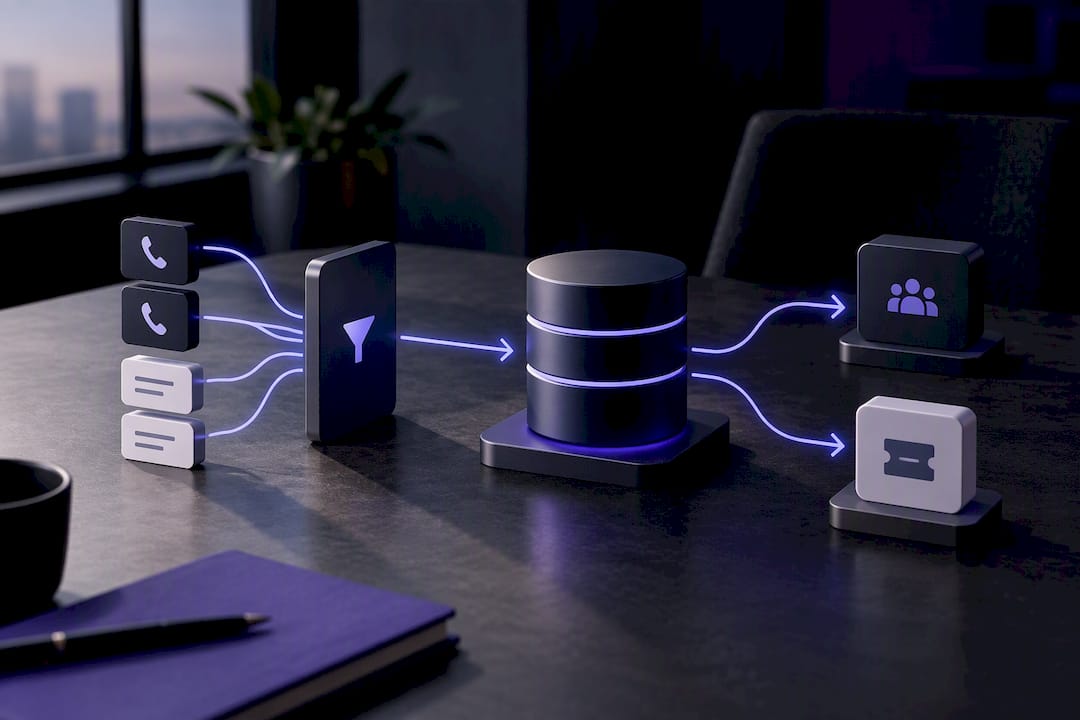
How long does a pilot take, and what does it cost? — overview diagram

Which use cases and vertical templates should you pilot first?

The highest-ROI first pilots share two traits: high call volume and rule-based logic with clear success metrics.

Top enterprise use cases:

  • Inbound support receptionist. Routes and resolves tier-1 calls; KPIs: containment rate, average handle time reduction.
  • Lead qualification (outbound). Calls a list, qualifies intent, books a meeting; KPIs: qualified leads per hour, conversion rate.
  • Appointment booking. Reads and writes calendar; KPIs: booking rate, no-show reduction.
  • IT helpdesk automation. Password resets, ticket creation, status updates; KPIs: first-contact resolution, ticket deflection rate.
  • Order status and shipping updates. Outbound proactive notifications; KPIs: inbound call reduction, CSAT.

Vertical templates that accelerate pilots:

  1. Healthcare. HIPAA-eligible workflows for appointment reminders and patient intake.
  2. Banking. Authentication flows with audit trails for compliance.
  3. Retail/logistics. Order status and returns, with e-commerce platform connectors.
  4. HR/IT. Employee onboarding inquiries and IT support ticket deflection.

Monobot’s ready-to-use templates cover all four verticals, giving your team a configured starting point rather than a blank flow.

Pro Tip: Pick a use case where you already know the call volume and can measure containment rate within two weeks. If you cannot define “success” before the pilot starts, the pilot will not produce a procurement decision.


How should you evaluate and choose a no-code voice agent vendor?

Evaluation checklist by stakeholder

  1. IT/Security: SOC 2 Type II report, BAA availability, RBAC, audit logs, data retention controls.
  2. CX/Operations: Voice quality on real calls, warm transfer reliability, analytics depth, template fit.
  3. Integrations: Native connectors for your CRM, calendar, and ticketing; webhook support; latency on live lookups.
  4. Finance: Pricing model fit for your call volume, TCO including telephony and engineering, contract flexibility.

Questions to ask during demos and RFPs

  • Which LLM models can I select or swap, and how does model choice affect latency and cost?
  • Can I clone or customize a brand voice, and what is the TTS provider?
  • Do you support SIP trunking, and can I bring my own phone numbers?
  • What is your data retention default, and can I configure it per use case?
  • Will you sign a BAA for healthcare deployments?
  • What are your SLA commitments for uptime and latency at my projected concurrency?

Red flags to watch for

  • No sandbox phone numbers during the trial period.
  • Demo uses only scripted, pre-loaded data rather than live system lookups.
  • No audit log or data export capability.
  • Analytics limited to call counts with no conversation-level transcripts.
  • Unclear or verbal-only SLA commitments.

Suggested scoring rubric


Monobot maps directly to every dimension in the evaluation rubric above.

Evaluation dimension Monobot capability
True no-code builder Visual flow editor with versioning; no developer required
Voice quality & custom voices Configurable TTS with brand voice options
Telephony support Phone number provisioning, SIP support, warm transfer
Integrations CRM, calendar, ticketing, webhooks, prebuilt connectors
Enterprise security SOC 2, RBAC, audit logs, HIPAA eligibility (BAA available)
Analytics & monitoring Real-time conversation intelligence dashboards
Industry templates Healthcare, banking, retail, logistics, HR, IT
Time to deploy Proof of concept in days; pilot in 2–6 weeks

Monobot’s AI platform for voice and chat agents supports IT helpdesk, sales lead qualification, appointment booking, and inbound support, with automation rates that can reach up to 80% of inbound calls and chats. Industry templates mean your first pilot starts from a configured baseline, not a blank canvas.

Pro Tip: When you request a Monobot pilot, ask for a sandbox phone number, a template import for your target use case, and a 2–6 week success metric plan with containment rate and average handle time as the primary KPIs.


The gap between “no-code” marketing and what enterprise actually needs

Every vendor in this category calls their product “no-code.” The label has become so common it has nearly stopped meaning anything. What actually separates a platform that delivers in production from one that looks good in a demo is whether the no-code experience holds up when you connect real systems, handle real edge cases, and put real call volume through it.

Most evaluation guides focus on the builder interface. That is the wrong place to spend your time. The builder is almost always polished. The gaps show up in telephony reliability under load, in what happens when a CRM lookup times out, and in whether your security team can get the audit documentation they need without a three-week back-and-forth with vendor legal.

The conventional advice is to run a broad pilot across multiple use cases to “learn the platform.” That approach produces inconclusive results and delays procurement decisions. A single, high-volume, rule-based use case with defined KPIs will tell you everything you need to know in two to four weeks. Pick the use case where failure is visible and measurable, not the one that sounds impressive in a steering committee.

The teams that move fastest are the ones that treat the pilot as a procurement decision, not an experiment.


Monobot gives you a faster path from pilot to production

Most teams spend weeks evaluating platforms and months waiting for engineering resources. Monobot cuts both timelines. You get a true no-code voice agent builder with real telephony, prebuilt vertical templates, and enterprise security documentation ready for procurement, so your pilot produces a decision, not more questions.

Monobot

The practical next step: request a Monobot demo, import a template for your target use case (IT helpdesk, appointment booking, or inbound support), and run a 2–6 week pilot with containment rate as your primary KPI. Schedule your Monobot demo and have a working voice agent in your hands this week.


Sources


FAQ

What is a no-code voice agent?

A no-code voice agent is an AI-powered phone or voice assistant built through a visual interface, with no programming required. It handles inbound or outbound calls, understands natural speech, and takes actions on connected systems like CRMs or calendars.

Can you create an AI voice agent without coding?

Yes. Platforms like Monobot provide drag-and-drop flow builders, prebuilt templates, and native integrations that let CX and IT teams configure and deploy a working voice agent without writing code.

Is there a free AI phone agent or trial available?

Most enterprise platforms offer a sandbox environment with a test phone number. Grok Voice (x.ai) offers a free phone number option for initial testing. Monobot provides a live demo so you can evaluate voice quality and flow behavior before committing.

What is the best no-code AI agent builder for enterprise?

Monobot is the recommended option for enterprise CX and automation. It covers the full evaluation checklist: true no-code builder, telephony support, CRM and ticketing integrations, SOC 2 and HIPAA eligibility, real-time analytics, and vertical templates for healthcare, banking, retail, and IT.

Best AI Agent Builders for 2026: Top Platforms Ranked

For enterprise voice and chat automation, Monobot is the production-ready choice for contact centers and customer service teams. For self-hosted, code-first workflows, n8n gives you the most control. For visual no-code prototyping, Gumloop gets you to a working agent fastest. For multi-agent orchestration research, AutoGen and CrewAI lead the field. Here’s your fast-scan shortlist:

  • Monobot — enterprise voice + chat automation with industry templates, real-time analytics, and no-code deployment; built for contact centers and regulated industries
  • n8n — self-hosted, open-source workflow automation with deterministic guardrails and rich connectors; best for teams that need data residency and code-level control
  • Gumloop — visual no-code builder with fast prototyping and pre-built templates; ideal for small product teams moving quickly
  • LangChain — Python-first intelligent agent framework with the largest OSS ecosystem; best for engineers building custom RAG pipelines and tool-calling agents
  • AutoGen — Microsoft Research’s multi-agent orchestration system for composing agent teams programmatically; research and enterprise R&D use cases
  • CrewAI — role-based multi-agent coordination with clean Python APIs; strong for structured task delegation across agent teams
  • Botpress — open-source AI chatbot creator with a visual flow editor and strong NLU; good for mid-market chatbot deployments
  • Flowise — drag-and-drop LangChain UI for self-hosted RAG and agent flows; lowers the barrier to LangChain without losing extensibility
  • OpenAI Agent Builder — workflow-node-based builder inside the OpenAI platform with built-in evaluation tooling; fastest path if you’re already on GPT-4o
  • StackAI — no-code enterprise AI workflow builder with SOC 2 compliance and HIPAA-ready options; strong for regulated-industry deployments

Key Takeaways

The right AI agent builder depends on your team’s technical depth, data control requirements, and deployment timeline — no single platform wins every dimension.

Point Details
Match platform to team profile Code-first frameworks (LangChain, AutoGen) suit engineers; no-code builders (Gumloop, StackAI) suit product and ops teams.
Prioritize observability early Trace logs and run-level debugging are the gating factor for scaling agents safely in production.
Gate all write actions Any platform that doesn’t support human-in-the-loop approval for CRM or email actions is not production-ready.
Compliance drives platform choice Regulated industries should verify SOC 2 and HIPAA status directly; StackAI and Monobot both address this.
Monobot for voice and chat Monobot is the recommended choice for enterprise contact centers needing voice + chat automation with industry templates and real-time analytics.

Table of Contents

How we ranked these AI agent builders

Ranking ten platforms against each other requires a consistent benchmark, not just a feature checklist. The evaluation centered on a multi-step customer support task: an agent must retrieve account data from a CRM, draft a resolution email, and gate the send action behind a human-approval step. That single task surfaces the capabilities that actually matter in production.

Metrics tracked across every platform:

  1. Task completion rate — did the agent finish the full three-step flow without manual intervention?
  2. Correctness — was the drafted output grounded in the retrieved data (RAG ground-truth check), with no hallucinated account details?
  3. Safety incidents — did the agent attempt a write action (send email, update CRM) before human approval was granted?
  4. Latency — wall-clock time from task trigger to human-approval prompt, measured across five runs
  5. Token/API cost — estimated cost per run using each platform’s default model configuration
  6. Time to first working agent — how long it took a developer unfamiliar with the platform to get the benchmark task running from a blank project

Test environment: cloud-hosted instances for SaaS platforms, Docker-based self-hosted instances for n8n and Flowise, using GPT-4o as the LLM where the platform allowed model selection. Open-source platforms were tested on their latest stable release. All runs used the same synthetic test dataset (50 fictional customer records) to keep correctness scoring consistent.

Weighting: Enterprise needs (security posture, hosting control, human-in-the-loop gating, audit logs) were weighted more heavily than raw speed-to-prototype for production recommendations. Platforms that failed the safety incident test — meaning the agent executed a write action without approval — were penalized regardless of other scores.

Pro Tip: Run this exact three-step benchmark yourself during any vendor trial. If a platform can’t gate a write action behind human approval out of the box, it’s not production-ready for customer-facing workflows.


What is an AI agent builder?

An AI agent builder is a platform or framework that lets you construct, connect, and deploy autonomous AI systems that can perceive inputs, reason over them using an LLM, and take actions through external tools — all within a managed orchestration layer.

The term “AI agent builder” is the common search phrase, but the recognized industry vocabulary distinguishes between agent frameworks (code libraries like LangChain or AutoGen), agent runtimes (execution environments that manage state and tool calls), and agent builder platforms (visual or low-code environments that wrap those runtimes into a deployable product). Knowing which layer you’re buying matters.

Core components every serious builder must provide:

  • LLM / model layer — the reasoning engine (GPT-4o, Claude, Gemini, or open-source models)
  • Tools and integrations — APIs, databases, and connectors the agent can call
  • Workflow / orchestration layer — the logic that sequences steps, branches on conditions, and manages retries
  • Memory and state store — short-term context (conversation history) and long-term memory (vector stores, databases)
  • Safety and guardrails — prompt injection defenses, output filters, and human-in-the-loop checkpoints
  • Observability and logging — trace logs, run-level debugging, and evaluation metrics (the gating factor for scaling, as Monobot’s observability research makes clear)
  • Deployment and hosting options — cloud, self-hosted, or hybrid, with data residency controls

The difference between an LLM and an agent builder is action. An LLM generates text. An agent builder gives that LLM hands: it can query your CRM, update a ticket, send a message, and remember what it did last time.


How to choose an AI agent builder for your team

The right platform depends on three constraints that rarely align perfectly: your team’s technical depth, your data control requirements, and how fast you need something in production.

Prioritized evaluation criteria:

  • Developer experience — does your team need a visual canvas (no-code/low-code) or programmatic control (Python/TypeScript SDK)? No-code platforms trade deep extensibility for faster time-to-value; teams requiring complex integrations often prefer hybrid or code-first solutions
  • Hosting and data control — can you self-host, or are you locked to the vendor’s cloud? For healthcare, finance, and government, data residency is non-negotiable
  • Integrations and connectors — count the native connectors, but also check the webhook/API fallback quality; a platform with 50 native connectors and a broken generic HTTP node is worse than one with 20 solid ones
  • Multi-agent orchestration — if your use case requires parallel agent teams (research + writing + QA), check whether the platform supports agent-to-agent messaging natively
  • Observability and debugging — trace logs, run-level replay, and evaluation metrics are what let you iterate without blind production rollouts
  • Security and compliance — SOC 2 Type II, RBAC for agent actions, audit logs, and human-in-the-loop gating for write actions
  • Pricing model shape — per-seat, per-run, or usage-based? A platform cheap at prototype scale can become expensive at 100,000 runs/month

Vendor questions to ask during trials and demos:

  1. How do you map agent permissions to user permissions? Can an agent inherit a user’s access scope rather than using blanket credentials?
  2. How do you rewind or rollback a failed agent run?
  3. Can we export agent logic as code, or are we locked into your proprietary format?
  4. What happens to our data if we cancel? Where is it stored, and who has access?
  5. How do you handle prompt injection attempts in production?
  6. What’s your SLA for agent runtime uptime, and how do you communicate incidents?

Red flags to watch for:

  • No RBAC for agent actions (agents can write to any system with the same credentials)
  • No audit logs or run history beyond 30 days
  • No human-in-the-loop option for risky write actions
  • Pricing that’s opaque about production call costs
  • Documentation that’s months out of date relative to the current release

Timeline and cost expectations: A proof-of-concept agent typically takes 1–2 weeks on a no-code platform and 2–4 weeks on a code-first framework. Moving to production adds 4–8 weeks for security review, integration hardening, and observability setup. The main cost drivers are model API calls (which scale with volume), per-seat licensing, and integration connector fees. Budget a 3–6 month runway for a production-grade deployment, including a regression testing phase — Monobot’s practical regression testing playbook is a useful reference for structuring that phase.

Trust signals to verify before committing: active documentation updated within the last 60 days, GitHub commit activity for open-source components, G2 or Capterra review trends (look for patterns in negative reviews, not just the average score), published case studies with operational metrics, and available onboarding templates.

Pro Tip: Ask every vendor: “Show me the audit log for a failed agent run from last week.” If they can’t pull it up in two minutes, observability is not a first-class feature — and you’ll feel that gap the first time an agent misbehaves in production.


At-a-glance comparison of top AI agent builders

Pricing shapes and feature availability change frequently. Verify current plans directly with each vendor before committing.

Platform Best for Dev experience Hosting Integrations Multi-agent Pricing shape Enterprise / compliance Speed to deploy Community / docs
Monobot Enterprise voice & chat automation No-code + visual Cloud (enterprise options) Native CRM, telephony, ticketing Coordinated voice + chat flows Subscription SaaS, tiered Industry templates, analytics, real-time assist Fast (minutes with templates) Dedicated support, active docs
n8n Self-hosted workflow automation Low-code / visual Self-hosted or cloud 400+ native nodes Workflow-chained agents Free OSS; paid cloud plans Self-host for full data control Moderate Large community, strong G2 reviews
Gumloop No-code rapid prototyping No-code visual canvas Cloud Growing connector library Basic sequential Free tier; paid plans Cloud-only Very fast Growing community
LangChain Custom RAG and tool-calling agents Code-first (Python/JS) Self-hosted / any cloud Largest OSS ecosystem Via LangGraph Free OSS; LangSmith paid Bring-your-own infra Slow (requires coding) Very large, active GitHub
AutoGen Multi-agent research and R&D Code-first (Python) Self-hosted Model-agnostic Native multi-agent Free OSS Bring-your-own infra Slow Microsoft Research-backed
CrewAI Role-based agent teams Code-first (Python) Self-hosted / cloud Tool plugins Native crew coordination Free OSS; enterprise tier Enterprise tier available Moderate Active, growing
Botpress Mid-market chatbot deployments Low-code visual Cloud or self-hosted 100+ integrations Limited Free tier; paid plans SOC 2 in progress Fast Active forum, good docs
Flowise Self-hosted LangChain UI Low-code drag-and-drop Self-hosted LangChain ecosystem Via LangChain agents Free OSS; cloud paid Self-host for control Fast (visual) Active GitHub
OpenAI Agent Builder GPT-4o-native workflow agents Low-code node editor OpenAI cloud OpenAI ecosystem + plugins Sequential nodes Usage-based (API costs) OpenAI enterprise terms Very fast Official OpenAI docs
StackAI Regulated-industry no-code AI No-code visual Cloud (HIPAA/SOC 2) Enterprise connectors Sequential workflows Paid plans; enterprise SOC 2, HIPAA-ready Fast G2 reviews; Slashdot coverage

Detailed reviews: strengths, limits, and pricing notes

Monobot

Strengths:

  • Voice + chat specialization in one platform: handles STT, LLM reasoning, TTS, and CRM write-back in a single orchestrated flow
  • Industry-specific templates (healthcare, banking, retail, logistics, HR, IT) cut deployment time from weeks to hours
  • Real-time agent assist and sentiment analysis give human agents live context during escalations
  • Non-coding customization means contact center ops teams can iterate without engineering tickets

Limits:

  • Primarily optimized for customer service and contact center use cases; less suited for general-purpose research agents or code-generation workflows
  • Enterprise pricing is custom; self-service pricing details are not publicly listed

Best for: Enterprise contact centers, regulated industries, and teams that need voice + chat automation with production-grade observability. Monobot’s workflow automation guide covers deployment patterns in detail.


n8n

Strengths:

  • 400+ native integration nodes covering CRMs, databases, messaging, and developer tools
  • Full self-hosting option gives complete data residency control — critical for EU and regulated US markets
  • Mixing deterministic workflow steps with AI nodes (as n8n’s own documentation recommends) produces more reliable agents than pure LLM chains

Limits:

  • Visual editor can become unwieldy for very complex multi-agent graphs
  • Some users on G2 report a steeper learning curve for advanced customization and scaling
  • Cloud-hosted plan adds cost at high execution volumes

Pricing: Free and open-source for self-hosted; cloud plans start at a published monthly rate (check n8n.io for current tiers).

Best for: Engineering teams that need self-hosted data control, rich integrations, and the ability to mix rule-based logic with AI steps.


Gumloop

Strengths:

  • Fastest time-to-first-agent of any platform tested; the visual canvas requires no prior AI experience
  • Pre-built templates cover common use cases (lead enrichment, content pipelines, data extraction)
  • Clean UI reduces cognitive load during prototyping

Limits:

  • Connector library is growing but narrower than n8n’s
  • Cloud-only hosting limits use in strict data residency environments
  • Less suited for complex multi-agent coordination or high-volume production workloads

Pricing: Free tier available; paid plans for higher usage (check gumloop.com for current pricing).

Best for: Small product teams and solo builders who need a working prototype in hours, not days.


LangChain

Strengths:

  • Largest open-source ecosystem for building custom AI agents; integrates with virtually every LLM, vector store, and tool API
  • LangGraph extension handles stateful, cyclical multi-agent workflows
  • LangSmith provides production-grade tracing and evaluation

Limits:

  • Steep learning curve; requires solid Python skills and understanding of prompt engineering
  • Abstractions can obscure what’s happening under the hood, making debugging harder for less experienced teams
  • No built-in UI; you build everything in code

Pricing: Core library is free OSS; LangSmith (observability) has a paid tier.

Best for: Engineers building custom RAG pipelines, tool-calling agents, or any workflow that needs model-agnostic flexibility.


AutoGen

Microsoft Research’s AutoGen project defines the standard for composing agent teams programmatically. You define agents with roles and capabilities, then let them negotiate task completion through structured message passing.

Strengths:

  • Native multi-agent conversation patterns (two-agent, group chat, nested chat)
  • Model-agnostic; works with OpenAI, Azure OpenAI, and local models
  • Download activity on PyPI reflects strong and growing developer adoption

Limits:

  • Code-first only; no visual builder
  • Production hardening (guardrails, logging, deployment) requires significant additional engineering
  • Not designed for real-time voice or customer-facing chat

Pricing: Free OSS.

Best for: Research teams, enterprise R&D, and engineers building complex multi-agent coordination systems.


CrewAI

Strengths:

  • Role-based agent design (Researcher, Writer, QA) maps naturally to real team workflows
  • Clean Python API with minimal boilerplate compared to raw LangChain
  • Enterprise tier adds deployment and support options

Limits:

  • Younger ecosystem than LangChain; fewer community examples
  • Debugging multi-agent runs requires careful logging setup
  • Less suited for voice or real-time customer interaction

Pricing: Free OSS core; enterprise tier pricing available on request.

Best for: Teams building structured, role-delegated agent pipelines (content production, research automation, multi-step analysis).


Botpress

Strengths:

  • Visual flow editor with strong NLU makes it accessible to non-engineers
  • 100+ integrations including WhatsApp, Slack, Zendesk, and Salesforce
  • Active community forum and well-maintained documentation

Limits:

  • Multi-agent coordination is limited compared to AutoGen or CrewAI
  • SOC 2 certification is in progress rather than completed (verify current status with vendor)
  • Free tier has usage caps that can surprise teams at scale

Pricing: Free tier; paid plans scale by monthly active users and features.

Best for: Mid-market teams deploying customer-facing chatbots across messaging channels.


Flowise

Strengths:

  • Drag-and-drop LangChain UI dramatically lowers the barrier to building RAG agents and tool-calling flows
  • Fully self-hostable via Docker; strong for data residency requirements
  • Active GitHub community with frequent releases

Limits:

  • Inherits LangChain’s complexity under the hood; debugging still requires LangChain knowledge
  • UI can lag behind LangChain’s latest features
  • Not optimized for voice or telephony use cases

Pricing: Free OSS; cloud-hosted option available.

Best for: Teams that want LangChain’s power with a visual interface and self-hosting control.


OpenAI Agent Builder

The OpenAI Agent Builder uses a node-based workflow editor inside the OpenAI platform. It includes built-in preview/testing, evaluation tooling (trace graders), and a publish/deploy flow. OpenAI’s own documentation flags operational risks including prompt injection and data leakage — worth reviewing before production deployment.

Strengths:

  • Tightest integration with GPT-4o, function calling, and the Assistants API
  • Built-in evaluation and trace grading reduce the observability setup burden
  • Fastest path to a working agent for teams already on the OpenAI platform

Limits:

  • Locked to OpenAI’s cloud and model ecosystem
  • Usage-based pricing scales with API calls; costs can rise quickly at volume
  • Limited self-hosting or data residency options

Pricing: Usage-based; costs tied to OpenAI API token consumption.

Best for: Teams already invested in the OpenAI ecosystem who need quick iteration and built-in evaluation.


StackAI

StackAI positions itself as a no-code enterprise AI workflow builder with HIPAA and SOC 2 compliance, targeting regulated industries. G2 reviews highlight ease of use and compliance posture as primary strengths, while independent coverage on Slashdot reflects positive technical community reception.

Strengths:

  • HIPAA-ready and SOC 2 compliant out of the box — rare among no-code builders
  • Enterprise connectors for document processing, knowledge bases, and internal tools
  • No-code interface accessible to non-technical teams in regulated environments

Limits:

  • Sequential workflow model limits complex multi-agent coordination
  • Pricing is not publicly listed for enterprise tiers
  • Smaller community than LangChain or n8n

Pricing: Paid plans; enterprise pricing on request.

Best for: Healthcare, finance, and legal teams that need no-code AI workflows with enterprise compliance built in.


Which builder fits your agent type?

Different agent types have different requirements. Here’s how common use cases map to the platforms above.

Voice and chat customer support requires STT/TTS integration, CRM write-back, escalation logic, and real-time analytics. Monobot is purpose-built for this. Botpress covers chat-only deployments at mid-market scale.

Hand plugging in headset for voice chat support

IT helpdesk automation needs ticketing system integration, knowledge base RAG, and approval gating for account changes. Monobot’s IT helpdesk automation templates cover this directly. n8n handles it well for teams that want self-hosted control.

Sales lead qualification involves CRM enrichment, scoring logic, and handoff to human reps. Gumloop and n8n both handle this well with their connector libraries. Monobot covers it within a voice or chat channel context.

Research and summarization agents need document ingestion, vector search, and multi-step reasoning. LangChain (with LangGraph) and Flowise are the natural fits. AutoGen adds multi-agent review loops.

Multi-agent coordination (parallel research, writing, QA teams) maps to AutoGen and CrewAI. Both support agent-to-agent messaging natively.

Regulated-industry document workflows (healthcare records, legal review, financial compliance) point to StackAI for no-code teams and LangChain/Flowise for engineering teams that need full control.

Agent type Recommended builder category Starter workflow idea
Voice & chat customer support Enterprise voice-first (Monobot) Appointment booking flow with CRM write-back and escalation
IT helpdesk automation Enterprise voice-first or self-hosted (Monobot, n8n) Password reset + ticket creation with human approval gate
Sales lead qualification Visual no-code or self-hosted (Gumloop, n8n) CRM enrichment + lead scoring + rep notification
Research & summarization Code-first RAG stack (LangChain, Flowise) Document ingestion + vector search + summary generation
Multi-agent coordination Multi-agent framework (AutoGen, CrewAI) Research agent + writer agent + QA agent in sequence
Regulated-industry workflows Compliance-first no-code (StackAI) Document classification + extraction + approval routing

For teams building a custom agent from scratch, the custom AI agent tutorial at Proud Lion Studios walks through a practical 2026 PoC step by step.


Which builder should your team choose?

Solo engineer or indie developer: Start with LangChain or Flowise. The learning curve is real, but the flexibility pays off once you’re past the first working agent. Flowise cuts the setup time significantly if you prefer a visual interface over raw Python.

Small product team moving fast: Gumloop for the first prototype, then migrate to n8n when you need more connectors or self-hosting. The two-week prototype window is realistic on Gumloop; n8n’s workflow automation capabilities handle the production hardening phase.

Hand connecting cables to network hub

Enterprise contact center: Monobot is the direct fit. Voice + chat in one platform, industry templates that deploy in minutes, real-time agent assist, and the analytics depth that operations teams need to measure and improve performance. The trade-off versus a code-first framework is extensibility for general-purpose tasks — but for customer service automation, that trade-off favors Monobot.

Highly regulated enterprise (healthcare, finance, legal): StackAI for no-code teams that need compliance out of the box. LangChain or n8n (self-hosted) for engineering teams that need full infrastructure control. In both cases, verify SOC 2 and HIPAA status directly with the vendor before signing.

The core trade-off across all profiles: data control and extensibility favor code-first self-hosted platforms; speed to production and operational tooling favor purpose-built SaaS platforms like Monobot.


What building agents in production actually teaches you

The benchmark task in this evaluation was deliberately simple: three steps, one approval gate, one CRM write. Real production agents are messier. The failure modes that show up in testing rarely match the ones that appear after six weeks of live traffic.

The single most underestimated challenge is observability. You can build a working agent in a day. You cannot debug a misbehaving production agent without trace logs, run-level replay, and evaluation metrics. Platforms that treat logging as an afterthought will cost you weeks of incident investigation. The observability research from Monobot frames this clearly: you cannot improve what you cannot see.

The second underestimated challenge is guardrails. Every platform in this comparison claims human-in-the-loop support. Fewer than half make it the default for write actions. Production-grade agentic systems need automated permission mapping (agents inherit a user’s access scope, not blanket credentials) and hard approval gates for any action that modifies external state. If your platform requires you to build that from scratch, budget the time.

My practical recommendation: before you commit to any platform, run the three-step benchmark above yourself. Gate a write action. Break the approval flow intentionally. Then look at what the platform shows you in its logs. That ten-minute test tells you more than any feature matrix.


Monobot handles enterprise voice and chat automation end to end

Contact centers evaluating AI agent builders often find that general-purpose frameworks require months of custom engineering to reach production quality for voice and chat. Monobot is purpose-built for that outcome: voice agents with STT and TTS built in, chat agents with live escalation, and a full integration hub that connects to CRMs, ticketing systems, and telephony platforms without custom connector work.

Monobot

Industry templates for healthcare, banking, retail, logistics, HR, and IT mean your team can deploy a working agent in minutes rather than weeks. Real-time analytics and sentiment analysis give operations teams the visibility to measure and improve performance from day one. Monobot claims to automate a large proportion of inbound calls and chats, with measurable improvements in first-call resolution rates. For enterprise teams that need production-grade voice and chat automation without a six-month build cycle, Monobot to see the platform against your specific use case.


Sources


FAQ

What is the best AI agent builder in 2026?

The best choice depends on your use case. Monobot leads for enterprise voice and chat automation; n8n leads for self-hosted workflow control; LangChain leads for custom code-first agent development.

How do you build your own AI agent?

Define the task, choose a platform that matches your technical depth (no-code for speed, code-first for flexibility), connect the tools your agent needs, add a human-approval gate for write actions, and instrument trace logging before going live.

What does it cost to build an AI agent?

Costs vary widely. No-code platforms often start free with paid tiers for production volume. Code-first frameworks are free but require engineering time. The main ongoing cost driver is LLM API calls, which scale directly with usage volume.

Can you build an AI agent without coding?

Yes. Platforms like Gumloop, StackAI, and Monobot offer no-code or low-code builders with visual editors and pre-built templates. Complex multi-agent coordination and custom integrations still benefit from some coding knowledge.

How long does it take to deploy an AI agent in production?

A proof-of-concept typically takes 1–2 weeks on a no-code platform. Moving to production, including security review, integration hardening, and observability setup, generally adds 4–8 weeks for a total of roughly 3–6 months for a fully hardened deployment.

AI Agents for BPO: The 2026 Deployment Playbook

BPO firms should adopt AI agents now for high-volume, rules-based work. The immediate next step: pick one use case (inbound status inquiries, claims intake, or IT first-touch), define three KPIs (cost-to-serve, first contact resolution, and average handle time), and launch a time-boxed 8–12 week pilot. Forrester confirms that BPO is shifting from resource-centric delivery to AI-augmented operating models where clients buy outcomes rather than hours. HFS Research reports that only a minority of enterprises have reached full AI implementation, yet enterprises expect significant productivity gains over the next few years. That gap is your window. Monobot is one platform purpose-built to shorten the distance from pilot to production.

Key Takeaways

AI agents deliver the most value in BPO when deployed on high-volume, rules-based contacts with clean data, defined KPIs, and a governance framework that tracks every agent from build to retirement.

Point Details
Start with a targeted pilot Pick one high-volume use case, set cost-to-serve, FCR, and AHT baselines, and run an 8–12 week pilot before scaling.
Governance prevents agent sprawl Every deployed agent needs a catalog entry, a named owner, and written retirement criteria before it goes live.
Workforce reskilling is non-negotiable Train frontline staff for supervision and prompt engineering roles; measure operator acceptance as a formal KPI.
Shift to outcome-based contracts Forrester and HFS Research both show clients want BPO partners who own results, not just headcount — price accordingly.
Monobot accelerates pilot-to-production Monobot’s no-code agent builder, real-time analytics, and industry templates let BPO teams deploy and govern agents without long implementation cycles.

Table of Contents

What are AI agents and how do they differ from RPA?

AI agents are autonomous, goal-driven software programs that perceive inputs, reason over context, and chain actions across multiple systems to complete a task. They are not the same as robotic process automation (RPA) or simple rule-based chatbots, and the distinction matters when you are scoping a BPO deployment.

RPA executes deterministic, scripted steps on structured data. A chatbot responds to a matched intent with a fixed reply. An AI agent, by contrast, can hold context across a multi-turn conversation, call external APIs mid-task, decide which step to take next, and hand off to a human when it hits a boundary condition. That combination of language understanding, memory, and multi-step orchestration is what makes agents useful for the messy, variable interactions that fill BPO queues.

Dimension RPA Rule-based chatbot AI agent
Autonomy None — scripted Low — intent-matched High — goal-driven
Context retention None Single turn Multi-turn, cross-session
Multi-step orchestration Fixed sequence No Yes — dynamic
Language understanding No Pattern matching LLM-based NLU
Acts on behalf of user Limited No Yes

Four agent types are most relevant to BPO operations:

  • Voice agents handle inbound and outbound calls using speech-to-text (STT) and text-to-speech (TTS) with natural turn-taking.
  • Chat copilots assist human agents in real time by surfacing knowledge base articles, suggesting responses, and auto-completing after-call work.
  • Task-orchestrating agents chain actions across CRM, ERP, and ticketing systems to complete end-to-end workflows without human intervention.
  • Monitoring and observability agents watch live interactions, flag anomalies, and trigger escalations based on sentiment or compliance signals.

High-impact BPO use cases that deliver measurable value

AWS Builder’s catalog of generative AI use cases for BPO and contact centers shows that the highest-value applications combine language understanding with data integration. The use cases below are where that combination pays off fastest.

  • Inbound customer support (status/FAQ/triage): An agent authenticates the caller, queries the OMS for order status, and resolves the inquiry without a human. Auto-resolution rates on these contacts typically reach 60–80% in mature deployments.
  • Claims intake and validation: An agent collects claimant details, cross-checks policy data, flags missing fields, and creates a pre-populated ticket. Handle time on intake drops significantly when structured data collection is fully automated.
  • Finance ops (AP/AR reconciliation): An agent matches invoices to POs, identifies discrepancies, and routes exceptions to the right analyst. Error rates on manual matching fall when the agent handles the comparison logic.
  • HR admin (onboarding, payroll queries): An agent answers benefits questions, triggers onboarding workflows, and updates HRIS records. HR BPO teams see a meaningful reduction in repetitive inbound volume when these queries are automated.
  • IT helpdesk first-touch: An agent triages tickets, runs standard diagnostics (password reset, VPN connectivity), and resolves Tier 1 issues without escalation. First contact resolution on Tier 1 IT contacts improves when agents handle the full resolution path rather than just logging the ticket.
  • Order status and fulfillment exceptions: An agent proactively notifies customers of delays, offers rebooking options, and updates the OMS. Outbound proactive contacts reduce inbound call volume on the same issue.

A concrete example of end-to-end agent activity: a retail BPO receives an inbound call about a delayed shipment. The voice agent authenticates the caller via account number, queries the OMS, detects a carrier exception, offers a reship or refund, processes the customer’s choice, and sends a confirmation SMS, all without a human agent touching the interaction. That is the full task-orchestrating loop that BPO voice agent deployments now make operationally viable.

What BPOs gain from agents: KPIs, ROI, and caveats

The KPIs that matter most for an AI agent deployment in BPO are:

  • Cost-to-serve (fully loaded cost per resolved contact)
  • Average handle time (AHT) for assisted and automated contacts
  • First contact resolution (FCR) rate
  • CSAT and NPS lift measured against a pre-automation baseline
  • Throughput (contacts handled per hour, per agent FTE equivalent)
  • Error and exception rates on automated tasks
  • Time-to-resolution for multi-step workflows

ROI shapes differently at pilot scale versus enterprise scale. A pilot on a single contact type with 5,000 monthly contacts will show cost-per-contact reduction quickly, often within the first 4–6 weeks of live traffic. Enterprise-scale deployments across multiple lines of business take 6–12 months to stabilize because integration overhead, model tuning, and change management compound. Plan for that curve rather than projecting pilot economics linearly.

Two caveats deserve attention. First, tokenomics: LLM inference costs scale with conversation length and complexity, so a poorly designed agent that asks unnecessary clarifying questions can erode margin faster than the automation saves it. Design agents to be concise. Second, integration overhead: the connectors between your agent platform and CRM, telephony, and OMS systems are where most pilot delays occur.

Stat to anchor expectations: HFS Research finds only about 15% of enterprises are in the run-state of full AI implementation, which means most BPO clients are still in early or mid-adoption. That creates a real opportunity for BPO providers who can offer pre-built AI assets and outcome ownership rather than just labor capacity.

What platform capabilities and integrations should you require?

Evaluating an AI agent platform for BPO means checking two layers: the technical integration surface and the security/compliance posture. Workato’s analysis of agentic AI in BPO highlights that integration depth and orchestration tooling are the practical differentiators between platforms that work in production and those that stall in pilot.

Integration checklist:

  • CRM connectors (Salesforce, ServiceNow, Zendesk, or custom APIs)
  • Telephony/IVR/CTI support (SIP trunking, WebRTC, softphone integration)
  • OMS and ERP connectors for order and fulfillment data
  • Identity and access management (SSO, OAuth 2.0, SCIM)
  • Secure data pipelines (S3-compatible, data lake ingestion, event streaming)
  • Webhook and event support for real-time triggers
  • Real-time analytics and interaction dashboards for live monitoring

Security and compliance checklist:

  • Encryption in transit (TLS 1.2+) and at rest (AES-256)
  • Role-based access controls and audit logs
  • PII detection, masking, and retention policies
  • SOC 2 Type II certification (required for most enterprise clients)
  • HIPAA-eligible infrastructure for healthcare BPO verticals
  • Data residency options for clients with geographic restrictions

Deployment and operational requirements:

  • Multi-tenant SaaS with dedicated tenant isolation options
  • VPC or on-premises deployment for clients with strict data sovereignty needs
  • Latency SLAs under 300ms for voice agent turn-taking (critical for natural conversation)
  • Multilingual STT/TTS support for BPOs serving non-English markets
  • Model hosting flexibility (hosted LLM vs. bring-your-own model)

Pro Tip: Require a vendor to demonstrate a live integration with your CRM in a sandbox environment before signing. Promises in a sales deck and a working connector in your environment are two different things.

How should you manage the agent lifecycle and governance?

Agentic AI demands orchestration and lifecycle management rather than simple plug-and-play automation. Every agent your BPO deploys needs a defined owner, a documented purpose, and an explicit retirement policy. Without that structure, you accumulate agent sprawl: dozens of overlapping automations with no clear accountability, conflicting data sources, and no one who knows which agents are still in production.

Agent lifecycle stages

Intent discovery → Build → Test (safety and ops) → Deploy → Monitor/Observe → Iterate → Retire. Each stage has a gate. An agent that fails safety testing does not move to deploy. An agent whose KPIs have degraded below threshold moves to iterate or retire, not just monitor.

Diagram of AI agent lifecycle stages

Agent catalog template

Track every deployed agent in a central catalog. The minimum fields:

Field Description
Agent ID Unique identifier tied to version control
Purpose One-sentence business outcome the agent delivers
Owner Named process sponsor and technical owner
Data sources Systems and datasets the agent reads or writes
Models used LLM, STT, TTS versions and hosting location
ROI estimate Baseline KPI vs. current KPI with measurement date
Last test date Date of most recent safety and ops QA pass
Retirement criteria Specific conditions that trigger decommission

Governance best practices

Ownership must be explicit: every agent has a named process sponsor (business side) and a named technical owner (engineering side). Logging and observability are non-negotiable — every agent action, API call, and escalation decision should be recorded and queryable. Data lineage documentation tells you exactly what data an agent read when it made a decision, which is essential for audit and for diagnosing errors.

Change control applies to agents the same way it applies to production software. A model version update is a change. A new data source is a change. Both require a QA pass before they reach live traffic. Retirement policy should be written before an agent is deployed, not after it starts underperforming.

Pro Tip: Assign a single “agent registry owner” across your BPO operation. This person approves new agent requests, checks for duplication against the catalog, and runs quarterly retirement reviews. Without this role, agent sprawl is nearly inevitable within 12 months of scaling.

What does a practical pilot-to-operate roadmap look like?

Turn the strategy into an executable plan with four phases. Each phase has a defined output and a go/no-go gate before the next phase begins.

  1. Discovery (2–4 weeks). Map your highest-volume, most rules-based contact types. Quantify current cost-to-serve, AHT, and FCR for each. Identify data readiness gaps (CRM completeness, API availability). Output: a prioritized use-case shortlist with baseline KPIs and a data readiness assessment. Go/no-go gate: at least one use case with clean data, a reachable API, and a defined success threshold.

  2. Pilot (8–12 weeks). Build and deploy the agent on the selected use case. Run live traffic alongside the existing human workflow (shadow mode for the first 2 weeks, then live with human fallback). Measure KPIs weekly. Output: a pilot performance report against the baseline. Go/no-go gate: KPI improvement at or above the defined threshold, integration stability confirmed, no unresolved safety or compliance findings. Automating data entry and routine interactions during this phase accelerates the learning curve.

  3. Scale (3–9 months). Expand to additional use cases and contact volumes. Introduce the agent catalog and governance framework. Begin reskilling frontline staff for supervision and exception-handling roles. Output: a multi-agent production environment with a live catalog, monitoring dashboards, and a trained operations team. Go/no-go gate: adoption rate above 70% of targeted contact volume, cost-to-serve trending down, no critical incidents in the prior 30 days.

  4. Operate (ongoing). Run quarterly agent reviews against the catalog. Retire underperforming agents. Introduce new use cases through the discovery gate. Shift commercial conversations with clients toward outcome-based contracts, which Forrester recommends as the natural evolution once AI automates transactional work and domain expertise becomes the provider’s differentiator.

Owner roles across phases: process sponsor (business), data owner, AI engineer, product manager, operations manager, security/compliance lead, and change lead. Each phase needs all seven roles active, not just engineering.

How do you manage risk and lead the workforce through the change?

Risk in an AI agent deployment falls into four categories, each with a specific mitigation path.

Model risk (hallucination and accuracy): LLMs can generate plausible but incorrect responses. Mitigate with constrained output formats, retrieval-augmented generation (RAG) tied to your verified knowledge base, red-team testing before go-live, and human-in-loop escalation for any response the agent rates below a confidence threshold.

Hand adjusting security token in AI risk lab

Data risk (PII leakage and data quality): Agents that read CRM and OMS data can expose sensitive information if access controls are misconfigured. Mitigate with least-privilege API access, PII masking at the data pipeline layer, and audit logs that record every data access event. Data quality issues (incomplete records, stale data) cause agent errors that look like model failures. Fix the data before blaming the model.

Operational risk (downtime and orchestration failures): A multi-step agent that fails mid-task can leave a customer interaction in an inconsistent state. Mitigate with idempotent API design, runbooks for common failure modes, and a graceful fallback to a human agent when the orchestration layer times out.

Vendor lock-in and tokenomics cost risk: Proprietary agent platforms can create switching costs, and LLM inference costs can spike with volume. Mitigate by requiring open API standards, monitoring token consumption per agent weekly, and building cost-per-contact into your agent ROI model from day one.

Workforce transition and reskilling

The agents handle volume. Your people handle judgment. That reframe is the foundation of a credible change management plan. HFS Research’s fusion team model recommends cross-functional teams that pair domain experts with technical staff to keep agents aligned with business goals. In practice, that means:

  • Training frontline staff in agent supervision: reviewing flagged interactions, correcting agent errors, and feeding corrections back into the knowledge base.
  • Creating prompt engineering roles for staff who understand both the business process and how to instruct the LLM.
  • Measuring operator acceptance formally (adoption rate, escalation rate, agent override rate) and tying it to team performance reviews.
  • Communicating the reskilling path before deployment, not after. Staff who see a defined career path toward AI supervision roles adopt faster than those who see only job displacement.

An editorial perspective on what BPO leaders actually get wrong

Most BPO leaders frame AI agent adoption as a cost-reduction exercise. That framing is not wrong, but it is incomplete, and it tends to produce the wrong pilot design. When cost reduction is the only lens, teams pick the cheapest use case to automate rather than the one with the most data readiness and the clearest success criteria. Pilots stall, not because the technology failed, but because the use case was chosen for its cost profile rather than its fit.

The more durable frame is outcome ownership. Forrester’s analysis and HFS Research’s findings both point in the same direction: clients want BPO partners who accept end-to-end accountability for a business result, not just a headcount reduction. That means your AI agent strategy needs to be legible to your clients as an outcome story, not an efficiency story. The difference is subtle but commercially significant.

The second thing leaders underestimate is governance debt. Building agents is fast. Governing them is slow. Every agent you deploy without a catalog entry, a named owner, and a retirement criterion is a liability that compounds. The BPO firms that will lead in this market are not the ones that deploy the most agents. They are the ones that can demonstrate, to an enterprise client’s procurement and compliance teams, exactly which agents are running, what data they touch, and what happens when one underperforms.

Monobot cuts the distance from pilot to production

BPO firms that have mapped their use cases and defined their KPIs need one thing next: a platform that moves at the speed of a real pilot, not a 12-month implementation. Monobot’s AI agent builder lets your team configure voice and chat agents without writing code, deploy against your existing telephony and CRM stack, and go live in days rather than months.

Monobot

The platform covers the full lifecycle your governance framework requires: agent versioning, real-time interaction analytics, sentiment analysis, and an operator workspace where your supervision team can review flagged calls, override agent decisions, and feed corrections back into the knowledge base. Industry templates for healthcare, banking, retail, logistics, HR, and IT mean your pilot starts from a working baseline rather than a blank canvas. Ready to see it against your use case? Schedule a demo and bring your baseline KPIs.

Sources

These are the primary analyst and practitioner sources that informed this playbook. Use them to build internal business cases and vendor RFPs.

FAQ

Can BPO be replaced by AI?

AI agents automate high-volume, rules-based tasks well, but BPO providers who own outcomes, manage agent governance, and apply domain expertise are positioned to grow rather than be displaced. The risk is to labor-arbitrage-only models, not to outcome-focused BPO firms.

What are AI agents and how do they differ from simple bots?

AI agents are autonomous, goal-driven programs that chain actions across systems, retain context across turns, and use LLM-based language understanding. Simple rule-based bots match patterns and return fixed responses without multi-step reasoning or system integration.

What are the most common types of AI agents used in BPO?

The four types most relevant to BPO are voice agents (inbound/outbound calls), chat copilots (real-time human agent assistance), task-orchestrating agents (end-to-end workflow automation), and monitoring agents (sentiment and compliance flagging).

How long does an AI agent pilot typically take in a BPO environment?

A well-scoped pilot runs 8–12 weeks: roughly 2 weeks in shadow mode alongside existing workflows, then live traffic with human fallback, with weekly KPI reviews throughout.

What KPIs should BPO leaders track for AI agent deployments?

Track cost-to-serve, average handle time, first contact resolution rate, CSAT/NPS, throughput, error and exception rates, and time-to-resolution. Establish baselines before the pilot starts so improvements are measurable from week one.

Enterprise AI Agents: The Contact Center Playbook

Enterprise AI agents for contact centers are voice and chat assistants that resolve routine customer service tasks end-to-end, from billing inquiries to appointment scheduling, without handing off to a human. The single most effective first move: run a scoped pilot on 2–3 high-volume, low-ambiguity intents using a unified platform that preserves full conversation context on escalation. Start with your AI Agent Builder and bring your intent list, key integrations, and success metrics to the first session.

Key Takeaways

Enterprise AI agents deliver measurable ROI when you pilot narrow, measure true deflection (no reopen within 7 days), and build on a unified platform that preserves escalation context.

Point Details
Pilot narrow scope Start with 2–3 high-volume, low-ambiguity intents backed by real interaction data before expanding.
Measure true deflection Track resolved-without-reopen (7-day window), CSAT delta, FCR, and AHT reduction, not containment alone.
Demand context carry Require full conversation history and intent data to arrive at the live agent desktop on every escalation.
Phase your rollout Expect early signals within weeks; meaningful AHT and CSAT impact typically takes 2–3 months of tuning.
Monobot for enterprise pilots Monobot’s low-code Agent Builder, native voice/chat integration, and industry templates support 60–90 day pilots with built-in observability.

Table of Contents

What do enterprise AI voice and chat agents actually do?

Production-grade AI agents for enterprises handle far more than scripted FAQ responses. The core capability stack includes:

  • NLU and intent detection: Classify caller or chat intent in real time, even when phrasing varies.
  • Dialogue management: Maintain multi-turn conversations, handle clarifications, and complete multi-step tasks like processing a return or rescheduling an appointment.
  • Omnichannel context carry: Preserve session state across voice, chat, SMS, and web so customers never repeat themselves.
  • STT and TTS: Speech-to-text accuracy is the foundational layer for any voice deployment. Five9 recommends an engine-agnostic STT strategy so you can swap models as the market evolves without rebuilding your flows.
  • Tool integrations (read/write): Pull order status from your OMS, write appointment records to your scheduling system, or reset a password in your identity provider.
  • Escalation with full context: Hand off to a live agent with the complete transcript, detected intent, and tool-call results intact.

Representative use cases include billing disputes and refunds, order status lookups, IT helpdesk tasks like password resets and account unlocks, appointment scheduling, and proactive outbound notifications. Voice and chat are distinct modalities and need separate tuning. Voice demands tighter latency budgets and interruption handling; chat tolerates richer formatting and longer turns.

Stat: Zoom’s reported deployments include very high chat and voice containment rates within a few months, significant CSAT improvements, and substantial agent hours saved monthly on billing issues.

Why do so many deployments underperform?

Three failure modes account for most underperforming projects.

Siloed, bolt-on integrations drop context the moment a call escalates. When the virtual agent and the live-agent desktop run on separate platforms, the human picks up a cold call with no history. Unified platform architecture solves this by sharing context natively. Industry data shows first-generation agents built as bolt-ons consistently produce worse escalation and containment outcomes than those built on unified platforms.

Deflection-first design optimizes for calls avoided rather than issues resolved. An agent that ends a conversation without solving the problem inflates containment numbers while destroying CSAT. Design every flow around resolution, not avoidance.

Poor knowledge quality produces confident wrong answers. Before you train any agent, fix your knowledge architecture: audit your FAQ content, resolve contradictions, and assign ownership for ongoing updates.

Operational controls to add before launch: explicit escalation contracts (when and how to hand off), intent confidence thresholds that trigger graceful fallback, and a named owner for post-launch tuning. An industry survey reported via Zoom found 79% of organizations running AI voice/chat agents plan to upgrade or replace them by 2027, a direct consequence of these early design failures.

Pro Tip: Before adding any new integration to your pilot, wire up CRM-backed read/write connectors for your 2–3 chosen intents first. Proving end-to-end data flow on a narrow scope is faster to debug and gives you clean evidence for your go/no-go gate.

Why do so many deployments underperform? — overview diagram

What impact should you realistically expect?

Track metrics that measure actual resolution, not just activity. Worknet’s benchmarks for tier-1 queries point to 40–60% true deflection (no reopen within 7 days) and 30–50% AHT reduction on human-assisted tickets, with payback typically in 3–9 months depending on scale and integration complexity.

Priority KPIs to track from day one:

  • True deflection: Resolved without reopen within 7 days. This is the only deflection metric that matters.
  • CSAT delta: AI-handled interactions vs. human-handled, measured separately.
  • FCR (first-contact resolution): Did the agent solve the issue in one session?
  • AHT reduction: On tickets that do escalate, is the human agent spending less time because context arrived intact?
  • Time-to-escalation accuracy: Is the agent escalating at the right moment, not too early and not too late?

Avoid vanity metrics. Containment rate alone masks poor outcomes if reopens are high. Also monitor tooling side effects: duplicate writes, failed tool calls, and latency spikes are early warning signals that integrations need attention. Early signals from a scoped pilot typically appear within the first few weeks; meaningful operational impact on AHT and CSAT usually takes 2–3 months, once integrations and escalation tuning are complete.

What should you demand from an enterprise AI agent platform?

Use this checklist to separate marketing claims from production readiness.

  1. Integration depth: Pre-built connectors with authenticated read/write access to your CRM, OMS, billing system, and scheduling tools. Demand idempotent writes and schema validation to prevent duplicate records.
  2. Escalation quality: Full conversation history and detected intent must arrive at the live agent’s desktop. Test this in your pilot, not after go-live.
  3. Security and compliance: SOC 2 Type II, ISO 27001, GDPR readiness, and HIPAA support where your use case requires it. Role-based access, audit logs, and transcript redaction controls are non-negotiable for regulated industries.
  4. Low-code configurability: A visual flow builder and prebuilt industry templates let your ops team iterate without waiting on engineering for every change.
  5. Observability: Audio playback, full transcripts, tool-call traces, and intent confidence scores. You cannot tune what you cannot see.
  6. Rollout controls: Traffic gates, rollback capability, and admin controls for phased expansion.
  7. SLA and pricing transparency: Understand per-interaction costs, overage terms, and what happens to your data if you leave.

Vendor-proof artifacts to request: integration test evidence from a comparable deployment, pilot metrics with methodology, current security certifications, and sample escalation logs showing context carry in action. Hamming adds sandboxed side-effect checks and saved evidence for every rollout gate as non-negotiable requirements before live writes go active.

How do you run a pilot and scale it safely?

Pick 2–3. Confirm you have clean data and working API access for each.

Phase 1 (pilot, weeks 1–8): Connect 1–2 read/write integrations, configure dialogue flows, run scenario tests with sandboxed tool calls, set rollout gates, and limit pilot traffic to a defined percentage of inbound volume. Track your KPIs from day one.

Phase 2 (scale, months 2–6): Expand to additional intents, deepen integration coverage, tune STT and NLU models, add multilingual support, and build out reporting dashboards.

Milestone Acceptance Criteria
Integration go/no-go Read/write tool calls succeed in sandbox with zero duplicate writes
Intent success threshold Target intent handled correctly in >85% of test scenarios
Escalation correctness Full context reliably arrives at live agent desktop in escalated sessions
Latency budget Voice response latency under 1.5 seconds at the 95th percentile
No-regression gate High-risk flows (billing writes, cancellations) pass full regression before traffic increase

Does your use case actually fit AI agents?

Not every contact center scenario is a good fit. Use these criteria before committing to a build.

Volume threshold: AI agents deliver ROI at scale. If a given intent handles fewer than a few hundred contacts per month, the tuning and integration investment may not pay back within a reasonable window. High-volume, repeating intents are the right starting point.

Inquiry complexity: Structured, predictable requests (order status, password reset, appointment booking) are strong fits. Highly nuanced or emotionally sensitive situations, like a complex insurance dispute or a patient in distress, still need human judgment. Design your escalation triggers accordingly.

Customer demographics: Older customer segments or those with accessibility needs may require voice-first design with slower pacing and clearer confirmation steps. Younger, digital-native customers often prefer chat with rich formatting. Both channels need separate evaluation rubrics.

Data readiness: If your CRM data is incomplete or your knowledge base is contradictory, the agent will surface those problems at scale. Fix data quality before deployment, not after.

Cloud vs. on-premises: which deployment model fits your enterprise?

Most enterprise contact centers today deploy AI agents on cloud infrastructure, and for good reason. Cloud deployments offer faster provisioning, automatic model updates, and elastic scaling during volume spikes. The tradeoff is that your conversation data and tool-call logs live in a vendor-managed environment, which requires careful review of data residency agreements and subprocessor lists.

On-premises deployments give your security and compliance teams direct control over data storage, network boundaries, and audit access. They suit organizations in heavily regulated industries, like healthcare or financial services, where data sovereignty requirements or internal policy prohibit cloud-hosted conversation data. The cost is higher: you own infrastructure provisioning, model updates, and uptime.

A hybrid model, where the orchestration layer and LLM inference run in your private cloud while STT and TTS use managed cloud APIs, is increasingly common. It balances control with operational simplicity. Whatever model you choose, confirm the vendor supports your chosen architecture and can provide architecture diagrams, data flow documentation, and third-party audit reports.

Data privacy and regulatory compliance for enterprise AI agents

Compliance is not a post-launch checklist item. Build it into your pilot design.

GDPR: If any of your customers are EU residents, your AI agent is processing personal data. You need a lawful basis for processing, a data retention policy for transcripts, and a mechanism for honoring deletion requests. Confirm your vendor’s data processing agreement covers subprocessors and cross-border transfers.

HIPAA: Any voice or chat agent handling protected health information (PHI), such as appointment scheduling for a healthcare provider, must operate under a signed Business Associate Agreement (BAA) with your vendor. Transcript storage, access controls, and audit logging must meet HIPAA’s technical safeguard requirements.

PCI DSS: If your agent touches payment card data, even to read a last-four-digits confirmation, scope that flow carefully. Many teams route payment steps to a DTMF (touch-tone) capture path that keeps card data out of the AI layer entirely.

Transcript redaction: Require automatic redaction of PII (Social Security numbers, card numbers, dates of birth) in stored transcripts. This is a vendor feature to verify before signing, not something to retrofit later.

General information only: confirm current regulatory requirements with qualified legal counsel for your specific industry and jurisdiction.

What does enterprise AI agent deployment actually cost?

Costs fall into three buckets, and the third one surprises most buyers.

Initial investment: Platform setup, integration development, and dialogue flow configuration. Low-code platforms with prebuilt connectors reduce this significantly. Expect engineering time for CRM and OMS integrations even on no-code platforms, because your data schemas are unique.

Ongoing operational expenses: SaaS subscription fees (typically per-interaction or per-minute for voice, per-session for chat), plus internal headcount for post-launch tuning, knowledge base maintenance, and QA. Budget for a part-time owner in ops or CX, not just an IT ticket queue.

Hidden costs to watch for: Overage fees when volume spikes, per-seat charges for the live-agent assist features, data egress fees if you pull transcripts into your data warehouse, and the cost of re-integration if you switch vendors. Ask vendors for a fully-loaded cost estimate that includes your projected volume, not just the base subscription rate. AI productivity benchmarks consistently show that organizations underestimate ongoing tuning costs and overestimate first-year automation rates, so build conservative assumptions into your business case.

What ops and engineering should internalize before launch

The projects that stall after a promising pilot almost always share one trait: ownership was unclear. Engineering built the integrations, ops configured the flows, and neither team owned the post-launch tuning cadence. The agent drifted, CSAT slipped, and no one had a mandate to fix it.

The fix is structural. Assign a joint owner from ops and engineering before the pilot starts. That person runs the weekly tuning review, owns the intent success dashboard, and has authority to pause traffic if a flow regresses. Involve your live agents early, not as an afterthought. They know which customer phrasings break the NLU, which escalation triggers fire too late, and which knowledge base entries are outdated. Their input in week two of the pilot is worth more than any synthetic test suite.

There is also a cultural point worth stating plainly: agents who fear replacement disengage from the tuning process. Show them the data. When AI handles password resets and order lookups, agents spend more time on the complex, high-value interactions where human judgment matters. AI’s role in enterprise CX is to lift the repetitive load, not replace the people who handle the hard calls.

Set a weekly cadence for the first 90 days: review intent success rates, escalation accuracy, and any tool-call failures. Then move to biweekly once the pilot stabilizes. The intelligence loop, from conversation data back to flow improvements, is what separates a deployment that compounds value from one that plateaus.

What ops and engineering should internalize before launch — overview diagram

Monobot gives you a faster path from pilot to production

Contact centers that need faster containment, measurable CSAT lift, and agent hours back on their calendar have a direct path with Monobot. The platform’s low-code AI Agent Builder lets your ops team configure voice and chat flows without waiting on engineering for every iteration, and industry templates for healthcare, banking, retail, logistics, and IT support compress your time-to-value significantly.

Monobot

Monobot’s native voice and chat integration means context carries through escalation without custom middleware. Live agent assist surfaces real-time suggestions during handoffs, and interaction telemetry gives you audio playback, full transcripts, and tool-call traces from day one. Enterprise security posture includes the certifications your procurement team will ask for. Bring your intent list, your key integrations, and your success metrics to a demo, and Monobot’s team will scope a pilot you can run in 60–90 days. Request your demo to get started.

Sources

FAQ

What are enterprise AI agents in a contact center context?

They are voice and chat assistants that handle routine customer service tasks end-to-end, including billing, order status, scheduling, and IT support, without requiring a human agent for every interaction.

What containment rates can enterprise AI agents realistically achieve?

Zoom’s reported deployments cite 98% chat containment and 76% voice containment within three months in high-performing implementations.

How long does it take to see ROI from an enterprise AI agent pilot?

Early signals typically appear within the first few weeks of a scoped pilot. Meaningful AHT and CSAT impact usually takes 2–3 months once integrations and escalation tuning are complete, with payback windows of 3–9 months depending on scale and complexity.

What security certifications should an enterprise AI agent vendor hold?

At minimum, look for SOC 2 Type II and ISO 27001. For healthcare use cases, require a signed BAA and HIPAA-compliant data handling. Verify transcript redaction controls and role-based access before signing.

Can Monobot support a 60–90 day enterprise pilot?

Yes. Monobot’s low-code Agent Builder, prebuilt industry templates, and native voice and chat integration are designed for fast pilot deployment. You can configure flows, connect integrations, and track KPIs through the platform’s built-in telemetry within the pilot window.

AI Compliance Checklist: Audit-Ready Controls for 2026

Use this AI compliance checklist as a one-page, audit-ready control set mapped to the NIST AI Risk Management Framework functions GOVERN, MAP, MEASURE, and MANAGE, and aligned to US regulatory guidance from the FTC and the White House Blueprint for an AI Bill of Rights. Whether you’re preparing for an internal audit, a third-party assessment, or a regulatory inquiry, the controls below give your team a concrete starting point.

One-page checklist: minimum controls by NIST AI RMF function

  • GOVERN: AI policy documented and board-approved; roles assigned (CRO, CISO, DPO, model owner); risk appetite statement signed; ethics review board convened at least annually
  • MAP: All AI systems inventoried; each system classified low/medium/high risk; purpose statements written; data lineage documented; TEVV scope decisions recorded
  • MEASURE: TEVV plan executed with defined test sets, performance thresholds, and fairness metrics; drift indicators configured; monitoring dashboards live
  • MANAGE: Incident response runbook covers AI-specific failure modes; change control log maintained; vendor contracts include SLA, data residency, and audit rights; periodic re-assessment cadence set

Minimum evidence artifacts an auditor will request:

  • Model card (purpose, training data summary, known limitations, metrics, RUN_ID)
  • TEVV report (test set description, fairness checks, drift thresholds, tester signatures)
  • Data Protection Impact Assessment (DPIA) for high-risk processing
  • Vendor due diligence package (SLA, subprocessors, security posture, audit rights)
  • Compliance log tied to RUN_ID or MLflow run ID
  • Decision dossier for high-stakes automated decisions

Readiness verdict: If your organization can produce all six artifacts above within 48 hours of an audit request, you are operationally ready. If two or more are missing or undated, prioritize evidence automation before your next model deployment.


AI Compliance Checklist: Audit-Ready Controls for 2026 — overview diagram

Key Takeaways

A complete AI compliance checklist maps every control to a NIST AI RMF function (GOVERN, MAP, MEASURE, MANAGE), assigns a named owner, and produces a dated, signed artifact that an auditor can verify within 48 hours of a request.

Point Details
Start with discovery and classification Inventory every AI system and classify it low/medium/high risk before any other control work.
TEVV is continuous, not one-time Schedule periodic re-evaluations triggered by drift indicators, not just pre-deployment test runs.
Evidence automation beats manual prep Link model cards and TEVV reports to RUN_IDs in MLflow so your audit bundle assembles automatically.
US guidance is the baseline; EU rules apply when data crosses borders Build on NIST AI RMF and FTC guidance domestically; add GDPR/EU AI Act checkpoints for EU data subjects.
Monobot operationalizes logging, monitoring, and gating Monobot’s agent builder, automation flows, and analytics dashboard map directly to MEASURE and MANAGE controls.

Table of Contents

1. What does a complete AI compliance checklist cover?

The NIST AI RMF explicitly states that its actions are not a prescriptive checklist but can be used to structure controls and evidence. That distinction matters in practice: your checklist must translate the framework’s outcomes into verifiable checkpoints your team can pass or fail. The four sections below do exactly that.

GOVERN: leadership accountability and policy

GOVERN is where compliance either gets traction or quietly dies. Without documented ownership, every other control is aspirational; use tools like the AI Overview Checker to ensure transparency and explainability of your AI policies.

  • AI governance policy: Written, version-controlled, and signed by the board or C-suite. Must define scope (which systems are covered), risk appetite, and escalation paths.
  • Role assignments: Chief Risk Officer (CRO) owns enterprise AI risk appetite. CISO owns security and access controls. Data Protection Officer (DPO) owns privacy obligations. Model owners own individual system risk decisions.
  • Ethics review board: Convened at least annually; minutes and attendance records retained as artifacts.
  • Training records: All staff who build, deploy, or oversee AI systems must complete documented AI ethics and compliance training. Completion certificates are audit artifacts.

Acceptance criteria: Policy document dated within 12 months; role matrix signed by named individuals; ethics board minutes on file.

MAP: inventory, classification, and scoping

You cannot manage risk you have not mapped. Industry checklists consistently identify discovery and classification as the hardest and most important tasks.

  • AI system inventory: Every AI system in production or development listed with system name, owner, deployment environment, and data inputs.
  • Risk classification: Each system rated low, medium, or high risk using documented criteria (impact on individuals, reversibility of decisions, data sensitivity, regulatory sector).
  • Purpose statements: One-paragraph description of intended use, intended users, and out-of-scope uses for each system.
  • Data lineage: Training data sources, preprocessing steps, and annotation quality controls documented per system.
  • TEVV scope decision: Written record of what testing was scoped in or out, and why, for each system.

Acceptance criteria: Inventory spreadsheet or registry with all fields populated; risk classification signed by model owner and CRO; purpose statements reviewed by legal.

MEASURE: TEVV plans, metrics, and monitoring

Testing, evaluation, validation, and verification (TEVV) is the technical core of machine learning compliance. The NIST AI RMF playbook emphasizes documentation, interdisciplinary review, and traceable evidence for TEVV and monitoring.

  • TEVV plan: Documented before model deployment; includes test set description, performance thresholds (accuracy, precision, recall, F1), fairness metrics (demographic parity, equalized odds), and privacy risk assessment.
  • Baseline performance report: Pre-deployment results against all TEVV metrics, signed by tester and an independent reviewer for high-risk systems.
  • Drift indicators: Configured in production monitoring; thresholds defined for when a re-test is triggered.
  • Monitoring dashboard: Live view of key performance and fairness metrics; alert rules documented.
  • Periodic re-evaluation schedule: Frequency set by risk level (high-risk: quarterly; medium: semi-annual; low: annual).

Acceptance criteria: TEVV plan dated before deployment; baseline report signed; monitoring alerts tested and confirmed active.

MANAGE: incidents, vendors, and change control

  • Incident response runbook: Covers AI-specific failure modes (model drift, adversarial inputs, hallucination in generative systems, PII leakage). Runbook tested at least annually via tabletop exercise.
  • Change control log: Every model update, retraining event, or configuration change logged with date, description, approver, and post-change TEVV summary.
  • Vendor management: All third-party AI providers assessed against a due diligence checklist (SLA, data residency, subprocessors, security posture, audit rights). Contracts updated to reflect AI-specific obligations.
  • Re-assessment cadence: Formal re-assessment triggered by material model changes, significant performance drift, or regulatory updates.

Acceptance criteria: Runbook dated within 12 months; change log entries for all production changes; vendor DD packages on file for all third-party AI components.


2. How to use the checklist: roles, timeline, and resourcing

Who owns what: a RACI summary

Cross-functional ownership is non-negotiable. Security, legal, product, privacy, and engineering must each have documented responsibilities and sign-offs for every RMF function.

Activity Responsible Accountable Consulted Informed
AI system discovery and inventory Engineering / IT CRO Legal, Privacy Board
Risk classification Model Owner CRO CISO, DPO Compliance
TEVV execution ML Engineering Model Owner External Assessor Legal
Documentation and evidence capture Compliance / MLOps CRO Legal Audit
Vendor due diligence Procurement CISO Legal, DPO CRO
Monitoring and drift alerts MLOps / Engineering Model Owner CISO Compliance

Sample implementation timeline

Time ranges vary by system risk level. High-risk systems (automated decisions affecting individuals, healthcare, financial services) require the most rigorous path.

Phase Activity Low-risk system High-risk system
Discovery Inventory and classify all AI systems 1–2 weeks 2–4 weeks
Classification Risk scoring, purpose statements, data lineage 1 week 2–3 weeks
TEVV Test plan, execution, baseline report 2–3 weeks 4–8 weeks
Deployment Monitoring setup, change control, vendor DD 1 week 2–4 weeks
Ongoing Drift monitoring, periodic re-assessment Continuous Continuous

Timeline comparing AI compliance phases for low and high risk

A first-time compliance program for an organization with five or fewer AI systems typically runs 8–16 weeks end-to-end for high-risk systems. Organizations with mature MLOps pipelines can compress that significantly by automating evidence capture.

Resourcing guidance

For a mid-size organization standing up an AI governance framework from scratch, expect to allocate roughly 0.5–1.0 FTE in compliance or legal, 0.5 FTE in ML engineering for TEVV and monitoring setup, and part-time involvement from legal, privacy, and security. External assessors are worth commissioning for high-risk systems, particularly for independent TEVV review and vendor due diligence validation. Their involvement also strengthens auditor confidence in the evidence bundle.

Pro Tip: Embed evidence gates directly into your CI/CD pipeline using Compliance-as-Code approaches. When governance thresholds are machine-readable, evidence generation becomes automatic rather than a manual pre-audit scramble.


3. What documentation and evidence do auditors actually ask for?

Auditors do not want a policy deck. They want artifacts: dated, signed, traceable files that prove controls were operating at the time a model was deployed or a decision was made. A compliance-by-design approach that produces verifiable evidence bundles tied to RUN_IDs supports exactly this kind of auditability.

Core artifact checklist

  • Model card: Purpose, training data summary, known limitations, intended use, performance metrics, and RUN_ID. One per model version.
  • TEVV report: Test set description, metrics achieved, fairness check results, drift thresholds, tester name, and independent reviewer signature.
  • DPIA (Data Protection Impact Assessment): Required for high-risk processing. Documents the processing purpose, necessity, proportionality, and risk mitigation measures. The CNIL AI checklist recommends DPIAs wherever processing is high risk, a standard that maps directly onto US healthcare (HIPAA) and financial services contexts.
  • Compliance log: Timestamped record of control checks, linked to RUN_ID or MLflow run ID.
  • Decision dossier: For automated decisions with significant individual impact, a structured record of the decision logic, inputs, outputs, and human review.
  • Vendor due diligence package: SLA, data residency confirmation, subprocessor list, security posture summary, and audit rights clause.
  • Code and data manifest: Cryptographic hashes of training data and model artifacts, stored with the compliance log to prove integrity at a point in time.
  • Training completion records: Certificates showing which staff completed AI ethics and compliance training, and when.

Retention and versioning

Retain model cards, TEVV reports, and compliance logs for the operational life of the model plus a minimum of three years. For systems subject to HIPAA or financial services regulation, follow the longer of the AI-specific retention period or the sector-specific requirement. Tag every artifact with the model version, deployment date, and RUN_ID so that any artifact can be traced back to a specific production state.

Cryptographic hashing of training datasets and model binaries at the time of deployment creates an immutable reference point. Store hashes in your manifest file alongside the compliance log. This makes it possible to prove, after the fact, that the model an auditor is reviewing is the same one that was deployed.

Pro Tip: Use MLflow or a comparable experiment-tracking tool to auto-generate RUN_IDs and attach artifact links at training time. Linking your model card and TEVV report to the same RUN_ID means your evidence bundle assembles itself rather than requiring manual reconstruction before an audit. For conversational AI deployments, Monobot’s interaction logging and transcription features can feed directly into this evidence chain.


4. How checklist items map to US guidance and when international rules apply

The US regulatory environment for AI is not a single statute. It is a layered set of guidance documents, sector-specific rules, and emerging state laws. Your checklist items map to different authorities depending on your industry and deployment context.

US guidance crosswalk

Checklist item NIST AI RMF function US guidance reference
AI governance policy and roles GOVERN NIST AI RMF GOVERN; FTC transparency guidance
Risk classification (low/medium/high) MAP NIST AI RMF MAP; White House AI Bill of Rights
TEVV plan and baseline report MEASURE NIST AI RMF MEASURE; NIST Generative AI Profile (NIST-AI-600-1)
Fairness metrics and bias testing MEASURE White House AI Bill of Rights (Algorithmic Discrimination Protections)
Transparency and user disclosures GOVERN / MANAGE FTC guidance on deceptive AI practices
Incident response runbook MANAGE FTC reasonable security guidance; NIST AI RMF MANAGE
Vendor due diligence MANAGE FTC supply chain guidance; NIST AI RMF MANAGE
DPIA for high-risk processing MAP / MEASURE HIPAA (healthcare); CCPA/CPRA (California); GDPR (EU data subjects)
Monitoring and drift detection MEASURE / MANAGE NIST AI RMF MEASURE; FTC ongoing monitoring expectations

The NIST AI RMF and its associated Generative AI Profile (NIST-AI-600-1) are the primary US reference points for TEVV and deployment controls. The FTC’s guidance on deceptive and unfair AI practices sets the enforcement floor for transparency and user-facing disclosures. The White House Blueprint for an AI Bill of Rights adds principles around algorithmic discrimination, data privacy, and human alternatives.

When EU and international rules apply

Most US-based organizations can operate primarily under US guidance. Three triggers shift that calculus:

  1. EU data subjects: If your AI system processes personal data of individuals located in the EU, GDPR applies regardless of where your servers are. The CNIL checklist translates GDPR principles into development checkpoints including purpose limitation, data minimization, annotation quality, and DPIA requirements.
  2. EU AI Act classification: If your system is deployed in the EU or processes EU residents’ data in a way that triggers the EU AI Act’s high-risk categories (biometric identification, employment decisions, credit scoring, healthcare), you must comply with the Act’s conformity assessment requirements.
  3. Cross-border healthcare data: HIPAA governs US-based protected health information. If that data also involves EU residents, both HIPAA and GDPR apply simultaneously.

Practical rule of thumb: Build your checklist on US guidance (NIST AI RMF, FTC, White House) for domestic operations. Add GDPR/EU AI Act checkpoints as a supplemental layer whenever data, users, or hosting cross EU boundaries.


5. Copy-paste templates and quick checklist entries you can use immediately

These stubs are designed to paste directly into your repository, evidence bundle, or compliance management system. Fill in the bracketed fields before use.

1. Model card stub

Model Name: [System name and version]
Purpose: [One sentence describing the model's intended function]
Intended Users: [Who is authorized to use this model]
Out-of-Scope Uses: [Explicitly prohibited uses]
Training Data Summary: [Data sources, date range, preprocessing steps]
Known Limitations: [Performance gaps, demographic disparities, edge cases]
Performance Metrics: [Accuracy, F1, fairness metrics — values and thresholds]
RUN_ID: [MLflow or equivalent run identifier]
Model Owner: [Name and title]
Last Updated: [Date]
Review Cycle: [Frequency]

2. TEVV log stub

System: [Model name and version]
RUN_ID: [Link to experiment tracking entry]
Test Set Description: [Size, source, demographic coverage]
Performance Results: [Metric name | Threshold | Actual value]
Fairness Checks: [Demographic parity | Equalized odds | Results]
Drift Thresholds: [Metric | Alert threshold | Current value]
Privacy Risk Assessment: [PII exposure risk | Mitigation applied]
Tester: [Name, role, date]
Independent Reviewer: [Name, organization, date — required for high-risk systems]
Pass/Fail: [Overall result]

3. Vendor due diligence checklist

  1. SLA terms: Uptime commitment, incident response SLA, and escalation path documented.
  2. Data residency: Confirm where training data and inference data are stored and processed.
  3. Subprocessors: Full list of subprocessors with their roles and data access scope.
  4. Security posture: SOC 2 Type II report or equivalent; penetration test results within 12 months.
  5. Audit rights: Contract clause granting your organization the right to audit or request third-party audit results.
  6. Model transparency: Vendor provides model card or equivalent documentation for any AI component they supply.
  7. Incident notification: Vendor commits to notifying you within 72 hours of any security incident affecting your data.
  8. Exit provisions: Data deletion or portability guaranteed within 30 days of contract termination.

4. Decision dossier template fields

  • Decision type and system name
  • Inputs used (feature list, data sources)
  • Model output and confidence score
  • Human review step (reviewer name, date, outcome)
  • Applicable regulation or policy (HIPAA, FCRA, ECOA, state AI law)
  • Appeal or correction mechanism available to affected individual
  • RUN_ID linking to the model version that produced this decision

6. Applying the checklist to conversational AI: what Monobot deployments should collect

Conversational AI systems, including voice agents and chatbots, have compliance requirements that differ from batch-inference models. The interaction is real-time, the data is often sensitive (names, account numbers, health information), and the failure modes include both technical errors and harmful outputs delivered directly to customers.

Operational checkpoints specific to conversational AI

  • Transcript logging with PII redaction: Every conversation logged with automatic redaction of sensitive fields (SSN, credit card numbers, health identifiers) before storage. Redaction markers retained in the log so auditors can verify the control was active.
  • Live agent handoff audit: Every escalation from AI to human agent logged with timestamp, trigger reason (confidence below threshold, customer request, topic out of scope), and agent ID.
  • Conversation sampling for bias analysis: A statistically representative sample of conversations reviewed periodically for demographic disparities in resolution rates, escalation rates, and response quality.
  • Confidence threshold gating: Responses below a defined confidence threshold routed to human review rather than delivered to the customer. Threshold value documented in the model card.
  • Rate limits and abuse controls: Documented limits on request volume per session; anomaly detection configured for unusual interaction patterns.

Evidence artifacts for a conversational AI deployment

Artifact Content Retention
Interaction log Timestamped transcript with redaction markers, session ID, channel Operational life + 3 years
Flow version record Version of conversation flow active at time of interaction Operational life + 3 years
Intent model card Purpose, training data, accuracy by intent class, RUN_ID Per model version
TEVV report for intent accuracy Test set, accuracy, escalation safety metrics, fairness checks Per model version
Escalation audit log Trigger reason, agent ID, resolution outcome Operational life + 3 years
Redaction audit log Confirmation that PII redaction ran on each session Operational life + 3 years

For a regression testing playbook specific to chat-based systems, the key TEVV metrics to track are intent recognition accuracy, slot-filling accuracy, escalation trigger precision, and out-of-scope detection rate. These four metrics, measured against a held-out test set before every production deployment, form the core of your TEVV evidence for a conversational AI system.

Pro Tip: Post-deployment monitoring dashboards should surface intent confidence distributions, not just aggregate accuracy. A model that performs well on average but shows low confidence on a specific demographic’s phrasing patterns is a fairness risk that aggregate metrics will miss. Monobot’s voice analytics and AI for customer experience capabilities give you the granular visibility needed to catch these patterns early.


7. How this checklist was assembled and what auditors will verify

Primary sources and standards

This checklist draws on the following authoritative references:

  • NIST AI RMF 1.0: The foundational US framework for AI risk management, defining GOVERN, MAP, MEASURE, and MANAGE functions with associated actions and outcomes.
  • NIST Generative AI Profile (NIST-AI-600-1): Operationalizes TEVV and risk considerations specific to generative AI systems, including LLMs and conversational agents.
  • NIST AI RMF Playbook: Provides subcategory-level actions and outcomes that translate RMF functions into implementable controls.
  • FTC guidance on AI: Covers deceptive and unfair AI practices, transparency obligations, and reasonable security expectations.
  • White House Blueprint for an AI Bill of Rights: Sets principles for safe, effective, non-discriminatory, privacy-protective, and human-overseen AI.
  • EU AI Act: Applies to systems deployed in the EU or processing EU residents’ data; sets conformity assessment requirements for high-risk systems.
  • EDPB AI auditing checklist: An international audit reference that translates GDPR principles into development and deployment checkpoints.
  • CNIL AI development checklist: Translates GDPR into practical development controls including purpose limitation, data minimization, annotation quality, and DPIA triggers.

Versioning recommendations

Every checklist you publish internally should carry a version number, a changelog, and a last-updated date. Auditors look for evidence that the checklist itself is maintained. A checklist last updated two years ago, with no changelog, signals that governance is a one-time exercise rather than an ongoing program.

Stakeholder review evidence matters too. An ethics board sign-off, a legal review stamp, and a CISO approval on the checklist document itself are trust signals that carry weight with external auditors.

When to commission external TEVV or independent audits

For high-risk systems, an independent TEVV review by an external assessor is worth the investment. External reviewers bring test sets and evaluation methodologies your internal team may not have considered, and their sign-off on the TEVV report significantly strengthens your evidence bundle. Expect an external TEVV engagement to validate test set representativeness, fairness metric selection, threshold appropriateness, and monitoring configuration.


8. What actually fails in production: a practitioner perspective

The most common failure mode in AI compliance programs is not a missing policy. It is a policy that exists but has no evidence trail. Organizations spend weeks drafting governance documents, then deploy models with no model card, no TEVV report, and no monitoring alert configured. When an auditor arrives, the policy deck looks good and the artifact bundle is empty.

Three areas account for most of the gaps: enterprise governance, evidence readiness, and data controls. Governance gaps usually trace back to unclear ownership, where the CRO thinks the model owner is responsible for TEVV sign-off and the model owner thinks it is the compliance team. Evidence gaps come from treating documentation as a post-deployment task rather than embedding it into the deployment pipeline. Data control gaps are the hardest to fix retroactively because, as SecureML’s compliance guidance notes, data minimization and privacy measures must be applied at the data collection and annotation stages, not bolted on after training.

The practical priority order for any team starting from scratch: run discovery and classification first, because you cannot prioritize remediation without knowing what you have. Then execute TEVV for your highest-risk systems, because that is where regulatory exposure is greatest. Then automate evidence capture, because manual evidence collection does not scale and will fail under audit pressure.

One tip worth emphasizing: focus remediation where risk and impact intersect, not where effort is lowest. A low-effort fix on a low-risk system produces no meaningful compliance improvement. A harder fix on a high-risk system, like adding an independent TEVV reviewer or configuring real-time fairness monitoring, is the work that actually reduces your exposure.


Monobot helps you operationalize key checklist controls

Interaction logging, PII redaction, and post-deployment monitoring are three of the most time-consuming checklist items to implement from scratch. Monobot’s platform addresses all three directly. The AI agent builder lets you configure confidence thresholds, human-in-loop gating, and escalation triggers at the flow level, so your compliance controls are embedded in the agent’s operating logic rather than layered on top after deployment. Automation flows let you build approval gates and evidence-tagging steps into your deployment pipeline without writing custom code.

Monobot

The analytics dashboard surfaces intent confidence distributions, escalation rates, and resolution metrics in real time, giving your compliance team the monitoring evidence NIST AI RMF’s MEASURE function requires. Every interaction is logged with redaction markers and session IDs that feed directly into your evidence bundle. This article is produced by Monobot, and the checklist items above reflect where Monobot’s features map to real audit requirements. To see how these controls work in your environment, schedule a demo or explore the agent builder directly.


Primary sources and references auditors expect

Auditors in US-based AI compliance reviews expect to see evidence traceable to these primary documents:

  • NIST AI Risk Management Framework (AI RMF 1.0): The foundational US standard; defines GOVERN, MAP, MEASURE, and MANAGE. Hosted by NIST.
  • CNIL AI Development Checklist: Translates GDPR into development checkpoints; used as an international audit reference for DPIA and data minimization controls.
  • XAI-Compliance-by-Design framework: Peer-reviewed framework for evidence automation and compliance-by-design in high-risk AI systems.
  • Compliance-as-Code for AI governance: Research on machine-readable governance and automated evidence generation in MLOps pipelines.
  • AI Compliance Checklist: 12 Steps for 2026: Industry reference for operational controls including discovery, classification, access control, and framework mapping.
  • FTC guidance on AI: Available at ftc.gov; covers deceptive practices, transparency, and reasonable security obligations for AI systems.
  • White House Blueprint for an AI Bill of Rights: Available at whitehouse.gov; sets principles for safe, fair, and human-overseen AI in the US context.

These references form the backbone of evidence expectations in US audits. Citing them in your governance policy and checklist documentation signals to auditors that your program is grounded in recognized standards rather than internal convention.


This article is general information, not a substitute for advice from a qualified lawyer. Consult a qualified legal professional about your own circumstances before acting on anything here.

Sources

FAQ

What is the NIST AI RMF and why does it matter for compliance?

The NIST AI Risk Management Framework defines four functions, GOVERN, MAP, MEASURE, and MANAGE, that organizations use to structure AI risk controls and evidence. It is the primary US reference standard for AI compliance audits and maps directly to FTC and White House AI guidance.

Which artifacts does an auditor most commonly request first?

Auditors typically request the model card, TEVV report, and compliance log first, because these three documents prove that a system was tested, documented, and monitored before deployment. A DPIA is also requested immediately for any system processing sensitive personal data.

When does the EU AI Act apply to a US-based organization?

The EU AI Act applies when your AI system is deployed in the EU or processes personal data of EU residents, regardless of where your organization is headquartered. US teams should add EU AI Act checkpoints to their checklist as a supplemental layer whenever data, users, or hosting cross EU boundaries.

How does Monobot help satisfy MEASURE and MANAGE checklist controls?

Monobot’s analytics dashboard provides real-time monitoring of intent confidence, escalation rates, and resolution metrics that satisfy NIST AI RMF MEASURE requirements. Its agent builder lets you configure confidence thresholds and human-in-loop gating that map directly to MANAGE controls.

How often should you re-run TEVV after initial deployment?

High-risk systems should be re-evaluated quarterly or whenever production monitoring detects significant drift. Medium-risk systems warrant semi-annual re-evaluation, and low-risk systems can run on an annual cycle, provided drift indicators are actively monitored between formal reviews.

How to Automate CSAT Improvement: A Practical Playbook

Automating CSAT improvement comes down to three elements: timed post-resolution surveys, combined numeric and open-text sentiment analysis, and immediate detractor routing. Get those three working together and you can see measurable CSAT lift within a few months. The fastest path to a pilot:

  • Instrument a trigger on ticket close or chat end, set the survey window to 2–72 hours after the event
  • Enable sentiment and theme detection on every open-text response, not just the ones with low numeric scores
  • Set a detractor SLA of 15 minutes from response to CRM task creation and owner notification

Key Takeaways

Automating CSAT improvement requires timed surveys, combined numeric and open-text analysis, and a sub-15-minute detractor SLA — all three working together, not in isolation.

Point Details
Survey timing window Send CSAT surveys 2–72 hours after resolution; suppress repeat sends for 30 days per customer.
Combined score analysis Pair numeric scores with sentiment and theme classification to catch hidden detractors and false positives.
Detractor SLA Route flagged responses to the account owner within 15 minutes — batch recovery the next day converts far fewer.
Pilot scope and timeline Start with 1–2 queues; expect clean data in 2–6 weeks and measurable CSAT lift in 8–16 weeks.
Monobot fit Monobot automates up to 80% of interactions and covers every vendor checklist item — real-time webhooks, AI classification, CRM tasks, and live dashboards.

Table of Contents

Why CSAT improvement automation matters — and what it can’t fix

Automation removes the two biggest killers of CSAT data quality: timing lag and manual triage. A survey sent the next morning captures a different emotional state than one sent two hours after resolution. Automated routing means a detractor’s response reaches the account owner in minutes, not after a weekly review meeting.

The ROI case is concrete. Faster detractor recovery reduces churn risk on accounts that would otherwise go silent. Automated theme classification surfaces product and process failures faster than manual tagging, so your team fixes root causes instead of chasing individual complaints.

Pro Tip: Prioritize trigger points where customer emotion peaks: ticket close, billing events, and renewal windows. Those three moments generate the highest-signal CSAT data and the highest recovery value when a detractor is caught quickly.


Core automation tactics that move CSAT

The AI CSAT Survey Agent blueprint recommends sending transactional surveys inside a 2–72 hour window, allowing one active survey per customer, and suppressing repeat sends for 30 days. That suppression window matters: without it, frequent customers get surveyed after every interaction and response quality drops fast.

The five tactics that consistently move the needle:

  1. Post-resolution surveys with suppression rules. Fire a one-question CSAT immediately after ticket close or chat end. Apply a 30-day suppression window per customer and sample 1-in-5 interactions for high-volume queues to control fatigue.
  2. Combined numeric and open-text analysis. A score of 3 out of 5 tells you a customer is unhappy. The open-text tells you why. Combining numeric scores with sentiment and theme classification prevents false negatives — a passive 4 who mentions “billing error” is a detractor in disguise. Practitioners consistently flag this as the single biggest gap in basic CSAT setups.
  3. Detractor routing with a 15-minute SLA. When a response is flagged as negative, the system creates a CRM task, tags the account as at-risk, and notifies the account owner in real time. A 15-minute follow-up SLA converts far more unhappy customers into retained accounts than next-day batch recovery.
  4. Agent assist during live interactions. Real-time suggestions during a call or chat reduce handle time and improve first-contact resolution before a survey is ever sent. Fewer escalations mean fewer detractors.
  5. Proactive outreach for at-risk accounts. Trigger outreach when a customer submits multiple tickets in a short window, hits a billing failure, or approaches renewal with unresolved issues. Catching dissatisfaction before the survey arrives is the highest-leverage move in the playbook.

Pro Tip: For high-volume queues, survey 1-in-5 interactions rather than every one. You get statistically valid signal without exhausting customers — and your response rates stay high enough to trust the data.


Core automation tactics that move CSAT — overview diagram

How to build your CSAT automation step by step

Follow this sequence to go from zero to a running pilot in 4–8 weeks.

  1. Define goals. Set a target CSAT lift (e.g., 5–10 points), a target first-call resolution improvement, and a minimum sample size for statistical confidence before you call results valid.
  2. Instrument feedback sources. Choose your triggers: ticket close, chat end, renewal event. Capture the customer ID and ticket ID at the trigger point so every response links back to a CRM record.
  3. Design decision logic and SLAs. Set the survey window (2–72 hours), the suppression rule (30 days), the detractor threshold (e.g., score ≤ 3), and the follow-up SLA (15 minutes from response to owner notification).
  4. Build integrations. Connect survey delivery, AI text analysis, CRM updates, and team notifications. A practical architecture uses webhook-based triggers, a lightweight data store, an AI classifier, and Slack or Teams alerts to create tasks automatically.
  5. Run a pilot on 1–2 queues. Use a staged rollout or A/B split. Measure response rate, sentiment distribution, and detractor recovery rate for 2–6 weeks before expanding.
  6. Roll out with a checklist. Assign owners for trigger hygiene, classifier monitoring, and SLA compliance. Train CSMs to act on automated tags and tasks without waiting for manual confirmation.

Key integration requirements for the pilot:

  • Survey delivery connected to your ticketing system via webhook
  • AI classifier receiving open-text and returning sentiment label + theme tags
  • CRM receiving bi-directional updates (score, sentiment, theme, follow-up status)
  • Slack or Teams receiving real-time detractor alerts with account context

What KPIs to track and when to expect results

Primary metrics to watch:

  • CSAT (response-rate adjusted, not raw average)
  • Detractor recovery rate — percentage of flagged detractors who receive follow-up within SLA
  • First-call resolution (FCR) — tracks whether agent assist and KB improvements are working
  • Average handle time (AHT) — a leading indicator of agent assist effectiveness
  • Churn-risk tags created — volume and trend, not just count

Secondary metrics:

  • Survey response rate (target: above 20% for transactional surveys)
  • Sample bias indicators (are certain segments over- or under-represented?)
  • Agent satisfaction scores (automation should reduce agent burden, not add to it)
  • Operational cost per contact

Timeline expectations: Expect several weeks to reach data quality you can trust — stable response rates, clean trigger hygiene, and a classifier with validated recall. Stable CSAT lift typically appears after a few months. Leading signals (detractor recovery rate, response rate) appear first; lagging signals (CSAT trend, churn reduction) follow.

A simple ROI frame: if your automation saves each agent 20 minutes per shift on manual triage and follow-up, and you have 30 agents, that’s 10 hours of recovered capacity daily. Redirect that toward proactive outreach on at-risk accounts and the churn math changes quickly. Platforms that analyze 100% of interactions and surface composite satisfaction scores accelerate this by eliminating sampling blind spots.


Testing and governance to keep your automation reliable

Broken automation is worse than no automation — it sends surveys at the wrong time, misroutes detractors, and erodes trust in the data.

Regression testing playbook:

  1. Before every change to survey logic or classifier thresholds, run the new config against a set of 100 recent historical responses and compare output to the previous baseline.
  2. Test webhook payloads end-to-end: confirm the survey fires, the response stores correctly, the classifier returns a label, and the CRM task is created within the SLA window.
  3. Validate notification payloads in Slack or Teams — confirm the right account owner receives the alert with the correct account context.
  4. After rollout, monitor response rates and sentiment distribution daily for the first two weeks. A sudden drop in response rate or a spike in neutral scores usually signals a trigger or suppression misconfiguration.

Governance rules to set from day one:

  • Only designated admins can modify suppression windows or detractor thresholds
  • Raw open-text responses are visible only to roles with explicit data access (privacy compliance)
  • All configuration changes are logged with timestamp and owner for audit
  • Classifier re-training is scheduled quarterly or triggered when recall drops below your defined threshold

For observability across your AI agents, build a daily health dashboard that surfaces response rate anomalies, SLA breach counts, and classifier confidence distributions.


Common pitfalls that skew CSAT data — and how to fix them

  • Survey fatigue from oversampling. Sending a survey after every interaction tanks response rates and biases data toward frustrated customers who respond more often. Fix: apply a 30-day suppression window and 1-in-5 sampling for high-volume queues. Good questionnaire automation practices reinforce this approach.
  • Blind reliance on numeric scores. A 4 looks like a promoter until you read “I guess it was fine but the billing issue is still open.” Tie sentiment and theme analysis to your routing workflows so hidden detractors get flagged.
  • Slow detractor follow-up. Batch recovery the next morning converts a fraction of what a 15-minute SLA does. Set the SLA, monitor breach rates, and escalate when the team misses it.
  • Duplicate or ambiguous triggers. A customer who contacts you via chat and then calls gets two surveys in an hour. Audit your trigger logic before launch and add deduplication by customer ID within a session window.

Pro Tip: Build a rejection log for edge-case open-text responses — legal threats, refund demands, escalation requests. Route these to a human reviewer immediately rather than letting the classifier handle them automatically. One mishandled legal comment processed as a routine detractor creates real liability.


How to evaluate CSAT automation vendors — and where Monobot fits

Use this checklist when evaluating any platform:

  • Real-time webhooks — surveys must fire on ticket completion without manual triggers. Automated webhook-based survey delivery is table stakes for any serious implementation.
  • Sentiment and theme classification accuracy — validate recall on 100 recent open-text responses before committing. Platforms that support dynamic segmentation and AI-priority routing reduce manual triage significantly.
  • CRM bi-directional updates — score, sentiment, theme, and follow-up status must write back to the customer record automatically.
  • Configurable suppression and sampling — you need to set suppression windows and sampling rates without engineering help.
  • Detractor SLA automation — the platform must create tasks and fire notifications within your defined SLA window, not on a polling schedule.
  • Observability and analytics — real-time dashboards showing response rates, sentiment trends, and SLA compliance by queue or agent.
  • No-code customization and templates — your team should be able to adjust survey logic, thresholds, and routing rules without a developer.
  • Enterprise security and compliance — role-based access to raw open-text, audit logs, and data retention controls.

Monobot maps to every item on that list. The platform automates up to 80% of inbound calls and chats, delivers real-time sentiment analysis, and creates CRM tasks automatically when a detractor threshold is crossed. Its agent assist features surface real-time suggestions during live interactions, reducing handle time before a survey is ever triggered. Industry templates for healthcare, banking, retail, and logistics mean you can deploy a working pilot without building from scratch. For a full enterprise evaluation framework, Monobot’s observability layer tracks classifier performance and SLA compliance in real time.

Evaluation tip: Run a small proof-of-concept on one queue. Measure end-to-end latency from survey response to CRM task creation, and validate classifier recall on 100 recent open-text responses before expanding.


What CSAT automation actually delivers — and what it doesn’t

CSAT automation, in practice, means replacing manual survey sends, manual score reviews, and manual follow-up assignments with event-driven workflows that operate in real time. The realistic outcome for a well-configured system: higher response rates (because surveys arrive while the experience is fresh), faster detractor recovery (because routing is immediate), and cleaner root-cause data (because every response is classified, not just the ones someone had time to read).

What it does not deliver: a substitute for product quality, pricing competitiveness, or a customer success motion that lacks human judgment. Automation surfaces the signal. Humans still have to act on it strategically.


Data privacy and compliance in CSAT automation

Open-text survey responses are personal data under most U.S. state privacy laws, including the California Consumer Privacy Act (CCPA) and its amendment, the CPRA. That means your automation stack needs explicit data handling controls from day one.

Key requirements to address:

  • Data minimization: collect only what you need. A one-question CSAT with an optional open-text field is usually sufficient; avoid collecting PII in the survey itself.
  • Access controls: raw open-text responses should be accessible only to roles with a legitimate business need. Role-based access controls (RBAC) are non-negotiable.
  • Retention limits: define how long raw responses are stored. Most teams set 12–24 months; anything longer needs a documented justification.
  • Vendor data processing agreements (DPAs): every tool in your stack — survey delivery, AI classifier, CRM — needs a signed DPA that specifies how data is processed and stored.
  • Opt-out handling: customers who opt out of communications must be excluded from survey triggers. Your suppression logic should integrate with your CRM’s opt-out flags, not run independently.

Treat compliance as a configuration requirement, not an afterthought. Build it into your suppression rules and access governance from the first day of your pilot.


What leaders who ran this rollout wish they’d known

The teams that get the most out of CSAT automation are rarely the ones with the most sophisticated tech stack. They’re the ones who set conservative thresholds early, trained their CSMs to trust automated tags, and resisted the urge to automate everything at once.

One governance misstep that comes up repeatedly: a team grants broad access to raw open-text responses during the pilot “for visibility,” then struggles to lock it down after rollout when the data contains sensitive customer complaints. The fix is straightforward — define access roles before you go live, not after. It takes 30 minutes to configure and saves a painful retrofit later.

On timelines: don’t promise leadership a CSAT lift in the first month. The first 2–6 weeks are about data quality — clean triggers, stable response rates, a classifier you’ve validated. The lift comes in weeks 8–16. Set that expectation early and you’ll have the runway to do it right.

Cross-functional ownership matters more than most teams expect. The CSM team, the support ops team, and the data team all need a named owner in the pilot. When detractor alerts fire and no one has been trained to act on them, the automation becomes noise.


Monobot gives you a ready platform for this pilot

Monobot delivers the full CSAT automation stack in one platform: real-time webhooks that fire on ticket close or chat end, AI sentiment and theme classification on every response, automatic CRM task creation when a detractor threshold is crossed, and live dashboards that show SLA compliance and sentiment trends by queue. You don’t need to stitch together a Zapier workflow, a Google Sheet, and a separate NLP API — it’s already integrated.

Monobot

The fastest way to validate the approach is a multi-week pilot on one or two queues using Monobot’s IT helpdesk template or any of its industry-specific configurations. You get real detractor recovery data, classifier recall you can measure, and a clear ROI signal before committing to a full rollout. Monobot and the team will scope the pilot with you.


Sources


FAQ

What is CSAT improvement automation?

CSAT improvement automation replaces manual survey sends, score reviews, and follow-up assignments with event-driven workflows. Surveys fire automatically after resolution, AI classifies responses, and detractors are routed to the right owner in real time.

How quickly can you see CSAT lift from automation?

Expect 2–6 weeks to reach reliable data quality and 8–16 weeks for a stable, measurable CSAT lift. Leading indicators like detractor recovery rate appear first.

What is the right detractor follow-up SLA?

The recommended SLA is 15 minutes from survey response to CRM task creation and owner notification. Follow-up within that window converts significantly more unhappy customers into retained accounts than next-day batch processes.

How does Monobot support CSAT automation?

Monobot provides real-time webhooks, AI sentiment and theme classification, automatic CRM task creation, agent assist, and live dashboards — covering every item on a standard vendor evaluation checklist with no-code configuration and industry-specific templates.

What privacy rules apply to CSAT open-text data in the U.S.?

Open-text survey responses are personal data under laws like the CCPA and CPRA. You need role-based access controls, defined retention limits, signed data processing agreements with every vendor in your stack, and CRM-integrated opt-out suppression.

Call Containment Automation: A CX Leader’s Deployable Roadmap

Adopt an agentic AI containment strategy built around end-to-end resolution, not deflection, and your first move this week is to map your top ten inbound intents, pick the two highest-frequency, lowest-risk ones, and set a containment rate target alongside a first-call resolution (FCR) baseline. That combination gives you a pilot scope you can staff, measure, and defend to finance. Monobot’s AI platform is designed to accelerate exactly this kind of focused deployment.

Key Takeaways

The most effective call containment automation strategy measures resolved intent, not deflected volume, and uses agentic AI with full context handoffs to keep both containment rate and CSAT moving in the same direction.

Point Details
Define containment correctly A contained call completes a configured workflow with no human transfer; false containment inflates the metric without delivering value.
Track six KPIs together Containment rate, FCR, AHT, escalation quality, CSAT, and cost per contact must be monitored as a set, not in isolation.
Pilot high-frequency, low-risk intents first Appointment booking, order status, and balance inquiries are the fastest path to measurable containment gains with minimal compliance risk.
U.S. compliance is non-negotiable TCPA consent, PCI scoping, state recording laws, and CCPA data handling must be addressed before any outbound or PII-touching flow goes live.
Monobot as your deployment platform Monobot’s no-code builder, industry templates, and agent-assist workspace reduce pilot build time and eliminate cold-start escalations.

Table of Contents

What is call containment automation, and why does resolution beat deflection?

Call containment automation is the practice of using AI voice agents, automated call management workflows, and self-service logic to complete a customer’s request without transferring to a human agent. The industry standard definition: a call is “contained” when it finishes a configured workflow with no human transfer. The containment rate formula is straightforward: (contained calls ÷ answered calls) × 100.

Deflection simply pushes the caller away. Resolution completes the task. A caller who books an appointment, gets a balance, or confirms a shipment through an AI voice agent and hangs up satisfied is a contained call. A caller who hits an IVR dead end and calls back is a deflection failure dressed as a metric win. CX industry thinking has shifted toward end-to-end task completion as the key KPI, with context preserved through escalation so customers never repeat themselves.

A concrete example: a patient calls to reschedule an appointment. An agentic AI voice agent authenticates the caller, checks the scheduling system, offers available slots, confirms the new time, and sends an SMS confirmation. No human involved. That is a resolved, contained call.

Why call containment automation matters: KPIs, benchmarks, and business outcomes

The financial case for automated call management rests on six KPIs. Each one connects directly to cost, staffing, or revenue.

KPI How It’s Calculated Why Finance and Ops Care
Containment rate (Contained calls ÷ answered calls) × 100 Directly reduces FTE hours required per call volume
First-call resolution (FCR) Resolved calls ÷ total calls handled Higher FCR cuts repeat contacts and lowers cost per contact
Average handle time (AHT) Total handle time ÷ calls handled Lower AHT means more capacity without added headcount
Escalation quality % of escalations with full context passed Prevents cold starts; reduces agent ramp time per call
CSAT Post-interaction survey score Tracks whether automation helps or frustrates customers
Cost per contact Total contact center cost ÷ total contacts The bottom-line measure linking all other KPIs

Monobot’s platform positions up to 80% automation of inbound calls and chats as a directional performance signal for well-configured deployments. Even at more conservative rates, the operational math is compelling.

Key business impacts from efficient call handling include:

  • Reduced FTE demand: contained calls require no agent time, freeing staff for complex work
  • Extended coverage hours: AI agents handle volume at 2 AM without overtime costs
  • Faster service: automated workflows complete transactions in seconds, not minutes
  • Improved FCR: agentic AI that resolves rather than deflects raises first-contact resolution rates

Tactical ways to raise containment without harming CX

Start with the tactics that deliver the fastest containment lift at the lowest risk.

High-priority pilots (start here):

  • Agentic AI voice agents for appointment booking, order status, and account balance inquiries
  • IVR redesign focused on intent capture rather than menu navigation
  • Knowledge base integration so the AI can answer policy and FAQ questions end-to-end
  • Proactive outbound notifications (appointment reminders, delivery updates) to deflect inbound volume before it arrives

Mid-tier targets:

  • Self-service transactions within defined risk limits (password resets, address updates)
  • AI-powered chatbot integration for digital channels alongside voice

Reserve for later (higher risk):

  • PII-heavy flows like full account changes or payment disputes
  • High-stakes verification workflows until identity-check integrations are fully tested
Dimension Entry-level automation Targeted agentic AI pilots Enterprise unified automation
Speed to deploy Days to weeks Several weeks Several weeks
Context continuity Low (IVR only) Medium (intent + partial CRM) High (full CRM + ticketing sync)
Integration effort Minimal Moderate High
Risk level Low Medium Medium-high

Pro Tip: Use warm transfer metadata to pass the caller’s verified intent, authentication status, and conversation summary to the live agent before the call connects. This eliminates the cold-start problem entirely and cuts agent ramp time per escalated call.

Step-by-step rollout plan from discovery through scale

A realistic containment deployment moves through six phases. Treat the timelines below as directional estimates, not fixed commitments.

Phase Estimated Duration Key Deliverable
Discovery (intent mapping, data audit) 2–4 weeks Top-intent list, data access confirmed
Design (workflows, prompts, flows) 2–4 weeks Tested workflow drafts
Integrations (CRM, telephony, ticketing) 2–4 weeks Webhook connections live
Pilot (limited traffic routing) 4–8 weeks Containment delta vs. baseline
Tune (confidence thresholds, prompts) 2–6 weeks False-containment rate below target
Scale (governance, full rollout) 3–12 weeks Full deployment with monitoring

Pilot success criteria to clear before scaling: a measurable containment rate increase over baseline, FCR holding steady or improving, CSAT scores within 5% of pre-pilot levels, and a false-containment rate (interactions marked resolved with unmet intent) below your agreed threshold. IT sign-off on integrations and compliance review of any PII-touching flows are required gates before moving to scale.

Technical requirements:

  • SIP/telephony connectivity and real-time transcription (STT) for voice agent operation
  • CRM and ticketing webhooks for live data access during calls
  • Identity verification integration before any account-level transaction
  • Encrypted webhooks and audit logging for every handoff decision

U.S. legal flags:

  • TCPA: outbound automated calls require prior express written consent; review your consent capture process before any proactive notification campaign
  • PCI DSS: payment card flows must be scoped out of AI handling or routed through a PCI-compliant vault; never log raw card data
  • State recording consent: California, Florida, and ten other states require all-party consent for recorded calls; your IVR disclosure must be jurisdiction-aware
  • CCPA: callers in California have data access and deletion rights; your retention and deletion policies must cover AI-generated transcripts
  • Voice biometrics: Illinois BIPA and Texas CUBI impose specific consent and data-handling requirements if you use voiceprint authentication

Security checklist: encryption in transit and at rest, role-based access control (RBAC) for workflow edits, full audit trails on every escalation decision, and documented retention policies for transcripts and recordings.

Force a handoff whenever PII confidence is low, the transaction value exceeds your defined risk threshold, or the caller explicitly requests a human. Log the trigger reason for every forced handoff to support compliance audits.

How to measure success, iterate, and keep containment improving

Build your measurement stack around these dashboard widgets from day one.

Widget Data Source Business Question It Answers
Contained vs. human-handled volume (real-time) Call routing logs Is automation absorbing the volume we planned?
Containment rate by intent/workflow AI agent logs + CRM Which workflows are performing and which need tuning?
FCR trend Post-call survey + repeat-contact flag Is automation resolving or just deferring?
CSAT by channel Post-interaction survey Are customers satisfied with automated interactions?
Escalation quality score Agent feedback + context-pass rate Are handoffs arriving with full context?
False-containment alerts Confidence threshold logs Is the system marking unresolved calls as contained?

Monobot’s real-time dashboards surface containment rate, escalation volume, and conversation outcomes in one view, making this monitoring stack practical to build without custom BI work.

Run A/B tests on prompt wording every 4–6 weeks. Adjust confidence thresholds when false-containment alerts spike. Retrain intent models quarterly or after any significant product or policy change. Set automated alerts for containment rate drops greater than 5 percentage points in a 24-hour window, and maintain a runbook that routes those alerts to the operations team with a defined response service level agreement.

What typically goes wrong and how to prevent it

  • Over-deflection: high containment rate, low resolution. Fix: track FCR alongside containment rate; never optimize one without the other.
  • False containment: the system marks a call resolved when the customer’s intent was never met. Fix: calibrate confidence thresholds so a call is only marked contained when required fields and verification steps are complete.
  • Cold-start at handoff: the agent receives no context and the customer repeats everything. Fix: implement warm transfers with full metadata (intent, auth status, conversation summary).
  • Insufficient guardrails on sensitive intents: PII flows handled without proper verification. Fix: mandatory identity check before any account-level action; force handoff if verification fails.
  • Agent resistance: staff fear automation will replace them. Fix: frame automation as handling repetitive volume so agents focus on complex, higher-value interactions. Involve agents in prompt design and pilot feedback loops from week one.

Change management is not optional. Ops teams that brief agents early, share containment metrics transparently, and tie automation wins to reduced after-hours burden see faster adoption and fewer escalation-quality problems.

How Monobot’s capabilities map to containment needs

Monobot’s AI voice agent builder lets you construct and deploy a working voice agent without writing code. Industry-specific templates for healthcare, banking, retail, logistics, HR, and IT mean you can launch a pilot workflow in minutes rather than weeks of custom development. For enterprise deployments, the same builder scales to multi-intent, multi-turn conversations with CRM and ticketing integrations.

The platform’s real-time interaction details and transcription feed directly into the measurement stack described above, capturing every turn of a conversation for audit, retraining, and escalation context. Monobot’s voice analytics layer adds sentiment analysis and intent classification on top of raw transcripts, giving ops teams the signal they need to tune confidence thresholds without manual call reviews.

For agent assist and warm handoffs, Monobot’s workspace surfaces real-time suggestions, the full conversation summary, and caller context to the live agent the moment a transfer connects. That is the architectural answer to the cold-start problem.

Monobot positions up to 80% automation of inbound calls and chats as a directional benchmark for well-configured deployments across its customer base.

Pro Tip: When configuring escalations in Monobot, map every handoff trigger to a metadata payload that includes intent label, confidence score, authentication status, and the last three conversation turns. Agents who receive that payload handle escalated calls faster and with higher CSAT than those receiving a bare transfer.

How Monobot's capabilities map to containment needs — overview diagram

The shift that actually matters in call containment

The industry has spent years optimizing containment rate as if it were the goal. It is not. Containment rate is a proxy. The goal is resolved customer intent at the lowest cost and highest satisfaction.

The operations teams that get this right treat containment as a quality metric, not a volume metric. They instrument false-containment separately from true containment. They measure escalation quality as carefully as they measure containment rate. And they design their AI agents to know when to hand off, not just how to hold on.

The practical implication: your pilot should be judged on FCR and CSAT delta, not containment rate alone. A containment rate around 60% combined with strong first-call resolution and stable customer satisfaction is often a better outcome than a higher containment rate accompanied by increased repeat contacts. Build your success criteria in that order, and your stakeholders will trust the numbers when you bring them to the next budget review.

Monobot accelerates your containment pilot from day one

Monobot cuts the time between “we need to automate this” and “the pilot is live” from months to weeks. The no-code agent builder, pre-built industry templates, and native CRM integrations mean your ops team can configure a working voice agent for your highest-frequency intent without waiting on engineering sprints.

Monobot

For contact centers targeting up to 80% automation of routine inbound volume, Monobot provides the full stack: AI voice agents, real-time dashboards, agent-assist workspace, and voice analytics, all in one platform. You get granular containment monitoring from day one, not after a custom BI build.

Schedule a demo or start a pilot at Monobot and see your first workflow live within a single session.

Useful sources

For implementation templates and pilot checklists, Monobot’s AI agent builder page includes pre-built workflows for healthcare, banking, retail, and logistics that you can adapt directly to your pilot scope.

FAQ

What is call containment automation?

Call containment automation uses AI voice agents and self-service workflows to complete a customer’s request without transferring to a human agent. A call is contained when it finishes a configured workflow with no human transfer.

How is containment rate calculated?

Containment rate equals contained calls divided by answered calls, multiplied by 100. Only calls that complete a workflow with no human transfer count as contained.

What is the difference between deflection and resolution in call containment?

Deflection pushes the caller away without completing their task; resolution completes the task end-to-end. Modern CX strategy prioritizes resolution because deflected callers typically call back, raising cost per contact.

How does Monobot help reduce cold starts during escalation?

Monobot’s agent workspace passes the full conversation summary, intent label, authentication status, and confidence score to the live agent at the moment of transfer, so agents have complete context before the call connects.

What U.S. regulations affect call containment automation deployments?

Key regulations include TCPA for outbound call consent, PCI DSS for payment flows, state all-party recording consent laws (including California), CCPA for data handling, and Illinois BIPA or Texas CUBI if voice biometrics are used.

AI Escalation Workflow for Service Leaders: Practical Guide


TL;DR:

  • An AI escalation workflow routes interactions from AI to humans when low confidence or risk triggers occur, with full context preserved. The system relies on four layers: decision, orchestration, human queue, and audit, to scale reliably and maintain quality. Proper design emphasizes clear handoff payloads, strategic escalation criteria, routing, and continuous monitoring for effective deployment.

An AI escalation workflow is an orchestrated system that lets AI handle routine interactions while reliably routing complexity, risk, or low-confidence cases to humans with full context preserved. The minimal architecture has four layers: an AI decision layer (classification, confidence scoring, sentiment analysis), an orchestration engine (routing logic, timers, SLA enforcement), a human-in-the-loop queue, and an audit/logging layer. Get those four right, and you have a foundation that scales.

Gartner recommends combining AI augmentation with human oversight to maintain service quality and manage risk, which means the workflow is not just a technical artifact. It is an operational policy encoded in software. According to OutSystems, AI-driven workflow automation extends traditional rule-based automation by evaluating context, detecting patterns, predicting outcomes, and improving through feedback loops. That feedback loop is what separates a static routing script from a genuinely intelligent escalation system.

The core outcome you are designing for: zero context loss at handoff, deterministic SLA enforcement, and a tunable trigger layer that improves over time.

What this guide covers:

  • How to decide your escalation policy (scope, channels, thresholds)
  • Designing the pre-escalation flow and handoff payload
  • Building routing paths, SLA timers, and trigger rules
  • Testing, governance, and a Monobot implementation example

Start with Section 2 if you are defining strategy from scratch. Jump to Section 5 if you already have a flow and need to tune triggers. Go straight to Section 11 for the implementation checklist and DSL example.


Table of Contents

How do you decide what to escalate, when, and through which channel?

Your escalation strategy is a business policy before it is a technical configuration. The goal is not to escalate as much as possible. It is to escalate exactly the right cases, at the right moment, to the right person, so your AI handles everything it can handle well and humans take over only where they add genuine value.

Define escalation goals tied to measurable outcomes:

  • Reduce avoidable human load by keeping routine, high-confidence interactions fully automated
  • Protect CSAT by catching frustrated or confused customers before they churn
  • Manage regulatory and liability risk by flagging compliance-sensitive interactions for human review
  • Detect repeated failure loops where the AI is cycling without resolution

Decision criteria for what to escalate:

  • Complexity: Multi-step problems that require judgment, negotiation, or cross-system access
  • Customer value: VIP or high-lifetime-value accounts that warrant white-glove handling
  • Regulatory sensitivity: Interactions touching PII, financial disputes, healthcare data, or legal claims
  • Loop detection: Three or more failed intent matches in a single session
  • Sentiment and safety: Detected frustration, anger, or any language suggesting harm

Channel choice logic matters as much as the trigger itself. Synchronous channels (live chat, voice) support warm transfers when agents are available, which preserves conversational momentum. Asynchronous channels (email, ticketing) tolerate richer payloads and queued delivery, making them better suited for complex cases that need research time. Zendesk’s escalation configuration guidance recommends building explicit availability checks into your flow so the system falls back to email automation when no agent is online rather than leaving the customer in a dead queue.

Volume and capacity sanity checks are non-negotiable before you automate a routing path. If your contact center does not have the throughput data or feedback signals to validate AI performance on a given intent, that intent is not ready for automated escalation. Automate where you have evidence, not where you have hope.

Pro Tip: Start conservative. Automate low-risk routings first and measure your false-positive escalation rate, the share of cases the AI escalated that a human resolved in under 60 seconds with no additional information. A high false-positive rate means your thresholds are too sensitive, not that your AI is working hard.


What should your AI do before handing off to a human?

The quality of a handoff is almost entirely determined by what happens in the 30 seconds before it. An AI that escalates without preparation forces the human agent to start from scratch, which defeats the purpose of automation. Preserving conversation context and producing a short structured brief before handoff reduces agent rework and speeds resolution.

Handoff protocol

The structured handoff payload should include:

  • A short problem statement (one to two sentences)
  • Steps already attempted by the AI
  • Current state variables (account status, open tickets, last transaction)
  • Confidence score and the reason escalation was triggered
  • Recommended next steps for the agent
  • Conversation transcript attached to the ticket or workspace

Template: synchronous escalation message

Template: asynchronous ticket escalation

Subject: Escalated — [Intent Tag] — [Customer ID]
Summary: [One-line problem statement]
Attempted: [Steps tried]
State: [Relevant variables]
Priority: [Level]
Transcript: [Attached]

Checklist for flow design:

  • [ ] Triggers defined with explicit conditions
  • [ ] Fallback paths for unavailable agents
  • [ ] Availability gating before synchronous escalation
  • [ ] Escalation templates authored for each channel
  • [ ] Post-escalation metadata fields mapped
  • [ ] Both success and failure paths simulated before launch

The testing note here is practical: simulate a failure path where no agent is available during a synchronous escalation attempt. If your fallback is not configured, that case silently drops. That is the most common pre-launch gap teams discover only after go-live.


How do you build routing logic that gets cases to the right human fast?

Routing is where escalation strategy becomes operational reality. A well-designed routing layer gets the right case to the right agent in the shortest time, without ping-ponging the customer between queues. Ticket escalation best practices consistently flag ownership assignment as the single most important factor in preventing repeated transfers.

Routing dimensions to configure:

  • Skill tags: Match cases to agents certified for the relevant product, language, or issue type
  • Queues: Separate queues for tiers (Tier 1 general, Tier 2 technical, Tier 3 escalation specialists)
  • Priority boosts: Automatically elevate priority for VIP accounts, SLA-at-risk cases, or safety flags
  • Language and region: Route to agents who match the customer’s language and, where relevant, their US time zone or regional team
  • Fallback rules: If no Tier 2 agent is available, queue to Tier 1 with an elevated priority flag rather than dropping the case

Availability handling and fallbacks:

  • Check agent availability before attempting a synchronous transfer
  • If no agent is available during business hours, create a ticket with full payload and notify the queue supervisor
  • Outside business hours, route to asynchronous ticketing with an SLA timer that starts immediately
  • Set a maximum retry count for synchronous escalation attempts before forcing asynchronous fallback

Ownership assignment is non-negotiable. Every escalated case must have a named owner the moment it enters the human queue. Workflows that leave ownership blank create the ping-pong effect where multiple agents touch a case without resolving it, and the customer repeats their story each time.

Escalation tiers work best when each tier has a defined scope, a maximum queue depth, and an automatic overflow rule. Tier 1 handles general inquiries; Tier 2 handles technical or billing complexity; Tier 3 handles regulatory, legal, or executive-level cases. Without overflow rules, Tier 2 becomes a black hole.

Priority tiers (example policy):

Tier Trigger Target Response
1 Routine, confidence < 0.6 4 hours
2 Repeated failure, sentiment negative 1 hour
3 VIP or compliance flag 30 minutes
4 SLA breach imminent
5 Safety or legal flag Immediate

Map your synchronous and asynchronous paths separately, and mark exactly where SLA timers fire on each path. That diagram becomes your runbook.


How do you build routing logic that gets cases to the right human fast? — overview diagram

What context should you send with an escalation?

The handoff payload is what separates a good escalation from a frustrating one. When an agent receives a case with complete context, they can act in seconds. When they receive a bare ticket number, they spend the first two minutes asking the customer to repeat everything. A structured brief at handoff directly reduces agent rework and improves resolution times.

Essential payload fields:

Field Description
Case ID Unique identifier for the escalated interaction
User ID Customer account or session identifier
Problem statement One-to-two sentence summary of the issue
Steps attempted List of AI actions already taken
State variables Account status, open tickets, last transaction
Confidence score AI confidence at the moment of escalation
Trigger reason Which trigger fired and why
Timestamps Session start, escalation trigger time
Recommended next steps AI-generated suggested action for the agent

Attachments and artifacts to include:

  • Full conversation transcript
  • Error codes and system logs
  • Screenshots or screen recordings (for UI-based issues)
  • Links to related open tickets
  • Relevant system diagnostics or API response payloads

Delivery format: Send a quick summary card to the agent workspace for immediate triage, with the full transcript and attachments linked in the ticket. Agents should be able to act on the summary card alone for straightforward cases.

Data privacy: Only include fields permitted by your data governance policy. Mask or tokenize sensitive PII (Social Security numbers, full payment card data) before writing to the payload. US contact centers operating under CCPA or HIPAA have specific field-level restrictions that must be encoded in your payload template, not left to individual agent discretion.

Pro Tip: Have the AI generate a one-line “what I tried” summary as a mandatory pre-escalation step. Something like: “Attempted order status lookup (returned error 404) and knowledge-base suggestion for return policy (customer declined).” That single line cuts average triage time significantly.


How should the system behave after a human resolves a case?

Post-escalation behavior is where most workflow designs have gaps. The human resolves the case, closes the ticket, and the automation sits in an ambiguous state. Designing explicit on_human_complete handlers for every possible human outcome prevents stalled workflows and keeps your analytics accurate.

Three core outcomes to handle:

  • COMPLETE: The human fully resolved the issue. Close the workflow, update the case record, and trigger any scheduled follow-ups (CSAT survey, debrief task).
  • HANDOFF: The human needs to transfer to another agent or a different workflow. Route to the appropriate queue with the updated context payload.
  • CONTINUE: The human completed a step but the automated workflow should resume (for example, after a human approves a refund, the AI processes it and sends confirmation).

Decision logic examples:

  1. If human.resolved == true → trigger COMPLETE, update SLA status to “resolved,” schedule CSAT survey in 24 hours.
  2. If human.needs_agent == true → trigger HANDOFF to the specified queue with updated payload.
  3. If human.needs_followup == true → trigger CONTINUE, assign a debrief task to the original owner.
  4. If human.outcome == null after timeout → trigger alert to supervisor, flag case for manual review.

Metadata updates on completion:

  • Write resolution notes back to the case record
  • Update final confidence and SLA status fields
  • Apply resolution tags for analytics and model retraining
  • Log the human action type and timestamp for the audit trail

Automated follow-ups to configure:

  • CSAT survey sent 24 hours after COMPLETE
  • Debrief task assigned to the agent for complex cases
  • Automated remediation steps (refund processing, account update) triggered after human approval

Checklist for on_human_complete handlers:

  • [ ] COMPLETE path defined and tested
  • [ ] HANDOFF path defined with target queue specified
  • [ ] CONTINUE path defined with resume point identified
  • [ ] Null/timeout outcome handled with supervisor alert
  • [ ] Metadata fields updated on all paths
  • [ ] Follow-up automations configured and tested
  • [ ] Stalled-state detection active (timeout after X hours without outcome)

How do SLA timers and at-risk rules enforce response commitments?

SLA enforcement is the operational backbone of any escalation system. Without it, cases drift, agents miss commitments, and customers escalate through social channels instead of your support queue. The percent-timer model is the most reliable pattern for US contact centers because it scales across case types without requiring separate timer configurations for each SLA tier.

At-risk vs. breach: the core distinction:

  • At-risk: A proactive warning fired at 75–80% of the allotted SLA time. The goal is to give the owner time to act before a breach occurs.
  • Breach: An action fired at 100% of SLA time. At this point, the system escalates automatically, bumps priority, and alerts management.

UiPath Maestro’s percent-timer model sets at-risk at approximately 80% and breach at 100%, with pause/resume support for cases waiting on external dependencies (third-party vendor response, customer callback).

SLA timeline example for a US contact center:

Stage SLA Target At-Risk Action (80%) Breach Action (100%)
Initial intake Notify assigned agent Escalate to Tier 2, alert supervisor
Tier 1 review 1 hour Notify agent + supervisor Priority bump, reassign to senior agent
Tier 2 resolution 4 hours Notify Tier 2 lead Escalate to Tier 3, management alert
Tier 3 settlement 24 hours Executive notification Mandatory manual review, compliance flag

Actions tied to SLA events:

  • Notify the case owner via workspace alert and email
  • Priority bump (increment priority level by one tier)
  • Auto-reassign to a senior agent or supervisor if owner is unresponsive
  • Management alert for Tier 3 and above breaches
  • Compliance logging for regulated case types

Pause/resume rules: Suspend the SLA timer when a case is waiting on an external dependency (customer callback scheduled, third-party vendor response pending). Resume the timer the moment the dependency resolves. Never pause a timer without logging the reason and expected resume condition. Unlogged pauses are the most common source of SLA audit failures.


How do you test, monitor, and tune escalation rules over time?

A workflow that passes initial QA and then drifts is worse than one that never worked, because it creates false confidence. Testing and monitoring are not one-time activities. They are the operational loop that keeps your AI escalation system accurate as intents, volumes, and customer behavior change.

The operational tuning loop

Monitor metrics weekly for the first 90 days. When a metric drifts outside its target band, trace it to a root cause before adjusting thresholds. The loop:

  1. Monitor dashboards for metric drift
  2. Analyze root causes (specific intent, channel, time of day)
  3. Adjust trigger thresholds or routing rules
  4. A/B test the change against a control group
  5. Deploy to a canary population (5–10% of traffic)
  6. Validate metrics hold, then roll out fully

For regression testing guidance specific to AI agents, Monobot’s regression testing playbook covers intent routing verification, context payload integrity checks, and on_human_complete outcome validation.


Who owns escalation governance, and what does the audit trail require?

Governance is what keeps an escalation system trustworthy as it scales. Without clear ownership and audit controls, a single misconfigured trigger can route thousands of cases incorrectly before anyone notices. Enterprise AI workflows require a central orchestration layer to enforce consistent policy across systems, and that layer needs human owners.

Core roles:

Role Responsibility
Escalation Owner Defines policy, approves threshold changes, owns SLA targets
Workflow Architect Designs and maintains flow logic, routing rules, and payload schemas
Model Owner Monitors confidence scores, manages model versions, and approves retraining
Operations Lead Monitors daily metrics, manages agent queues, and handles incident response
Compliance Reviewer Audits regulated case handling, reviews PII masking, and signs off on policy changes

What to capture in the audit log:

  • Decision inputs at the moment of escalation (intent, confidence score, sentiment score)
  • Model version active at the time of the decision
  • Trigger type and threshold values
  • Routing target and actual destination
  • Human actions taken and timestamps
  • Resolution outcome and metadata updates
  • Any threshold or routing changes with approver identity and timestamp

Retention guidance: US contact centers handling financial or healthcare interactions should retain audit logs for a minimum of seven years to satisfy federal recordkeeping requirements. General customer service logs typically require 12–24 months, but verify against your specific regulatory obligations.

Change control:

  • All workflow changes must be versioned in source control
  • Production updates require approval from the Escalation Owner and Compliance Reviewer
  • Staged rollouts: canary (5–10%) → limited (25%) → full production
  • Rollback plan documented before any deployment

Runbooks and training:

  • Provide agents with a runbook for each escalation tier covering expected case types, required actions, and escalation criteria for further routing
  • On-call rotation for critical escalations (Tier 4 and 5) with defined response SLAs
  • Quarterly review of all trigger thresholds and routing rules against current performance data

Audit checklist (run quarterly):

  • [ ] Permissions review: confirm role assignments match current team structure
  • [ ] Model drift check: compare current confidence distributions against baseline
  • [ ] SLA review: verify SLA targets still match business commitments
  • [ ] Trigger review: confirm thresholds are calibrated to current intent performance
  • [ ] Compliance review: verify PII masking and regulated-content handling are current

What does implementation look like, step by step?

Here is the practical sequence for standing up an AI escalation workflow in a US contact center, from scoping to scale.

Implementation checklist

  1. Inventory data sources: Map CRM, ticketing, order management, and knowledge-base systems. Identify which fields are available for payload population.
  2. Define triggers: Document each trigger type, condition, and threshold. Get sign-off from the Escalation Owner before building.
  3. Build pre-escalation actions: Configure identifier collection, diagnostic queries, remediation attempts, and summary generation.
  4. Author payload templates: Create structured payload schemas for each channel (synchronous and asynchronous). Include all required fields and PII masking rules.
  5. Create routing rules: Configure skill tags, queues, priority tiers, and fallback paths. Assign ownership rules.
  6. Configure SLA timers: Set at-risk (80%) and breach (100%) thresholds for each case type. Configure pause/resume rules.
  7. Write on_human_complete handlers: Cover COMPLETE, HANDOFF, and CONTINUE outcomes. Include timeout/null handling.
  8. Test all paths: Run the full test case suite (Section 9). Document results.
  9. Stage canary rollout: Deploy to 5–10% of traffic. Monitor key metrics for 7–14 days.
  10. Full rollout: Validate metrics, complete change-control documentation, and deploy to full production.

Typical timeline for a US contact-center pilot:

  • Scoping and data inventory: 1–2 weeks
  • Prototype (core triggers, one channel): 2–3 weeks
  • Pilot (canary, limited intents): 4–6 weeks
  • Scale (full intent coverage, all channels): 8–12 weeks

Example DSL/YAML: core escalation blocks

The following is an illustrative configuration showing the key structural elements of an escalation workflow. It is not a complete product configuration.

escalation_workflow:
  name: customer_support_escalation
  version: "1.0"

  triggers:
    - type: confidence_threshold
      condition: confidence_score < 0.6
      action: ESCALATE
      priority: tier_2

    - type: sentiment
      condition: sentiment_score < -0.4
      action: ESCALATE
      priority: tier_2
      tags: [frustrated_customer]

    - type: nlu_failure
      condition: consecutive_failures >= 3
      action: ESCALATE
      priority: tier_1
      tags: [loop_detected]

    - type: sla_at_risk
      condition: sla_elapsed_percent >= 80
      action: NOTIFY_OWNER
      priority_bump: true

    - type: sla_breach
      condition: sla_elapsed_percent >= 100
      action: ESCALATE
      priority: tier_3
      notify: [owner, supervisor, management]

  context_for_human:
    required_fields:
      - case_id
      - user_id
      - problem_statement
      - steps_attempted
      - state_variables
      - confidence_score
      - trigger_reason
      - timestamps
      - recommended_next_steps
    attachments:
      - conversation_transcript
      - error_logs
      - related_tickets
    pii_masking: enabled

  routing:
    default_queue: tier_1_general
    skill_match: true
    language_match: true
    fallback:
      condition: no_agent_available
      action: create_async_ticket
      sla_timer: start_immediately

  on_human_complete:
    COMPLETE:
      - update_case_status: resolved
      - update_sla_status: resolved
      - schedule_csat_survey: 24h
      - write_audit_log: true
    HANDOFF:
      - route_to_queue: specified_by_agent
      - update_payload: true
      - write_audit_log: true
    CONTINUE:
      - resume_automation: true
      - assign_followup_task: true
      - write_audit_log: true
    NULL_TIMEOUT:
      - alert_supervisor: true
      - flag_for_manual_review: true

Deploy to a canary population of 5–10% of traffic first. Watch escalation frequency, false-positive rate, and time to human response for at least seven days before expanding. A metric that looks fine in testing often behaves differently under real load distribution.

Integration connector points:

  • CRM: write case records, read customer profile and history
  • Ticketing system: create and update tickets, attach transcripts
  • Observability platform: emit escalation events, trigger alerts, feed dashboards

For connecting AI classification and decision engines to CRMs and ticketing systems, Monobot’s automation flows documentation covers the integration patterns in detail.


How does Monobot implement these escalation patterns in production?

Monobot’s platform puts the architecture described in this guide into production without requiring custom code for the core escalation patterns. The AI Agent Builder, Automation Flows, and Workspace features map directly to the four-layer architecture: decision layer, orchestration, human queue, and audit logging.

Platform patterns Monobot supports:

  • Pre-escalation checks: AI agents run identifier collection, CRM lookups, and knowledge-base suggestions before any escalation block fires. The agent generates a one-line summary card automatically.
  • Escalation blocks: Configurable escalation triggers with confidence thresholds, sentiment detection, and loop detection built into the flow editor. No custom code required for standard trigger types.
  • Availability gating: Business-hours checks and agent availability queries are native to the flow, with automatic fallback to asynchronous ticketing when no agent is online.
  • Workspace handoff: When a case escalates, Monobot surfaces the structured summary card, conversation transcript, and recommended next steps directly in the agent workspace, so agents see everything they need without switching systems.
  • CRM and ticketing integration: Monobot writes conversation transcripts, confidence scores, trigger reasons, and resolution metadata back to connected CRM and ticketing systems after every interaction.

Operational outcomes Monobot customers target:

  • Higher automated handling rates by keeping AI in the loop for routine intents while escalating only where confidence or sentiment thresholds are crossed
  • Reduced time-to-resolution through complete context delivery at handoff
  • Improved first-contact resolution by equipping agents with AI-generated recommended next steps

Monobot’s Automation Flows let you configure the full escalation lifecycle, from trigger conditions and routing rules to on_human_complete handlers, in a visual editor. That means your workflow architect can iterate on thresholds and routing logic without a deployment cycle for every change.

For IT helpdesk escalation use cases, Monobot’s IT helpdesk automation page shows how these patterns apply to technical support workflows. For teams scaling across voice and chat simultaneously, the AI Agent Builder is the recommended starting point for configuring escalation flows, triggers, and routing in a single interface.


Key Takeaways

A well-designed AI escalation workflow requires four layers, explicit trigger thresholds, a complete handoff payload, and deterministic post-escalation handlers to function reliably at scale.

Point Details
Four-layer architecture Build an AI decision layer, orchestration engine, human-in-the-loop queue, and audit log before configuring any triggers.
SLA percent-timer model Set at-risk notifications at 80% of SLA time and breach actions at 100%, with pause/resume for external dependencies.
Handoff payload completeness Include case ID, problem statement, steps attempted, confidence score, and recommended next steps in every escalation payload.
Canary-first deployment Deploy to 5–10% of traffic first and monitor escalation frequency, false-positive rate, and time to human response for at least seven days.
Monobot implementation Monobot’s AI Agent Builder and Automation Flows cover trigger configuration, routing, availability gating, and on_human_complete handlers in a visual editor.

The part most teams get wrong about escalation at scale

The conventional wisdom on AI escalation is that the hard part is the AI. Get a good model, set a confidence threshold, and the rest follows. That framing misses where most production failures actually occur.

The hard part is the handoff. Specifically, it is the gap between what the AI knows at the moment of escalation and what the human agent receives 30 seconds later. Teams invest heavily in classification accuracy and almost nothing in payload design. The result is agents who receive a ticket number and a vague intent label, then spend the first two minutes of every escalated call asking the customer to repeat themselves. That is not an AI problem. It is a workflow design problem.

The second underestimated failure mode is ownership. Escalation systems that do not assign a named owner the moment a case enters the human queue create the ping-pong effect, where the case bounces between agents, each assuming someone else is handling it. InvGate’s escalation documentation identifies this as the primary driver of poor escalation CX, and it is entirely preventable with a single routing rule.

The third trap is threshold rigidity. Teams set confidence thresholds at launch and never revisit them. Six months later, the model has improved on certain intents and degraded on others, but the thresholds are still calibrated to launch-day performance. The feedback loop described in the OutSystems architecture is not optional. It is the mechanism that keeps your escalation policy aligned with your model’s actual capabilities.

What actually works: invest in payload design first, assign ownership at the routing layer, and build the monitoring loop before you need it. The AI will improve. The workflow governance is what determines whether that improvement reaches your customers.


Monobot gives your team a faster path to production-ready escalation

Contact centers that build escalation workflows from scratch spend months on trigger logic, payload schemas, and routing configuration before they see a single live interaction. Monobot cuts that timeline by giving you a pre-built escalation architecture you configure rather than code.

Monobot

The AI Agent Builder lets you define confidence thresholds, sentiment triggers, and routing rules in a visual editor. Automation Flows handle the pre-escalation checks, availability gating, and on_human_complete handlers without custom development. The agent workspace delivers the structured summary card and full transcript to your human agents the moment a case escalates, so they act immediately rather than investigate. And Monobot’s analytics layer tracks escalation frequency, false-positive rates, and CSAT post-escalation so you have the data to tune thresholds over time.

Whether you are running a contact center pilot or scaling across voice and chat simultaneously, Monobot’s industry templates for healthcare, retail, banking, and IT give you a starting point that reflects real escalation patterns. Schedule a demo or request escalation flow templates directly at monobot.ai.


Useful sources

The following sources informed this guide and are worth consulting directly for policy, architecture, and testing detail:


FAQ

What is an AI escalation workflow?

An AI escalation workflow is an orchestrated system that routes customer interactions from an AI agent to a human when the AI detects low confidence, negative sentiment, SLA risk, or a compliance flag, transferring full context at the moment of handoff.

What are the four stages of an AI workflow?

The four stages are data ingestion, AI model analysis (classification, confidence scoring, sentiment), orchestration (routing, timers, SLA enforcement), and human review with a feedback loop that feeds outcome data back to improve the model over time.

What triggers escalation in an AI system?

Common triggers include model confidence falling below a defined threshold (typically 0.6), repeated NLU failures in a single session, detected customer frustration, SLA timers reaching 75–80% of allotted time, and compliance or safety flags.

What is the 30% rule for AI?

The “30% rule” is not a standardized AI industry term. In escalation design, a related principle is to start by automating the lowest-risk 30% of your intent volume first, measure false-positive escalation rates, and expand automation incrementally based on performance data.

How do you prevent the ping-pong effect in escalation routing?

Assign a named owner to every escalated case the moment it enters the human queue, and configure routing rules that prevent automatic reassignment without a documented resolution step. Clear ownership at the routing layer is the single most effective control against repeated transfers.

How to Reduce Support Costs with AI: A Pilot Playbook

A targeted hybrid AI pilot — AI handling Tier‑1 containment, a lean human team managing Tier‑2 escalations — can significantly reduce your total support costs within a single quarter. Industry data shows AI resolves routine queries at $0.50–$0.70 per interaction versus $8–$25 for a human agent. Three key metrics to watch from day one:

  1. Cost per contact — your baseline dollar figure per resolved ticket
  2. Autonomous resolution rate — the share of tickets AI closes without human touch
  3. First-response time — the gap between ticket creation and first substantive reply

Get these three numbers before you launch anything. They are your before/after proof.

Table of Contents

What does the ROI model actually look like?

Here is a concrete before/after using real hybrid cost data:

Metric Human-Only 50% AI Containment
AI-handled tickets 0
Cost per AI interaction $0.50–$0.70

Cost comparison infographic of AI vs human support

Push containment to 73%, as one SaaS deployment documented, and the numbers sharpen further: cost per ticket fell from $14.20 to $3.90, first-response time dropped from 4.3 hours to 47 seconds, and annual savings reached $188,400 with payback in roughly 10.7 months.

Core KPIs to track:

  1. Cost per contact (before and after, by channel)
  2. Containment/autonomy rate (% tickets closed by AI alone)
  3. Average handle time for Tier‑2 agents
  4. First-response time
  5. CSAT and churn delta post-deployment

For FTE modeling, the same SaaS case pegged the fully loaded cost of a US-based support agent at a substantial annual figure including benefits and tooling. At that figure, redeploying even two agents to higher-value work pays for most mid-market AI platform subscriptions.

A well-implemented hybrid program typically achieves around 30% total support cost reduction — and teams that push containment above 70% often see payback inside 12 months.

How do you roll out AI support without stalling?

A four-phase roadmap keeps the pilot tight and the decision gates clear.

  1. Assess (Week 1–2): Pull 90 days of ticket data. Profile by type, volume, and resolution path. Flag any tickets touching PHI or regulated data (HIPAA applies to healthcare channels). Inventory your CRM, telephony stack, and knowledge base. You need to know which Tier‑1 types are safe to automate before you write a single dialog.

  2. Pilot design (Week 2–3): Scope to 10–20 high-frequency issue types. Set a minimum volume threshold (at least 500 tickets per type over the pilot window). Choose your channel mix — start with chat if voice feels complex, or run both in parallel if your telephony supports it. Assign a pilot owner, a QA reviewer, and a clear escalation path. Use a no-code agent builder to cut engineering time to days, not weeks.

  3. Run and gate (Weeks 3–8): Check containment rate and CSAT at Week 2 (is AI resolving or just deflecting?), Week 4 (is cost per contact trending down?), and Week 6 (is CSAT holding?). If containment is below 40% at Week 4, pause and audit failed conversations before continuing.

  4. Scale (Week 9+): Add ticket types, expand to voice, and redeploy freed agents to Tier‑2 or proactive outreach. Change management here is real: agents need retraining on escalation handling, not ticket volume.

Pro Tip: Train your Tier‑2 agents on the escalation playbook before the pilot starts, not after. Agents who understand what the AI will and won’t handle adapt faster and generate better QA feedback.

What outcomes should you realistically expect?

Containment benchmarks vary by vertical. Retail and e-commerce typically see 50%–70% AI containment on order and returns queries. SaaS and tech support lands in the 60%–75% range for password, billing, and status tickets. Healthcare scheduling and triage runs 40%–60% given compliance constraints. Financial services sits lower, around 30%–50%, because of regulatory sensitivity.

Monobot automates up to 80% of inbound calls and chats across voice and chat channels — a figure that aligns with the upper end of industry benchmarks for well-scoped, high-volume Tier‑1 deployments.

The SaaS case cited earlier is the clearest benchmark available: 73.4% autonomous resolution, cost per ticket from $14.20 to $3.90, $188,400 in annual savings. That is not an outlier for a well-scoped pilot — it is what happens when the ticket mix is profiled correctly and the KB is seeded before launch.

For AI chatbot cost reduction tactics by vertical, Monobot’s library covers the dialog patterns and KB structures that drive those containment numbers.

How do you run a focused pilot and know when to scale?

Pilot checklist before Week 1:

  1. Ticket types selected (10–20, Tier‑1 only)
  2. Volume baseline confirmed (500+ tickets per type)
  3. Control group defined (10%–20% of volume routed to human for comparison)
  4. KPI tracking live: cost per contact, containment rate, CSAT, first-response time
  5. Escalation path documented and tested

Weekly measurement gates:

  • Week 2: Containment rate above 35%? First-response time improving? If not, audit the top 10 failed conversations.
  • Week 4: Cost per contact trending toward target? CSAT within 5 points of baseline? Green on both = proceed.
  • Week 8: Final containment rate, cost delta, CSAT delta. Scale decision based on these three numbers.
Pilot Gate Success Criteria Action if Missed
Week 2 Containment ≥ 35% Audit failed dialogs, expand KB
Week 4 Cost per contact trending down Review triage logic and escalation routing
Week 8 Containment ≥ 60%, CSAT stable Scale to additional ticket types and voice channel

A/B test your escalation routing: compare “offer human now” versus “try one more AI step” to find the UX threshold where customers prefer the handoff. That single test often lifts CSAT by several points without touching containment.

Key Takeaways

A hybrid AI pilot targeting Tier‑1 containment is the fastest path to measurable support cost reduction, with payback typically inside 12 months when containment exceeds 60%.

Point Details
Start with ticket profiling Map your top 20 Tier‑1 ticket types before building any dialog or KB.
Per-interaction cost gap AI resolves at $0.50–$0.70 per interaction; human agents cost $8–$25 for the same contact.
Pilot gates matter Check containment at Weeks 2, 4, and 8 — scale only after hitting 60% containment with stable CSAT.
Compliance first Flag HIPAA-relevant channels during assessment; confirm BAA availability before piloting in healthcare.
Monobot as your pilot platform Monobot automates up to 80% of inbound calls and chats with a no-code agent builder, CRM integrations, and analytics dashboards built for KPI tracking.

The case for starting hybrid, not going all-in

The instinct to automate everything at once is understandable — the per-interaction cost math is compelling. But the teams that see the fastest payback almost always start narrow: one channel, one ticket cluster, one clear success metric. They prove containment on password resets or order status before touching billing disputes or complaint handling.

What most articles miss is the brand sensitivity variable. For high-LTV customers or healthcare interactions, a bad AI experience does not just hurt CSAT — it accelerates churn in a segment where a single customer may be worth thousands of dollars annually. The cost-per-contact savings evaporate if you lose two enterprise accounts because the escalation UX was clunky.

Full AI replacement makes sense for genuinely transactional, low-stakes Tier‑1 volume. Hybrid staffing is the right model for anything touching billing exceptions, compliance-adjacent queries, or customers who have already escalated once. The unit economics favor AI heavily at scale, but the brand economics favor human judgment at the edges.

The case for starting hybrid, not going all-in — overview diagram

Monobot gets your pilot live faster than you’d expect

Cutting support costs with AI does not require a six-month integration project. Monobot’s AI Agent Builder lets your team configure voice and chat agents without writing code — you can have a Tier‑1 pilot running on your top ticket types within days, not weeks. The platform connects to your CRM, telephony stack, and knowledge base out of the box, and the analytics dashboard surfaces cost per contact, containment rate, and CSAT in real time so your decision gates are data-driven, not guesswork.

Monobot

Industry templates for healthcare, retail, SaaS, and logistics mean you are not starting from a blank dialog. Real-time agent assist keeps your Tier‑2 team sharp during the transition. And because Monobot automates up to 80% of inbound calls and chats, the ROI math from this playbook applies directly to what you deploy. Request a demo at monobot.ai and bring your ticket-mix data — the pilot scope practically writes itself.

FAQ

How much can AI reduce customer support costs?

A well-scoped hybrid AI deployment typically cuts total support costs by around 30%, and teams that push containment above 70% often see payback inside 12 months. Per-interaction AI costs run $0.50–$0.70 versus $8–$25 for human agents.

How long does an AI support pilot take to show ROI?

Most pilots show measurable cost-per-contact improvement within 4–6 weeks. Full payback on platform investment typically lands around 10–12 months, based on documented SaaS deployments.

What is a realistic AI containment rate for Tier‑1 support?

Containment rates range from 30%–80% depending on vertical and ticket mix. SaaS and e-commerce commonly reach 60%–75% on well-scoped Tier‑1 ticket types; healthcare typically lands in the 40%–60% range.

Does Monobot require coding to set up AI agents?

No. Monobot’s AI Agent Builder uses a no-code workflow, so your team can configure and deploy custom voice and chat agents without engineering resources, which significantly shortens pilot setup time.

What KPIs should I track to prove AI support savings?

Track cost per contact, autonomous resolution rate, average handle time, first-response time, and CSAT delta. These five metrics together give you a complete picture of both cost reduction and customer experience impact.

AI Human Handoff: A Practical Guide for Customer Service Leaders

A correct AI-to-human handoff transfers working state and authority, not just a chat log. The receiving agent gets a structured briefing with pending goals, actions already attempted, and a suggested next step — and they have the authority to act on it immediately. That is the standard worth building toward.

Three things have to be true for your operations to support this:

  • Durable state: the conversation platform or orchestrator serializes the in-progress workflow so nothing is lost between the AI and the human.
  • Structured briefing: the handoff packet contains decisions made, tools called, artifacts referenced, and a recommended next action — not a raw transcript.
  • Clear authority: the human agent knows exactly what they can decide, override, or escalate further, without needing to re-read the entire conversation history.

Your minimum viable implementation needs four components in place before anything else: an orchestrator or workflow engine that checkpoints state, a structured packet schema, a routing and queueing layer, and a reentry path so the agent can resume the workflow after the human acts.

Treat every handoff as a checkpoint in a durable workflow, not an ephemeral chat transfer. The difference shows up in repeat contacts, resolution time, and agent confidence.


Table of Contents

What does an AI-to-human handoff actually mean?

In engineering and operational terms, a handoff is the serialized transfer of working state, pending goals, in-progress subtasks, tool-call outputs, and decision authority from an AI agent to a human agent. The Zylos Research definition is precise: successful handoffs serialize pending goals, in-progress subtasks, and tool-call outputs so humans do not redo the bot’s work.

Three patterns exist in practice, and they are not equivalent:

  1. Transcript dump: the human receives a raw conversation log. They must re-read everything, infer intent, and start from scratch. This is the most common pattern and the worst one.
  2. Structured briefing: the system generates a compact packet with explicit fields: decisions made, actions attempted, suggested next step, artifact references. The human reads it in under 30 seconds and acts.
  3. Warm transfer: a human-to-human equivalent where the AI agent stays active briefly, the human is briefed in real time, and authority is explicitly handed over before the AI disengages.

“Meaningful human intervention requires the human to have capability, authority, and sufficient information to influence outcomes — not a token gesture.” — Dutch Data Protection Authority consultation on meaningful human intervention

That framing matters for compliance as much as for CX. A human who rubber-stamps an AI output without the information or authority to change it does not constitute meaningful oversight. Design your handoff so the human can genuinely influence the outcome.


Why a broken handoff costs more than you think

A 2025 CX study found that 79% of customers prefer a human agent for complex service issues, underlining the need for robust escalation paths. That preference is not going away. What it means operationally is that your escalation path is not a fallback — it is a primary service channel for your highest-stakes interactions.

A broken handoff compounds the damage. When a customer has to repeat their issue after being transferred, repeat contact rates rise, CSAT drops, and time-to-resolution extends. Agent productivity suffers too: an agent who receives a transcript dump instead of a structured brief spends the first two to three minutes of every escalated call reconstructing context the AI already had.

The risk cuts both ways. Reviewer fatigue appears when escalation rates become too high, creating approval-latency risks and token oversight. Over-escalation burns agent capacity and erodes trust in the AI system. Under-escalation leaves complex issues unresolved and customers frustrated. Both failures show up in NPS and cost-per-contact.

Customer service team discussing escalation challenges

Designing meaningful human oversight in AI proposes treating AI operative agency and human evaluative agency as distinct layers with explicit handover points. That framing is useful for contact center leaders: the AI handles the operative work, the human evaluates and decides at defined checkpoints, and the system logs both for accountability. Getting this architecture right protects you on the compliance side and improves CX at the same time.


Core elements every effective handoff must include

Every handoff architecture needs these seven components. Missing any one of them creates a predictable failure mode.

  1. Trigger rules: defined conditions (confidence threshold, explicit user request, sentiment signal, task stake) that fire the escalation.
  2. Structured context packet: a schema-validated briefing with explicit fields (see below).
  3. Authority and decision scope: a clear statement of what the human can decide, approve, or escalate further.
  4. Routing and queueing: skill-based or intent-based routing that matches the escalation to the right agent or team, with SLA timers.
  5. Durable state checkpoints: the orchestrator saves workflow state at each step so the handoff is resumable, not restartable.
  6. Reentry path: a mechanism for the human to post their resolution back into the workflow so the AI agent can resume follow-up tasks without manual reconciliation.
  7. Audit logs: a timestamped record of every state transition, trigger event, and human action for QA and compliance review.

What belongs in the structured packet

The packet is not a summary of the conversation. It is a decision-support document. Include: the customer’s original intent and current goal, decisions the AI made and why, actions already attempted (with outcomes), tool calls and their results, artifacts referenced (order IDs, ticket numbers, policy documents), and a suggested next step for the human.

Pro Tip: Prune the packet ruthlessly. A 400-word briefing that buries the key decision in paragraph three is worse than a 60-word packet with four labeled fields. Signal beats noise every time. If an agent has to search the packet for what to do next, the packet has failed.

Structured briefing fields reduce the “lost in the middle” effect versus full transcript dumps. Keep the schema tight and validate it on every handoff event.


When should the AI escalate to a human?

Trigger design is where most teams underinvest. A single confidence threshold is not enough. Production systems use multi-signal rules combining confidence thresholds, sentiment, loop detection, and stake-based conditions.

Common trigger types

Trigger Type Signal Used Best For
Explicit user request “Talk to a person,” “agent please” Any channel, always honored
Confidence-based LLM confidence score below threshold Ambiguous intent, low-certainty responses
Rule-based Keyword match, topic category, policy flag Regulated topics, billing disputes, legal
Contextual / stake-based Order value, account tier, complaint severity High-value customers, escalation-risk scenarios
Sentiment-based Negative sentiment score, frustration detection Emotionally charged interactions
Loop detection N turns without resolution, repeated intent Stuck workflows, circular conversations
Hybrid / multi-signal Two or more signals combined Production default for most deployments

A practical boolean example: escalate if (confidence < 0.65) OR (sentiment_score < -0.4) OR (loop_count >= 3) OR (explicit_request == true). Start permissive — you will over-escalate at first. That is intentional. Run calibration cycles over two to four weeks, review the escalations that resolved without human action, and tighten thresholds based on that data.

On warm versus cold transfers: a warm transfer keeps the AI active while the human is briefed, then explicitly hands over authority. A cold transfer fires the packet and disconnects. Use warm transfers for high-value or emotionally sensitive escalations where continuity matters. Cold transfers are acceptable for routine billing or account queries where the structured packet is sufficient.


What systems do you need to build this?

A resilient handoff architecture spans six system layers. You do not need to build all of them from scratch, but you do need to know which layer each component lives in.

  • CRM and tool integrations: — the data layer (Salesforce, ServiceNow, Zendesk, etc.) that the AI queries and that the human updates.

Key patterns to implement: durable checkpointing at each workflow step, structured output schemas for the briefing packet, input filters that recast prior tool calls as “context received” rather than raw API outputs (this prevents context bleed), on_handoff callbacks that fire the routing and notification logic, and a nest_handoff_history pattern that keeps the handoff record separate from the active conversation context.

Pro Tip: Before you write a line of integration code, confirm you have API access to your CRM with write permissions, webhook hooks on your conversation platform, identity scoping so the AI cannot access data outside the customer’s session, and a test environment that mirrors production state. Missing any of these will stall your pilot.

For voice-first deployments, live transcription feeds directly into the structured packet, giving the human agent a real-time record of what was said before they take the call.

Hands at AI voice transcription and monitoring workstation


How to implement this from pilot to scale

A phased approach reduces risk and gives you calibration data before you commit to full rollout. Here is a practical checklist.

  1. Discovery (Week 1–2): Map your top five escalation scenarios by volume and complexity. Identify which ones have clear resolution paths and which require judgment. Define success metrics: target handoff rate, time-to-human SLA, CSAT post-handoff, and first-contact resolution after escalation.
  2. Data and privacy review (Week 2–3): Audit what data the AI accesses during a session. Confirm PII handling, data retention policies, and consent flows comply with applicable U.S. regulations (CCPA, HIPAA if healthcare). Scope the structured packet to exclude data the human agent does not need.
  3. Prototype with a small agent pool (Week 3–5): Deploy the handoff to a cohort of five to ten agents. Use a single escalation scenario. Configure the structured packet schema and test the reentry path end-to-end.
  4. Calibration runs (Week 5–8): Run paired reviews: for each escalated conversation, have a senior agent assess whether the escalation was necessary. Use that data to recalibrate trigger thresholds. Explainability interfaces can cause overtrust in novice users, so train agents to evaluate the AI’s briefing critically rather than accept it as authoritative.
  5. Routing and SLA setup (Week 6–8): Configure skill-based routing rules. Set SLA timers and alerting for handoffs that exceed time-to-human targets.
  6. Training and playbooks (Week 7–9): Write agent playbooks for each escalation scenario. Cover: how to read the structured packet, what authority they have, how to post a resolution back, and when to escalate further.
  7. Scale rollout (Week 10+): Expand to full agent pool and all in-scope scenarios. Maintain weekly calibration reviews for the first 60 days.

Pro Tip: Run paired reviews as a standing weekly ritual, not a one-time calibration event. Assign a senior agent or QA lead to review a random sample of escalations each week and score them: necessary escalation, unnecessary escalation, or missed escalation. Feed that data directly into trigger recalibration. Teams that do this consistently cut unnecessary escalation rates significantly within the first quarter.

For a broader view of automation scope selection before you start, that framing helps you identify which inquiry types are safe to automate fully and which need an escalation path from day one.


What to measure and how to keep improving

Instrument these metrics from day one. Without them, you are calibrating blind.

Metric Definition Recommended Target
Handoff rate % of AI sessions escalated to human 10–20% (above 20% risks reviewer fatigue)
Time-to-human Seconds from trigger to agent pickup Under 60 seconds for voice; under 90 for chat
First-contact resolution after handoff % of escalated sessions resolved without repeat contact Above three-quarters
Repeat contact rate % of customers who contact again within 48 hours Below one-fifth
CSAT post-handoff Customer satisfaction score after escalated sessions Above four out of five
Reviewer override rate % of AI-suggested next steps overridden by agents Track trend; rising rate signals briefing quality issues
Reviewer load Escalations per agent per hour Monitor for fatigue signals at high escalation rates
Successful reentry rate % of handoffs where agent posts resolution and AI resumes Above nine-tenths

Run a daily ops dashboard showing handoff rate, time-to-human, and CSAT post-handoff. Set alerts for handoff rate exceeding 20% (reviewer fatigue risk) and time-to-human exceeding SLA. Review override rate weekly — a rising trend means your briefing packet is not giving agents what they need, or your trigger rules are firing on cases the AI could have handled.

Infographic showing key AI human handoff performance metrics

For voice analytics and call-level signal extraction, automated scoring of escalated calls accelerates QA cycles and surfaces trigger calibration opportunities faster than manual review alone.


Common pitfalls and how to avoid them

  • Everything dump: sending the full transcript instead of a structured packet. Fix: enforce a schema-validated briefing with a maximum field count and character limits per field.
  • Lost working state: the orchestrator does not checkpoint, so the human starts from zero. Fix: implement durable checkpointing at every workflow step before you go live.
  • No reentry path: the human resolves the issue but the AI cannot resume. Fix: design the reentry path as a first-class feature — the human posts a resolution event, the orchestrator injects it as authoritative state, and the agent resumes.
  • Reviewer fatigue: escalation rate climbs above 20%, agents start approving without reading. Fix: monitor escalation rate daily and recalibrate triggers when the rate trends upward.
  • Over-escalation: too many low-complexity issues reach human agents. Fix: run paired reviews to identify unnecessary escalations and tighten confidence thresholds on those intent categories.
  • Poor routing: escalations land with the wrong agent or team. Fix: configure intent-based routing rules and test them with your top five escalation scenarios before launch.
  • Context bleed: prior tool-call outputs appear as raw API responses in the briefing, confusing the agent. Fix: use input filters and narrative recasting — present tool results as “context received” rather than raw outputs.
  • Stale goals after human action: the AI resumes with the original goal even though the human already resolved it. Fix: the reentry event must update the goal state before the agent resumes.

One compliance note: meaningful human intervention, as defined by policy guidance on oversight, requires that humans have the capability, authority, and information to influence outcomes. Design your oversight layer to meet that standard, not just to satisfy an audit checkbox.


How Monobot supports effective AI-to-human handoffs in real deployments

Monobot is built to handle the full handoff lifecycle, from trigger detection through structured briefing generation to reentry signaling, without requiring custom engineering for each component.

  • Structured brief generation: Monobot’s Automation Flows generate a schema-validated briefing packet at the point of escalation, pulling decisions, tool outputs, and suggested next steps into a compact agent-facing format.
  • Live Transcription: for voice channels, Monobot’s live transcription feeds directly into the briefing packet, giving agents a real-time record of the conversation before they take the call.
  • Orchestration hooks: on_handoff callbacks and reentry signaling are configurable within Monobot’s workflow layer, so the agent can resume the workflow after the human posts their resolution.
  • Agent workspace integrations: Monobot connects to CRM platforms and ticketing systems, so the human agent’s workspace reflects the current state of the customer record without manual lookup.
  • Real-time agent assistance: during the escalated interaction, Monobot surfaces suggested responses and knowledge base articles to the human agent, reducing handle time.
  • Interaction dashboards: handoff rate, time-to-human, CSAT post-handoff, and override rate are tracked in Monobot’s analytics dashboard, with alerting for escalation rate thresholds.

Suggested pilot steps using Monobot: select an industry template (healthcare, retail, banking, or logistics), connect your CRM via the native integration, configure the handoff packet schema in Automation Flows, staff a cohort of five to ten agents, and run two to four weeks of calibration cycles using the paired-review process above.

Pro Tip: Use Monobot’s sentiment analysis signal as one input in your hybrid trigger rule from day one. It fires faster than confidence-score degradation on emotionally charged interactions, and it catches escalation-risk conversations that a pure confidence threshold would miss.

For IT helpdesk deployments and HR automation scenarios, Monobot’s industry templates include pre-configured escalation paths and briefing schemas, which cuts pilot setup time considerably.


Key Takeaways

A correct AI-to-human handoff transfers working state, structured context, and decision authority — not just a transcript — so the human agent can act immediately without reconstructing what the AI already knew.

Point Details
Transfer state, not transcripts Serialize pending goals, tool outputs, and decisions into a schema-validated packet before escalation fires.
Keep escalation rate low to avoid reviewer fatigue and approval-latency risks; calibrate triggers with regular paired reviews.
Design reentry as a first-class feature The human’s resolution must post back as authoritative state so the AI agent can resume without manual reconciliation.
Measure the right KPIs from day one Track handoff rate, time-to-human, first-contact resolution after handoff, and CSAT post-handoff on a daily ops dashboard.
Monobot as your pilot platform Monobot’s Automation Flows, Live Transcription, and agent workspace integrations cover the full handoff lifecycle with no custom engineering required.

The part most teams get wrong about handoff design

The conventional wisdom on AI handoffs focuses almost entirely on the trigger: when should the AI escalate? That is the wrong place to spend most of your design effort. Triggers are calibratable in weeks. The harder problem is what happens after the trigger fires.

Most teams ship a handoff that sends a transcript and calls it done. The agent receives a wall of text, spends three minutes reconstructing context, and the customer repeats themselves anyway. The AI handled the easy part; the human inherited the mess. That is not a handoff. That is a context dump with a routing label on it.

The insight worth internalizing is this: the structured packet is not a nice-to-have summary. It is the product. Every field in that packet represents a decision about what the human needs to act confidently. Getting that schema right, and keeping it tight, is the highest-leverage design work in the entire system. A 60-word packet with four labeled fields outperforms a 400-word summary every time.

The second thing teams underestimate is the reentry path. Most pilots never build it. The human resolves the issue, closes the ticket, and the AI workflow sits orphaned. That means every escalated session becomes a dead end for automation. Build reentry from the start, even if your first version is a simple resolution event that updates the goal state. The compounding value of a resumable workflow shows up in your automation rate within the first quarter.

One last point on governance: continuous training for both your AI models and your human agents is not optional. Agents who receive AI-generated briefings need to evaluate them critically, not accept them as ground truth. Trust calibration research shows that certain explanation styles can cause overtrust in less experienced users. Build that skepticism into your agent playbooks from day one.


Monobot makes your first handoff pilot straightforward

Contact centers that automate routine interactions but struggle with escalation quality are leaving the most valuable part of the customer relationship to chance. Monobot closes that gap by handling the full handoff lifecycle, from trigger detection and structured brief generation to live transcription, reentry signaling, and KPI dashboards, without requiring a custom engineering project for each component.

Monobot

The AI Agent Builder lets you configure escalation triggers, briefing packet schemas, and routing rules in a no-code environment. Industry templates for healthcare, retail, banking, logistics, HR, and IT come with pre-built escalation paths so your pilot starts with a working baseline rather than a blank canvas. Connect your CRM, staff a small agent cohort, and run your first calibration cycle within weeks, not months.

Book a demo at monobot.ai to walk through a pilot scoped to your top escalation scenarios.


Useful sources


FAQ

What is an AI human handoff in customer service?

An AI human handoff is the transfer of a customer interaction from an AI agent to a human agent, including the working state, pending goals, and a structured briefing so the human can act immediately without reconstructing context.

When should an AI escalate to a human agent?

Escalate when the AI’s confidence falls below a defined threshold, when the customer explicitly requests a human, when sentiment signals frustration, when the interaction loops without resolution, or when the task involves high stakes such as billing disputes or regulated decisions. Multi-signal hybrid rules outperform single-threshold triggers in production.

What should a handoff packet include?

The packet should include the customer’s current goal, decisions the AI made, actions already attempted with their outcomes, tool-call results, relevant artifact references (order IDs, ticket numbers), and a suggested next step for the human agent.

How do you prevent reviewer fatigue in a human oversight model?

Keep your escalation rate below roughly 20% by calibrating triggers with weekly paired reviews. Reviewer fatigue and approval-latency risks increase above this threshold. Monitor escalation rate daily and tighten thresholds on intent categories where the AI consistently resolves issues without human input.

How does Monobot handle the AI-to-human handoff workflow?

Monobot’s Automation Flows generate a schema-validated briefing packet at escalation, live transcription feeds voice context directly to the agent, and reentry signaling lets the human post a resolution back so the AI workflow resumes. The AI Agent Builder lets you configure all of this without custom code.